Monday, March 22, 2010

10 Places NOT to Use Your Debit Card

I thought this informative article was pretty interesting because I use my debit card A LOT. I usually use my debit card instead of cash, because I hate getting a bunch of coins back when I pay with cash. However, I guess there's some disadvantages to using debit cards all the time because as the article says, it is a direct line to your bank account. That's scary to think about. The ten places that you shouldn't use your debit card are:

1. Online
2. Big-Ticket items
3. Deposit required items
4. Restaurants
5. When you're a new customer
6. Buy now, take delivery later
7. Recurring payments
8. Future travel
9. Gas stations and hotels
10. Checkouts or ATMS that look "off."

The article explains in more detail why these 10 places are no good for debit cards. I guess i'll be paying more attention to where I'm using my debit card next time. But cash is so annoying!


Oh shoot. Sorry Brian. I didn't know you posted on the same article haha. I started my post yesterday so I just continued it today, and didn't go to the home page of the blog. Sorry! I don't see a delete button to delete my post. :[

10 Places NOT To Use Your Debit Card

Many, if not most, people have credit or debit cards, including many high school students. Although online usage is probably the biggest assumed risk with credit cards, many other surprising places have proven to be risky.

According to research from various sources such as the Credit Union National Association and the National Consumer Law Center, the top 10 places that you should NEVER use your credit card are:

Online
On "Big Ticket" Items
When a Deposit is Required
In Restaurants
When You're a New Customer
"Buy Now, Deliver Later"
On Recurring Payments
Future Travel
Gas Stations and Hotels
and
Checkouts and ATMS that "Look 'Off'"

Although some of these places may seem pretty random, the reasons for each are provided, in detail, in the full article. For example, if you use a debit card at a gas station or a hotel, "some gas stations and hotels will place holds to cover customers who may leave without settling the entire bill".

These ten particular places surprised me, other than "online". Have any of you ever experienced an issue with using a debit card in these or other places?

Sunday, March 21, 2010

Classic to the Core: Luxury companies that stayed true to their roots didn't merely survive the recession, they thrived.

The recession. It seems to be a hot topic on many people's minds, and, unfortunately, the damage it did withstands the efforts being put forward to end it.

Many businesses were forced to close or downsize due to the lack of sales profits, but some businesses were able to pull through. Those few lucky businesses may surprise you.

Labels like Louis Vuitton and Burberry were actually able to maintain-or even improve-their sales, by bringing back old classics to their stores.

Louis Vuitton, a 156 year old company, has done particularly well during this time of economic struggle. By viewing and selling products as "almost a piece of art," LV has been able to thrive over the last few years.

It strikes me as strange that luxury brands such as these have been able to bea the recession, while other inexpensive companies have crumbled.

Landmark Healthcare Bill Passes

Today, the House of Representatives made history as it passed the Healthcare bill into law with a vote of 219 to 212.

To pass the bill, House Democrats made a deal with abortion opponents within their party that an executive order would be given restricting taxpayer dollars from funding abortion. This deal gave the Democrats the final votes they needed. The law requires that insurance companies give aid to all, even those with preexisting conditions, and extends healthcare to 32 million currently uninsured people. The latter significantly reduces rising healthcare costs and will eventually reduce federal budget deficits. The bill also adds 16 million people to Medicaid rolls and subsidizes private coverage to low to middle-income people, at a cost of $938 billion over 10 years. This cost will be offset by significant reductions in Medicare and new taxes and fees on businesses and affluent americans.

What are your opinions / outlooks on the law? Does it reach far enough, or does it fall short? Additionally, the vote took place along party lines, with no Republicans voting for the bill and about 35 Democrats voting against it as well. Why do you think there is such a deep divide between parties? Looking to the future, could the success of the bill determine the continuing success of either party?


Democrats had control of the health care votes

President Obama and House Democrats had won the health care votes. The House had a long argument and at the end voted the bill to have coverage of 32 million Americans who do not have insurance. They banned insurers to deny coverage for people because of their medical condition records and they estimate a $138 billion cut in deficits over ten years. The bill that cleared Senate won at the House with 219-212. The article says that the president had 18 days of traveling to four states and lobbying to more than 60 lawmakers. This is the first time that Americans would be required to buy insurance and have penalties if they did not. Most of the money in the bill would be to families at incomes of up to $88,000 a year to have it pay for their premiums.The insurance companies cannot have lifetime dollar limits on not giving coverage to children because of their medical conditions of the past or cancel policies when a policyholder became sick. Now it is said that parents could keep children up to 26 instead of 23 on family insurance plans. To pay for the changes in the health care there would be about $400 billion higher taxes in the next ten years and about half of it is on people with incomes over $200, 000 and couples over $250, 000. The bill also "cut more than $500 billion from planned payments to hospitals, nursing homes, hospice and other providers that treat Medicare patients."

This is definitely could be a huge change to the American people. Depending on if you need health care or your income this bill could benefit or vice versa. Now many people who cannot healthcare could have it and some would have to pay more. This is a bill that I believe could help President Obama greatly as this is a major bill that he and the Democrats successfully got through House. Do you think the health care bill will benefit you or not?

Demise of coral, salamander show impact of Web

The internet...could it really be one of the "greatest threats to rare species" in the world?

According to CITES (the 175-nation Convention on International Trade in Endangered Species), this seemingly far fetched thought is now quite a reality.

By access of the internet, many poachers and black market venders are able to branch out their clientele base to other parts of the world that were previously unaccessable to them. According to a survery, over 7,000 illegal animal species were traded online over the course of a mere three months. Ebay was also found to be a large sponsor of online ivory trading.

To combat this devistating issue, CITES has planned out an e-commerce proposal that will hopefully put an end to this.

I was surprised when I read the title to this, and was shocked after reading the article itself. I was dissapointed that there wasn't any information about how I could help out CITES, but I'm sure if I researched the subject more I would find ways.

Toyota shareholders sue over fallen stock price

Toyota shareholders are outraged over the fallen stock price of this automaker. These shareholders are heading to court with lawsuits claiming that Toyota's executives purposely misled investors and the public about seriousness of the accelerator problems in millions of its vehicles.

These shareholder cases are only part of many potentially costly lawsuits against Toyota over the acceleration issue, including those filed by crash victims and their families. Many people also argue that their vehicles are worth a lot less because of the recalls to the vehicles.

The lawsuits argue that the top company executives have known for nearly a decade that faulty electronic throttle controls caused vehicles to sometimes careen wildly out of control but covered it up to protect the company's reputation for safety, and also its stock price.

Even though the shareholders and lawsuits seem to have good arguments, Ford won a recent case over investors.

'In one of the best-known recent auto product liability cases, Ford prevailed over investors who claimed the company made misleading statements about the safety of the popular Explorer sport utility vehicle prior to a massive tire recall prompted by a series of rollover crashes. A federal judge ruled in December 2001 that although some of the company statements amounted to "corporate puffery," Ford could not accurately foresee the impact of the recall when the statements were made."

What do you think the ruling will be when the lawsuits against Toyota are taken to court? It looks like Toyota is in deep doodoo. Even if they do win their case, I'm sure Toyota's reputation will go down the drain.

Saturday, March 20, 2010

Media Effects on the Public

According to Doris Graber, a professor at the University of Chicago, "People who are exposed to the mass media already possess a fund of knowledge and attitudes which they bring to bear on new information. Since we do not know precisely what this information is, nor the rules by which it is combined with incoming information, we cannot pinpoint the exact contribution which mass media make to the individual's cognitions, feelings, and actions"

I agree, people do approach the news with their preexisting views in mind, criticizing some bits of information and soaking up others like a sponge. I do believe, however, that they system is much more straightforward than Graber makes it sound.

It is obvious that these effects exist - just take a look at the type of political reporting done around elections. The media can and will sway voters, but just with different levels of intensity and effectiveness. Contrary to Graber's statement that there are no rules, independents and voters who are undecided are much more likely to be swayed one way or another by the media than voters with strong political beliefs on either end of the spectrum. Stated simply, the weaker your political convictions, the more vulnerable you are to media effects.

There is a hiccup, though, in the system. The most apparent way to measure the media's effects on "individual's cognitions, feelings, and actions" is to measure the public's response to certain news reports - but how do we measure the public's response other than through media reporting? This presents a conflict of interest in which Graber is absolutely right about the difficulty of measuring media's effect on the public. The most viable solution to this problem would be to collect data through polls, and measure media effects statistically. In this paper, Larry Bartels, a professor of politics, communications, and public affairs at Princeton does just that. Take a look.

Unfair judge with too much power?

As I was reading the news I stumbled across this article on the daily news. A judge in Hobart Australia allowed this sex offender to see his children on alternate weekends.
I think this is just flat out wrong. I think the children should be cared by their relatives instead. As said "Decisions in the Family Court are supposed to be about the best interests of the child."
Hopefully the children are safe. Do you think the judge did the right ruling to allow the father to be with his children or not?

With cheap food imports, Haiti can't feed itself

After the earthquake in Haiti smashed markets, collapsed warehouses/buildings, and left more than 2.5 million people without enough to eat, the U.S. has aided the victims in Haiti with food, especially rice. Inexpensive imports, especially rice from the U.S. has destroyed local agriculture and left Haiti unable to feed themselves. As the U.S. has been importing cheap rice and other foods to Haiti, it has resulted in a lack of investment in Haitian farming. Furthermore, this has devastated farmers because they are unable to produce agriculture. For the Haitians, "near-total dependence on imported foods has been a disaster. Haiti's government is also asking for 722 million for agriculture to fix the estimated 31 million of quake damage to agriculture, but mainly for projects restoring Haiti's watersheds to improve irrigation and infrastructure.

The policies stated earlier were led by Bill Clinton. He publicly apologized this month for the policies that destroyed Haiti's rice production. He stated, "I had to live every everyday with the consequences of the loss of capacity to produce a rice crop in Haiti to feed those people because of what I did; nobody else." However, now Clinton and Bush are leading U.S. fundraising for Haiti.

Wow. I never knew that sending food, such as rice to a country in need would actually create negative effects, but now I understand how the importing of food into Haiti has devastated farmers and their agriculture. I also like how Clinton apologized for his mistake, and is now fixing it and doing more to help Haiti.

U.S., Russia will sign nuclear treaty in April

This article says that Russia and The U.S. will sign a new nuclear disarmament treaty in early April inthe Prague. Russian and US negotiators have been in intense talks to agree a successor to the 1991 START treaty,which expired in December. President Obama and Russian President Medvedev agreed last July that the new treaty should reduce the number of warheads on either side to between 1,500 and 1,675. Currently, the US has some 2,200 nuclear warheads, where as Russia has about 3,000. Furthermore, the new treaty also acknowledged a link with the planned US missile defense facilities in Eastern Europe.

I think this is a great idea to create a nuclear arms treaty between the US and Russia. I think nuclear warheads are scary because if one country were to release their warheads on another country, it would create a domino affect. I do not want to imagine what would happen to everybody if the world began releasing all their nuclear missiles and weapons on each other. I'm glad that Obama and the Russian president are working to reduce the number of warheads.

Friday, March 19, 2010

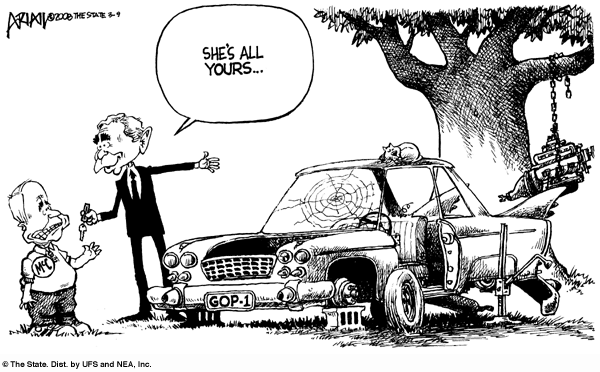
She's All Yours...


I thought that this was hilarious.

Gay Men and Lesbians Barred From Some Clinical Trials

Many gay and lesbian couples are being denied participation in medical studies and research. The exact reasoning for this discrimination is unsure, but the New England Journal of Medicine stated that researchers need to be careful "when they develop exclusion criteria that are based on sexual orientation.”

Not only are they being refused from studies about sexual disorders, but they are being denied from studies about other disorders such as ADHD.

Although this is one of the least threatening issues that the GLBT community is facing right now, it is still perturbing that people are discriminating without justification.

Fashion Feels Fur’s Warm Embrace

As you may have heard, the United States figure skater Johnny Weir was pressured by fans into changing his fur costume for the Vancouver Olympics last month.

Unfortunately, it seems that the fashion world is not as concerned with being politically correct. In the New York fashion show, Oscar de la Renta included fox cuffs, Michael Kors featured Cayote Capes, and D&G featured fox mukluks.

Although fur is said to give "a richness in texture", the methods used to collect the fur are cruel, and, unfortunately unavoidable. Many animals are skinned alive and left to die painfully on the floor of factories.

Despite PETA's drastic efforts to reduce the usage of fur in high-fashion, it persists. Tossing dead raccoons and throwing tofu pies at people may be at the far end of the spectrum, but I feel that it is a neccessary evil in order to put a stop to the fur trade industry.

Because many designers may still be unwilling to relinquish the sales of their sometimes $30,000 fur jackets, the message needs to be made very clear to the fashion industry that fur will no longer be tolerated.

How to Report the News

In this hilarious video, Charlie Brooker pokes fun at how TV reporters report the news.
Makes you wonder - have we really become such a soundbite society?

Are school suspensions constitutional?

With the increasing popularity of zero-tolerance policies, there has been an ongoing debate about the constitutionality of school suspensions. Is denying students schooling a violation of their constitutional right to an education? The North Carolina Supreme Court will decide on Monday.

The case involves two North Carolina sophomore girls who got in a fight and were suspended for a semester. As additional punishment, the girls were told they could not attend the county's alternative school for troubled students and were denied aid to study at home. But do these actions really serve their purpose? Does banning these girls from school really make the school and community safer and serve as a proper punishment for their actions? Or is the effect just the opposite- do suspensions send already troubled students deeper into academic failure and dropping out?

Some school districts are revising their methods, and are providing behavioral counseling and mediation to wrongdoers as part of the suspensions. The North Carolina high school district involved in the case, though, stated that severe budget cuts required it to enforce its strict policy. "Are you going to take money from teaching in order to pay for home schooling and conflict resolution because of a child's misbehavior?" said Robert Belcher, chairman of the school board.

Are suspensions proper punishment for wrongdoers? Or do they send the wrong message that education is a privilege, and not a right? Do they truly confront the problem at hand? And the ultimate question: are they constitutional? Keep your eyes and ears open for the court's decision on Monday.

Graduation rate disparities between whites and Hispanics

A recent study by the American Enterprise Institute, a nonprofit research organization, found that the college graduation rates of Hispanic students continues to lag behind those of white students, no matter how selective the college. This report complements an earlier study done by the Pew Hispanic Center that found that only 16% of Latino high school graduates earned a degree by age 29, compared with 37% of non-Hispanic whites and 21% of African-Americans.

There are a variety of reasons for this notable discrepancy. Culture has a huge role: many Hispanics are very family-oriented, and social ties to home may restrict some students from completing their education. Language may act as a barrier as well. Additionally, university administrators have described whites as generally being "better prepared academically and financially for college."

Applying this research to the changing demographics of the U.S., where Hispanics comprise the nation's largest minority (and probably its fastest-growing, too), it is essential to close the gap between Hispanic graduation rates and those of whites. Affirmative action may be a viable solution, along with providing more financial aid to Hispanic families and devoting more attention and funds to our nation's community colleges. What do you guys think? What are some of the reasons this discrepancy exists, and how can we close the gap?

Thursday, March 18, 2010

Government internet control?

The President of Venezuela Hugo Chavez wants to control the internet. He wanted regulation of the Internet and said a website "falsely reported the murder of one of his ministers." Chavez said "The Internet cannot be something open where anything is said and done. Every country has to apply its own rules and norms." The President Hugo Chavez is angry with the gossip website Noticierodigital that falsely wrote that Diosdado Cabello was assassinated. Diosdado Cabello is a senior minister and close helper of the president. The president says that the website falsely kept information online for two days. There are websites like Facebook and Twitter where many people use for social networking. These websites are suppose to be very popular for people against Venezuela's current government and they use it to organize protests and other events. The article says that Chavez has complained that people use these sites to "spread unfounded rumors." People who are aginst Chavez are afraid he will have the government oversight the internet like other countries. Some countries that do this are Cuba, China, and Iran.

I think this is just flat out invasion of privacy. I personally believe that it is outrageous that governments would want to control what people do on the internet. Hopefully Chavez will not try to start monitoring the web and people could be free to say what they want online. Do you think the government should be allowed to monitor what you do online because a website made a mistake on their news?

The world's only immortal animal

This is a really short article, but I thought it was pretty interesting. I never knew the "fountain of youth" really existed. This is one unique jellyfish. However, this immortal jellyfish may cause environmental problems. Because they do not die, there is a high chance that they may overpopulate in the oceans. Maybe they might even become invasive species in the future.

Experts debate dangers of wearing popular sheepskin boots

So I was on Yahoo!'s homepage the other day and I ran across this article about Uggs. I thought it would be really interesting to post here, because SOOO many people wear these boots. I've always imagined how comfortable Ugg boots were, but I never knew that they could actually be bad for you. In the article, Dr. Drysdale stated that people's feet are slipping around inside the shoe and "with each step, the force falls towards the inside of the foot and the feet splay. This flattens the arch and makes it drop. The result can be significant problems with the foot, the ankle, and ultimately, the hip." I found this pretty shocking. However, I remember seeing a girl walking around Aragon one day with Uggs. Her foot wasn't even on the sole of the boot anymore! She was stepping on the side of the boot, as it bent to the right each time she took a step. I wondered how she was walking like that. I guess that is one of the examples of how the boot can damage your feet. Ultimately, the experts in the article state that Ugg boots, whether real or fake, just don't provide enough support for the feet. What do you guys think about this?