Friday, February 26, 2016

Shooting in Kansas, Possibly Sparked by Protection Order

Regardless of whether you're for or against gun control, whether you believe the Second Amendment is unimpeachable or outdated, please join me in a moment of silence for the victims and wishing the fervent wish that this headline wasn't all-too-familiar.

On the night of February 25, 2016, the day before this posting, another shooting happened in Hesston, Kansas, a tiny town in central Kansas of 37,000 people. According to CNN, the shooter, Cedric Ford, killed three people and injured 14 more, some of them critically. So far, it appears that after Cedric Ford was served a restraining order to stay away from his ex-girlfriend, he proceeded to go on a shooting rampage, killing three people, stealing the last one's car, and then going to a lawn equipment manufacturer's building, where he proceeded to shoot 14 more people.

You guys have all heard the debate on gun control/gun rights before. We've heard about the Second Amendment, the effectiveness of gun control, "common sense" gun laws.

So here's my question: who do you think is responsible for stopping these tragedies before they happen? A common answer is the government (hence gun control). But is it possible that businesses should also take part in finding a way to regulate guns, running private background checks on their buyers? Or is gun control, as a concept, more of a public good, and thus impractical to expect a private enterprise to carry out?  Is it in a gun manufacturer's interest to make sure their guns do not go to people who have a higher likelihood of committing a crime? Move beyond only-profit considerations (although those could be accounted for morally), and also into moral considerations/behavioral economics.


Source(s): http://www.cnn.com/2016/02/26/us/kansas-shooting/

Oil prices "barreling" downwards


The price for a barrel of oil recently reached its lowest point since 2004. The decline started in June 2014, and has led to oil companies yielding significantly lower profits. This caused a notable scaling-down in the oil industry, with hundreds of thousands of workers unemployed and several companies going bankrupt (New York Times).

One explanation for this is that the competition for oil exporters has increased, causing producers to lower prices to stay competitive. Previously, Middle Eastern countries used to dominate the oil industry. However, Canada and Asian countries have started distributing oil, forcing the price down as well. Also, the demand is falling due to the increasing prevalence of electric cars and hybrids (New York Times).

Despite the fact that oil prices have been dropping for so long, some investors are still optimistic that the prices will rise once again when production catches up with the decreased demand. However, this is risky because the countries that are newer to the oil industry are showing few signs of scaling down and reducing production (The Week and New York Times).

I think that it will take quite some time for oil to start increasing in value again. Considering that there has been overproduction since 2014, I do not see it re balancing any time soon. Looking at the supply and demand graphs from the second NYT article, it seems that there has not been a production imbalance that has lasted this long since 2000. The fact that it is taking so long for production to start matching demand could cause bigger issues in the future. However, some people might consider this to be good news since it means that people are becoming less dependent on fossil fuels.

Do you think that oil prices will go back up any time soon? Why or why not?
What do you think would happen if supply continued to increase faster than demand?
In the past, production only exceeded consumption for short periods at a time. How come the industry has stayed like this for so long now?

Sources:

http://www.nytimes.com/interactive/2016/business/energy-environment/oil-prices.html

http://www.nytimes.com/interactive/2016/business/energy-environment/oil-price-supply-demand-imblance.html

http://www.theweek.co.uk/oil-price/60838/oil-price-why-the-market-is-completely-out-of-whack/page/0/1

Thursday, February 25, 2016

U.S. Submits North Korean Sanctions Resolution to the U.N.


Earlier today, the U.S. submitted a resolution designed to tighten existing sanctions on North Korea to the United Nations Security Council.  The 22-page proposal was distributed to all 15 members of the council and is designed to upgrade the current sanctions against North Korea following the country's recent nuclear weapons test on January 6th and rocket launch on 7th.  In the past decade, North Korea has conducted four nuclear tests and launched six long-range missiles, which have all been in violation of U.N. Security Council resolutions. 

Some of the major points of the resolution included mandatory inspection for all cargo going in and out of the country, financial sanctions on North Korean banks/assets, limitations on exporting certain minerals and metals, and the prohibition of aviation fuel.  The resolution also entails a list of certain North Korean individuals and entities who would be subject to sanctions. 

Samantha Power, the U.S. ambassador to the U.N., stated, "These sanctions, if adopted, would send an unambiguous and unyielding message to the DPRK regime... There will be consequences for your actions, and we will work relentlessly and collectively to stop your nuclear program."  Power also specified that the resolution is targeted at punishing North Korea's elite rather than the North Korean people as "the North Korean people have suffered so much already under one of the most brutal regimes the world has ever known" (USA), 

This resolution, if adopted, could potentially be strongest set of U.N. sanctions imposed in more than two decades (CNN). The vote on the resolution could be decided as soon as this weekend.  

How effective do you think this sanction will be?  Will it deter North Korea from future launches or will North Korea continue to with their antics? Do you think more sanctions will be necessary in the future? 

http://www.usatoday.com/story/news/world/2016/02/25/un-ambassador-power-submit-n-korea-sanctions-resolution/80918668/
http://www.cnn.com/2016/02/25/world/un-north-korea-sanctions-resolution/

Landmark Case Against a Massachusetts Nursing Home


Scott Barrow, the man suing Brandon Woods nursing home.

Previously denied the right to take his case against a nursing home to court, Scott Barrow has been given his right to sue and his case will be heard in court next month.

Barrow wanted to sue the nursing home for not preventing his mother's death, despite staff having observed alarming hostility and warning signs from his mother's mentally ill roommate. The contract he signed contained an arbitration clause, so instead of taking his case to court, Barrow had to have it settled by a private arbitrator. In 2010, Barrow lost the case after the arbitrator ruled in favor of the nursing home.
     
By signing contracts with an arbitration clause, people surrender the right to bring a case to court (CANHR). Legal disputes between individuals and businesses must instead be settled in private with an arbitrator. Neither side is allowed to present evidence to the arbitrator.

     But in 2014 with the help of lawyers, a judge ruled in favor of Barrow and agreed with his lawyers that although he signed the contract for his mother, he did not have the authority to bind his mother to the contract. Meaning, Barrow's mother was not bound to the contract or it's arbitration clause.

Seven years after his mother's death, Barrow’s case against Brandon Woods will be heard in a Massachusetts state court. While the outcome of this case is yet to be determined, I would consider this a landmark case because Barrow was able to overcome the arbitration clause; prior to this case, judges often upheld the arbitration clause.

Questions:
Should Barrow have read the fine print of the contract better or is he truly the one at fault for his mother’s demise? Why or why not?
With the expanding use of the arbitration clause by different businesses, should the federal government outlaw arbitration in contracts?
Lastly, do you think businesses have the right to use arbitration, or does the clause infringe on people's rights to sue?

Sources:
http://adr.findlaw.com/arbitration/arbitration-rules-and-procedures.html
http://www.canhr.org/arbitration/

Wednesday, February 24, 2016

Comcast and AT&T Respond to the Dawning of Fast Internet (It's Still Not from Them)

No matter which of the huge Internet Service Provider (ISP) giants you give money to every month in order to be able to access the world's biggest database of cute animal photos, you've probably had problems with them. Speeds don't improve, and, worst of all, customer service sucks. 

However, a (relatively) brand new yet familiar player is coming on the scene: Google Fiber. Google Fiber uses fiber optics, or glass/plastic threads, to transmit data, as opposed to the metal wires that are used by most of the United States. The project boasts up to 1 gigabyte/second download speeds. For context, the national average is estimated by Google as being at around 10 megabytes/second. That's 1000 times slower.

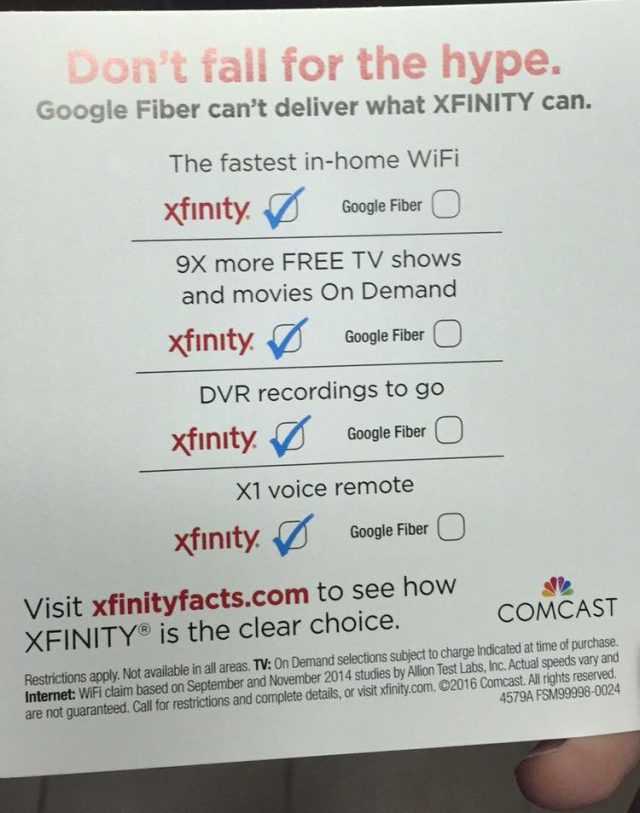
What's really interesting about this topic, though, is the reactions of Comcast and AT&T, neatly summarized in the picture below:

A letter from Comcast to citizens in Atlanta, Georgia,
where Google Fiber is being implemented. (source)
Also, in Huntsville, Alabama, where Google Fiber is also on its way to implementation, AT&T and Comcast have both promised (eventual) 1 GB/s speeds.

This seems like a classic case of the market correcting itself–these companies had a powerful hold over the industry that was leaving consumers frustrated with the product and the accompanying services, but a new, entrepreneur company has paved the way for better service everywhere, and now the big companies are trying to keep up.

But is it?

Keep in mind that not only have these companies have had their unspeakable power for a (relatively) painfully long while, the "entrepreneur"company is a well-established Silicon Valley giant.

So does this example serve the idea that the market corrects itself by way of the invisible hand, or does it decry a completely free market that allows such dominance of the few? What role should the government be taking? Also, what are the possible benefits and detriments of having a service like Google Fiber in your city? (It should be noted that Google Fiber is on its way to San Francisco).

Extra credit (not really): Propaganda–what do you think of its use here, not just by Google Fiber's opponents, but by Google Fiber itself?

Sources:
https://www.techdirt.com/articles/20160222/09101033670/google-fiber-expanding-faster-further-making-comcast-very-nervous.shtml
http://www.webopedia.com/TERM/F/fiber_optics.html
https://fiber.google.com/about/
http://www.al.com/news/huntsville/index.ssf/2016/02/what_do_att_and_comcast_have_t.html
http://arstechnica.com/business/2016/02/as-google-fiber-hits-atlanta-comcast-says-dont-fall-for-the-hype/


Disparity between the Wealthy and the Poor Continues to Grow


While the growing gap between high and low-income Americans is not new news, I would like to write about how Social Security plays into this gap.

New life-saving vaccinations and other medical advances in the past few decades have improved the health of many individuals. Obama’s health care plan has also helped improve public health by reducing the amount of Americans without health insurance. However, Americans are not benefiting from these advances equally. Those with higher incomes reap today’s benefits because they have the money to be able to access and afford it.

Aside from differences in health, income, and life expectancies, differing Social Security benefits are also contributing to this widening gap between the rich and the poor. Those with low-income jobs tend to retire earlier than the full retirement age (66 years old in 2015) while those with high-income jobs tend to retire at or later than the full retirement age (Brookings). A person’s Social Security benefits increase as they work for more years. Consequently, Americans who earn a high income tend to receive higher Social Security benefits than Americans with lower incomes. Unequal Social Security benefits maintain the disparity between high and low income workers.

As the US continues to experience more advances in technology and medicine, more and more low-income Americans are being left behind while high-income Americans enjoy longer lives and improved living conditions. For people born in 1960 or later, the retirement age will be pushed up to 67 years old for workers to earn the full benefits (National Academy...). Meaning this trend of low income, low benefits and high income, high benefits is likely to continue.

Questions:
Do you think the government should be doing more to provide welfare for those who need it? Why or why not?
Are there any other disparities between the wealthy and the poor?

Sources:

Tuesday, February 23, 2016

Apple Resists Court Order from Justice Department


Apple is currently resisting a court order filed by the Justice Department last Friday to assist the FBI in unlocking the iPhone of Syed Farook, one of the two gunmen involved in the San Bernardino shooting last December.  The FBI is asking Apple to disable an iPhone security feature that erases an iPhone’s data once a password is entered incorrectly ten times.  Once that function is disabled, the government can crack the password without the risk of data being deleted.  Data encrypted on the device would most likely include evidence that could provide key clues as to why the shooters targeted certain victims, if the shooters were planning other attacks and if they received direction from overseas (Washington Post). 

Justice Department lawyers question Apple’s steadfast refusal to cooperate, wondering whether the tech giant is prioritizing their “marketing strategy” over a terrorist investigation. ”Apple’s current refusal to comply with the Court’s Order…appears to be based on its concern for its business model and public brand marketing strategy,” Justice Department attorneys wrote in the court filing.

According to Apple’s CEO, Tim Cook, “The U.S. government has asked us for…something we consider too dangerous to create. They have asked us to build a backdoor to the iPhone” (Washington Post).  Creating this “master key” to disable security on Farook’s phone would provide the FBI with important information related to the case; however, it could also jeopardize the security on every iPhone and risk the safety/privacy of citizens if the bypass is found in the wrong hands.  Apple believes that the court order is a direct “overreach by the U.S. government” and that it would set a dangerous precedent for the future in which other software companies could be forced to hack into its customers’ devices (CNN).

A federal court hearing in Riverside, California has been scheduled for March 22nd to resolve the dispute.  It is expected that many privacy advocates and civil liberties groups will file various amicus briefs (USA Today).

What do you think? Is Apple justified in their resistance to cooperate in creating a “backdoor”? Is the information found in this phone worth potentially jeopardizing the security/privacy of millions of iPhone users? 


Monday, February 22, 2016

Is Cruz playing "dirty" in the GOP race?


Senator Ted Cruz at a campaign event in Henderson, Nev., on Sunday.

Today Ted Cruz asked one of his top aides, Rick Tyler, to hand in his resignation for posting a misleading  and 'inaccurate' video (CNN). The controversial video showcased subtitles which implied that the GOP presidential candidate Marco Rubio had said that "there were 'not many answers' in the Bible" (NYT). 

This video was in some sorts a tipping point in the Cruz campaign for a couple reasons. First off, Donald Trump, Ben Carson, and Rubio have accused Cruz of playing "dirty" tricks throughout the campaign. These accusations highlight the irony of Cruz's campaign, especially because one of his slogan reads "TrusTed." Secondly, Cruz and Rubio are bitterly fighting over the support from evangelicals in order to have a chance to beat the current front runner, Trump. By throwing low blows at Rubio over the Bible, Cruz may have just put a nail in his own coffin as his unfavorable ratings have been increasing over the past few months. According to a Monmouth University poll, in November, Cruz had a unfavorable rating of 21%, and now he has an unfavorable rating of 39% (NYT).

What do you think about Trump and Rubio's comments? Do you think Cruz is going too far over the gray line of mudslinging? To what extent should candidates be allowed to publicize negative ads and posts (on social media especially)? Do you think that the recent actions committed by the Cruz campaign will have a large impact on the upcoming Nevada caucus? How about the long run?

http://www.nytimes.com/politics/first-draft/2016/02/22/ted-cruz-fires-top-aide-for-spreading-misinformation-on-marco-rubio/?hp&action=click&pgtype=Homepage&clickSource=story-heading&module=a-lede-package-region&region=top-news&WT.nav=top-news
http://www.cnn.com/2016/02/22/politics/rick-tyler-marco-rubio-video-

Sunday, February 21, 2016

What About the Zika Virus?

The Zika virus has been gaining attention rather recently. There have been two cases reported in the U.S., but this disease is far more common in South America. As of now, there are an estimated one or two cases per 100,000 people (Washington Post).

The two cases brought into the U.S. were of 80 passengers returning from another country. There has also been a case reported in Puerto Rico (Washington Post).

The Zika virus causes microcephaly, "unusually small heads and damaged brains," in infants. There were a surge of these cases in Brazil, when doctors began to notice a trend. Zika combined with other viruses can lead to this effect; Zika is the main cause, however (NYT).

Symptoms include rash, fever, joint pain, and red eyes (NYT). What's even more alarming, though, is Zika has now been found to lead to paralysis as well as the previously mentioned effects. In Colombia, one of five (severe) cases in the past 6-weeks is that of a 10 year old girl who has lost function in her legs (Washington Post).

1. Zika is relatively new. Is it like the Ebola epidemic, in that the "scare will blow over," so to speak?
2. If so, why? If not, how is Zika different?

1. https://www.washingtonpost.com/news/world/wp/2016/02/21/zika-has-been-linked-to-birth-defects-now-it-may-be-causing-paralysis/?hpid=hp_no-name_zika-730pm_1%3Ahomepage%2Fstory
2. http://www.nytimes.com/interactive/2016/health/what-is-zika-virus.html

Kalamazoo Shooter was Driving for Uber Between Shootings


On Saturday, in Kalamazoo, Michigan, three shootings occurred within seven hours of one another. Authorities believe that all three of these shootings were committed by the same person, Jason Dalton, an Uber driver. Authorities now have reason to believe that Dalton was even driving Uber customers in between the shootings. A source suspects that he was even looking for more fares after the last shooting, which killed four people and put a fourteen-year-old girl in critical condition. Dalton was arrested at 12:04 a.m. on Sunday morning. Authorities found a handgun in the back of his car at the time of his arrest.

One of the more peculiar parts of this case, however, was that Dalton's neighbors, the Pardos, described him as part of a 'typical American family' (CNN). Besides from spontaneously shooting in his backyard or into the sky, another longtime neighbor, James Block, said Dalton was a "'well-mannered' and pleasant" man (NYT).

The motive of these shootings is still unknown as Dalton is predicted to be formerly charged with "six counts of murder, two counts of assault with intent to commit murder, [and] six counts of felony firearm" on Monday (CNN).

Kalamazoo is another city to add to the long list of cities that have experienced mass shootings within the past year or so. Why do you think there have been so many mass shootings recently? Is it because of lenient gun control laws? People's need to make a political statement? What do you think the federal, state and/or local governments should do to prevent these shootings? 

Concrete evidence for black holes published


A little more than a week ago, a group of scientists and researchers known as the LIGO (Laser Interferometer Gravitational-Wave Observatory) Scientific Collaboration published evidence that heavily suggested the existence of black holes in the universe (BBC).

Last September, gravitational waves were perceived by the two LIGO antennas in Washington and Louisiana for the first time in history. Between the two antennas, the waves that were picked up were nearly identical to each other, further enhancing the reliability of the discovery. The waves are believed to have been caused by two black holes merging (New York Times).

The evidence confirms what Albert Einstein predicted in his theory of general relativity from 1916. He asserted that gravitational waves existed, but with little evidence to prove it. This is due to the fact that there was not technology that could actually sense the waves at the time. The significance of the waves is that they serve as the first pieces of evidence that support the existence of black holes, as there really is nothing else in the universe (to our knowledge) that could create such waves (NPR).

Why does all of this matter?

For one thing, this discovery means that we have ways to examine objects that do not emit light. Until now, we have depended on the fact that an entity in the universe emits light in order for us to observe it. The existence of gravitational waves breaks that barrier, and will likely lead to further heavenly discoveries (TechInsider and Vox).

I think it is important to note that there is a slight possibility that the gravitational waves can be from something other than a black hole. The LIGOs were upgraded very shortly before they detected the gravitational waves. Since the waves reported are the first perceived gravitational waves in history, there is no benchmark for them. It is not completely certain that black holes are the only phenomena that can create gravitational waves. I think that this is really good evidence for black holes, and would be surprised if it turned out that they do not actually exist. However, I think that there should be a little more data gathered with the new LIGO technology to determine whether or not the detected waves were actually from black holes.

Do you think that the gravitational waves can prove with complete certainty that black holes exist? 

Saturday, February 20, 2016

The Scoop on South Carolina

February 20, 2016 marked the South Carolinian caucus for this election season. And, with results in, it is clear that Donald Trump is the winner.

By a 33% victory, Trump took South Carolina. The battle for second place raged on between Marco Rubio and Ted Cruz. As of now, it appears that Rubio has won by a .2% margin, coming in at 22.5% against Cruz's 22.3% (Fox).

Bush halted his campaign after a crushing defeat in a distant fourth place with 8%. Now, according to Rubio, this is a "three candidate race," of which he is sure he will secure the nomination. He welcomed Governor Nikki Haley, an Indian-American, and Sen. Tim Scott, an African-American, on stage with him as he pledged to run as the face of a new generation of Republicans. The son of Cuban immigrants, Rubio underscored his policies with an emphasis on "generational change" (New York Times).

South Carolina is a winner-take-all system, which means Trump has gained 29 delegates from winning South Carolina. Further, per congressional district won, he gains three additional delegates. This means Trump has, in total, gained 44 delegates (so far). Currently, this is more than all of his competitors' delegates combined (Washington Post).

1. Keeping in mind the statistics regarding Trump's delegates, as of now, do you believe the South Carolinian win will almost assuredly predict Trump securing the GOP nomination?
2. How do you believe Trump would fair against Clinton? Sanders?
3. Is Rubio's platform regarding generational change viable? In other words, will the face of Republicanism as we see it today embrace his vision?

1. http://www.nytimes.com/2016/02/21/us/politics/south-carolina-primary.html?action=click&pgtype=Homepage&clickSource=story-heading&module=span-abc-region&region=span-abc-region&WT.nav=span-abc-region
2. http://www.foxnews.com/politics/2016/02/20/make-or-break-trump-seeks-sc-win-as-several-gop-candidates-fight-for-life.html
3. https://www.washingtonpost.com/news/the-fix/wp/2016/02/17/if-donald-trump-wins-south-carolina-can-he-be-stopped/

Friday, February 19, 2016

The Democratic Race in Nevada


The Democratic caucus in Nevada is tomorrow, February 20th. However, the question of who will win the caucus still remains in contention as the two Democratic candidates, Hillary Clinton and Bernie Sanders, are effectively tied in the eyes of likely caucus goers according to a recent CNN/ORC poll.

Some important issues for voters in Nevada include gun control laws, the economy, immigration and race relations. In terms of gun control laws, Sanders seems to have the upper hand as some see Clinton's gun control policies as too liberal. Clinton has hammered down on Sanders as having gun control policies that are too moderate; however, this criticism may have hurt Clinton in Nevada's rural Democratic areas. Clinton, however, seems to be slightly ahead in the arenas of "foreign policy, race relations, immigration, and healthcare" (CNN Poll). The economy seems to be a split territory between the two candidates. Clinton has polled 1% higher than Sanders in terms of the economy. However, among those who see the economy as their number one priority, voters seem to have polled in favor of Sanders.

For a little bit of the more well-known advantages, Sanders is polling ahead of Clinton with voters under the age of 55. Clinton, on the other hand, is in favorable terms with the Las Vegas area because of her support from union members.

One element that has added to the uncertainty of Nevada's fate is the skeptical participation of eligible voters. Sanders, once again, is relying on new voters while Clinton seems to appeal to voters who are more likely show up at the caucus tomorrow.

So, who do you think will win the Nevada caucus? Will one candidate win by a long shot or will this be another close race like Iowa? Keeping in mind that there are still over 40 primaries to go, which candidate needs Nevada the most? Does Sanders need to prove that he can fare well in different parts of the country? Or does Clinton need to stockpile on early wins to blow Sanders out of the water?

http://www.cnn.com/2016/02/17/politics/hillary-clinton-bernie-sanders-nevada-poll/
http://www.cnn.com/2016/02/19/politics/nevada-democrats-2016-loneliest-road/
http://www.nbcnews.com/news/latino/latinos-hold-some-cards-nevada-democratic-caucus-n522096

Wednesday, February 17, 2016

President Obama to Visit Cuba


President Barack Obama is planning on traveling to Cuba sometime in late March. This trip will theoretically precede Obama's trip to Argentina and plans on being scheduled before Good Friday and Easter Sunday, two important Latin American holidays. Tomorrow, Thursday, the administration will announce a more finalized version of the president's Latin American travels (Washington Post).

In 2014, Cuba and the U.S. started a reconciliation of relations. Then, last summer, diplomatic ties were formally reestablished (Washington Post). Additionally, the U.S.'s embassy in Havana, Cuba, was reopened, as well as the restoration of air traffic in and out of Cuba to the U.S. (ABC), which was once banned.

Obama would be the first sitting president since Coolidge in 1928 to visit Cuba (NBC). This makes Obama's visit somewhat historic, especially to American-Cuban relations.

Obama makes clear that his visit to Cuba is an attempt to reach out to all Cubans, not just President Castro himself (Washington Post). Obama wants to impress upon Cubans the ideas of moving forward and expanding their country's means of free expression.

Some people believe this visit is a mistake, as it could only reaffirm Cuban leaders' repressive actions. Rep. Ileana Ros-Lehtinen, Republican from Florida and a senior member of the House Foreign Affairs Committee, happens to agree with this notion (Washington Post).

1. Given my last statement, do you believe Obama's trip to Cuba will do more harm than good?
2. Are there other ways to go about promoting free expression in Cuba that are less outright than a face-to-face visit by the sitting American president?

1. https://www.washingtonpost.com/politics/obama-to-visit-cuba-just-eight-months-after-embassy-reopens-in-havana/2016/02/17/c0db1b46-d5ea-11e5-9823-02b905009f99_story.html?hpid=hp_hp-more-top-stories_obama-cuba-1040pm%3Ahomepage%2Fstory
2. http://www.nbcnews.com/news/world/president-obama-make-historic-visit-cuba-u-s-official-says-n520461
3. http://abcnews.go.com/US/president-obama-planning-trip-cuba-month-sources/story?id=37015093

Tuesday, February 16, 2016

Cruz's Tax Plans for America


U.S. Republican presidential candidate Senator Ted Cruz (R-TX) walks from the stage at a campaign event on the USS Yorktown in Mount Pleasant, South Carolina February 16, 2016. REUTERS/Joshua Roberts SAP is the sponsor of this content. It was independently created by Reuters' editorial staff and funded in part by SAP, which otherwise has no role in this coverage. . SAP is the sponsor of this content. It was independently created by Reuters' editorial staff and funded in part by SAP, which otherwise has no role in this coverage.

GOP presidential candidate Ted Cruz is sticking to his conservative roots with his plans, revealed in November, pertaining to the future of the American economy. Among his ideas, Cruz claims that when he becomes president he will try to eliminate the IRS (Internal Revenue Service) and introduce a new tax plan. This tax plan would consist of a "flat 10 percent individual income tax" and a "16 percent broad-based consumption tax" (Reuters, Washington Post).

An analysis completed by the nonpartisan Tax Policy Center concluded that Cruz's plan would slash federal revenues by $8.6 trillion in 10 years, causing a substantial addition to our already increasing debt. Additionally, these flat income taxes would more largely impact poorer Americans rather than middle- and high-income taxpayers. In fact, these taxes would substantially decrease the tax burden on the wealthy and would also slightly decrease the tax burden on middle-income families.

Cruz's campaign spokesperson Rick Tyler responded to the Tax Policy Center's analysis by saying that "'tax cuts create economic growth...economic growth creates more taxpayers who make more money and have more revenue to be taxed, which creates more revenue for the government'" (Washington Post).

Opponents of Cruz's tax plan also cite that historically large tax cuts by GOP presidents such as Ronald Reagan and George W. Bush have resulted in increased national debt. According to the Washington Post, these increases in national debt occurred because the economic growth that was predicted or proposed to happen afterwards, to hypothetically offset the decrease in federal revenue, never occurred.

After reading Tyler's response, I could not help myself from noticing the large gap in the vague phrase "'tax cuts create economic growth.'" Tyler elaborates on how economic growth would aid our government but never actually bridges the gap between tax cuts and economic growth. After reading about economic growth in tonight's homework, do you think that Cruz's tax plan will really increase economic growth? And if so, how? Also, what do you think about Cruz's proposal to get rid of the IRS? What consequences, good and/or bad, could this proposal possibly have? Lastly, do you agree or disagree with Cruz's policies. What are some alternative ideas for spawning economic growth for our country?

Sources:
https://www.washingtonpost.com/politics/analysis-cruz-tax-plan-would-benefit-rich-explode-deficit/2016/02/16/9e8353ca-d50d-11e5-a65b-587e721fb231_story.html
http://www.reuters.com/article/us-usa-election-cruz-taxplan-idUSMTZSAPEC2GNQMPP4

Economists' Criticisms for Sanders' Plans


 Bernie Sanders’ health care plan is expansive, to say the least. It would require revamping many parts of the government; it could increase the size of the federal government by up to 50% (NYT), impose a higher tax on the wealthy as well as a 6.2% payroll tax and 2.2% income-related premium applicable to all works (Huffington Post), all the while with claims to save trillions of dollars over the course of many years, theoretically balancing out and saving Americans more than what they’d be paying in increased taxes to fund this plan.
With such large ideas, there are bound to be equally as large criticisms; these criticisms come even from fellow liberals. One of Sanders’ biggest ideas is a single-payer health care system, which essentially means health care becomes de-privatized and the government assumes all its costs. The 2.2% tax described above is supposed to be the central player in paying for this system, but economists question whether or not this tax will yield enough (NYT).
Further, the usefulness of this plan for the upper-middle to upper-class is obviously questionable; they are likely wealthy enough to afford a privatized version of all of what Sanders’ is proposing without suffering increased tax cuts. Under the plan, they’d end up spending more.
Lastly, for a single-payer health care system to function without financially ruining itself, it has to make decisions on which treatments it wants to cover. This means the government makes this choice. Just because coverage is provided by the government doesn’t mean everything is covered. The government cannot cover absolutely everything and hold down its costs, so there will still be instances where Americans will be left without coverage for some (likely more expensive) treatments due to the government having to balance costs (New Yorker).

  1. Do you think the criticisms of Sanders’ plan are valid? Whether the ones you see here or others you’ve heard.
  2. What do you think about single-payer?
  3. How do you think the upper-middle to upper-class is going to be affected? Will they in fact lose more than they’ll gain?