Obama has a new unlikely ally in Congressional Republicans. The president is looking for Congress to approve a fast-track approach for the Trans Pacific Partnership (TPP) trade agreement between twelve countries in the Pacific Rim, including Chile and Japan. This deal has been negotiated for several years in secret, and is the largest trade deal since NAFTA was signed in the 1990s. It is likely that a provision will be introduced into the Senate Finance committee that will have the Congress just vote up or down on the agreement, but only after a public review period. This is the result of an agreement between Obama and Congressional Republicans.
The president is at odds with many in his own party who are distrustful of trade deals. The more liberal wing of the party, as well as labor unions, do not like trade deals as that are often seen as threatening of domestic manufacturing jobs, or at least unions, by leading to more outsourcing, and a way for companies to get around environmental laws. Harry Reid, the Senate majority leader, said "not only no but hell no" of the deal. Elizabeth Warren has also expressed disapproval, especially of the secrecy of the negotiations. Republicans are much more supportive of free-trade, as it can create more markets for American goods, revealing the unlikely partnership.
How do you think debate on this deal will affect the presidential elections, especially the Democratic primaries? Do you think the TPP is a good deal? Should it have the "fast-track" or should Senators be able to make amendments and filibuster?
Other Articles:
"Obama: Democrats have their facts wrong on Trans-Pacific Partnership deal"
"U.S. Chamber, AFL-CIO clash at Senate hearing over Obama’s free trade push"
Wednesday, April 22, 2015
Tuesday, April 21, 2015
Former Egyptian President Morsi sentenced to 20 years in prison

The official reason for the trial and subsequent imprisonment was the use of force by members of the Muslim Brotherhood during protests a year after he took power. However, given that the military, which conducted the trials against Morsi, came to power soon after the protests, it is more likely that the new leaders are just trying to clean up after their coup. Amnesty International has said that the trial was a "sham."
This trial was part of a larger smear campaign against the Muslim Brotherhood. A high level leader of the Brotherhood, Mohammad Badie, received the death sentence in his trials, and the entire organization has been labeled a terrorist organization by the military led government. Additionally, while pursuing charges against Morsi, the military government dropped charges against Mubarak. This demonstrates a total lack of equal application of the law.
I'm not saying that Morsi is a saint or the the Muslim Brotherhood is a perfect organization. However, if Egypt is to ever have a dialogue about the balance of power and the role of religion in government, they must have a civilian government, not a military regime.
What do you think of the sentence against Morsi and the actions taken against the Muslim Brotherhood?
What should the US do or say in response, if anything? What about the larger international community?
Does this signal the end of the Arab Spring?
Monday, April 20, 2015
Rising Issue with the Military Medical System
T.J. Moore was a 19 year old recruit for the U.S. Air Force who at the time mysteriously passed away amidst running a 1.5 mile test run. One year later, the answers as to why his death occurred are still unclear to Moore's family. The NY Times has discovered that Moore had been pulled from recruit testing days before his death due to a genetic condition that had been overlooked.
Moore is one of many cases to demonstrate the military medical system's inability to be held accountable. In a system responsible for 1.3 million service members, members are not allowed to seek medical care elsewhere without specific approval. Moreover, they are prohibited from filing malpractice suits in cases of death or injury. Federal law essentially prevents military service members from obtaining any answers if they file complaints within the medical system.
Moore's case, among many other military medical deaths, point to a larger issue with the healthcare service members receive. Families and loved ones are often intentionally barred from any investigation of not only the truth, but any details. More specifically until 2009, health care professionals who delivered poor quality care were reported not to the national database responsible for reporting medical problems but rather an internal database. With the final realization of this problem, 54 hospitals and hundreds of clinics have recently come to attention for its medical practices and safety investigations, or lack thereof.
We would expect the medical care given to military service members to be better than substandard, provided that the safety of the country depends on their services. Thus, is the military medical system something that can be improved or regulated? If so, how?
Moore is one of many cases to demonstrate the military medical system's inability to be held accountable. In a system responsible for 1.3 million service members, members are not allowed to seek medical care elsewhere without specific approval. Moreover, they are prohibited from filing malpractice suits in cases of death or injury. Federal law essentially prevents military service members from obtaining any answers if they file complaints within the medical system.
Moore's case, among many other military medical deaths, point to a larger issue with the healthcare service members receive. Families and loved ones are often intentionally barred from any investigation of not only the truth, but any details. More specifically until 2009, health care professionals who delivered poor quality care were reported not to the national database responsible for reporting medical problems but rather an internal database. With the final realization of this problem, 54 hospitals and hundreds of clinics have recently come to attention for its medical practices and safety investigations, or lack thereof.
We would expect the medical care given to military service members to be better than substandard, provided that the safety of the country depends on their services. Thus, is the military medical system something that can be improved or regulated? If so, how?
Friday, April 17, 2015
Japan is now the biggest holder of US Debt, surpassing China

Source: Quartz
China is no longer the biggest holder of U.S. Treasury debt, a position it has held for over 6 years. There are two components to this change. First, Japan has been consistently buying a lot of bonds in the past couple of years, and second, China's waning economic growth has correlated with less U.S. bond purchases.
As Matthew Yglesias from Vox points out, there's been a lot of media buzz about the U.S.'s big debt to China, and our resultant economic dependency on them. However, he also explains that that debt exists not because the U.S. Treasury is in dire need of more money, but because countries like China and Japan want to buy in; it's safe investment, and for countries who do so much export trade with the U.S., cycling the money around is good for growth.
Do you think the debt to China something to be worried about? Otherwise, is there something to be said about the state of Japan and China's respective economies by the stats and patterns from above?
Obama's Clean Power Plan Challenged in Court
Article
On Thursday, the legal battle against Obama's most significant step in addressing climate change ensues. The country's two largest coal corporations, in conjunction with 14 coal-producing states, are challenging the Environmental Protection Agency in its latest regulation, known as the Clean Power Plan. This regulation specifically targets the coal industry, being the largest producer of carbon dioxide emissions in the U.S. By focusing on the rate reduction of carbon pollution, the Clean Power Plan specifies an emissions target for each state. Moreover, this plan sets limits specifically on the power plants themselves, looking to reduce national carbon emissions from power plants by 30 percent of 2005 levels by 2030 (Magill).
The plaintiffs of the case, the two coal corporations and the 14 states, claim that the EPA lacks the authority to implement such a regulation and that current preparations for the rule have already hurt states and coal businesses. They have thus petitioned the court to block the EPA from finalizing the plan, a very rare occurrence in court. However, two of the three judges seemed skeptical of the plaintiff's arguments against the EPA.
This lawsuit demonstrates the coal industry's attempts to save itself and its unwillingness to account for the negative externalities they have caused. Do you think their argument is a valid point? Moreover, will such an expansive proposal as this be viable across the country?
Sources: Magill
Thursday, April 16, 2015
Fast for Fifteen- The Push on Minimum Wage

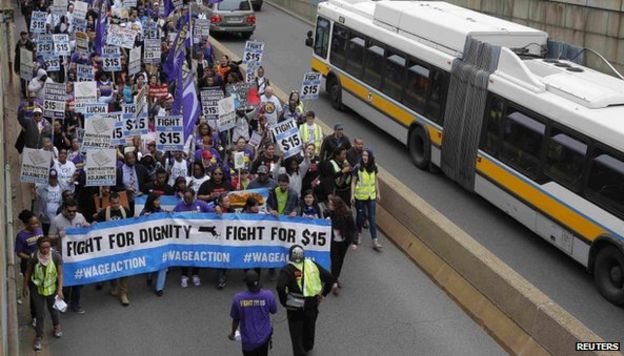
The movement known as Fast for Fifteen began their largest efforts yet on Wednesday morning, staging protests and sit-ins across 200 cities nationwide in fast food chains and airports. What originally began as a push to increase the minimum wage of fast-food workers two years ago, Fast for Fifteen has now, however, expanded their efforts to include retail, airport and homecare workers.
The current national minimum wage of service workers is $7.25, an amount that is immensely difficult to support a family with. Fast for Fifteen seeks to raise this to $15, a motion of which President Obama supports. The Fast for Fifteen movement has already reached a degree of success, achieving statements by multiple corporations, such as McDonald's and Target, to raise their wage floors.
The expansion of this movement is significant in improving the quality of life for many and ensuring financial security for Americans in the future, as now not only workers in the fast food industry have hope for higher wages. Although Fast for Fifteen have acquired initiatives by such large corporations, many worry it is still not enough to ensure that such a change happens. Moreover, political activists believe this movement is long overdue, especially as the 2016 presidential elections arise, as it is the first wide-scale challenge to an otherwise resolute wage system.
Despite their initiatives, do you think corporations such as McDonald's and airports have incentive to guarantee such wage changes? What do you think these motions mean for the economy and future of the U.S. if the minimum wage were to increase to $15?
Wednesday, April 15, 2015
U.S. Industrial Production Falls in March
Source: Morath, Wall Street Journal
This quarter marks the first time U.S. industrial output has declined since the end of the recession (2nd quarter of 2009). This specific economic indicator measures output from manufacturing, mining, and utility industries, and historically, has been helpful in forecasting GDP growth and general economic prosperity. The Fed has stated that this decline is due to the recent "drop in oil and gas well servicing."
Decreasing production is never a good sign for the economy, but it's a bit too early to tell whether this decline is just part of the natural cycle, or an additional symptom of a stalling economy. GDP, consumer spending, investment, have all been slowing recently. However, the oil industry is seeing a bit of a rebound (link), which could be a sign that this slump is just temporary.
Do you think that the industrial production numbers this quarter should be something to worry about? Take a look at the chart above for historical data.
Obama Offers Iraq $200 million in Aid
Obama's offer arose from expectations that Abadi would request for additional help in US weaponry, although Abadi did not do so. Obama continues to believe progress has been made in the Islamic State conflict, but there is still more to be resolved. Such a proposal will extend U.S. involvement in this conflict, presenting the U.S. as more of a target to IS attacks and submerging more of the U.S. investment in this overseas conflict.
Do you think Obama made the right choice in extending aid to Iraq, in other words was this aid necessary? What could this mean for our state or economy?
Tuesday, April 14, 2015
Obama acts to remove Cuba from terror list

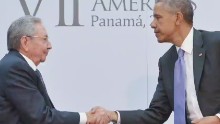
Obama has continued to make advancements toward opening up relations with Cuba by recommending to Congress that Cuba be removed from the US' list of countries that sponsor terrorism. Since making his intentions public in his State of the Union Address, President Obama has taken various steps to try and ease the tension between the two nations. Last week, Obama and current leader of Cuba, Raul Castro, sat down to discuss the current state of affairs, which is a huge step, as there have been no meetings like this one for over 50 years between leaders of the two countries.
Opening up relations with Cuba could possibly serve both economic and commercial benefits, as continuing to ease the embargo will allow consumers in both countries to purchase goods. Additionally, resolving the tension would hopefully allow transportation directly between the United States and Cuba, increasing tourism in both countries, and easing the process for Cuban-Americans to visit their family and friends back home.
What do you think about Obama's stance on opening relations with Cuba? Do you think that it is safe to end the embargo and open relations, or do you still feel that Cuba poses a threat to our nation's security?
Monday, April 13, 2015
Oklahoma Police Shooting Captured on Body Camera
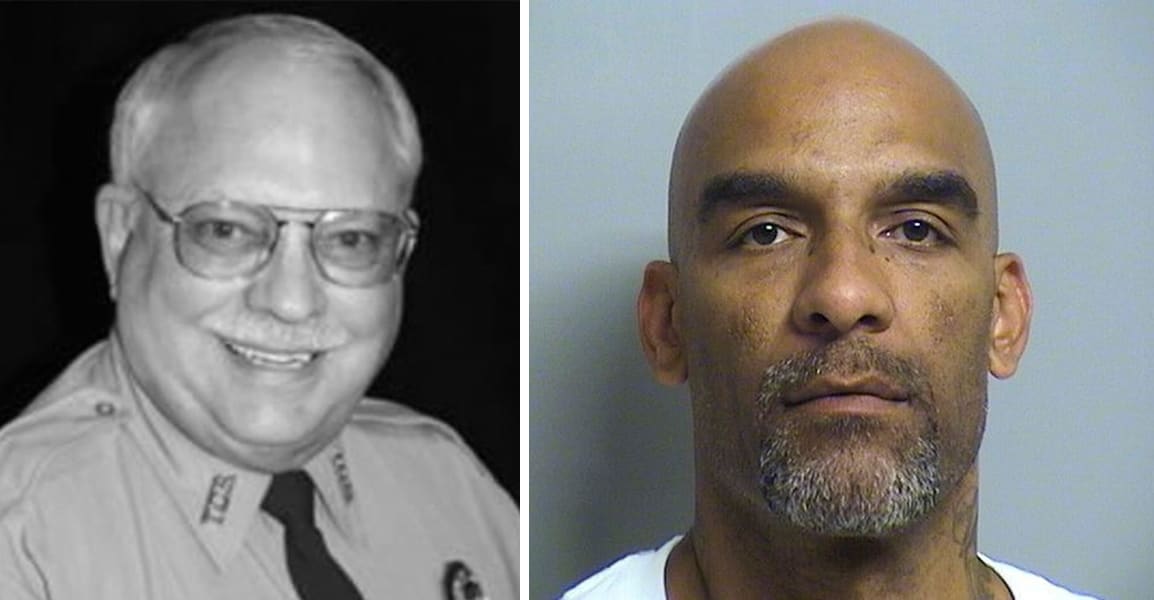
Eric Courtney Harris, suspected of drug and gun trafficking, was pursued and tackled by deputy Bob Bates. Harris was unarmed as he actively attempted to escape despite Bates holding him back. During the following brawl, the video captures gunshots, and the phrase "Oh! I shot him! I'm sorry." Harris was handcuffed, and taken to a hospital, where he died. No charges have been filed against Bates yet, although an investigation is taking place, as well as an assessment by the FBI.
What angers me is that these stories are uncommon. And these awful things most likely have been happening for a long time - just tucked away from the public eye, only for victims to witness. Even though out of 1.1 million officers in America, a fraction abuse their power, police brutality is a problem that needs to be addressed. It is my firm belief that murder is never justified - even if an authority figure is the killer. Although policemen have a duty to protect citizens and prevent crime, there is a line that cannot be stepped over, no matter what.
Are policemen justified in using such force against criminals in these cases, as it effectively works when suspects won't cooperate? Or has police force gone too far, and should be dealt with in order to prevent further deaths?
Sunday, April 12, 2015
Jobs are up, but what about hiring?
(Source: http://www.vox.com/2015/4/7/8363463/job-openings-have-come-back-since-the-recession-why-not-hiring)
Recent months have been good for job growth. The Labor Department published a report this past week, and job openings are up to 5.9 million, higher than it has been for almost one and a half decades.
However, as evidenced by the graph above, hiring hasn't been growing nearly as fast. There are a couple of possible explanations. It could be just more structural unemployment, if job availability is growing in fields for which the current pool of unemployed workers is either over- or underqualified. Otherwise, it could just be a longer lag between the employment cycle and the business cycle following a hard recession and slow recovery, as business owners are being more careful and patient when taking on new workers.
If the first is true, it could suggest that the best way to target unemployment and boost the economy is to figure out a way to address the skills mismatch (which, in this time, is especially present in the form of technological unemployment). If it's the second, we may just have to wait out the process.
Do you have any thoughts on contributing factors to this recent trend?
Hillary Clinton finally announces presidential campaign
One thing that pops to everyone's minds when the word "Hillary" comes up is: experience. When it comes to strategy, it seems like Clinton has learned from her previous mistakes. For comparison, here's the campaign trailer from her 2008 bid:
There are both advantages and disadvantages to her long history in the public eye. As Todd VanDerWerff from Vox says, Hillary Clinton "doesn't need to introduce herself to the public," so she can focus her launch on establishing "tone." However, many Democrats have been turned off by her supposed "unquestionable candidacy."
What do you think about Clinton's campaign strategy so far? Will she be able to maintain all her support, what with the GOP pinpointing her as an early target?
Friday, April 10, 2015
Oklahoma Approves Ban on Second Trimester Abortion Method

This law is capable of transforming current abortion policy in the country by highlighting and thereby preventing certain ethical issues. Now, however, Kansas is the state with the most restrictions on abortion, calling for questions about this bill's constitutionality in restricting a woman's right to abortion. This law begins to define a distinction to the extent of a woman's rights versus certain ethical issues, bringing about the debate that a woman should be able to choose for herself.
What do you think the implications of this law are, as it enters a subjective area of abortion policy?
Is it constitutional or rather an infringement on woman's rights?
Thursday, April 9, 2015
Utility to pay $1.6B after deadly California pipeline rupture
PG&E has been penalized $1.6 billion by the California Public Utilities Commission for the pipeline explosion in San Bruno in 2010. In the explosion, eight people were killed, while approximately fifty were injured. 37 houses were destroyed by the blast. The majority of the penalties collected from PG&E will reportedly go to "gas transmission pipeline safety infrastructure improvements".
This disaster was certainly horrible publicity for PG&E, as it was discovered that the pipelines in the surrounding area were in horrible shape and had been disregarded by PG&E. Funds that were intended to be used on the infrastructure of the pipeline were diverted to other programs.
Do you think this penalty was fair to PG&E? Should it have been stricter or more lenient?
Rand Paul Accepting Campaign Donations in Bitcoin

Upon officially announcing his campaign for the 2016 presidential elections, Kentucky Senator Rand Paul has opened up randpaul.com to donations. And, interestingly, contributions can be sent in the form of Bitcoins, with a caveat that those donations may not exceed $100.
There are a lot of reasons why Paul would make this move, and he has already established himself as a fairly unorthodox member of his party. First, it'd generate a decent amount of media attention towards his campaign. Second, it may help him attract voters who believe in the power of the Bitcoin, often younger and tech-savvy: a part of the electorate that tends to vote against Republican candidates (see: tedcruz.com). Lastly, it makes a nod at his long-established distrust of the Federal Reserve (a sentiment many Bitcoin supporters share).
Bitcoin donations have been accepted by some political candidates in California, Colorado, and New Hampshire, but this is the first time a presidential candidate has done so. Some worry that if this trend continues, it may be easier for people to donate money illegally (for example, from other countries), since Bitcoin transactions are effectively untraceable.
Do you think Rand Paul's support of Bitcoin is significant?
Is there a need for tighter regulations on campaign donations made in Bitcoins?
Lichtblau, NY Times
Reuters, Newsweek
Aftermath of Terrorist Attack on Kenyan School
On April 2nd, nearly 150 people were killed in a massacre in a university in Garissa by Al-Shabaab, a militant group. After shooting and killing two school guards, 5 attackers stormed into the school, specifically targeting Christian students in early morning prayer, before killing themselves. 148 students were found dead by the time the massacre was over. The attack has been pronounced as the worst attack on Kenya since the 1998 bombing of the U.S. Embassy by Al-Qaida. Not only has grief overtaken the country, but many schools now fear another attack.
Since the incident, the Kenyan government has been criticized for having prior knowledge of a potential attack on a school in Garissa, yet failed to send help quickly enough to prevent the deaths of so many students. However, officials are working to track down people affiliated with Al-Shabaab, and freezing the accounts of people suspected of funding the attack financially. So 86 accounts have been frozen, although the Interior Ministry predicts there will be more. Furthermore, on Monday, Kenya launched airstrikes on Al-Shabaab training camps located in Somalia, and has been on the lookout for Mohamed Mohamud, the alleged organizer of the attack.
Do you think that criticism of the Kenyan government is justified in accusing it of doing too little to late? Is the Kenyan government doing enough in the aftermath of the attack? What sort of additional measures should be taken to prevent these tragedies in the future?
Wednesday, April 8, 2015
Nike's Secret Weapon
Nike has had extreme success marketing their subsidiary Converse in recent months. Sales from Converse increased 28% in the last economic quarter, bringing the revenue to about $538 million dollars. Although officials at Nike are crediting the success of Converse to "better distribution in the US and Europe". While this may account for a portion of the sales increase, there is certainly more to the story.
Last fall, Nike filed lawsuits against 31 different companies, claiming that these companies were infringing upon the trademark of Converse shoes. As the article states, Nike claimed to have sent around 180 cease and desist letters to the companies in an effort to stop production. However, this didn't seem to be working well enough, so Nike took the issue to court. The court cases have resolved mostly in Nike's favor, as many settlements have been reached. Citing one specific example, the article explains that designer Ralph Lauren has "agreed not only to pay Converse monetary damages, but it also would be required to destroy all infringing shoes".
Would you say that Nike's strategy of using trademark lawsuits to earn monetary compensation and increase their market is a fair practice?
Tuesday, April 7, 2015
Afghanistan's changing of the guard: ISIS recruits in Taliban territory

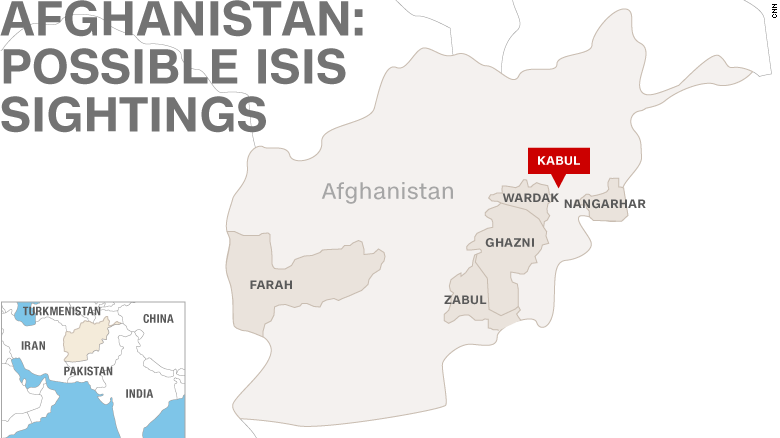
A video released today revealed an ISIS flag, and troops, south of Kabul in Afghanistan. Although the Afghan president has expressed his concern about the threat that ISIS poses to his country, any ISIS presence in Afghanistan, where US troops are still in the process of withdrawal, is worrisome. While the Taliban and ISIS are definitely not on good terms, the idea of ex-Taliban members, or even current ones, joining forces with ISIS is downright terrifying. The revival of a strong terrorist presence in Afghanistan could potentially slow, or even stop, the withdrawal of American troops from the area.
ISIS' recent terrorist attacks have ranged from videos of them torturing and killing Americans, Syrians, and anyone opposed to their Jihadist ideals to planned assassinations, such as the one on the French satire group, Charlie Hebdo.
The issue of US involvement in the Middle East/Africa has been a recurring problem throughout the last 20 years. On one side of the spectrum, the US' failure to intervene in what came to be the Rwandan Genocide was catastrophic. Despite this, it any notion of the US becoming increasingly involved with recent conflicts such as Libya or Syria has faced heavy resistance.
This raises the question, at what point would the Obama administration consider a more serious intervention plan, placing American troops on the ground?
Do you think that the current situation calls for increased intervention?
Monday, April 6, 2015
Transgender Woman Cites Attacks and Abuse in Men's Prisons
![]() |
| (Left) Ashley Diamond before prison (Right) Diamond after 3 years in prison |
Diamond recently filed a lawsuit against the Georgia Department of Correction, with the U.S. Justice Department declaring their support of the inmate. In a statement by Vanita Gupta, Civil Rights Division, "Prison officials have the obligation to assess and treat gender dysphoria just as they would any other medical or mental health condition." Denying hormonal therapy to Diamond classifies as "cruel and unusual punishment", and goes against the rights given in the 8th Amendment.
There is no doubt in my mind of the unconstitutionality of the treatment Ashley Diamond received at the hands of the Georgia's prison. In seeking legal action, Diamond has become a sort of spokesperson for the transgender minority. The transgender community is often discriminated against, and the abuse is only amplified in a prison setting. By bringing attention towards the issue in prison, Diamond is fighting for the rights of transgender people everywhere. The rights of the transgender community should not be ignored.
Do you think Diamond is justified in seeking legal action against the GDC? What do you think would be the result of Ms. Diamond's lawsuit, and how would it affect policies regarding transgender people?
Sunday, April 5, 2015
California drought: Why mandatory cuts didn’t hit farms
On Wednesday, April 8, Governor Jerry Brown issued the very first order of its kind in California: a mandatory cutback on water usage. This crackdown will require residents and businesses to lessen water usage by 25 percent. Brown also plans to implement programs that will help support his order, such as replacing homeowners' grasses with drought-tolerant landscaping and swapping out current dishwashers and toilets with more water-efficient ones. However, Brown's executive order does not apply to farmers/agricultural purposes, even though this industry uses 80 percent of the state's water that could otherwise be made available to residents and other businesses. This exemption made for agriculture has sparked controversy. Some argue that farmers have already suffered drastic losses as a result of the worsening drought, and additionally, the water that farmers use are essential to producing food for the rest of the state's population. Others argue that while making it necessary for residents and businesses to cutback on water is a good idea, the fact that farmers are using 80 percent of the state's water does not exactly help the intentions of saving water.
Whose side do you take? Do you think Brown issued a fair order, and if not, what possible improvements could be made to it? What are some of your other thoughts on this issue?
Subscribe to:
Posts (Atom)