Friday, January 10, 2014

Sam sex marriage story in Utah UPDATE


 Sources:

Today the Obama administration announced that it will recognize the some 1,300 marriages between that took place in Utah since December 20th and that these married couples will be “eligible for all relevant federal benefits on the same terms as other same sex marriages” (Holder). Eric holder issued a statement confirming these marriages legitimacy at the federal level, but their legitimacy in the state of Utah is still murky, and receiving state benefits is still a battle.

This was an important victory for same sex couples in Utah today, but they still have a lot to go through. In addition, we have another interesting case of federalism. If the federal government recognizes these marriages as legal and eligible for couple’s benefits, should the state be forced to as well? Also at work here is an interesting dynamic between the courts. However, this is extremely detailed and difficult to explain in a concise manner. (For a good summary of what’s going and the background to this case go here: http://www.scotusblog.com/2013/12/utahs-same-sex-marriage-ban-falls/)

Thursday, January 9, 2014

BRIDGEGATE


Photo Chris Christie

Demeaning Cartoon of Chris Christie

For four days in last September, all but one lane closed in the George Washington Bridge from Fort Lee, New Jersey, bringing cars to a standstill. Why does this matter? Well, it has come to light that certain members of the New Jersey Governor Chris Christie's administration were involved in closing the traffic lanes to spite Democratic opposition. Currently, the extent to which Christie knew what was going on in the scandal that has now been dubbed Bridgegate is unclear, even after a two hour long press conference with Christie.

A recurring theme in our AP Gov't discussions is the structure of the state government, both in relationship to the nation as a whole and to the individual state itself; this scandal happens to be one that significantly affected both. My question is this: supposing Christie had no idea any of this disgraceful plotting was going on, is it still his job to take responsibility for the Bridegate scandal? As the chief elected executive of New Jersey, isn't his job to oversee all pressing issues that affect his state? What issues absolutely require his focus and oversight, and what issues can be delegated to lower aides and administrators? What do you think?

Articles:
"I have no idea what this post is referencing and need general information"
http://www.nytimes.com/2014/01/09/nyregion/christie-aide-tied-to-bridge-lane-closings.html?hp

"I would like an update on what happened to the people involved in the traffic scandal."
http://www.nytimes.com/2014/01/10/nyregion/christie-controversy-bridge-lane-closings.html?hp&_r=0

"Why is Christie being so fishy?"
http://www.thedailybeast.com/articles/2014/01/09/chris-christie-took-his-sweet-time-to-find-the-truth-about-of-bridgegate.html

"I wish I knew eight things Christie said at his vague press conference."
http://www.usatoday.com/story/news/politics/2014/01/09/christie-bridge-scandal-press-conference-quotes/4391725/

Basketball game in North Korea


Sources:

In celebration of Kim Jun Un;s 31st birthday, the retired basketball player, Dennis Rodman, recruited a group of 40 and 50 year old retired basketball players to play in an exhibition game against a North Korean basketball team. The game took place yesterday in Pyngnong. This was Rodman’s fourth visit to North Korea in the last year. He has claimed to be trying to open up relations between the US and Korea, but in light of what happened in the last two days, he is obviously pitifully ignorant to the political atmosphere in North Korea and its connection to the US.

The exhibition game began as a pretty hilarious news story for most people, but on Wednesday, when Chris Cuomo asked Rodman if he would use this opportunity to help Kenneth Bae, the imprisoned US citizen, Rodman erupted into an incoherent and highly offensive rant. (check it out here: http://www.cnn.com/video/data/2.0/video/world/2014/01/07/newday-cuomo-dennis-rodman-kenneth-bae-cutdown.cnn.html).

The players have said that they have no political intentions, but what are some of the political byproducts that could result from this game having been played? Is it time to stop strong-handing North Korea and instead try to ease tensions through basketball games and maybe hot dog eating contests? I’m being facitious, but it’s a legitimate question.

Wednesday, January 8, 2014

Another post on everybody's favorite plant!


sources:
http://swampland.time.com/2014/01/06/why-legal-weed-is-working-in-colorado/


On January 1st, in what many are calling “green Wednesday” (Altman). sColorado rolled out the law that passed last year, legalizing the sale, use, and growth of marijuana for recreational purposes. Most of us know this, but is Colorado’s current law legal? What we have, is an interesting dynamic of federalism at play. Throughout our nation’s history, states have tried to assert their own agendas, even if they contradicted federal law. Will the federal government force Colorado to close down marijuana dispensaries? Probably not. Then, what’s the point of a national ban on the drug? This get’s even more complicated when you consider the role of the courts.  “In august, the legal justice department said it will not challenge states which legalize recreational marijuana, but it still remains illegal under federal law” (CNN, Shmidt).
Instead of centering comments on what this story means for the fight for marijuana legalization or decriminalization, let’s discuss what this means for the federal government. What do it mean for the states? Does this represent a trend of a more hands off, libertarian federal government? Could Colorado have had such a successful roll out of their law with a republican president or senate in charge?

For a short, but comprehensive overview of the status of legal marijuana in colorado and the conditions of the law check out the video here: http://swampland.time.com/2014/01/06/why-legal-weed-is-working-in-colorado


CAN GAY PEOPLE GET MARRIED ALREADY


Fox News Article
http://www.foxnews.com/politics/2014/01/08/utah-governor-says-state-will-not-recognize-gay-marriages-amid-court-battle/

New York Times Article
http://www.nytimes.com/2014/01/09/us/utah-governors-office-says-state-wont-recognize-same-sex-marriages.html

The Daily Beast (Newsweek) Synopsis
http://www.thedailybeast.com/cheats/2014/01/08/utah-gov-gay-marriages-are-void.html

Utah Gov. Bob Herbert told state agencies Tuesday not to recognize same-sex marriages that took place in the two weeks after a federal judge overturned the state's ban on them (Newsweek). Until further resolution is clarified, same sex marriages are blocked while state officials appeal a decision determining what exactly a civil union is defined as. (This is an extremely simplified summary of all the legal procedure involving the garbled situation that is gay marriage in America. For more specific details, please read the articles. The New York Times one is the most detailed, and The Daily Beast's is the most concise.)
My question: why is the marriage equality issue so complicated? Obviously there are many factors surrounding conflicting personal beliefs and whatnot, but I'm talking about all the legal conflict between state and federal decisions. Is there an easier way? Are we doomed by our federal system to make only slow and tedious change? What do you think?

REPUBLICANS MOVE TO CLAIM POVERTY-FIGHTING MANTLE


New York Times article
http://www.nytimes.com/2014/01/09/us/politics/republicans-move-to-reclaim-poverty-fighting-mantle.html?hp

Republicans are attempting to gradually shift their focus as a party to include the issue of poverty. In other words, the GOP is trying to gain a reputation as more compassionate and aware of issues involving people from all economic levels.
The NY times article depicts the Republicans as seeking to more or less get credit for trying to tackle the issue of poverty so that they will be more liked by a broader audience. From a Republican politician standpoint, this is a great idea. Already viewed as distant from the poor by the general public, the Republican Party would surely benefit from being thought of as a more "poverty-fighting" type of crowd. Nevertheless, I can't help but feel that poverty is not a Republican issue, nor a Democratic issue. Poverty is nonpartisan, and such attempts to try and attach combating poverty to a specific party is silly and ineffective.
However, it is possible that this article is casting the GOP in an unfavorable light. Perhaps the various antipoverty programs that are being introduced demonstrate an actual desire to improve conditions of the poor and there is no ulterior motive behind said programs at all. What do you think?

STEUBENVILLE DEFENDANT RELEASED


ABC News Article

The Daily Beast (Newsweek) Synopsis

After a little under a year, Ma'lik Richmond was released from his juvenile detention center. I think this is ridiculous. Although this case happened back in March, learning about Richmond's release aggravates me since it feels very, very, very soon for him to be let out. I feel that his punishment was not harsh enough and inadvertently makes light of the fact that he raped another human being while she was intoxicated and vulnerable.
But what do you think? Please don't be frightened by my strong feelings about this case; I'm genuinely interested in hearing other opinions on Richmond's release. According to Richmond's attorney, Richmond has "reflected, learned, matured and grown in many ways." I'm not sure if I am swayed by Richmond's self discovery, but if you are, I'd be interested in hearing why.

Oh, and another topic of discussion: Richmond's age. As a seventeen year old, he is subject to a different set of rules under a criminal law trial than he would be if he were only a little older. In regard to this case, I feel Richmond's age seems a little arbitrary considering his actions but I can understand others' arguments that stress the importance of young people not having to be defined by one moment in their life. 
Are these different standards for seventeen year old criminals versus eighteen year old criminals necessary? Archaic? Fair? Unfair?

Saturday, January 4, 2014

Abortion restrictions on the rise - what's next?

Source
An increasing number of abortion clinics are being shut down or are vulnerable to being shut down due to the growing amount of anti-abortion restrictions that states are passing. One issue that will be heard at a federal appeals court is "a Texas requirement that abortion doctors have admitting privileges at local hospitals." Admitting privileges refer to "doctors’ right to admit his or her patients to a specific hospital or other treatment facility," and is a reason why so many clinics are forced to close in Texas. Abortion rights advocates are pushing for support in a Democrat Senate, and likewise, pro-life advocates are hoping to pressure the Senate through the Republican House.

Both sides agree that  2014 will be an important year for the debate on abortion. Abortion rights advocates believe candidates who are more moderate will have higher chance of getting elected in key red and swing states, lessening the influence of extremists. On the other hand, pro-life advocates believe it is much harder to get an abortion with today with these restrictions in place. An interesting point raised that how difficult it would be get an abortion depends on where someone lived - a "pre-Roe" like condition. Do you agree that our nation is at a turning point in regards to abortion? Have certain requirements (like admitting privileges) regressed states back before Roe v. Wade

Friday, January 3, 2014

Military veteran pension cuts trigger backlash


One provision in the bipartisan budget deal signed by President Obama last Thursday has received considerable backlash: cuts to military veteran pensions. The cut is a "one-percentage-point reduction in the annual cost-of-living increase" which is a relatively modest, and is estimated to save $6 billion in 10 years. A considerable chunk of the defense budget is allocated for pension and compensation, and Paul Ryan, one of authors of the budget deal, has insisted that this is a "reasonable adjustment" to a defense budget that may soon become unstable. Critics concede that reform is necessary, but any changes should be applied to future enlistees only. 

Due to the considerable backlash, new ideas have been proposed replacing military pension cuts, one of them being ending Saturday mail. This proposal would end Saturday mail delivery by the United States Postal Service, and is expected to save $17 billion over 10 years, more saved than that of the military pension cuts. However, this proposal will definitely spark anger throughout postal service groups, and there is no perfect solution to please everyone. I believe the veteran's outrage has another layer than just money. Of course, money would play a huge role in their anger, especially when some in the military have planned their future with the promised pension in mind, but I think to veterans these cuts look like the United States dismissing an important promise. 

It seems that someone's budget/service is going to be slashed, but the question is who and by how much, so what do you think is the most sensible and simple plan for these budget cuts? Are veterans and critics of the provision in the budget deal overreacting to a small cut, or they rightfully angry at what seems to be a breaking of a significant promise? Judging from the backlash and range of ideas to replace the military pension cut, I think this provision will at least be modified in the near future.

Thursday, January 2, 2014

Kerry (once again) to prioritize climate change policy

Climate change over ten year increments
Source

Even as a senator in 2010, current Secretary of State John Kerry has pushed for effective climate change and energy policy. Now Kerry is once again at the forefront of the battle to ensure that the United States develops comprehensive and effective policies to deal with our ever changing climate and the consequences that come with it. Although Kerry has the drive to fight climate change, his actual successes are few, and the Senate has historically rejected most climate change bills. One of Kerry's goals as of now is to establish a strong relationship with China in order to reach a 2015 treaty over climate change.
The United States has had a long history of promising to do something about climate change, but Congress has not agreed on or passed any effective climate change policies in the last decade. However, just recently the EPA proposed new regulations in regard to carbon pollution for new power plants. Things at the capital seem to be changing and people are noticing that Kerry has brought in a new "dynamic" while dealing with climate change. While he does face obstacles, the "skepticism is much thinner" and the new year seems to be an opportune time to finally change our nation's passivity dealing with climate change. Do you think effective climate change policy will be created and passed this year, especially in light of controversial issues such as the Keystone Pipeline? Or will climate change once again be overshadowed by other issues like healthcare and the economy and Kerry's campaign is just another promise that will fall apart in the future?

Monday, December 30, 2013

Minimum wage: A key issue for 2014?


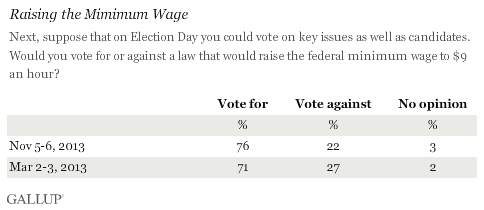
As the year comes to a close, the Democratic Party is hoping to shift gears and focus on the issue of minimum wage while the battle over healthcare continues. Democrats hope to raise the federal minimum wage (currently $7.25-per-hour) as well as place minimum wage raising proposals on state ballots in competitive states in time for the 2014 elections. Polls have indicated support for raising the minimum wage to $9-per-hour and Democrats are hoping to capitalize on this support and force the Republicans into position against "fairness." Here is a Gallup poll published about a month ago, indicating the increased support for raising the minimum wage:

Source

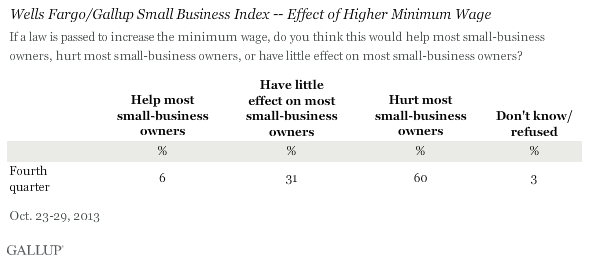
Republicans have asserted that raising the minimum wage hurts small businesses, and small businesses seem to agree. This Gallup was published at the end of November and asked small businesses whether raising the minimum wage would hurt and help small businesses:

Source
So while the general public seems to favor raising the minimum wage, it remains a more contested issue for small business owners. Republicans, including Speaker John Boehner, are more interested in creating jobs, and Boehner was quoted saying "Why would we want to make it harder for mall employers to hire people?" However, 2014 does seem to a be a turning point - 13 states will be raising the minimum wage starting January 1st. Placing this issue on the agenda for 2014 is definitely a political play for the Democrats who must overcome challenges in certain Senate races, but the execution of what the Democrats promise seems likely as well, seeing as the 13 states have already raised their minimum wage and that support continues to grow. Do you see the minimum wage debate an important issue for 2014? Or perhaps is this issue merely a way for the Democrats to regroup before the 2014 elections as the fight regarding healthcare rages on?

Saturday, December 28, 2013

Obama addresses new sexual assault policies in military


On Thursday President Obama signed a defense authorization bill aimed to reform sexual assault policies in the military, a much needed piece of legislation considering the slew of military scandals regarding sexual assault this year. The provisions of this bill include ending the statute of limitations for sexual assault or rape cases in military, so that even after a certain period of time has passed the perpetrator can still be prosecuted for the charges. Military commanders are now barred from overturning jury decisions in such cases  and are mandated to dishonorably discharge or dismiss those convicted of sexual assault. In the Wilkerson case linked above, Wilkerson's commander even attempted to give him a promotion after the commander overturned the jury decision. 

One measure, however, did not make the cut. Many survivors are advocating for sexual assault cases in the military to be prosecuted independently. As of now these cases are prosecuted within the chain of command for the purpose of "order and discipline," but how valid is that reasoning when it's clear that these cases are ignored or even harmful to victims that report them? Changes are happening -- the increased reporting of sexual assault indicate that the definition of sexual assault is becoming more clear to victims, and a decreasing of the fear and stigma that comes with reporting these cases. However, do you think change is happening fast enough? Obama has given a year for the military to conduct a review of its changes regarding sexual assault policies, but how effective can these changes be without the key measure mentioned above?

Friday, December 27, 2013

Gateway Drug


Mayor Robert Jacob behind the counter at Peace in Medicine
Photo by Max Whittaker, New York Times

Earlier this month the city of Sebastopol, California unanimously voted in Robert Jacob for mayor. Jacob, 36, is the founder and director of local medical marijuana dispensary Peace in Medicine. Consequently, he has become the first mayor in the United States to have a background in the medical marijuana industry. Sebastopol, a city an hour north of San Francisco, has a population of just over 7,500 and is known for its small town charm. Historically famous for its Gravenstein apples and plum orchards, this city has become home to Jacob’s thriving business. Peace in Medicine produces over 46,000 dollars of tax revenue for the small city, and Jacob has served in Sebastopol’s city council since 2012. With the evident economic prosperity of Peace in Medicine and the city’s election of Jacob, the industry of medical marijuana seems to be gaining influence locally. With twenty states legalizing the use of marijuana for medical purposes, and Colorado and Washington legalizing its recreational use in 2012, is it possible that the cannabis industry will grow to become as financially influential as traditional businesses, such as technology and agriculture? Will the medical marijuana industry produce more business owners that have the financial means to run for elected positions? How will the federal government, banning the legalization of marijuana on a national level, respond if this industry continues to expand and facilitate medical marijuana business owners to run for office? 

Read More:
http://www.nytimes.com/2013/12/26/us/in-california-a-mayors-rise-is-a-sign-of-the-times.html?smid=pl-share