Sunday, November 22, 2015

What if a Girl Wants to Become a Boy Scout?

       There is currently a group of girls in Santa Rosa, CA called the "Unicorns" who wish to become official members of Boy Scouts of America (BSA). Between the ages of 10 and 13, many were previously Girl Scouts, but disliked the non-adventurous and laid back atmosphere of girl scouting activities. The mother of one of the girls claims, "After lunch, you take a nap for an hour you sit on your bunk and you can read or color or write to a friend. You can't talk." These girls decided to take matters into their own hands.


       The idea all started when the "Unicorns" took part in a BSA-affiliated event that was open to both boys and girls. Since then, they have also participated in a "camporee", which is basically a series of friendly competitions in which many different Scout troops come and participate in outdoor challenges. The girls impressively earned 2nd place. In addition, the girls have formed a "companion council", which is a group loosely affiliated with BSA, in this case, a local den. The small group attends the same den meetings, participates in the same den activities, earns the same Cub Scout patches, and has even secured the support of several local BSA leaders. Unfortunately for the girls, BSA official policy is this: "The Cub Scouts and Boy Scouts programs are designed for boys and young men.", which means that the girls will never be able to become official Boy Scouts and perhaps more importantly, that the girls will be forced to disband their companion council group.

This brings up an interesting question: Should girls be allowed to join Boy Scouts?  Before I present the arguments for both sides, I know that some of you may have been wondering about Title IX. Hmmmm...If you can't discriminate based on sex, then the girls have a pretty good argument, right? Wrong. Section 1681 (a)(6)(B) of Title IX  grants exceptions to both Boy Scouts and Girl Scouts. Just thought it would be good to clear that up!

       One side would argue "yes" for several reasons. The first being the fact that girls want to do more "Boy Scout-like" activities that are not available to them in Girl Scouts. The second being the fact that it is unreasonable to believe that girls would be unable to keep up with the boys' activities. The girls who won 2nd place in the camporee can testify to that. The third being that if local leaders support the measure, why are they still being hindered by the "higher" ranks of the BSA administration?

       The other side, arguing "no" would also have a compelling argument. They would argue that Cub Scouts and Boy Scouts are organizations that , for over 100 years, have been devoted to the development of the young boys and young men in this world. Meetings should be a place where boys get to interact with other boys, which is a unique and valuable experience. They don't believe that girls are in any way inferior to the boys, they just believe that it is expected that Boy Scouts be for boys. If girls want to do more "Boy Scout-like" activities, then she should pressure her own Girl Scout troop or council to change, not attempt to gain entry in to an all-boys organization. Also, during camping outings, the possibility of boys and girls sharing tents could potentially be something to worry about. [Lastly, not all Girl Scout groups are like what was described in the first paragraph by one of the mothers. I know from experience that there is a significant amount of troops, at least in this area, that do participate in camping, hiking, and shooting activities. There are definitely some troops like the one the mother described, but don't go thinking all troops are like that.]

I should add that to BSA's credit, there are several coed programs that are offered. For example, "Venture Scouts" is basically the same thing as a traditional Boy Scout troop, except for two differences. The first difference is that Venturing is open to both boys and girls. The second is that there is even more of a focus on high adventure and outdoor activities. As another example, "Sea Scouts" is a program, like Venture Scouts, where both boys and girls are able to function similarly to a traditional Boy Scout troop, except with an emphasis on water activities, especially maritime and boating skills.

As a Boy Scout myself, when I saw this in the news, I thought it would be really interesting to explore and especially relevant to our last unit. What do you all think? Should girls be allowed in to Boy Scouts? If so, should boys be allowed in to Girl Scouts? Any other thoughts, questions?


**[bracketed statement is from my own observation. I am not taking sides on the issue here but rather adding a little bit of my own knowledge from experience teaching large groups of girls at Girl Scout camp]**

Sources:
-http://www.justice.gov/crt/title-ix-education-amendments-1972
-http://www.sfgate.com/news/article/All-together-now-North-Bay-girls-troop-fights-6594440.php
-http://www.nytimes.com/2015/11/23/us/girls-in-california-are-latest-to-seek-to-become-boy-scouts.html
-me?

Saturday, November 21, 2015

More Mexicans Leaving the U.S. Than Arriving

Despite all of Trump's overblown claims and racist remarks about Mexican illegal immigrants, a recent Pew Research study shows that more Mexicans are leaving the U.S. to return home than are arriving here.  From 2009 to 2014, the U.S. has had a net loss of approximately 140,000 Mexican immigrants.  In comparison to the 2.3 million net gain of Mexican immigrants between 1995 to 2000, the U.S. is seeing a complete reversal of a historical trend.  This change can be explained by the slow recovery of the U.S. economy after the Great Recession, stricter enforcement of U.S. immigration laws, and a significant improvement in the Mexican economy over the previous decades.  One reason for the improvement in Mexico's economy can be seen in their fertility rate.  At a surprisingly high rate of 7.3 in 1980, women were expected to have seven children in their lifetime.  Seen as the "replacement level" sufficient enough to keep population stable, the rate dropped to 2.2 in 2009.  Due to this drop in fertility rates, Mexico's economy has been able to flourish.  Less pressure on the labor market results in less incentive to more north.  Combined with the struggling economy after the Great Recession, it is clear why fewer people were seeking job opportunities in the U.S.  In Recent Years, Fewer Mexicans Have Friends or Family in the U.S.
What does this research show about Trump's stance on Mexican illegal immigrants?  In fact, China recently overtook Mexico in 2013 as the top source of U.S. immigrants.  Will this data effect the immigration policy of presidential nominees?  If so how?  Is a wall across the Pacific Ocean Trump's answer?

Sources:
http://www.outsidethebeltway.com/more-mexicans-are-leaving-united-states-to-return-home-than-arriving-in-united-states/

http://www.pewhispanic.org/2015/11/19/more-mexicans-leaving-than-coming-to-the-u-s/

http://www.outsidethebeltway.com/more-immigrants-to-the-u-s-come-from-china-and-india-than-mexico/

Why are so Many Young People Feelin' the Bern?

So, I thought I would just write about a few of the reasons why young voters are so enamored with Bernie Sanders. After all, according to a PEW study, almost 50% of folks aged 18-49 view "socialism" favorably. In comparison, by the same study, only 13% of 65+ year olds view "socialism" favorably. Now, understand that viewing the word "socialism" favorably is not the same as supporting Bernie Sanders, but it is no secret that Sanders is becoming rather popular in the younger tier of voters. By the way, this is by no means a definite, concrete news story, nor is it a comprehensive analysis of the ideology and platform of Bernie Sanders. This is simply a summary of ideas that I have gathered from other sources.

In a nutshell, after reading several articles, I came to the following conclusion:
   The reason why more young voters support Bernie Sanders is because they are young, and the reason why his support drops as voter age increases is because, well, they are older.

Now, understandably, that may not make a whole lot of sense, so let's take a closer look:
1-Economics- Many of the "older" generation have been able to get an education, get a job, and have a relatively successful economic life with no major setbacks. That is not the same for many in the younger generation. Why? 2008. In 2008, one of the worst economic disasters in the history of the country. Imagine graduating college during this time. What would you do? It was much more difficult for young people in the job market. You have just racked up a significant sum of college debt, and now your job prospects are slim. And for young workers who only had a few years of experience under their belts, you still need to pay off your college loans. Taking in to account the lingering effects of the recession, NPR claims that younger people are not as well of as their parents were when they were young. The parents, like I mentioned earlier, didn't suffer anything like 2008 when they were young. Their job security was better when they were young. The older generation has more faith in the economic system, whereas the younger voters have less faith in the economic system. Enter Bernie Sanders, who promises to make college more affordable and take on corporate america. Older voters have little reason to want such drastic change, but the young voters may be attracted by concepts such as less student debt and perhaps even the proposed rise in minimum wage. Essentially, Sanders offers hopes of a better economic future that young voters seem to be drawn to.
2-"Socialism"- The second reason actually does have something to do with the fact that Bernie Sanders classifies himself openly as a democratic socialist. Older generation may think of the former Soviet Union when they think of socialist. On the other hand, younger people may not default to that association of socialism with Soviet communism and the poor welfare of its citizens. They may associate socialism with some European countries like Sweden or Norway which have substantial amounts of healthcare and college tuition subsidized by the government. To younger voters, this sounds appealing. To older generations who may not be able to get over their "experience" with socialism (combined with less need for things like cheaper college tuition), Bernie Sanders has less to offer.

For all of you out there who are feeling the Bern, why? What makes Bernie Sanders so special? I know for a fact that I did not come close to summarizing all of the reasons why Sanders is appealing, so let's hear it!


Sources:
http://www.npr.org/2015/11/21/456676215/why-do-young-people-like-socialism-more-than-older-people
http://www.people-press.org/2011/12/28/little-change-in-publics-response-to-capitalism-socialism/
http://www.theguardian.com/us-news/2015/aug/20/bernie-sanders-millennials-young-voters
http://blogs.wsj.com/washwire/2015/10/27/a-big-challenge-for-hillary-clinton-bernie-sanderss-avid-supporters/

Friday, November 20, 2015

Growing Opposition to Syrian Refugees

In a statement given by Mayor David A. Bowers, the Democratic mayor of Roanoke, Virginia, he links Japanese internment during WWII to refusing to assist in the relocation of Syrian refugees; "I'm reminded that President Franklin D, Roosevelt felt compelled to sequester Japanese foreign nationals after the bombing of Pearl Harbor, and it appears that the threat of harm to America from Isis now is just as real and serious as that from our enemies then."  As ludicrous as this comparison is, it is, to an extent, true.  Just like the "real and serious" threat of the Japanese Americans being completely false and a product of wartime paranoia, the Syrian refugee threat is the same.  Although the threat of terrorists entering the US as a refugee is not nonexistent, Republicans seem to be taking an extreme stand.


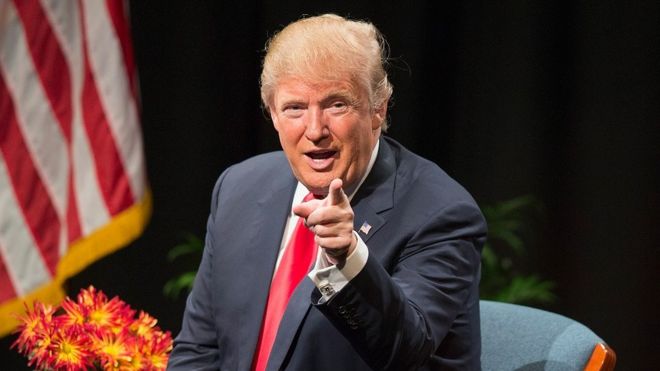
Republican presidential candidate Donald Trump points at the camera.


Putting Mayor Bowers' flawed history aside, there has been a significant increase in anti-Islam rhetoric in GOP.  Trump's suggestion of closing down mosques, increasing surveillance of Muslims, "certainly" and "absolutely" creating a database of Muslims in the US, and sending immigrants back, has caused a lot of controversy; "I'm putting the people on notice that are coming here from Syria as part of this mass migration... If I win, they're going back."  Although Trump's being the most extreme, other Republican presidential candidates are also solidifying their stance on Syrian refugees.  Stating that Obama's "nothing short of lunacy,"  Ted Cruz suggested that the US should accept Christian refugees from Syria but not Muslim.  Ben Carson compared terrorist Syrian refugees to "rabid dogs" in your neighborhood.   Finally, Marco Rubio supports Trump in closing down mosques on the grounds that "any place where radicals are being inspired" should be closed down.  Although Jeb Bush supports Ted Cruz's stance on only accepting Christian refugees, he strongly disagrees with the closing of mosques stating that "that's just wrong."  

During times of crisis, the balance between freedom and national security is questioned.  What is your opinion on the Syrian refugee issue?  Are the Republicans over reacting to a nonexistent threat or are they taking necessary precautions?  At what point should some freedoms be denied for "national security?"


Sources:

http://www.economist.com/blogs/democracyinamerica/2015/11/pulling-up-welcome-mat#comments

https://www.washingtonpost.com/politics/rabid-dogs-and-muslim-id-cards-anti-islam-rhetoric-grows-in-gop/2015/11/19/1cdf9f04-8ee5-11e5-baf4-bdf37355da0c_story.html?hpid=hp_hp-top-table-high_islampolitics-848pm%3Ahomepage%2Fstory

http://www.vox.com/2015/11/16/9746456/map-syrian-refugees-governors

http://www.cnn.com/2015/11/16/world/paris-attacks-syrian-refugees-backlash/

http://www.bbc.com/news/world-us-canada-34884544

http://www.foxnews.com/politics/2015/10/01/donald-trump-says-hed-send-back-syrian-refugees-taken-in-by-us.html

Wednesday, November 18, 2015

Supreme Court Asked to Address Alabama Same-Sex Custody Ruling

A woman in Alabama is asking the Supreme Court to reverse a decision made by the Alabama courts regarding custody of her children. The woman, known as "V.L.", shares three children with her ex-partner, who is their biological mother. Although they were never legally married, the pair moved to Georgia together to receive more parental rights as a same-sex couple, including legal adoption by V.L.
As these rights are not included in Alabama law, upon returning to the state, V.L.'s rights as a parent were voided and she is now denied access to her children. The argument made by Alabama justices is that, based on the fact that "Georgia law makes no provision for a non-spouse to adopt a child without first terminating the parental rights of the current parents", the state of Georgia essentially broke their own law by recognizing V.L. as a legal guardian of her children without terminating the parental rights of V.L.'s ex-partner.
However, V.L. maintains that she should still have the rights guaranteed to her by the state of Georgia, and that Alabama has broken the Full Faith and Credit Clause ("Full faith and credit shall be given in each state to the public acts, records, and judicial proceedings of every other state") by voiding her rights as a parent.
Interestingly enough, while the Alabama laws on same-sex adoption are seen as "terrifying" (Cathy Sakimura; National Center for Lesbian Rights) by LGBT+ rights groups, the courts seem to be sidestepping the issue. Instead, they seem to be determining this case based purely on interpretation of the Constitution.
It is unknown whether or not the Supreme Court will take the case, but LGBT+ activists are hoping they will, as a win in favor of V.L. would further legitimize same-sex couples as deserving of the same rights as different-sex parents.

Questions
-Who do you believe is more in the constitutional right in this case? Alabama or V.L.? Why or why not?
-Why do you think the courts are avoiding the fact that the case has to do with a same-sex couple?

Sources
-http://www.buzzfeed.com/chrisgeidner/justices-asked-to-take-up-case-of-lesbian-parents-adoption-r#.hn9owKoXk
-http://www.foxnews.com/politics/2015/11/18/lesbian-mother-asks-supreme-court-to-reverse-ala-ruling/
-https://www.washingtonpost.com/politics/courts_law/us-supreme-court-is-asked-to-hear-lesbian-adoption-case/2015/11/16/bd1180c4-8c9b-11e5-ae1f-af46b7df8483_story.html
-http://www.npr.org/2015/11/17/456432166/supreme-court-asked-to-take-messy-case-on-interstate-same-sex-adoption

Tuesday, November 17, 2015

Planned Parenthood v. Casey II: Whole Woman's Health v. Cole

During the Planned Parenthood Case that was recently presented (at least in 1st period), it was briefly touched upon that there will be a new case that the court is expected to rule on later this year regarding a Texas state law passed in 2013 which purportedly is hindering women who wish to receive an abortion. I thought it may be appropriate to expand on that, as the Constitutional Law unit is coming to close. [Let us all take a moment to pause, take a breath, and try not to panic about the test tomorrow].
First, let’s examine a few of the provisions of that Texas law:
1.                          1-    Abortion providers must have admitting privileges at nearby hospitals (within 30 miles). What does this mean? This means that any physician who performs an abortion procedure (surgical, medicinal, etc…), must be able to admit, or “check-in” the recipients of the abortion procedure at a nearby hospital if need be. That means if there is a women’s health clinic that performs abortions that is not affiliated with a nearby hospital and the doctors there do not have admitting privileges at said nearby hospital, then that clinic runs the risk of getting closed down, an issue that we will explore later on
2.                           2-    Abortions must be performed in buildings with the same building standards as “Ambulatory Surgical Centers”. What is an ASC? Great question! It has nothing to do with the large truck with sirens and lights. Rather, they are clinics that operate independently from hospitals and specialize in surgical treatment. Almost 100% of the time, this is outpatient surgical treatment (walk in, get surgery, leave same day vs walk in, get surgery, leave week later). I am not about to dive in to the fascinating field of building codes and regulations, but essentially, many abortion centers would require additional renovation in order to meet this standard.
Now, here comes the problem. According to Planned Parenthood and several other organizations, more than half of Texas’s abortion centers have been forced to close because of the 2013 law. There used to be 42, and now there are 19. Opponents of the law argue that these closures came to be for several reasons. The first reason is that many of the clinics had physicians who did not have admitting rights at nearby hospitals. If this was the case and physicians were unable to obtain these admitting rights, then the clinic is in violation of the fist provision that was discussed earlier and therefore, must be closed down. The second reason is that many clinics were not up to standard with the same building codes as the ASCs. That does not mean that the clinics were unsafe in any way, (they may have been…it just is not something you can automatically assume), it just means that they were not built the same way as ASCs, which are used for various types of surgery (Orthopedics, Ophthalmology, Urology, Gastrointestinal, etc…).
         According to studies cited by Reuters, the closure of half the states abortion clinics has negative implications. The study estimated that between 100k-240k women aged 18 to 49 have attempted abortion procedure themselves, using practices like special herbal concoctions, teas, and sometimes medicines which are illegally  obtained from Mexico without a prescription.  Unfortunately, women of lower social classes are most often the victims of the closure of abortion centers, and constitute a large percentage of those who are attempting abortions themselves. But underprivileged women are not the only victims. Many women, instead of being able to use a local clinic, must travel long distances from their town to an abortion clinic ( Texas is a BIG state and if there are only 19 abortion centers within the entire state, well…you get the picture). By doing so, they are forced to take of more time from their jobs and/or find childcare for their children, both of which have negative economic impacts on women regardless of class, but especially in the case of poor women. In addition, another study found that the average wait time for an abortion was three weeks, adding to the stress of the long drives and time off work.
           In Planned Parenthood v Casey (1992) the Court held that it is permissible for states to put restrictions on abortions just as long as the restrictions were not unnecessary burdens. Now, Rick Perry, the governor of Texas, along with the law’s other supporters, claim that regulations like these are essential for public health. If a woman has complications arising from her procedure, then the physician who was conducting the procedure should be able to put her in a hospital in order for the women to receive adequate care. Opponents to the law cite studies which results show a very low complication rate in abortion procedures. One such example would be a NCIB study which showed that in legally induced abortions, the mortality rate was .6 deaths per 1000 procedures, which amounts to a 0.0006% mortality rate. Feel free to double check the math. Also, if you are going to have an abortion, supporters argue, you had better have it in safe facilities that are well-equipped to handle emergencies. I, personally, agree with that argument, BUT, does a well-equipped abortion clinic need to be as well-equipped as an ambulatory surgical center, which performs various, and often more serious, types of surgery?
Here is the essential question: Whether or not you are pro-life or pro-choice, from a strictly legal standpoint here, does the Texas law being challenged in the Supreme Court violate the “unnecessary burden” limit imposed by the decision in PP v. Casey?
The court will rule on the constitutionality of the two provisions of the law that we explored in a case called Whole Woman’s Health (an abortion clinic) v Cole (Texas commissioner of Dept. of State Health Services). Stay tuned for the decision.

           This brings up several interesting discussion points: How do you think the court will rule in regards to the “essential question”? Are the two provisions of the Texas law unnecessary burdens? Should lawyers and judges be able to make decisions about the building codes of hospitals? Why shouldn’t doctors be able to make their own decisions on what they need or don’t need for an abortion procedure? Should ASCs and abortion clinics be held to the same standards? Why or why not? Additional thoughts?

Sources:
 http://www.reuters.com/article/2015/11/17/us-texas-abortion-idUSKCN0T62C220151117#R8hqDWBJ7WVpPldo.97
http://www.reuters.com/article/2015/11/16/us-usa-court-abortion-states-idUSKCN0T30VV20151116#R5K14G07QpMSEteT.97
http://www.nytimes.com/2013/07/19/us/perry-signs-texas-abortion-restrictions-into-law.html
http://www.scotusblog.com/case-files/cases/whole-womans-health-v-cole/
http://www.ncbi.nlm.nih.gov/pubmed/22270271
http://www.advancingsurgicalcare.com/whatisanasc

El Niño Will Be Strongest In 15 Years

And now for something completely different.
The El Niño weather phenomenon will be the strongest in fifteen years*, says the World Meteorological Organization (an agency of the UN). Increases in ocean temperatures are larger and more rapid than previously recorded– the Pacific Ocean is 5.4 degrees Fahrenheit above average. Effects of El Niño include severe droughts and flooding, seen not only in California but in Southeast Asia as well, where, in Indonesia, wildfires outbreaks have been devastating the country. Droughts have also been worrying Central America and eastern and southern Africa, where millions are at risk for starvation. Additionally, El Niño will bring heavy rainfall for California, southeastern America, and northwestern Africa.
While El Niño is not caused by climate change directly, it will bear some of the effects. “... This naturally occurring El Niño event and human induced climate change may interact and modify each other in ways which we have never before experienced,” says WMO Secretary-General Michel Jarraud.
The good news, however, (and we all know we need some) is that previous strong El Niños have prepared the world for weather-induced catastrophes. Jarraud adds that "We are better prepared for this event than we have ever been in the past... The level of international, national and local mobilization is truly unprecedented, exemplifying the value of actionable climate information to the society."

*Sources vary.

Questions
-Do you think the strength of El Niño will change the course of climate change debates? Why or why not?
-Since this is a global phenomenon that affects the United States, do you believe we have a responsibility to give aid to those more severely affected in other countries?

Sources
-https://www.wmo.int/media/content/el-ni%C3%B1o-expected-strengthen-further-high-impacts-unprecedented-preparation
-http://www.cnbc.com/2015/11/17/el-nino-on-track-to-be-one-of-the-worst-ever-un.html
-http://www.latimes.com/local/lanow/la-me-ln-el-nino-temperatures-new-record-20151117-story.html
-https://www.washingtonpost.com/news/capital-weather-gang/wp/2015/11/16/by-one-measure-this-wicked-el-nino-is-the-strongest-ever-recorded-what-it-means/?hpid=hp_hp-more-top-stories_cwg-elnino-350pm%3Ahomepage%2Fstory

Feminist Icons

Related to our drive-by look at civil rights, here is one of the better interview driven pieces of journalism I've read in the past year:
http://www.nytimes.com/2015/11/15/fashion/ruth-bader-ginsburg-and-gloria-steinem-on-the-unending-fight-for-womens-rights.html

Monday, November 16, 2015

Prisoners for Drug Trafficking Released Sooner Than Expected

The amount of time one serves in prison as a result of their punishment determined by a court has and always will be a concern for America's legal policies.  An example of this concern can be directed towards the fact that tens of thousands of people who have been serving prison terms for "drug trafficking" will be released before their actual sentences end.  In fact these sentences are being cut by "an average of 2 years."  This change is a result for the severe over population in prisons along with the actual expense for their upkeep.

Some people believe that this is early releasing of said prisoners is more beneficial than damaging to the community.  Julie Stewart, president of Families Against Mandatory Minimums, stated 'people have been over-punished for decades.'  The Justice Department said that "there is no evidence" that proves inmates in prison for longer periods of times affect the chances of their returning to prison.

The class has recently reviewed the judicial system and the process of cases making their way up to the Supreme Court.  Taking into account the complexity of the American legal system, it is hard to determine the punishment for breaking said law.  Not to mention the difficulty in determining what is constitutional or unconstitutional.

As a response to the prison sentences being shortened, do you think this will have a major impact on US policies regarding drug trafficking.  Will this have any significant impact on American society.  Is the punishment for drug trafficking too extreme?

Sources:
http://www.nytimes.com/2015/11/02/us/with-early-release-thousands-of-inmates-are-adjusting-to-freedom.html
https://listencurrent.com/current_events/544-prisoner-early-release

CIA Director Criticizes Post-Snowden Surveillance

The recent ISIS terror attacks have spurred interesting comments from John Brennan, Director of the CIA. Citing the attacks in Paris, Brennan claimed that he "would anticipate that this is not the only operation ISIL has in the pipeline”, and that the recent measures to reduce government surveillance have only weakened America's ability to identify "murderous sociopaths".
The surveillance reform Brennan refers to comes after the NSA scandal that began in 2013, when former NSA contractor Edward Snowden began releasing confidential documents exposing the highly suspicious and essentially corrupt acts of the agency, especially in regard to obtaining phone records. The passage of the USA Freedom Act in June of this year was meant to reduce the intrusive powers of the NSA and increase the privacy rights of American citizens.
However, John Brennan believes that this act and the general reevaluation of NSA power has made it more difficult to identify possible threats to the nation. While not commenting on France's intelligence and security, Brennan did say that the attacks were "not a surprise", implying that (at least) the CIA may have known about a planned large-scale ISIS attack.

Questions
-Do you believe that, in light of terrorist attacks, privacy rights should be weakened in order to protect citizens? What is the line between privacy and prevention?
-Do you believe Americans have a right to decide the level of privacy they can have, especially in times of terror? Or is this the government's right to decide?

Sources
-http://www.nytimes.com/2015/11/17/us/after-paris-attacks-cia-director-rekindles-debate-over-surveillance.html
-http://foreignpolicy.com/2015/11/16/citing-paris-attack-cia-director-criticizes-surveillance-reform-efforts/


Lebanon Attacks: Forgotten by Media?

A couple of days earlier, a double suicide bombing terrorized and attacked the streets of Lebanon, destroying a busy shopping area in the Bourj Brajneh district around 6 p.m. According to the Lebanese Health Ministry, about 43 people were killed and about 239 people wounded. ISIS has claimed responsibility for the attacks, but these statements are not verified, according to CNN. ISIS also claimed that it was targeting Hezbollah, a Shitte militant organization that backs the Syrian government.

"There's a lot of shattered glass on the street, a lot of blood, and it's really just a scene of chaos and carnage," said journalist Tamara Qiblawi. Citizens have been advised not to be near the scene as well as nearby hospitals so ambulances can take victims to the hospital more easily.

The White House condemned the attacks on Lebanon, stating that it would "only serve to reinforce our commitment to support the institutions of the Lebanese state, including the security services, to ensure a stable, sovereign and secure Lebanon." Iran, an ally of the Hezbollah, also condemned the attacks. Lebanon's prime minister, Tammam Salam, also condemned the bombings, who also called for a national day of mourning. Salam adds, "I pray that this tragedy is enough to wake up politicians so that they can put their differences aside so we can protect the country."

Additionally, the Lebanese Army revealed in a statement that the bombers had struck at 6 p.m. in order to maximize casualties. Furthermore, the body of a third bomber was found near one of the blast sites with his explosive belt fully intact. 

Many people took their sentiments about the attack to the social media. Some people also complained that the news of these attacks did not nearly get as much news coverage as the attack in Paris, which happened a day later. Facebook was also criticized for having the "Safety Check" feature in response for the attacks in Paris, but not for the Beirut bombings. Zuckerberg stated that prior to Friday, the feature has been only used for natural disaster events and now he plans to "activate Safety Check for more human disasters going forward as well."

How do you feel about these criticisms toward the media? Are they justified? Why or why not? Do you feel that the media has not had enough coverage for the Beirut bombings? Some believe believe that the events did get different media coverage, but for valid reasons, such as the fact that the Paris attacks were sudden, while the attacks in Lebanon happened in Beirut, an active war zone. Is this a valid justification? Overall, how do you feel about media and its power to spread awareness about various events, such as terrorist attacks?

Sources:
NY Times, BBC, CNN, The Washington Post (photo credit)

The Refugee Crisis and Islamophobia: Should States be Allowed to Turn Away Refugees?

After the devastating bombings in Paris, 19 U.S. governors, including Lindsey Graham (mentioned in the previous post), have voiced strong opinions against allowing immigrants in to the United States. All of the governors are part of the Republican Party. One additional democratic governor from New Hampshire also is against accepting refugees. Currently, the Justice Department is investigating the legality of the states’ refusals to accept Syrian refugees. What they have concluded so far is that technically, it is legal for these states in interfere with the organizations who are helping the refugees get in to the country (NGOs) to a certain extent. The investigation is still ongoing. 

       Several Republican candidates have also spoken out against the idea of having Syrian refugees, specifically Muslims entering the United States. Senator Ted Cruz calls the idea “lunacy”. He goes on to say, "Christians who are being targeted, for genocide, for persecution, Christians who are being beheaded or crucified, we should be providing safe haven to them.” Former Governor Jeb Bush offered similar sentiments, stating, “We should focus our efforts as it relates to the refugees for the Christians that are being slaughtered." Many other Republicans (Kasich, Paul, Carson, the list goes on…) also have voiced their opinions against permitting victims fleeing ISIS from entering the U.S.. Christians most certainly are targeted by ISIS; both Bush and Cruz are absolutely correct in that regard. However, ISIS, even though it is an “Islamic” (and that does not mean that the organization represents the true values of Islam in any way) persecutes against many Muslims as well. ISIS is a Sunni extremist group, and if you are a Muslim who does not agree with their ideology, especially if you are a Shiite Muslim, you are automatically a target—and being a target of ISIS can often be a death sentence.

       Up until now, the United States has taken in ~1,900 Syrian refugees over the past four years, but has pledged to take in up to 10,000 during the next fiscal year. In comparison, Germany has accepted 40,000 in August alone (lately, they have been taking much fewer). During the past 4 years, the United Kingdom has accepted almost 5,000 refugees, but the government recently enacted a plan to allow 20,000 spread out over the next 5 years.

       One fear (among many) that some harbored against refugees fleeing from the violence in Syria was the possibility that some are bound to be ISIS-affiliated and are using their refugee status to gain access into a country in order to coordinate and carry out a terrorist attack. Now, after the attack in Paris claimed by ISIS along with the pair of suicide bombings in Beirut—also claimed by ISIS—this fear, for many, has become very real. There was even a Syrian passport found near the body of one of the terrorists. Whether or not this is of any significance remains to be seen, as it is not unheard of in places like Turkey for non-Syrians to purchase fake Syrian passports on the black market in order to get preferential treatment in the refugee/asylum process in Europe. Even so, one of the attackers was indeed able to enter France under refugee status. That is a scary thought.


       What do you think about the idea of states refusing to accept refugees? Should that decision be up to them or up to the federal government? Obama and most democrats support the idea of allowing Syrian refugees to enter the country. What about the comments by G.O.P. presidential candidates? Would you consider them racist? A manifestation of Islamophobia into national politics? Justified given the circumstances? Other comments? 
       Unfortunately, this is a sad story any way you spin it. 


Sources:
http://www.bbc.com/news/world-us-canada-34835353

http://www.aljazeera.com/news/2015/11/islamophobia-syrian-refugees-usa-governors-151116164708308.html

http://www.huffingtonpost.com/entry/jeb-bush-syrian-refugees-christian-muslim_5648b98de4b045bf3def84df

http://www.huffingtonpost.com/entry/fake-syrian-passport-paris_5648f9ade4b060377349887e

http://www.theguardian.com/world/2015/nov/06/germany-imposes-surprise-curbs-on-syrian-refugees

http://thehill.com/blogs/blog-briefing-room/news/253244-white-house-planning-to-admit-10k-syrian-refugees

http://www.nytimes.com/2015/11/17/us/politics/gop-governors-vow-to-close-doors-to-syrian-refugees.html

Sunday, November 15, 2015

Lindsey Graham warns of terrorist attacks on U.S. soil

South Carolina senator and Republican presidential candidate Lindsey Graham warned of "another 9/11" during an interview with CNN's Jake Tapper on "State of The Union" on Monday. During the interview he stated that the United States must get boots on the ground in Syria and Iraq and play a very large role in the war against ISIS. If we don't get involved, Graham asserted, we can expect a similar attack to the horrific bombings and shootings in Paris, France here in the United States. The senator called for 10,000 American troops on the ground in Iraq as part of a regional military force.

Do you guys think Graham's warnings should be taken seriously? Do you think that, with the recent arrival of refugees on American soil, there could be the potential for an attack on the scale of what happened this past Friday? Would it be a good idea for the U.S. to play a large role in the war against ISIS?

Source:
CNN
Photo: www.politico.com

Japan: Return to Recession

On November 15 (our time), Japan's Cabinet Office announced that the national GDP contracted by an annualized 0.8% in the third quarter. Stocks in Tokyo also fell by approximately 1% during trading early Monday.

This puts Japan's experiment with so-called "Abenomics" on the rocks. The "Abenomics" plan, named after current Prime Minister Shinzo Abe, is a large bond-buying campaign, in addition to structural reforms and stimulus from the central government. Overall, the plan has largely failed to boost economic growth. Experts believe that the government needs to step up its stimulus efforts, but this has been met with some resistance by central bank officials. The national government is expected to announce new policy measures sometime around January.

I don't expect many students reading this blog to be up-to-date on Japan's economy and policies in relation to it, but for those of you who are: Do you think Japan should continue the "Abenomics" experiment? What measures do you think the country needs to take to make an economic recovery?

Sources:
CNN Money
Picture: www.ft.com


France Bombs ISIS Positions

Last Friday on November 13, France was attacked by ISIS terrorists resulting in approximately 130 deaths.  As a response to the terrorist attacks, this Sunday French fighter jets were sent to bomb ISIS strongholds in Raqqa, Syria.  Officials have described this as a "major bombardment" due to 20 bombs being dropped on the initial targets.

Previous to the attack, France has been bombing Islamic State positions as a part of the "U.S. lead operation."  Now, France has vowed to eliminate the group as an addition to France's President stating the attack as 'an act of war.'  Yet, there has been no word regarding the damage inflicted by the French bombardment nor the amount of collateral damage.  It has only been confirmed that every target has been hit.

The US has been involved with foreign affairs dating back to the American Revolution.  With France's response to the recent terrorist attacks, it can only be a matter of time before the US takes action.  Not to say they already have.  How do you think America will respond to the ISIS attack?  What kind of influence will this attack have on US foreign policies?  Why or why not should the US be involved with Syrian bombings.  

Sources:
http://www.huffingtonpost.com/entry/france-bombs-isis-syria_5648ef7be4b06037734982c4
http://www.cnn.com/2015/11/15/middleeast/france-announces-raqqa-airstrikes-on-isis/index.html
http://gawker.com/france-expands-bombing-campaign-against-isis-into-syria-1733246001

Saturday, November 14, 2015

Syrian Immigrant was among Paris Bombers

In the midst of the investigation into the horrific terrorist attacks in Paris, France that shocked the world yesterday evening, French officials were able to match the remains of one of the suicide bombers who attacked the Stade de France to a Syrian passport that had been used to apply for asylum in Europe's free-travel area. The holder of the passport that was found at the stadium near Paris had reportedly been registered as a refugee on the island of Leros on October 3rd. Security Officials in Europe have been worried for the duration of the refugee crisis that operatives within the Islamic State would mix in with the massive assembly of immigrants fleeing Iraq and Syria. After last night's events, it would appear that their worst fears have come to fruition.

Immigration policies have been a hot topic in world politics in recent years. Many would argue (and have been arguing for a long time) that weak immigration policies in Europe regarding the refugee crisis could potentially lead to the rise of terrorist groups in certain areas, and that countries need to be very strict in their enforcement of border policies. After what happened Friday night, I don't think many people doubt that the decision to shut down French borders is a good idea.

This event has sparked even more debate over immigration policies in the United States. Many conservative pundits and news analysts have now stated that they believe we should do as France does and shut down our borders completely. I do recall that a few students in our class voiced their opinions that the United States should take part in welcoming refugees from Syria and Iraq into our country. Do you still hold the same opinions? As for your views on immigration policies, do you think that the French government is doing the right thing by attempting to close off the borders to the country? Do you think it would be wise for the United States to do the same?

Sources:
Wall Street Journal
Photo: The Hindu

Racial Tension in Universities

Across the nation, students from the University of Missouri, Yale, UCLA, University of Michigan, University of Oklahoma, Arizona State and many more, have been protesting due to concerns of racism.

Protests in the University of Missouri have especially become very intense due to the large number of racist remarks that have occurred at the school. For example, a white student asked Ms. Gray, a black student, if black people had greasy skin because slaves were forced to sweat a lot. On a separate occasion, Ms. Gray found a picture posted by her roommate of a black girl being lynched, which caused Ms. Gray to attack her roommate. Additionally, students started to smear swastikas on walls across campus, and there has been complaints and concerns in regards to racist attitudes towards the student body president, who is black. Many students were outraged, and thus, the problem then escalated to a point where black football players were threatening to Boycott football games. As a result, the president of the school, Timothy M. Wolfe, resigned from his position and urged everyone to "use [his] recognition to heal and start talking" (Source).

Likewise, at Yale, students have been protesting because they are claiming that the administration wasn't sensitive enough towards racial and cultural concerns during Halloween. Many of the students met with Peter Salovey, Yale's President, and addressed to him that the school did not attend to the needs and concerns of the minority students on campus. However, there have been dissenting point of views. Erika Christakis, a faculty member and administrator at Yale,  expresses her belief that students should be able to express what they want when she states, "Is there no room for a child or young person to be a little obnoxious... a little bit inappropriate or pro-active or, yes, offensive?" (Source).

At the University of Michigan, an Asian and white fraternity planned a party with themes of "rappers, twerkers, and gangsters" as well as the "back to da hood again" theme. This resulted in racial backlash because black students were not allowed to join the party or the fraternity. University of Michigan, however, is arguing that it's very hard for them to control and suppress these types of parties before they happen. Along with this, if the fraternity isn't letting people join because they're black, it's very hard for them to find evidence of this due to the fact that the fraternity will never admit that they didn't let someone in their organization on the bases of race.

The incidences of racial discrimination and insensitivity go on forever. The reason why these series of protests have erupted in universities across the nation, is because when students start to protest in one area, the compassion, concern, and drive for what they believe to be right, will spread to students in other places who will ultimately start to protest for the same reasons. Also, naturally, when people see a big crowd fighting for something, they will want to join in and fight for that same cause. One might even say that these protests are a cause of some sort of domino effect that has occurred in universities across the nation, resulting in a chain of outraged and passionate students.

Questions:
Everyone is racist in some sort of way, and not all the racism can be suppressed in the world. Do you think that the students protesting are fighting for a cause that can't be fixed?
What actions should be done in order to help ease the racism that occurs at universities?
What type of racism occurs at the universities? Systemic, interpersonal, institutional, structural?

Sources:
Photo
New York Times, CBS News, NBC News, Inside Highered, WBT

Guns In School, Safe or Insane?

Recent state legislation ruled that it is legal to bring a concealed gun to school.  Two weeks ago, father Kenneth Herman was caught with a handgun holstered to his person at Clio Elementary School, Michigan.  In response, school officials denied Herman access to school grounds.  Herman later sued and won his case.  It was said state law prevents people from "carrying concealed firearms on school property," however, "the law allows individuals with concealed pistol licenses" to carry weapons into schools.

The precedent used in Herman's lawsuit was a Michigan Court of Appeals decision which stopped a library group from banning the "open-carrying of firearms" on the library's properties. The school's District argued Herman misinterpreted the appeals court decision stating that the "ruling does not apply to school districts."  Yet the court judge leaned towards Herman's argument concluding that the creation of policies regarding weapons is  "beyond the legal authority of the school district." 

Now, Mr. Herman can go to Clio with his pistol holstered to his waist.  Herman states how he "hopes Clio school officials do not violate" the court's decision.

With gun ownership being a huge political and social topic in todays society, it is hard to recognize its constitutionality.  What do you think about the court's decision.  Should we, as American citizens, have the right to own a firearm?  Should school districts have more legal influence on this topic? 

Sources:
http://www.mlive.com/news/flint/index.ssf/2015/08/judges_ruling_allows_open_carr.html
http://www.nytimes.com/2015/11/03/us/gun-owners-concealed-carry-schools.html?ref=topics


Friday, November 13, 2015

University protestors create segregated "Safe Spaces"


In a move that fits the very definition of "ironic," student activists belonging to the University of Missouri protest group Concerned Students 1950 separated into seven different groups at a meeting at the school's student center, including six groups in which white activists were excluded.

On Wednesday night, supporters of the activist group gathered in the University of Missouri student center after poor weather conditions led to the cancellation of a planned protest march. At some point during the meeting, white activists were asked to leave the room. Activist Johnetta Elzie posted a tweet stating that the group was split to create a  "black only healing space." The segregated groups were also confirmed by activist Steven Schmidt and local reporter Jared Koller.

The backlash that ensued across various forms of social media reveals the strict divide in public opinion on the recent wave of college protests across the country. Upon reading this article, I was taken aback by how casually the activists seemed to dismiss the nature of what they were doing. Personally, I have absolutely no idea why a "safe space" is needed to discuss topics in the open, especially one in which students of a specific race are barred from taking part in. It would seem that these students are so absurdly afraid of the presence of opinions contrary to their own that they demand a "bulletproof" zone in which any criticism of their point of view is completely taboo. Evidently, the black activists felt that the presence of white students posed a threat to their way of thinking.

We briefly touched on civil rights cases today in class, and though this story is a couple of days old, I felt like it could definitely be brought up in class as a worthy topic of discussion. What do you guys think? Is the creation of "safe spaces" to shield oneself from opposing opinions a legitimate course of action? And more importantly, was this modern example of segregation justified? Do you feel that to truly protect a certain groups' line of thought, other groups must be discriminated against if the situation allows for it?

Sources:
Daily Caller
Opposing Views
Photo: www.opposingviews.com

Google Car gets pulled over for driving too slowly

In Mountain View, CA, a Google self-driving car was pulled over for driving too slowly on El Camino Real. An officer in the area noticed traffic backing up behind the vehicle, which was traveling 24 mph at a 35 mph zone. The officer stopped the car and "made contact with the operators to learn more about how the car was choosing speeds along certain roadways and to educate the operators about impeding traffic."

The Google Self-Driving Project posted about the incident on its Google+ page, stating that they had "capped the speed of our prototype vehicles at 25 mph for safety reasons. We want them to feel friendly and approachable, rather than zooming scarily through neighborhood streets." The page also stated that after 1.2 miles of driving with these cars, none of them have been ticketed.

According to the Guardian, Google's prototype cars are allowed drive on public roads, but only in 35 mph zones. The Mountain View Police Department responded, stating that "In this case, it was lawful for the car to be traveling on the street as El Camino Real is rated at 35 mph.” The department added, “The Mountain View police department meets regularly with Google to ensure that their vehicles operate safely in our community."

Furthermore, in a blog post from the Mountain View Police Department, Google cars operate under the Neighborhood Vehicle Definition per 385.5 of the California Vehicle Code, and that it was lawful for the car to be traveling on the street, as El Camino Real is rated at 35 mph.

A while back, there was an article about Google's self-driving cars and their problem of being too lenient and cautious. Is capping the vehicles at 25 mph a bad thing? What do you think about Google's reasoning for this incident? How do you feel about potential driverless cars in the streets in the future? What does this say about the time we live in, which is often considered the digital age? Do you think these cars a necessity? According to the official page, Google cars promote safety and allow people who cannot drive to get around. Will these cars encourage other drivers to be more cautious?

Sources:
Mountain View Police Blog, NBC, The Guardian, GeekWire, Official Google Page (and photo credit)