Monday, March 21, 2016

Cuba Meeting Between Obama and Castro Reveals Old Grievances


(Photo Obtained from the Associated Press)

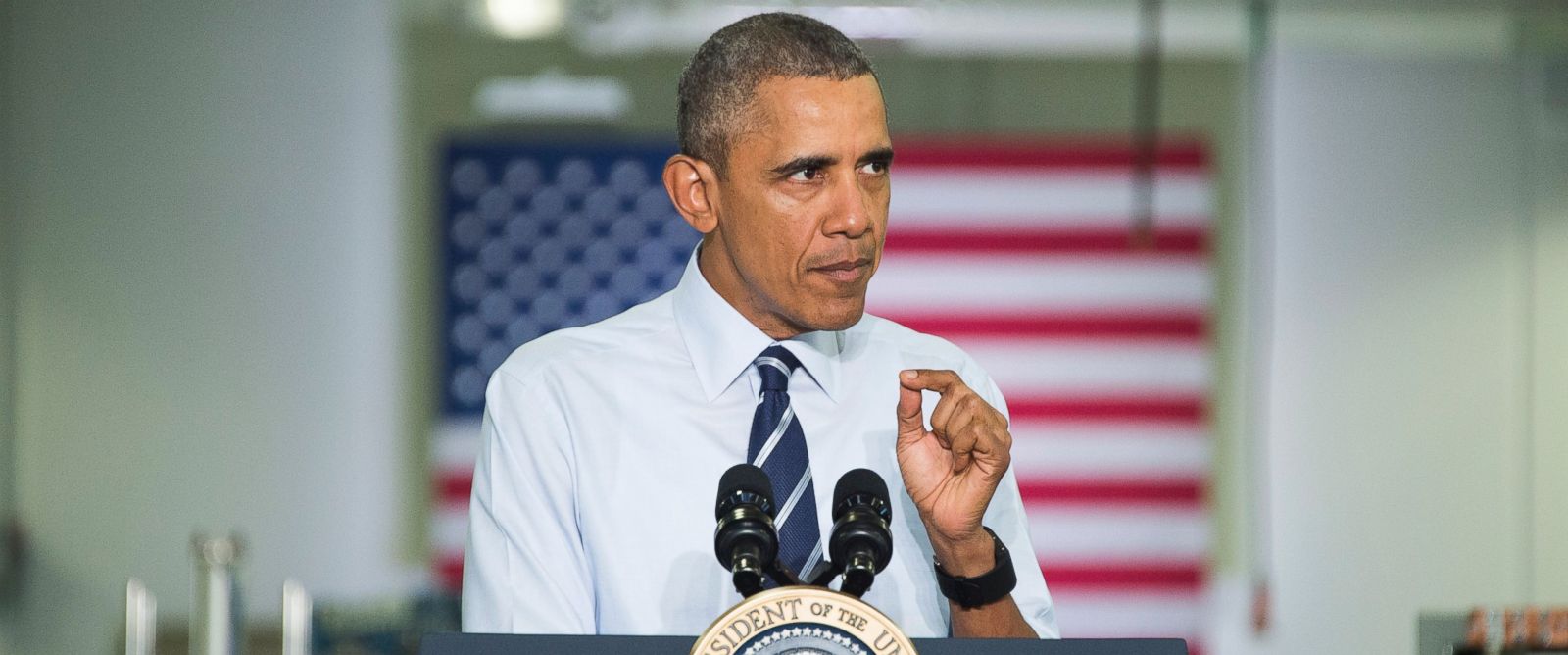
President Obama met President Raúl Castro today to discuss normalization, though the meeting revealed lingering tensions of a historic thaw, especially concerning the topic of humans rights. The two presidents engaged with reporters and with each other in the first meeting between the two governments in 88 years, including an awkward cross between a handshake and a revolutionary fist.

When asked about political prisoners, Castro had to say: “Give me a list of the political prisoners and I will release them immediately. Just mention the list. What political prisoners?” Humans rights groups quickly produced rosters of people who said they had been imprisoned for challenging the Cuban government and distributed them through social media. According to the Cuban Commission of Human Rights and National Reconciliation, 79 are still behind bars—40 of which are being held for peaceful protest. In response, however, Castro rebuked the United States for not providing universal health care, equal education, and equal pay; therefore, “it’s not right to ask...about political prisoners.” In response to a second question concerning humans rights, Castro added, “How many countries comply with all 61 human rights? Do you know? I do. None. None.”

Obama also assured Castro that the United States had no intentions to dictate Cuba’s future: “I affirm that Cuba’s destiny will not be decided by the United States or any other nation. Cuba is sovereign and rightly has great pride, and the future of Cuba will be decided by Cubans, not by anybody else.” Though Obama did not respond to Castro’s demands for Guantanamo to be returned to Cuba, he was optimistic about the end of the embargo: “The embargo’s going to end. When, I can’t be entirely sure.” He also said that direct flights to Cuba would begin this year, and regular tourism could happen very soon.

Castro summarized the significance of the meeting and expressed hope for continuing improving relations with the United States: “We agree that a long and complex path still lies ahead. What is most important is that we have started taking the first steps to build a new type of relationship, one that has never existed between Cuba and the United States.

Though this historic meeting perhaps marks the end of over 80 years of tension, lingering sentiments revealed impediments to the end of the thaw. It seems that both leaders are taking steps to end the decades-long conflict, but it may still be awhile before total normalization, especially concerning humans rights issues and Gitmo.

(Interesting Side-Comment: When a reporter asked Castro if he favored the election of Trump or Clinton, Castro simply smiled and said, “I cannot vote in the United States.”)

Questions:

To what extent can we trust Castro’s promise to release political prisoners, given his reluctance to address the issue?

What if the U.S. and Cuba cannot come to agreement on issues of human rights? Then what?

Sources:

http://www.nytimes.com/2016/03/22/world/americas/obama-and-raul-castro-to-meet-in-pivotal-moment-for-us-cuba-thaw.html


http://www.reuters.com/article/us-usa-cuba-castro-idUSKCN0WN0HQ

Apple's Help Unneeded to Unlock San Bernardino shooter's phone?

                                        
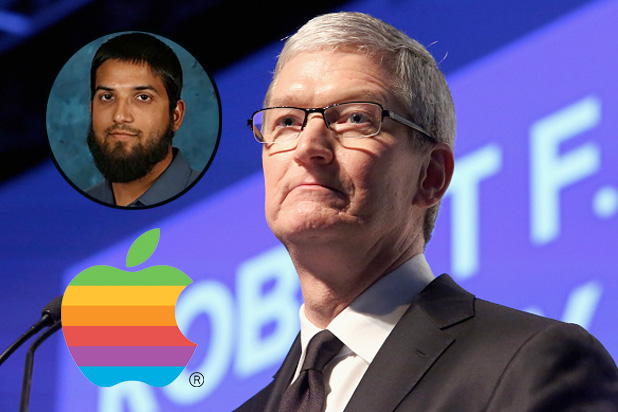
On December 2nd, two terrorists opened fire on people attending a holiday party at the Inland Regional Center in San Bernardino killing 14 and injuring 22. The married couple had met online and planned the massacre in their townhouse in Redlands. The two were killed in a shootout with police and husband Syed Rizwans cellphone has been a major piece of evidence that the FBI has been trying to gain full access to ever since. Apple has denied to help the FBI in cracking the phone stating privacy concerns and major controversy has spurred over whether or not Apple should comply.

 Last month, Apple was given a court order to lower security on the Iphone so that the FBI could gain access and Apple has been very strong in their stance that they will not offer any assistance. The court hearing between the two was planned to be held in Riverside on the 22nd of this month but just today the FBI announced that a third party may potentially be able to lower security and that Apple's help may not be a necessity. The hearing has been postponed and the department of Justice will report an update on its progress by April 5th.

If another party has the potential of doing what Apple will not comply to, should Apple just agree to help and save the FBI some time? Do you agree that helping the FBI would be seen by many as an act of invasion of privacy?

Sources: http://www.theguardian.com/technology/2016/mar/21/fbi-apple-court-hearing-postpone-unlock-terrorist-iphone

http://www.nytimes.com/2016/03/22/technology/apple-fbi-hearing-unlock-iphone.html


Sunday, March 20, 2016

Trump Faults Protesters Over Violence


(Photo obtained from the New York Times, taken by the Associated Press)

On Saturday, dozens of protesters blocked traffic near a Donald Trump event in Arizona. Three protesters were arrested and two cars were towed. Maricopa County Sheriff’s Office Deputy Joaquin Enriquez stressed that the arrests were for blocking the road, not for protesting. Regarding the blockage, Trump stated, “I think it’s really unfair that these, really, in many cases professional, in many cases sick, protestors can put cars in a road blocking thousands of great Americans from coming to a speech, and nobody says anything about that. It’s a very unfair double standard.”

The rally was also marked by violence, including one of the most violent confrontations at a Trump appearance. 32-year-old Tony Pettway was caught on video punching and kicking a protester and charged with assault and injury. The incident took place when an anti-Trump protester wearing an American flag shirt and holding a sign that read “Trump is Bad for America” was being escorted out of the rally.

In response to the incident, Trump refused to condemn the assault, claiming that the victim had been accompanied by another protester provocatively wearing a KKK costume: “There's a disgusting guy, puts on a Ku Klux Klan hat on, he thinks he is cute -- he's a disgusting guy, These are not good people, folks. They're throwing the flag all over the place... And they're not really protesters, they're agitators.”

Other Republican leaders, however, including Senator Mitch McConnell suggested that Trump should do more to calm his crowds. Republican national chairman Reince Priebus said it was a mistake for the campaign staff to get involved with the violence: “As far as everyone getting involved in the crowds, leave it to the professionals.” McConnell added, “I think all the candidates for president ought to be discouraging that kind of activity because the people in the audience tend to listen to those who are speaking. We ought to condemn this kind of violence and encourage the American people to engage in this political debate in a respectful way.”

So who’s to blame here? On one hand, perhaps Trump’s argument that the protesters should not have been blocking the road holds some merit. Regarding the violence, however, were the protesters being excessively provocative? To what extent should Trump be held responsible for the actions of his followers?

Sources:
http://www.cnn.com/2016/03/19/politics/donald-trump-arizona-joe-arpaio/

http://www.nytimes.com/politics/first-draft/2016/03/20/donald-trump-faults-protesters-over-violence-not-their-assailants/?rref=collection%2Fsectioncollection%2Fus

http://abcnews.go.com/US/anti-donald-trump-protester-punched-kicked-tucson-rally/story?id=37787313

Saturday, March 19, 2016

Anti-Vac Parents on Trial After Child Dies of Meningitis


“They are a poor excuse as parents.”
“QUIT SMILING.”
“Baby killers!”
These were just some of the comments left under the photos of David and Collet Stephan after the Canadian government opened its trial against the couple, charging them of failing to provide the necessities of life to their 19-month-old-son Ezekiel leading to his death on March 18, 2012.

From The Washington Post:
“According to prosecutors, David and Collet stubbornly refused to take their sick son to see a doctor, instead giving him home remedies such as smoothies containing hot pepper, ginger root, horseradish, onion and apple cider vinegar. Even after warnings from a family friend who is a nurse, the anti-vaccine couple took him to a naturopath for echinacea — an herb believed to stimulate the immune system — instead of to a doctor for an exam.

It was only when Ezekiel began to have trouble breathing that they rushed him to a hospital, prosecutors said.

By then, it was too late.

Ezekiel died from bacterial meningitis and empyema, two conditions routinely cured with antibiotics, a medical examiner told the court last week, according to the Lethbridge Herald.

If convicted, the parents could spend up to five years in prison.”

This case is but one example of the recent resurgence in vaccination debates, making a case for vaccination and modern medicine. In a poll conducted by the Pew Research Center, 83% of adults say the measles vaccine is safe for healthy children, while only 9% think it is unsafe. What is your opinion on this issue in the United States? To what extent can the free speech and exercise clause be upheld in the face of national health and security?  Should vaccines be compulsory? 

Wednesday, March 16, 2016

Obama Nominates Merrick Garland for Supreme Court


(Photo obtained from Politico, taken by the Associated Press)


President Obama announced today his nomination of Merrick B. Garland to fill the vacancy on the court, someone he believes is “widely recognized not only as one of America’s sharpest legal minds, but someone who brings to his work a spirit of decency, modesty, integrity, even-handedness and excellence.”

To provide some background, Garland has served as a federal appeals judge for the DC Circuit since 1997, a court that is widely viewed as the second-most powerful following the Supreme Court. His other qualifications include graduating with high honors from Harvard Law School, clerking for Justice William Brennan, and holding senior positions in the Justice Department. His age also makes him an ideal Obama nominee: at age 63, Garland is the oldest person nominated to the Supreme Court since Nixon’s nomination of Justice Lewis Powell in 1971.

Following the death of former Justice Antonin Scalia last month, there was considerable discussion about whether the vacancy would be filled before the end of Obama’s presidency. President Obama hoped that his nomination would be seen as a compromise: “I simply ask Republicans in the Senate to give him a fair hearing, and then an up-or-down vote. If you don’t, then it will not only be an abdication of the Senate’s constitutional duty, it will indicate a process for nominating and confirming judges that is beyond repair.”

Despite potentially disappointing from members of the Democratic Party who hope that a strictly liberal candidate would fill the ninth seat, Obama’s choice of Garland, “a well-known moderate who has drawn support over decades,” is definitely a politically strategic move. By nominating a unquestionably qualified moderate instead of a liberal, President Obama essentially dared the Republicans to obstruct the nomination process—and they did.

Senate Majority Leader Mitch McConnell stated later in the day that the Senate would not consider Garland’s nomination, that it would be unnecessary to act further on this nomination, and that the Senate would revisit the matter when it considers the qualifications of the next nominee.

Adding to the awkwardness of the situation, senators in the Republican Party have praised Garland in the past. For example. in 1997, Utah Senator Orrin Hatch supported Garland’s nomination to the DC Court of Appeals, saying

“Merrick B. Garland is highly qualified to sit on the D.C. circuit. His intelligence and his scholarship cannot be question… His legal experience is equally impressive… Accordingly, I believe Mr. Garland is a fine nominee. I know him personally, I know of his integrity, I know of his legal ability, I know of his honesty, I know of his acumen, and he belongs on the court. I believe he is not only a fine nominee, but is as good as Republicans can expect from this administration. In fact, I would place him at the top of the list.”

All of this ties back into the political factors which influence the nomination process of the Supreme Court. Garland indisputably meets the legal qualifications for nomination; however, obstructionist politics have prevented perhaps one of the most reasonable nominees the Republicans could have hoped for. Looking back at vacancies in the Supreme Court during election years in the past, it is definitely not standard practice to leave a seat open until after the election. As to whether or not that happens, we’ll just have to wait and see.


Questions:
Should a vacancy on the Court be a consideration for voters during an election year?

What do you think about McConnell’s response? Is it justified?


Sources:

Tuesday, March 15, 2016

Mother Teresa to be Declared Saint


Pope Francis announced today his plan to canonize Mother Theresa as a saint on September 4, the eve of the anniversary of her death on September 5, 1997. In most cases, two miracles are required to be considered a saint. Pope Francis declared in December 2015 that he would declare her a saint after recognizing her second miracle: the healing of a Brazilian man with multiple brain tumors after loved ones prayed to Mother Teresa. The first miracle, the reportedly inexplicable curing of a woman’s stomach tumor after praying to Mother Teresa, and she was beatified in 2003 by Pope John II after he waived a customary five-year wait period after her death in 1997.


In the Catholic religion, saints are believed to be people who have already entered heaven; canonized saints, those who are declared saints by the church after death, are prayed to and revered as model humans to be imitated. Mother Teresa spent most of her life working with the poor in India, founding the Missionaries of Charity in 1950 to care for “all those people who feel unwanted, unloved, uncared-for throughout society, people that have become a burden to the society and are shunned by everyone,” she said in her acceptance speech for the Nobel Peace Prize in 1979. Being canonized a saint? Seems like a no-brainer—unfortunately, it’s not that simple.


Mother Teresa has always been a subject of controversy, and critics attempt to bring to light Mother Teresa’s less saint-like actions. According to Huffington Post Associate Editor Krithika Varagur,


“She was no saint. To canonize Mother Teresa would be to seal the lid on her problematic legacy, which includes forced conversion, questionable relations with dictators, gross mismanagement, and actually, pretty bad medical care. Worst of all, she was the quintessential white person expending her charity on the third world -- the entire reason for her public image, and the source of immeasurable scarring to the postcolonial psyche of India and its diaspora.”


Varagur supports this idea, citing a 2013 study from the University of Ottawa, which revealed among its findings that Mother Teresa's missions provided inadequate medical care and of her conception of suffering and death: “There is something beautiful in seeing the poor accept their lot, to suffer it like Christ’s passion. The world gains much from their suffering.” To some, Mother Teresa is not a holy figure but rather a symbol of Western supremacy and resembles the idea of the”White Man’s Burden” during the late nineteenth century.


In matters regarding religion, it is important to respect others’ beliefs, but what do you think? To outsiders, canonizing Mother Teresa just seems like a smart PR move by the Catholic church, but to others this decision holds far more meaning. Given the controversy surrounding Mother Teresa’s actions in life, do you think she should be considered a saint? How might this decision affect the United States' relationship with the Pope and the Catholic Church?


Sources:


http://www.cnn.com/2016/03/15/europe/pope-mother-teresa-becomes-saint-september-4/index.hml

http://www.cnn.com/2015/12/18/europe/pope-francis-mother-teresa-second-miracle/index.html

http://www.nytimes.com/2016/03/16/world/europe/pope-mother-teresa-saint.html

http://catholicism.about.com/od/thesaints/f/What_Is_A_Saint.htm

http://www.huffingtonpost.com/krithika-varagur/mother-teresa-was-no-saint_b_9470988.html

Sunday, March 6, 2016

North Korean Threatens Nuclear Strike

North Korea has responded to the joint U.S. -South Korean military exercises by threatening a nuclear strike. However, is was expected for North Korea to react this way, as they have shown their ability, or their thoughts on the world perspective of politics. For example, they have tested missiles on February 8, 2016, which they have publicly announced to be a hydrogen bomb (3). Not to mention, they have also sunk the South Korean warship Cheonan on March 26, 2010, with no public apology (4).

Currently, the status of weapons of mass destruction in North Korea is not known to a specific enough for there to be large public arousal. Over and over again, tensions between North Korea and the UN/South Korea have been gradually increasing. However, between the magnitudes of the missiles tested in 2013 and 2016, it seems that has stayed around the same.

As of now, US and South Korean militaries will be working on “two exercises 'Key Resolve' and 'Foal Eagle,' which will run until April 30.” (2).

I feel that the global community does not need to take a more active stance in regards to North Korean foreign policy. Yes, they have tested missiles and nullified truces and negotiations, but in the grand scheme of things, they have not done widespread damage such as set of a series of terrorist attacks in America.

Does imposing more sanctions cause North Korea to act more rebellious?


What do you think about what the global community should do in regards to North Korea foreign policy?

Sources:
1 http://www.bbc.com/news/world-asia-21710644
3 http://www.theatlantic.com/international/archive/2016/02/north-korea-h-bomb-missile-test/462240/
5 http://www.bbc.com/news/world-asia-pacific-11813699

Tuesday, March 1, 2016

KFC Hires, Fires, then Re-hires a Transgender Woman

Vocabulary
Transgender woman: someone who identifies as a woman, but was born with characteristics of a different gender.

In Richmond, Virginia, Georgia Carter applied for a job at the local KFC. She was hired, but then management saw her (government-issued) ID, which read "male." When questioned, she said, "I'm transgender." She was then fired; she says the management cited the difficulty of not knowing "which bathroom [she could] use."

But the story has a happy ending (for social liberals)! This morning (March 1, 2016), KFC tweeted that the manager had been "terminated" and that "Ms. Carter was offered a job at any Richmond KFC," and a representative later confirmed that the treatment of Carter clashed with their policy of anti-discrimination, which covers gender identity and sexual orientation.

To what extent is having such a huge, international franchise take such a public, pro-transgender rights action a big step forward for transgender rights? The Huffington Post article cites The National Center for Transgender Equality with this statistic: "more than one in four transgender people have lost a job due to bias, and more than three-fourths have experienced some form of workplace discrimination."

It's worth noting that, in 2014 (and now, too, according to this article by equalityvirginia.org),  changing one's official female/male gender identity in Virginia required filing with the court, getting the signed order, getting a doctor's signature, changing information with Social Security, getting a new ID from the DMV, and, finally, changing all your official information with anyone of importance, like schools, banks, etc. The entire process can cost up to over 200 dollars, which is no small amount, especially for someone like Georgia Carter, who is applying for a job at KFC.

So, is transgender discrimination even worse for low-income people? Should Carter still have switched her government-issued ID? What measures could expedite this process? Also, consider the costs and benefits. Even beyond the $200, there's the time needed to make an appointment with the DMV or wait in line, the possible monetary and time cost of seeing one's doctor if one does not have insurance or even being unable to find a sufficiently sympathetic doctor, filing fees...the list goes on.

Finally–should the push for transgender rights be coming from mostly quarters like the government or interest groups/activists, or is it good for big companies to get involved, too? Consider KFC's possible motivations for addressing the problem (and the manner in which they did it).

Sources:
http://www.huffingtonpost.com/entry/kfc-fire-hires-trans-woman_us_56d5bec7e4b0bf0dab336fbe
http://www.themarysue.com/trans-woman-vs-kfc/
http://www.dmv.state.va.us/webdoc/pdf/dl17.pdf
https://www.whitman-walker.org/wp-content/uploads/2015/02/VA-Name-and-Gender-Change-Guide-July-2014.pdf

Monday, February 29, 2016

Donald Trump and White Supremacists


I'm sure this isn't exactly "news" to anyone reading this post–I mean, hello, "[Mexicans are] rapists?' Or how about the claim that there were Muslims in New Jersey cheering on 9/11? Regardless of if you think these comments were for publicity and are thus harmless or if you think they're deeply, troublingly, problematic no matter their reason, there's no denying that these comments will attract the support of...certain groups. 


Racist groups. White supremacists. The KKK. (In fact, he's been endorsed by a KKK biggie, Mr. David Duke, and another biggie white supremacist, Jared Taylor, who, up to this point, has never supported a presidential candidate.)


Of course, you can't help who you attract...right? But consider this–after David Duke endorsed him, Trump refused to condemn the KKK or David Duke, responding to an interviewer's inquiry of his reaction with a couple of beats around the bush. And, as John Oliver put it, at some point, there's no difference between pretending to be a racist, such as for publicity reasons, and being a racist.


So, assuming that Trump is not as offensive as this author thinks he is, and this whole thing is a publicity stunt...what would the consequences be of him becoming president? How could he change the political landscape–could he cause a realignment, a split of the Republican party? And what does his popularity indicate about Americans and their awareness of or sensitivity to race-related issues?


(Sorry that you have to see this guy's name on a headline for the gajillionth time.)


Sources: 
https://www.youtube.com/watch?v=DnpO_RTSNmQ
https://www.washingtonpost.com/news/fact-checker/wp/2015/07/08/donald-trumps-false-comments-connecting-mexican-immigrants-and-crime/
http://www.nytimes.com/2016/03/01/us/politics/donald-trump-supremacists.html

Cyber Hackers Accessed Over 700,000 Taxpayer Accounts


The IRS (Internal Revenue Service) announced on Friday that around 724,000 taxpayers' sensitive personal information was stolen in a cyber hack last year.  This new estimate is more than double the agency's previous estimate.  The IRS hack was first discovered last May and the IRS originally stated that 114,000 people's personal information had been breached in the hack.  However, in August, the IRS raised its count to as many as 334,000 (Fortune).

It is believed that these hackers were able to access people's personal information through a "get transcript" feature on the agency's website that has since been disabled.  Earlier this month, the IRS detected unauthorized efforts to gain access to more than 450,000 Social Security numbers and around 101,000 of those efforts were successful (US).

According to Rep. Jason Chaffetz, R-Utah, chairman of the House Committee on Oversight and Government Operations, "The IRS doesn't have its house in order at any level" (US).

What do you think? What possible measures could be taken against these cyber hackers? Would IRS protection be better if we entrusted it to private businesses?

http://www.foxnews.com/politics/2016/02/27/irs-cyber-hackers-got-info-on-roughly-7k-taxpayers-double-earlier-estimate.html
http://fortune.com/2016/02/26/irs-cyber-attack-hack/
http://www.usatoday.com/story/money/2016/02/26/cyber-hack-gained-access-more-than-700000-irs-accounts/80992822/

Sunday, February 28, 2016

A Generational Divide: Feminism and the Democratic Race

Note: Okay, before anyone gets angry, for the purposes of this post (and really, in real life too, but let's not have that argument here): Feminism, definition (according to Dictionary.com): the doctrine advocating social, political, and all other rights of women equal to those of men. Discard the "feminazi" or "angry feminist" connotations you may be used to, at least while you're considering the below. Thank you.

Madeline Albright, the first female Secretary of State and the highest-ranking U.S. female government official at the time of her appointment:
"There's a special place in hell for women who don't help other women." 
Yay, feminism! Equality! ...Right?

But when it was discovered that young (white) women, along with most other younger voters, tend to gravitate to Sanders over Hillary, that quote took on a slightly different meaning. Albright repeated the quote at a Clinton campaign event, evidently insinuating that women who don't support Clinton are horrible people/feminists. Gloria Steinem, feminist icon, also had something to say on the subject:
"...when you're young, you're thinking, 'Where are the boys?' The boys are with Bernie."
Ah, yes, of course. As the great opponents of women's suffrage thought, women vote for candidates for reasons of attraction and romance. Thank you, Steinem. (She later sort of apologized, saying she'd been misrepresented and hadn't meant to say that young women aren't serious about politics.)

But maybe feminists should be supporting Clinton. Maybe, rather than possibly undermining a serious milestone for women's rights and years upon decades of hard work, young women should throw their weight behind Clinton and make her the Democratic nominee, and maybe even President.

Should feminists be supporting Clinton over Sanders?  Does Albright have a point, or should we be waiting for Ms. Right, not Ms. Right Now? (credit for the cleverness goes to Kathleen Graves, who founded the "Babes for Bernie" Instagram account. No, it's horribly objectifying.)

And, y'know...is Clinton better for feminism?


Sources:
https://www.goodreads.com/quotes/14328-there-is-a-special-place-in-hell-for-women-who
http://www.cnn.com/2016/02/06/politics/gloria-steinem-hillary-clinton-bernie-sanders-boys/
http://www.cnn.com/2016/02/07/politics/gloria-steinem-sanders-maher/
https://www.washingtonpost.com/news/the-fix/wp/2016/02/08/nobody-involved-in-the-madeleine-albright-gloria-steinem-hillary-clinton-flap-has-much-to-be-proud-of/
http://www.huffingtonpost.com/brian-hanley/young-women-prefer-sander_b_9182756.html

Homeless Holdouts Remain Despite City Order


Several homeless holdouts continue to defy San Francisco's expired order to move out from under the Central Freeway.  On Tuesday night, the city's health department gave homeless residents living along Division and 13th streets under the freeway a notice of 72 hours to move out after they declared those streets a health hazard and a bane to nearby residents and businesses.  At its height, around 140 tents populated the area (ABC).  Many city outreach workers went from tent to tent to offer their resources and to persuade campers to leave the area (SF).

Once Friday came, many people moved away from under the freeway and moved to less crowded streets, while others moved to the city's new shelter at Pier 80.  However, many campers still remain in the area and resists the city's orders to leave.  San Francisco has had a long standing issue housing its homeless but it seems that tensions have worsened due to the shortages of affordable housing in the midst of a tech-based job boom (ABC).

Police have not been needed to forcibly remove anyone out.  It is unclear what city officials will do with the remaining campers who refuse the order.

What do you think? Could city officials have handled this issue in a better way? What should city officials do with the remaining campers? How should the issue of homelessness in SF be approached?

http://www.sfgate.com/bayarea/article/Holdouts-remain-at-SF-homeless-encampment-despite-6859482.php
http://abcnews.go.com/US/wireStory/deadline-looms-homeless-san-francisco-tent-city-37233384

Alabama Opposes Birmingham’s Raise in Minimum Wage


Earlier this month, Birmingham became the first city southern city to approve a local minimum wage. Their approved local minimum wage is $10.10, more than the national minimum wage of $7.25. However, this decision has caused more tension than excitement.

In response to Birmingham’s minimum wage increase, the Alabama Legislature met to discuss how to oppose this raise. The state is now planning to pass a bill that would prevent cities from setting their own minimum wage.

The intended purpose of Alabama’s bill is to keep the minimum wage consistent throughout the state, but some believe it is because the state doesn’t really care about its citizens.

Birmingham’s predominantly liberal inhabitants are still trying to fight to pass their $10.10 minimum wage, but some feel that the city will ultimately lose and be restricted by the state’s conservative Legislature.

Questions:
Do you think states have the power to control a city’s minimum wage?
Should the federal government intervene in this dispute?

Source:

Obama Calls for More Concern About Mass Shootings


Less than a week after six people were killed in the Kalamazoo shootings, three more people were killed and fourteen injured in Hesston, Kansas.

President Obama addressed the Kansas shooting in Jacksonville, Florida, requesting that the media cover incidents of mass shootings as a means of bringing more awareness to these kinds of issues.  He stated, "Once a week we have these shootings, and it doesn't dominate the news. And that's got to change... We cannot become numb to this. As long as I hold this office I'm going to keep on bringing this up, even if it's not getting the attention that it should" (USA).

Obama plans to speak out on every mass shooting event and pledges to "politicize" the issue until Congress passes gun control legislation (USA).

Within hours of the Kansas shooting, another mass shooting occurred in Mason County, Washington where four people were killed.  In 2016, there have been 50 mass shootings.

With mass shootings occurring almost every week, has the public become indifferent or "numb" to these events? Will more media coverage help shape mass shootings as a priority issue? When will stronger gun regulation be enforced?

http://www.usatoday.com/story/news/politics/2016/02/26/obama-mass-shootings-should-dominate-news/80995514/
http://abcnews.go.com/Politics/obama-decries-deadly-kansas-shooting-numb/story?id=37228183

Canada considers alternatives to current FPTP voting system


The Democratic Institutions Minister of Canada, Maryan Monsef, recently started the discussion of changing Canada's voting system from first past the post to something different. She specifically said "a mature democracy like Canada can do better" (CBCNews 1).

She stated that the primary goal of the change would be to improve voter turnout in elections.

Prime Minister Justin Trudeau originally brought up the idea, saying that he wanted the last election would be the last FPTP vote Canada would have. One of the main concerns about the current system is that the number of seats that a party wins in parliament is not very representative of the population (CBCNews 2).

Of course, the road to determining an effective voting is not very smooth. Like we studied in class, there is no such thing as a perfect voting system, and all have their flaws. However, the Canadian administration is looking into any and all alternative systems.

While no parties support specific voting systems, Conservatives say that this is a move by the Liberal Prime Minister to make sure the Liberals can win the election more often. They argue that a new system like the ranked ballot would appeal to Liberals because the Liberal party is more moderate, and would therefore earn more votes than the Conservative party would (CBCNews 2).

Trudeau chose Monsef to work on finding an ideal voting system because she apparently has no prior opinions on the issue (CBCNews 1).

Sources 3 and 4 are really good for reading about the different types of voting systems that the Parliament is considering.

While it may be difficult for Trudeau to achieve his goal to never have another FPTP election, I think it is definitely a worthwhile thing for Canada to try to do. I want to say that the US should try something similar, but I do not think that we necessarily need a complete change in the system to improve turnout. For Canada, even though  I think that a ranked ballot would be effective in achieving the purpose of improving voter turnout, considering the fact that many people do not vote because they feel like they are being forced to vote between two "electable" party candidates rather than who they really want to vote for.

If you read the articles about the different voting systems, which one do you think would work best in Canada?
Is it time for the US to switch voting systems as well? Why or why not?
Is it necessarily a bad thing if voting systems favor certain parties?

Sources:

1. http://www.cbc.ca/news/politics/monsef-electoral-reform-changes-referendum-1.3428593

2. http://www.cbc.ca/news/politics/justin-trudeau-electoral-reform-first-past-the-post-1.3292694

3. http://www.cbc.ca/news/politics/electoral-reform-which-party-would-benefit-most-1.2857321

4. http://www.metronews.ca/news/canada/2016/02/01/a-primer-on-alternatives-to-canada-s-first-past-the-post-electoral-system.html

Friday, February 26, 2016

Shooting in Kansas, Possibly Sparked by Protection Order

Regardless of whether you're for or against gun control, whether you believe the Second Amendment is unimpeachable or outdated, please join me in a moment of silence for the victims and wishing the fervent wish that this headline wasn't all-too-familiar.

On the night of February 25, 2016, the day before this posting, another shooting happened in Hesston, Kansas, a tiny town in central Kansas of 37,000 people. According to CNN, the shooter, Cedric Ford, killed three people and injured 14 more, some of them critically. So far, it appears that after Cedric Ford was served a restraining order to stay away from his ex-girlfriend, he proceeded to go on a shooting rampage, killing three people, stealing the last one's car, and then going to a lawn equipment manufacturer's building, where he proceeded to shoot 14 more people.

You guys have all heard the debate on gun control/gun rights before. We've heard about the Second Amendment, the effectiveness of gun control, "common sense" gun laws.

So here's my question: who do you think is responsible for stopping these tragedies before they happen? A common answer is the government (hence gun control). But is it possible that businesses should also take part in finding a way to regulate guns, running private background checks on their buyers? Or is gun control, as a concept, more of a public good, and thus impractical to expect a private enterprise to carry out?  Is it in a gun manufacturer's interest to make sure their guns do not go to people who have a higher likelihood of committing a crime? Move beyond only-profit considerations (although those could be accounted for morally), and also into moral considerations/behavioral economics.


Source(s): http://www.cnn.com/2016/02/26/us/kansas-shooting/

Oil prices "barreling" downwards


The price for a barrel of oil recently reached its lowest point since 2004. The decline started in June 2014, and has led to oil companies yielding significantly lower profits. This caused a notable scaling-down in the oil industry, with hundreds of thousands of workers unemployed and several companies going bankrupt (New York Times).

One explanation for this is that the competition for oil exporters has increased, causing producers to lower prices to stay competitive. Previously, Middle Eastern countries used to dominate the oil industry. However, Canada and Asian countries have started distributing oil, forcing the price down as well. Also, the demand is falling due to the increasing prevalence of electric cars and hybrids (New York Times).

Despite the fact that oil prices have been dropping for so long, some investors are still optimistic that the prices will rise once again when production catches up with the decreased demand. However, this is risky because the countries that are newer to the oil industry are showing few signs of scaling down and reducing production (The Week and New York Times).

I think that it will take quite some time for oil to start increasing in value again. Considering that there has been overproduction since 2014, I do not see it re balancing any time soon. Looking at the supply and demand graphs from the second NYT article, it seems that there has not been a production imbalance that has lasted this long since 2000. The fact that it is taking so long for production to start matching demand could cause bigger issues in the future. However, some people might consider this to be good news since it means that people are becoming less dependent on fossil fuels.

Do you think that oil prices will go back up any time soon? Why or why not?
What do you think would happen if supply continued to increase faster than demand?
In the past, production only exceeded consumption for short periods at a time. How come the industry has stayed like this for so long now?

Sources:

http://www.nytimes.com/interactive/2016/business/energy-environment/oil-prices.html

http://www.nytimes.com/interactive/2016/business/energy-environment/oil-price-supply-demand-imblance.html

http://www.theweek.co.uk/oil-price/60838/oil-price-why-the-market-is-completely-out-of-whack/page/0/1

Thursday, February 25, 2016

U.S. Submits North Korean Sanctions Resolution to the U.N.


Earlier today, the U.S. submitted a resolution designed to tighten existing sanctions on North Korea to the United Nations Security Council.  The 22-page proposal was distributed to all 15 members of the council and is designed to upgrade the current sanctions against North Korea following the country's recent nuclear weapons test on January 6th and rocket launch on 7th.  In the past decade, North Korea has conducted four nuclear tests and launched six long-range missiles, which have all been in violation of U.N. Security Council resolutions. 

Some of the major points of the resolution included mandatory inspection for all cargo going in and out of the country, financial sanctions on North Korean banks/assets, limitations on exporting certain minerals and metals, and the prohibition of aviation fuel.  The resolution also entails a list of certain North Korean individuals and entities who would be subject to sanctions. 

Samantha Power, the U.S. ambassador to the U.N., stated, "These sanctions, if adopted, would send an unambiguous and unyielding message to the DPRK regime... There will be consequences for your actions, and we will work relentlessly and collectively to stop your nuclear program."  Power also specified that the resolution is targeted at punishing North Korea's elite rather than the North Korean people as "the North Korean people have suffered so much already under one of the most brutal regimes the world has ever known" (USA), 

This resolution, if adopted, could potentially be strongest set of U.N. sanctions imposed in more than two decades (CNN). The vote on the resolution could be decided as soon as this weekend.  

How effective do you think this sanction will be?  Will it deter North Korea from future launches or will North Korea continue to with their antics? Do you think more sanctions will be necessary in the future? 

http://www.usatoday.com/story/news/world/2016/02/25/un-ambassador-power-submit-n-korea-sanctions-resolution/80918668/
http://www.cnn.com/2016/02/25/world/un-north-korea-sanctions-resolution/

Landmark Case Against a Massachusetts Nursing Home


Scott Barrow, the man suing Brandon Woods nursing home.

Previously denied the right to take his case against a nursing home to court, Scott Barrow has been given his right to sue and his case will be heard in court next month.

Barrow wanted to sue the nursing home for not preventing his mother's death, despite staff having observed alarming hostility and warning signs from his mother's mentally ill roommate. The contract he signed contained an arbitration clause, so instead of taking his case to court, Barrow had to have it settled by a private arbitrator. In 2010, Barrow lost the case after the arbitrator ruled in favor of the nursing home.
     
By signing contracts with an arbitration clause, people surrender the right to bring a case to court (CANHR). Legal disputes between individuals and businesses must instead be settled in private with an arbitrator. Neither side is allowed to present evidence to the arbitrator.

     But in 2014 with the help of lawyers, a judge ruled in favor of Barrow and agreed with his lawyers that although he signed the contract for his mother, he did not have the authority to bind his mother to the contract. Meaning, Barrow's mother was not bound to the contract or it's arbitration clause.

Seven years after his mother's death, Barrow’s case against Brandon Woods will be heard in a Massachusetts state court. While the outcome of this case is yet to be determined, I would consider this a landmark case because Barrow was able to overcome the arbitration clause; prior to this case, judges often upheld the arbitration clause.

Questions:
Should Barrow have read the fine print of the contract better or is he truly the one at fault for his mother’s demise? Why or why not?
With the expanding use of the arbitration clause by different businesses, should the federal government outlaw arbitration in contracts?
Lastly, do you think businesses have the right to use arbitration, or does the clause infringe on people's rights to sue?

Sources:
http://adr.findlaw.com/arbitration/arbitration-rules-and-procedures.html
http://www.canhr.org/arbitration/

Wednesday, February 24, 2016

Comcast and AT&T Respond to the Dawning of Fast Internet (It's Still Not from Them)

No matter which of the huge Internet Service Provider (ISP) giants you give money to every month in order to be able to access the world's biggest database of cute animal photos, you've probably had problems with them. Speeds don't improve, and, worst of all, customer service sucks. 

However, a (relatively) brand new yet familiar player is coming on the scene: Google Fiber. Google Fiber uses fiber optics, or glass/plastic threads, to transmit data, as opposed to the metal wires that are used by most of the United States. The project boasts up to 1 gigabyte/second download speeds. For context, the national average is estimated by Google as being at around 10 megabytes/second. That's 1000 times slower.

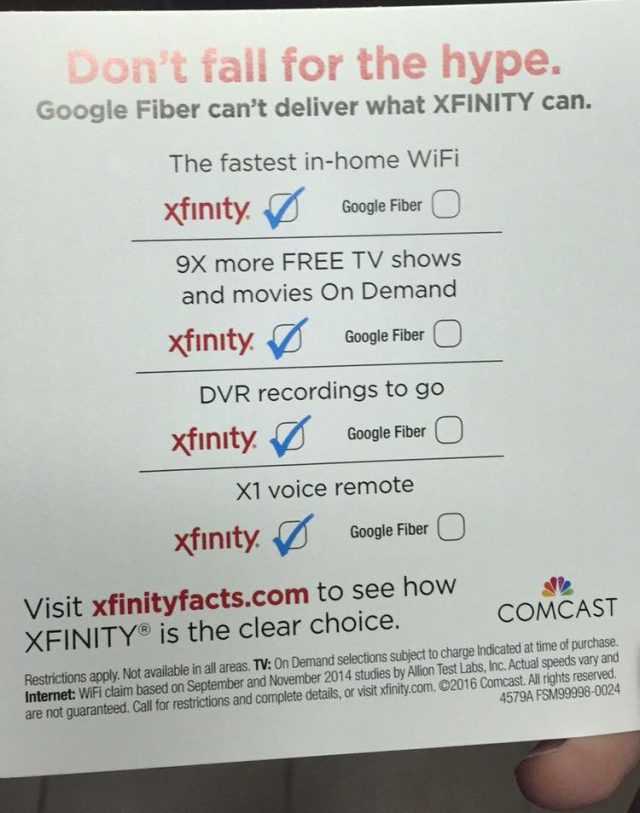
What's really interesting about this topic, though, is the reactions of Comcast and AT&T, neatly summarized in the picture below:

A letter from Comcast to citizens in Atlanta, Georgia,
where Google Fiber is being implemented. (source)
Also, in Huntsville, Alabama, where Google Fiber is also on its way to implementation, AT&T and Comcast have both promised (eventual) 1 GB/s speeds.

This seems like a classic case of the market correcting itself–these companies had a powerful hold over the industry that was leaving consumers frustrated with the product and the accompanying services, but a new, entrepreneur company has paved the way for better service everywhere, and now the big companies are trying to keep up.

But is it?

Keep in mind that not only have these companies have had their unspeakable power for a (relatively) painfully long while, the "entrepreneur"company is a well-established Silicon Valley giant.

So does this example serve the idea that the market corrects itself by way of the invisible hand, or does it decry a completely free market that allows such dominance of the few? What role should the government be taking? Also, what are the possible benefits and detriments of having a service like Google Fiber in your city? (It should be noted that Google Fiber is on its way to San Francisco).

Extra credit (not really): Propaganda–what do you think of its use here, not just by Google Fiber's opponents, but by Google Fiber itself?

Sources:
https://www.techdirt.com/articles/20160222/09101033670/google-fiber-expanding-faster-further-making-comcast-very-nervous.shtml
http://www.webopedia.com/TERM/F/fiber_optics.html
https://fiber.google.com/about/
http://www.al.com/news/huntsville/index.ssf/2016/02/what_do_att_and_comcast_have_t.html
http://arstechnica.com/business/2016/02/as-google-fiber-hits-atlanta-comcast-says-dont-fall-for-the-hype/


Disparity between the Wealthy and the Poor Continues to Grow


While the growing gap between high and low-income Americans is not new news, I would like to write about how Social Security plays into this gap.

New life-saving vaccinations and other medical advances in the past few decades have improved the health of many individuals. Obama’s health care plan has also helped improve public health by reducing the amount of Americans without health insurance. However, Americans are not benefiting from these advances equally. Those with higher incomes reap today’s benefits because they have the money to be able to access and afford it.

Aside from differences in health, income, and life expectancies, differing Social Security benefits are also contributing to this widening gap between the rich and the poor. Those with low-income jobs tend to retire earlier than the full retirement age (66 years old in 2015) while those with high-income jobs tend to retire at or later than the full retirement age (Brookings). A person’s Social Security benefits increase as they work for more years. Consequently, Americans who earn a high income tend to receive higher Social Security benefits than Americans with lower incomes. Unequal Social Security benefits maintain the disparity between high and low income workers.

As the US continues to experience more advances in technology and medicine, more and more low-income Americans are being left behind while high-income Americans enjoy longer lives and improved living conditions. For people born in 1960 or later, the retirement age will be pushed up to 67 years old for workers to earn the full benefits (National Academy...). Meaning this trend of low income, low benefits and high income, high benefits is likely to continue.

Questions:
Do you think the government should be doing more to provide welfare for those who need it? Why or why not?
Are there any other disparities between the wealthy and the poor?

Sources: