Monday, November 18, 2013

Rob Ford Continues to Lose Power


Toronto Sun
On November 18th, the Toronto city council motioned to decrease Toronto mayor Rob Ford's power.  Funds and power will be transferred to the deputy mayor.

In the past month, mayor Rob Ford, 44, has been exposed of buying and using crack cocaine.  Ford has also been accused of sexual harassment, using racial slurs, and drinking excessively.  

Ford is to remain in office due to Toronto's government system.  Unless Ford is convicted of criminal crimes, he will continue to be the mayor of Toronto, much to the chagrin of many citizens and government officials.

Sean Mallen/Global News

Many are frustrated with the mayor's conduct.  Citizens have expressed their discontent by drawing graffiti on a wall near the city hall. According to Councillor Denzil Minnan-Wong, Ford is "the worst spokesperson for the city of Toronto right now."


Ford admitted to smoking crack during his time as mayor earlier this month. Despite his scandal, he still has hopes of becoming prime minister.


Media has been especially critical of Ford's scandals.  It is undeniable he is unfit to be mayor of any city, however, has media gone too far?  It has been speculated that he is an alcoholic and has drug addiction. Personally, I feel embarrassed and bad for the mayor, he obviously has many issues, and I hope he finds professional help as soon as possible.  

As we have learned in the past few weeks, media has a big impact in politics.  It can help, and hurt, incumbents and candidates. In this case, do you think media has objectively presented facts, or merely attacked Ford?  And do you think that media is justified in what they're doing?

Article: http://www.bbc.co.uk/news/world-us-canada-24990650

Friday, November 15, 2013

Build Your Own Virus (Don't try this at home)

In my opinion, this is the scariest news I've read in a while: you can create your own virus.

The applications of new technology like 3D printers and DNA synthesizers are both incredible, and incredibly daunting. Already, 3D printing technology has advanced far enough that with freely available online blueprints, anyone with a 3D printer can print their own working gun. Airports security worries about all-plastic guns that may slide under their radar, since they don't even need to be made of metal.

Fears grow over 3-D printed guns


Even scarier: We've all heard about biological weapons, and perhaps read a book or seen a movie where disease is the villain's weapon of choice. Well now you can make your own virus. A DNA synthesizer costs about $3,000 on ebay, and the DNA sequences of thousands of animals, plants, bacteria, and–yes–viruses are available freely online. Add a package of nucleotides, and BAM. You can make a virus. In an effort to highlight the problem of allowing viral DNA sequences to be publicly online, a team from The Guardian sequenced a strain of smallpox–a disease eradicated from the population just 30 years ago (the article below).

Revealed: the lax laws that could allow assembly of deadly virus DNA

In this age of information, the government has a tough job maintaining what should be regulated and what should not be. Citing freedom of speech, scientists who sequence strains of any disease have the right to publish their findings. Yet if some of this information were to fall into the hand of (bio)terrorists, the effects on the world could be catastrophic. You might ask why a scientist would publish a viral sequence in the first place? Often times unaffiliated, independent researchers use such strains to find cures for the disease, or similar diseases.


There is a clearly a huge gap between the potential for good, and the potential for evil. There is also the issue of free speech vs. potential harm to Americans (and humans as a whole) for the government to consider. The bottom line:

Should the U.S. government censor the sequences of DNA available online?

(sorry it got so long. hopefully you were able to bear with me. this is important.)

Pope Francis vs. the Mafia

Pope Francis has already proven himself to be as progressive as a prominent Catholic leader can be. While he is not (and perhaps cannot be) in total support of gay marriage, pro-choice for women, gender equality in the clergy, and other liberal aims, he has shown himself to be much more accepting and tolerant to homosexuals, feminists, and even atheists than any pope preceding him.


Now he has turned his attention to the corruption within catholic institutions, most notably the organized crime by the mafia relating to the Vatican Bank. 


According to organized crime experts, Pope Francis' "crusade against corruption in the Catholic Church" has put him at odds with the mafia that control aspects of the Vatican Bank. The Catholic Church and Italian mafia have had "a long and complicated history... gangsters often paid for local church repairs or bankrolled feast day celebrations for Catholic saints... In exchange, Catholic officials kept silent about their illicit deeds."

I am rather shocked that such corruption has been allowed to continue for so long, especially in conjunction with such as supposedly righteous institution as the Catholic Church. Obviously, Pope Francis is right to expunge the bank of corruption, but are there other things to consider? Is ending generations of corruption worth the risk to his life? Consider from the point of view of, say, a Catholic homosexual, or an aspiring female clergy(wo?)man. Pope Francis may be their only chance in their lifetime to gain recognition from the Catholic Church, since they have been traditionally shunned (or worse). Is the risk still worth it?

Thursday, November 14, 2013

80 North Koreans Executed for Watching Foreign Films and Owning Bibles

In previous blog posts, we've debated about the U.S.'s role of being a sort of international policeman/watchdog figure. In the middle east, some commend the U.S's progress, while others criticize the U.S. for getting involved.


Now we hear about North Korea, where dozens of innocent civilians are being rounded up and publicly executed in front of thousands of other civilians for "crimes" like watching South Korean dramas and owning Christian bibles. Friends and family of the executed(/murdered) "criminals" are then taken to prison camps, further instilling fear in all North Koreans.


Clearly these killings are heinous and wrong by our standards. Morally, I feel that it is wrong to allow such killings to go on–for crimes like watching TV. Realistically, I believe the U.S. would be making a huge mistake to confront and even go to war with North Korea. What is your stance on the issue of involvement/non-involvement? What is the right balance between morals and reality? Is there a right balance?

Wednesday, November 13, 2013

The Dangers of Football


Football is a great, seemingly all-American sport. It promotes teamwork and physical fitness, and unites high schools behind a spirited but harmless rivalry.

Harmless? Apparently not. For the second time this year, a high school football player has died on the field as a result of head injuries:


Football has revealed itself to be one of the most dangerous major sports in America. Besides the broken bones (etc.) lasting trauma and damage to the brain have proven deadly for players. Concussions range in effects, from the extremes–like the unfortunate Charles Youvella (from the article above) who died just hours after his concussion–to more subtle but no less deadly effects, like Chronic Traumatic Encephelopathy which has been linked to depression and suicide in 4 NFL players
Approximately 120 American football players have died playing football in the past decade alone. By contrast, the last time a cross country runner, tennis player, badminton player, or swimmer died from his/her sport was, well, never.  

Football is engrained in American culture. But everything changes eventually. Should the youth in America make a concerted effort to shift our focus away from this needlessly harmful sport? Or is the contribution to our lives and culture enough to make up for the 12 Americans who die each year on the football field? I suppose the argument could be made that people die in everything–car crashes, earthquakes, war... yet the two high schoolers just buried might or might not change your perspective.

Enough about Obamacare already!

Okay, so we've probably all heard more than we ever wanted to about healthcare... but what does The Affordable Care Act (ACA) really mean? In case you need a clear, simplified explanation (like I did), there's a short video you can watch:

Obamacare seems to be losing support since the issue seems be be proving more divisive and fraught with issues than it's worth.


One of seemingly many problems: a significant number of Americans (especially those in lower income levels) may lose their current plans, if they're unable to afford the better (but more expensive) new plans. Even Democratic senator Richard Durbin urges Obama to be "open to constructive change," and some Democrats go so far as to say they might support a Republican proposal, if the problems with Obamacare can't be fixed.

Our class leans liberal/democratic. If you were in the position of a Democratic senator, what do you think would be the most reasonable solution? Would you cut your losses, so to speak, and support a Republican proposal to scale back Obamacare? Or do you think it's worth the risk to stay true to the original goal of Obamacare: affordable and comprehensive plans to cover ALL Americans?

Sunday, November 10, 2013

Typhoon Haiyan Leaves Estimated 10,000 Dead


Typhoon Haiyan struck the Philippines over the weekend with winds nearing 150 mph, destroying numerous villages and cities. Victims have provided chilling accounts of the storm and its devastating effects, with one visitor describing his surroundings as "World War III”:
“Everything was completely gone . . . A foot left of concrete around a building -- just a foot left of it, everything wiped out. Walking on debris and dead people two to three meters high; piles and piles … of dead people under the debris and some laid out on the sides, the ones they pulled out.
. . .
There were people – babies, children, old people -- laying out on the street, with blisters over their bodies from being dead. . . . Hundreds. Hundreds."
A local compared her town to a "World War II city," recalling her scenario:
"The hardest thing is ... seeing you mother floating in the flood and you don't know what to do. You just see there and the only thing is have to save yourself . . . . I could not save her because she drowned already, and it was not just water from the sea but mixed with dirty water — color black, like came from river and smell like canal."
President Obama and his wife conveyed that they were "deeply saddened'' by the catastrophe and that the U.S. would be providing aid to the Philippines. The U.S. military's Pacific Command is set to deploy aircraft and ships to help in search-and-rescue operations, and U.S. officials are encouraging those who want to help to donate money to humanitarian organizations.

Friday, November 8, 2013

CBS Apologizes for Erroneous '60 Minutes' Report on Benghazi


Following the discovery that Dylan Davies, the security contractor who provided an account of the attack on Benghazi last year to CBS, had given contradicting statements to his security firm and the FBI, CBS is set to broadcast an on-air correction on Sunday. Davies had claimed that he went to the Benghazi mission against orders from his superiors, and had even disabled an attacker at the mission. Davies' account of the Benghazi attack as conveyed to CBS was recently published in a book, The Embassy House, by a company owned by CBS. With this revelation, the publisher halted publication and recommended that bookstores remove the book from shelves as well. Additionally, Lara Logan, the correspondent who had given the report, issued an apology on CBS This Morning (the video above).

This is not the first time CBS has had to retract a 60 Minutes report; in 2004, it had apologized for questioning George W. Bush's service in the National Guard, the mistake resulting in several layoffs. I found a paragraph in an article on TIME about this issue interestingly similar to what we have been learning in class about the media and journalism:
"Whatever went on in this specific report, CBS’s wagons-circling response to reasonable criticisms was an example of an unfortunately familiar pattern in journalistic (and other screw-ups). Once someone stakes out a tough or controversial position, there’s a buy-in: from that point on, they’re conditioned to look for reasons to support a position they’re already invested in.
The fact that partisan groups are advancing a critique becomes reason to overlook the objective reasons for the critique. The fact that you’ve put in time and reporting resources–and don’t doubt that Logan and company worked as doggedly as they say they did–becomes reason to dismiss a source’s contradictory testimony. The story becomes the reason to defend the story (as do the consequences of admitting fault)."

Senate Bill on Bias Against Gays Receives Support


This past Thursday, a bill banning workplace discrimination based on gender identity and sexual orientation has found support in Mormons!  These unlikely supporters "have stepped in to provide the political muscle... and more often than not, [are] not just Mormons, but Republicans."  5 out of the 7 Mormons voted yes on this bill, and it passed with a majority of 64 to 32, with 10 Republicans joining.  Senator Orrin Hatch stated, "Religion should be respected, and so should people."

What happens after the apology?


Article
Yesterday, after Obama's apology regarding disappointments with Obamacare, the President has promised to fully address this issue, as well as the website flaws.  12 million Americans whose individual policies do not meet the requirements for "comprehensive care" are receiving cancellations notices.  This leads back to Obama unfortunately promising the country that they could keep their plans if they were satisfied with them.  In addition, "insurers cannot discriminate for preexisting conditions and must cover mental health, maternity care, and other areas," but it is seen that some other companies are withdrawing their care from states that have a lower amount of subscribers, in order to save money.  Based on how this is going now, do you think that our country's situation will turn out for the better?

Thursday, November 7, 2013

FDA Seeks to Ban Trans Fat


Earlier today, the U.S. Food and Drug Administration determined that partially hydrogenated oils can no longer be "generally recognized as safe," opening a 60-day consultation period "to collect additional data and to gain input on the time potentially needed for food manufacturers to reformulate products that currently contain artificial trans fat should this determination be finalized." Partially hydrogenated oils are commonly found in processed foods such as desserts, frozen food, and microwave popcorn in the form of trans fat; as a study from the U.S. Centers for Disease Control and Prevention determined that "[a]voiding foods containing artificially produced trans fat could prevent 10,000 to 20,000 heart attacks and 3,000 to 7,000 coronary heart disease deaths each year," the ban would label partially hydrogenated oils as additives, thus requiring approval for them to be used in food. Areas such as California and New York City have already banned the use of trans fat in restaurants, while McDonald's and other restaurants have already stopped using it in their food items. The ban would not apply to trans fat that is naturally found in meat and dairy products.

Personally, upon reading about the proposed ban, I was a bit skeptical. I don't know much about trans fat and the research that links the consumption of trans fat with an increased risk of heart disease, but I feel that the ban on trans fat doesn't necessarily improve circumstances: in the absence of partially hydrogenated oils, fast food chains and food manufacturers will turn to (or have already turned to) other sources of oil that are likely to present undesirable health risks as well. But then again, this may be an instance of choosing the option that presents the lesser evil.

What do you think - is this a step in the right direction? Even though the proposal may be imperfect, does its merits outweigh its shortcomings?

http://www.cnn.com/video/data/2.0/video/health/2013/11/07/exp-cohen-fda-to-ban-trans-fat.cnn.html  [video]
http://www.nytimes.com/2013/11/08/health/fda-trans-fats.html?pagewanted=1&_r=1


Obama on Insurance Cancellations


Article

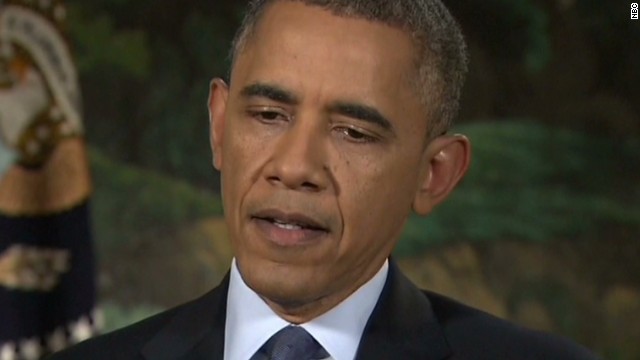
Today, President Obama has apologized for the insurance cancellations that were caused by Obamacare.  He states in an exclusive NBC interview, "I am sorry that they are finding themselves in this situation based on assurances they got from me."  Republicans have nailed Obama on this point, and the Democrats have voiced their concerns as well, as over 48 million Americans do not have any coverage whatsoever.  House Speaker John Boehner claims that if the is truly sorry for misleading the American people, and that his apology does not mean anything unless he supports this bipartisan effort to come up with a new health plan.  Do you think that his apology means something regardless of what he does and does not support?  Or do you agree with Boehner?

Wednesday, November 6, 2013

Church-State Dispute Over Public Prayers

Article

Recently, in New York, two women have claimed that the public prayers at a New York town's board meetings are "overwhelmingly Christian in nature."  It is obviously very difficult to construct a prayer that touches base with every religion, but I do feel like this prayer is a tradition, and it isn't as if the Supreme Court is blatantly disrespecting other religions.  To minimize this issue, I believe that they should make the prayer as generic as possible, so as to not anger any other religious institutions.  What do you think?

Tuesday, November 5, 2013

More on Obamacare

"What went wrong with HealthCare.gov"


I know we've heard a lot about Obamacare already, but I found this Washington Post story interesting as it focused more on what went on behind the scenes leading up to unveiling of HealthCare.gov, including the institutional and technical challenges those assigned with carrying out Obamacare's implementation faced. The article reasons that "the project was hampered by the White House’s political sensitivity to Republican hatred of the law — sensitivity so intense that the president’s aides ordered that some work be slowed down or remain secret for fear of feeding the opposition." It further alludes to the fragmentation of work and the inadequacies of the team put to the task.

On the other hand, James Taranto asserts in the Wall Street Journal, "The story Goldstein and Eilperin* tell is one not of GOP sabotage but of Obama administration self-sabotage. The geniuses who were sure they were capable of running the entire medical industry were so unnerved by the prospect of political opposition that at every stage of the way they undermined the president's own signature "achievement."" Although Taranto's right-wing leaning is made clear through this assertion and the rest of his response to the Washington Post story, I do agree somewhat that the shortcomings of Obamacare we have witnessed so far may be rightfully attributed in part to the Obama administration's underestimation of the difficulties that would arise in implementing it. What are your thoughts?

*the Washington Post article link I first provided

It's Election Day! Governor Christie wins the re-election in NJ.


Article

Republican Governor Chris Christie has won the re-election in New Jersey.  As the incumbent, he took 58.6% of the votes in the heavily democratic state.  The article mentions that the only other republican to win over 50% of the votes since George H. W. Bush in 1988.  Throughout his campaign, Governor Christie stressed that he likes compromise.  In all honesty though, Governor Christie obviously knew that if he should win in the more democratic states, he couldn't take on a conservative republican stance.  What else do you think contributed to his big win?

Monday, November 4, 2013

It may not be a presidential election or midterm election year...


David Lim (current San Mateo Mayor) and Robert Ross (current San Mateo Deputy Mayor)

...but tomorrow is Election Day nonetheless, and registered voters in the city of San Mateo will have the opportunity to cast ballots on a local measure, and for local school board members and city council members.

Personally, the ballot measure that will be on tomorrow's ballot, namely, Measure P, has caught my attention due to the sheer volume of "No on Measure P" signs I see on Aragon Blvd on the way to and from school everyday; submitted by the San Mateo-Foster City School District Board of Trustees, the measure would impose a property tax of approximately $19 per $100,000 in assessed value on homeowners. The wording of the question that I believe will show up on the ballot is:
"To improve local schools and protect high quality math, science, reading and writing instruction with funding that cannot be taken by the State, shall San Mateo-Foster City Elementary School District upgrade classrooms, science labs, and libraries, relieve school overcrowding, update classroom technology for higher 21st-century academic standards, and repair, construct, or acquire equipment, classrooms, sites and facilities by issuing $130,000,000 in bonds at legal rates, with citizen oversight, no money for administrators, and all funds staying local?"
One of the arguments I have heard against Measure P is that it demonstrates partiality towards Foster City in disproportionately distributing funds to Foster City schools over San Mateo schools. The ballot will need 55% approval to pass. 

Voters will have the opportunity to elect two individuals to the Governing Board of the San Mateo County Community College District, and three individuals to the San Mateo City Council tomorrow as well. (Upon doing a little research, I found that the five-member city council serves as our local legislative body, with each member serving a maximum of three consecutive four-year terms; a mayor is selected from within the council each December for a one-year term.)

Although I know that local politics may not be the topic most discussed in class, do you have any opinion on the races or measure, or is there any candidate or argument that has caught your attention? (I believe there are also some other items on the ballot for residents of Hillsborough or Foster City - I apologize for not mentioning them; would anyone care to provide more information on them in the comments?)

More information on local races, candidates, or measures in San Mateo County can be found on Smart Voter: http://www.smartvoter.org/2013/11/05/ca/sm/.

Sunday, November 3, 2013

LAX Tragedy


     Many of you have already heard of Friday's events at LAX, so I'll try to be brief. A 23-year-old gunman walked into LAX airport on Friday morning with a rifle and, what's reported to be, about 100 rounds of ammunition. One TSA agent was killed and multiple injuries were reported after the gunman opened fire. The gunman was shot in the head by police and remains in critical condition. 
     In the aftermath of largely publicized shootings such as this one, the gun debate will inevitably resurface. Do you think that the tragic events at LAX will put more pressure on Washington to pass effective legislature? 
     Friday's events have also pointed out major discrepancies in the management of airport security with open areas along drop off points outside and lack of patrolling officers around screening areas. What kind of new security measures do you expect to see?
     

Saturday, November 2, 2013

Human interest story - the elderly abandoned

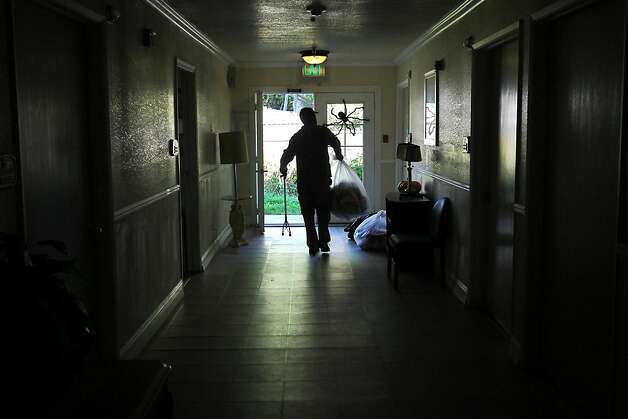
Burton Nash leaves with belongings left behind by his elderly parents, Eddie and Vernetta Nash in the abandoned Valley Springs Manor building October 31, 2013 in Castro Valley, Calif. Nash's parents moved into the facility in July and have recently been relocated to a new care facility after Valley Springs Manor was abandoned by most of its staff last weekend. Photo: Leah Millis, The Chronicle

A recent Bay Area story of tragedy is the abandonment of the elderly at Valley Springs Manor. For any of us who have witnessed the final years of our senior relatives, it is painfully evident that what happened there was not just a failure of government but a failure of all those people entrusted to care for them. Here's the story.

This column by Chip Johnson tells not of the politics involved but of the human side of this tragic incident. It also tells the tale of two caring individuals who refused to leave. Yes, there is the politics of why state regulators shut down this facility without a clear plan in place for the elderly. Yes, there is the politics of who bears ultimate responsibility. Yes, there is the politics of what role government should play in providing for the well-being of an ever aging Generation X.

But, "At the end of the day, the difference between calamity and chaos at Valley Springs came down to human compassion," says Johnson. Ironically, it was not the caregivers who remained but a janitor and a cook that took it upon themselves, without pay, to stay and not walk away.


Thursday, October 31, 2013

Partisan politics prevail and fail

About a week ago, I was reading this fascinating article, which was an analysis of how partisan cooperation saved the Democratic party from fracturing under Republican pressure. It's a rather long read but very insightful. This ties nicely with the 5th period FRQ because it is a clear example of how political parties can help the electorate party by rallying together a united front that together has the ability to successfully implement its agenda.


In addition, the clear example of cooperation between two two branches of government (executive and legislative) connects well to what we learned earlier in the year. Specifically, the article hones in on Senate Majority Leader Harry Reid's fluctuating relationship with President Barack Obama. Though both Democrats, both have been at odds with each other in the past. However, when facing shutdown and default, their union held the Democratic base together long enough to break the Republican front.

However, the next party that may break is the Democratic party itself. This article points to division within the party on issues related to the health care law and spying. While some candidates can afford to upset some influential party members, others cannot.

When do you think Congressmen should defect from party-endorsed policy? Although partisan politics has received much blame for the lack of progress in Congress, what merit do you think parties have in this day and age in government?

Random note for those who get it: a local news angle will come... at some point


Obamacare Website Update


     The U.S. Department of Health and Human Services has brought in tech experts from large companies such as Google, Red Hat and Oracle to aid in repairing the healthcare registration site. Officials are feeling confident that the site will be performing smoothly by November 30, which would give citizens enough time to enroll and begin receiving coverage by January 1.
     HealthCare.gov was opened with the intention of helping Americans in 36 states see if they qualify for tax credits to buy and sign up for private health insurance. The 14 states are not affiliated with HealthCare.gov have set up their own websites for this purpose and have been running smoothly in comparison to HealthCare.gov.
     Despite the newest efforts to improve the website, many remain skeptical about whether or not HealthCare.gov can really get its act together. Questions have also risen about the diligence of the trials and testing the website went through before launch.
   
     But, what do you guys think?

Links links links everybody

After showing the US the door, Iraq is back knocking.

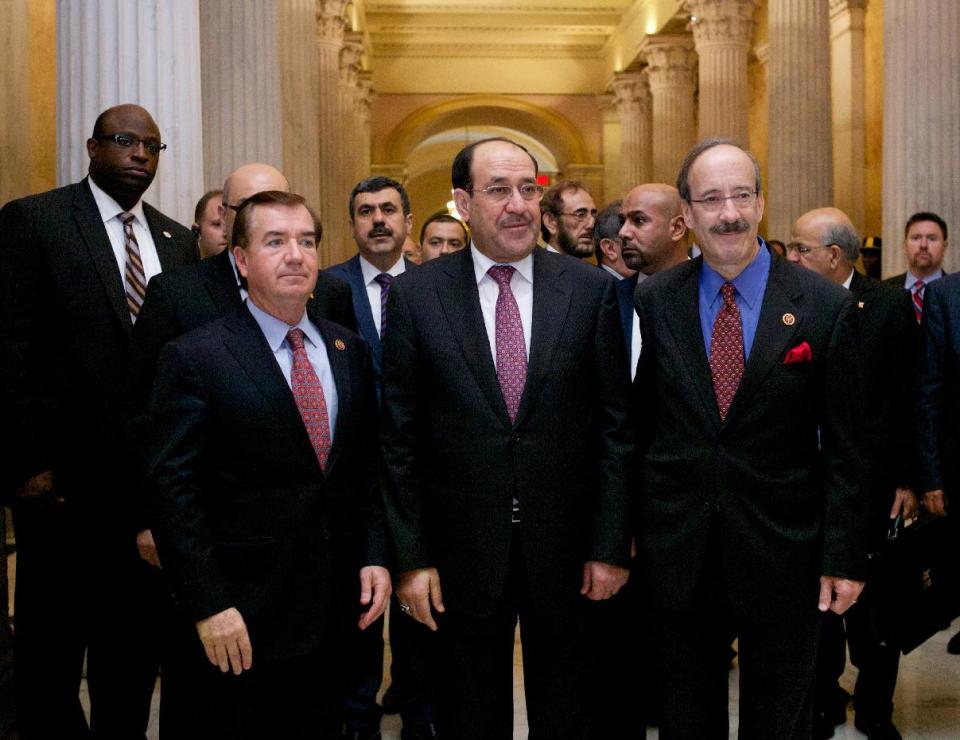
Iraq's Prime Minister Nouri al-Maliki, center, walks with the House Foreign Affairs Committee ranking Democrat Rep. Eliot Engel, D-N.Y., right, and the committee's chairman Rep. Ed Royce, R-Calif., on Capitol Hill in Washington, Wednesday, Oct. 30, 2013, before their meeting. Earlier, the prime minister met with Vice President Joe Biden. (AP Photo/Molly Riley)

In light of a resurgence in terrorist activity in Iraq, the Iraqi government has reached out to President Obama in hopes of receiving greater United States support.

The Iraqis are asking for weapons, training, and manpower but do not want U.S. troops on the ground. While the former U.S. ambassador to Iraq suggests that providing additional American personnel for guiding purposes costs relatively little, others, like Sen. John McCain, remain skeptical and insist on seeing a thought-out strategy for how Americans will help change the situation.

Although it may seem obvious for the U.S. to distance itself from a conflict it had just left, there are many considerations. One is the Iraqi's threat that they will turn to other nations, like China and Russia, for support. Americans have vested interest in maintaining positive ties with the nation, because it is geographically situated in a volatile region of the world that the U.S. wants influence in; however, it must also invest too much, for the tolls of intervention are painfully evident in the wars of the past decade.

How do you think the U.S. should react to this request?

In order to tie this back to Gov... Washington in his farewell address warned America to stay out of foreign affairs. In this day and age of globalization and complex foreign cooperation, to what degree, if at all, do you believe the U.S. should follow Washington's statement?

Article

Tuesday, October 29, 2013

From the Founder's Point of View


While the government shutdown and threat of default are a thing of the past at least for now, there is much to be analyzed. A recent Stratfor report touched upon what the Founding Fathers would have thought if they witnessed this fiasco.

In the report, I found that many of the author's points were corroborated by the Federalist papers that we read for class. Mainly, it is the point that the US government is intentionally set up such that progress would be difficult and cumbersome to achieve, but it would also prevent extremist factions and spur-of-the-moment events from rashly altering the course of government. However, what the Founding Fathers also believed was that our leaders would be reasonable and willing to moderate. They would be appalled by the hard-line stances and divisive rhetoric that has come to dominate politics today. The Fathers themselves, according to the report, were moderate men who approached problems with consideration for all viewpoints.

Perhaps one line in the report best sums up what the problem with our government is today. "The founders needed to bridge the gaps between the need to govern, the fear of tyranny and the uncertainty of the future. Their solution was not in law but in personal virtue." Personal virtue is a rare sight in Washington today.


Lastly, a quote that I'd like your thoughts on cause I've been trying to understand this: "The republic of the mind was always greater than the republic itself."


A cliche question: What do you think our Founders would say? 

Another question... What's the solution?

http://www.stratfor.com/weekly/us-debt-crisis-founders-perspective?utm_source=freelist-f&utm_medium=email&utm_campaign=20131015&utm_term=Gweekly&utm_content=title&elq=602ebaaf144344d6ad3282e603ae2618

Educators Debate the Extent of Online Surveillance


     Since the October 15 conviction of two girls for aggravated stalking, which led 12-year-old Rebecca Sedwick's suicide, the debate over the legality and necessity of online surveillance of students has once again become a popular topic of debate.
     In the past, the administration's job was simply to make sure that students behaved themselves on campus grounds. However, with the widespread use of social media as an emotional outlet for many students, educators are now having trouble walking the fine line between maintaining their students' right to free speech and keeping their students safe.
     In recent court cases, students have been suspended and jailed for their pictures and online posts. In Nevada, a 16-year-old was sentenced to 31 days in jail and a 90-day suspension from school for bragging online about having guns and planning to kills students on a specific date. He sued the school district for violating his first amendment rights, but the Ninth Circuit of Appeals dismissed his claim. On the other hand, courts in Indiana ruled that two students' online photos were simply "crude humor" as opposed to "substantial disruption."

     Do you think school administrators are justified in tracking their students' online actions? If so, where should they draw the line between students' free speech rights and maintaining the safety of their schools? Is legal action justified?  What constitutes "substantial disruption"?

Article


Sunday, October 27, 2013

UK Man deported after false statement to officials


After a slip-up at the Mexico/US border in 2009, Philip Hartley-Wall now finds himself in the UK, where he was born but hasn't lived in since he was 9 years old. Hartley-Will immigrated to the United States in 1981, and had lived in LA until 2009, where at the border he told officials he was a US citizen, when he only had a green card, meaning he held "permanent alien residency status." He plead guilty and was charged with making false statements to an official. After spending 7 months in federal prison, he was deported to the UK; he had no family nor connections there except for an acquaintance he made during his time in the immigration removal center. He stayed with his friend's family for six weeks after arriving in Manchester. His wife and 12 year old daughter still live in the US; his wife has had to sell their home after she couldn't keep paying the mortgage on only one salary and his daughter, described as having, "the body of a 12-year-old but the mental abilities of a six-year-old," has been acting up in school due to her father's absence. President Barack Obama is being urged to allow Hartley-Well clemency--or mercy to allow him back in the country. 

Should Hartley-Well be allowed back into the country? Would Obama allowing clemency backlash and cause other families experiencing the same event demand clemency as well? Should Hartley-Wall have been deported in the first place or was the punishment truly "disproportionate"? 

Thursday, October 24, 2013

FDA pushes for harsher regulations on painkilers


The FDA has urged the US to make painkillers harder for patients to obtain. The change in policy would make it more difficult for patients to obtain refills on prescription drugs; it would decrease the amounts of refills patients could get between prescriptions and would require a patient to bring in a written prescription to their pharmacy, rather than just having a doctor call in an order.

One of the main reasons for tightening restrictions is the increase in deaths caused by drug overdose--the number of deaths per year due to overdose has quadrupled since 1999.

These new regulations, if put in place, would require patients to get a new prescription every three months, rather than every six.

How much of an impact will these regulations make to patient health? How effective will they be on painkiller abuse?

Wednesday, October 23, 2013

Drones cause tension with Pakistan


Pakistani Prime Minister Nawaz Sharif and President Obama met today in the White House to discuss their alliance to battle terrorism, however the US's use of drones could cause some tension in that agreement.

Sharif has called for President Obama to stop the drone strikes in Pakistani borders, and stated that as long as those continue, there will be tension in US and Pakistan relations. Pakistanis hope their leader will convince the US to stop the drone attacks, as they feel they've been "pushed around by the US."

Along with drone strikes, added tensions have affected the relationship between Pakistan and the US. After the assassination of Osama bin Laden in 2011, the Pakistani government arrested a doctor for supposedly assisting the US in finding bin Laden's whereabouts; the US's mission to kill bin Laden was kept from the Pakistani government.

However, experts have mentioned that because of the recent decline in terrorist targets, the amount of drone attacks will likely begin to decrease.

Some experts argue that drone attacks are more effective and cause less civilian casualties than other methods might.

Do you think that the US has the authority to conduct counterterrorism in foreign countries? Do the benefits of killing terrorists outweigh the civilian casualties that will almost certainly occur? Is it acceptable to risk killing civilians in the short term for the long term benefit of security?

Tuesday, October 22, 2013

Affordable Care Act website can't get its stuff together


The already unpopular Affordable Care Act has disgruntled Americans further because of the continuously glitchy healthcare enrollment site. Democrats who have supported the act will need to defend their decision during mid-term election next year. Enrollment deadline for the healthcare plan is Dec. 15, but because of the website’s glitches, it’s difficult for people to submit or finish their enrollments. For those who are not insured by February 15th of 2014, they will be forced to pay a fine. Congress’s biggest concern is the damage control that is inevitable because of the struggle the website is having. Secretary of Health and Human Services Kathleen Sebelius is expected to give a statement in the near future about the failing website. Republican Paul Ryan has gone as far as to call for her resignation. 

My questions to you are;


Why not push the days back? Americans are clearly angered by the act, and now more so thanks to the malfunctions.

Another thing to note; Democrats are more technologically aware than Republicans in general, will this hurt that image? Will this give Republicans the opportunity to get their technological side to match up to the Democrats'? 


And what is the solution to this long term? Does this mean if the government wants to embrace technology, does it need to hire people from, say, Google to get there websites running the way they should? 

Friday, October 18, 2013

California Election Reform Article

This piece about California is currently the top story at the New York Times and it relates directly to several recent lessons including the politics of election districts. I would like to see more of a political science treatment to these issues, but the article has several obviously credible sources supporting its contentions. I think the article understates 2 important factors that help explain the more constructive tone in Sacramento: the Democrats supermajority status, which leaves the remaining Republicans a choice of being constructive or being shut out from governing, and Governor Brown's leadership, especially on fiscal issues. Still, having voted for all of these changes, I am glad to see that they might be having the intended effect.

On another note, the lack of blogging this week was my fault but we will return to student-driven blogging next week.

Sunday, October 13, 2013

U.S. Halts military aid to Egypt


American officials announced yesterday that the United States is withholding a large portion of military aid scheduled to be delivered to Egypt in light of military crackdown on Muslim Brotherhood protestors. The Brotherhood, which supports ousted President Mohammed Morsi, has been engaged in street protests against the military regime for over a month, protests that have cost hundreds of lives. The July ouster of Mr. Morsi, when the military stepped in to remove him, has been met with mixed reactions in the United States. Mr. Morsi's performance as president was obviously unsatisfactory, but this kind of breakdown of the democratic process is dangerous in itself. Even if the United States disagrees with the policies of a leader, is it prudent to allow the democratic process dissolve through a military coup? After three months of inaction, the United States has finally decided to take a stand by cutting off funds, but is this action too little too late? What could have been gained by cutting off aid earlier? Or not at all?

Tea Party Crashers

Cruz (from the video): "It is shameful that the administration is barricading and trying to shut down the memorials."

Wait but you... and your ridiculously long speech... and the fact that you helped shut down these memorials in the first place...? Oh, the irony.

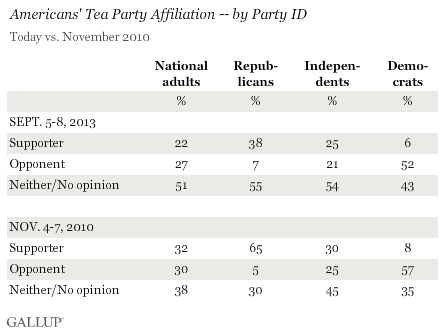
I had to wonder. Have some Tea Partiers left their party yet?


(Source: Gallup)

Hmm... so it seems like people are ditching the party. Poor Tea Party.

Despite the decline in the number of Tea Partiers, Cruz actually won the Values Voter Summit straw poll (sponsored by the Family Research Council Action) on Friday with 42% of the vote. Paul Ryan (Romney's VP candidate in 2012) finished with less than 5% of the vote. The Family Research Council Action president says that this straw poll "reveals what conservative, Republican-leaning voters are looking for in a potential candidate." It's meant to be an early predictor for the Republican choice for president. This Texas senator seems to be one of the leading Republican presidential candidates for the 2016 election.

We've recently just covered in class why third parties, sooner or later, generally fail. Recent events have obviously further tarnished the Tea Party's image. Do you think the Tea Party is about to end? What can Tea Party leaders possibly do to prevent a die-off? Which party (Republican or Democrat) do you think is absorbing the ex-members of the Tea Party and why? Do you think Cruz has a chance to be the leading Republican presidential candidate in 2016, or is his sudden rise going to be countered by a sudden fall?

Prepare for the Apocalypse (kind of)


President of the World Bank, Jim Yong Kim: "We're now five days away from a very dangerous moment. I urge U.S. policymakers to quickly come to a resolution before they reach the debt ceiling deadline... If this comes to pass, it could be a disastrous event for the developing world, and that will in turn greatly hurt developed economies as well" (source: Daily Mail)

Alarming times call for alarming warnings. In five days, the U.S. will have exhausted it's borrowing capacity. Jack Lew, the U.S. Treasury Secretary, have warned congressional leaders that "[i]f the government should ultimately become unable to pay all of its bills, the results could be catastrophic."

Bottom line is, we need to raise the $16.7 trillion debt limit. But the House won't vote on the debt limit until they settle the issue over the funding of Obamacare. Neither the president nor House Speaker Boehner is prepared to negotiate. If they can't reach an agreement by Thursday, the U.S. could start defaulting on its obligations as early as late October

Tensions are high. How confident are you that Congress will be solve this issue before the October 17th deadline? Are Republicans stubborn enough to not only shut down the government, but also let the U.S. default? What does this say about our government system? Which side (Boehner or Obama) do you think is going to give in a little to the other side first? Is this a matter of pride and ambition


Friday, October 11, 2013

Day 11 of gov shutdown: I miss sushi


I want to be all like, omnomnom.

But then I'm all like, mmm, better not. Most of the FDA food inspectors have been sent home because of the government shutdown. 

FDA spokesman Steven Immergut has made clear that they're trying to do the best for the public health with their skeletal staffs and limited resources, but that all routine food safety inspections will be suspended until the government is up and running again. Only facilities that "present an immediate threat to public health" will be inspected. About 367 inspections per week will be delayed.

The House passed a bill on Monday that would return funding for the FDA during the shutdown. But the Senate has dismissed this bill among the many other bills that are part of the Republicans' piecemeal strategy intended to mitigate the damage they've done to important government functions that are suffering from the shutdown. Californian House Rep Sam Farr argued against the bill, telling HuffPost that "[p]assing these bills would be like seeing a school bus on fire and agreeing only to rescue the good-looking kids. It's ridiculous. I want to put out the fire." Democrats like Farr believe in the need to reopen the government fully, not little by little, and raise the debt ceiling. 

Has the shutdown has improved your knowledge and appreciation for what the government does for us? Or has it only made you more infuriated by the government? Which "non-essential" part of the government that isn't being funded during the shutdown do you think SHOULD be funded and deemed "essential"? Is the Republicans' piecemeal strategy a strong or vain attempt to fund the government while saving face? And do you agree/disagree with the Democrats' response?

Thursday, October 10, 2013

Yelling for Yellen

(Source: The New Yorker)

One of the concerns surrounding Janet Yellen, Obama's nomination for the head of the Federal Reserve, is how she's going to balance jobs and inflation. Is she a hawk, or a dove?

She has been known to stress the need to fix high unemployment, maybe even at the risk of triggering inflation by doing so. To increase employment last year, she pushed hard to keep interest rates close to 0, risking a brief inflation increase. By seemingly valuing jobs over inflation, she's often been called a dove. But some argue that she's a "hawk in dove's clothing," since she did argue for rate rises in 1996 in order to control inflation. Balancing both views, Yellen's friend and writer for Bloomberg praises that "Yellen's appointment should be viewed as an investment in the Fed's dual mandate, which emphasizes the central bank's role in taming both unemployment and inflation" (Source: Bloomberg). Maybe she's not a dove or a hawk. Maybe she just adapts to changing circumstances, which is a relief, because she won't be as susceptible to endangerment by natural selection as the doves and hawks are.

Yellen's extremely impressive record, experience, ability to cooperate and compromise, creativity, work ethic, and educational background all convince me that she will be brilliant as the Fed chair. Furthermore, I believe she will inspire many aspiring young women, including myself. But do you think she'll be able to handle it? The dual responsibilities of the Federal Reserve (handling unemployment and inflation) proved to be a challenging for all previous Fed chairs. How will Yellen be different than Bernanke, or other chairs before her? Do you think she's a good fit for the job? Is she a hawk or a dove, and what would that mean for the country as a whole?

Lastly, can we just take a moment to recognize how awesome she is? And adorable?

Wednesday, October 9, 2013

Even the Brits don't like Snowden


The NSA has been under fire for the past few months after former contractor Edward Snowden released a cache of classified material regarding government surveillance techniques to outside sources. In recent news, British MI5 chief Andrew Parker condemned Snowden's actions as similar to giving "gifts to terrorists." The intelligence chief addressed UK news stating that in order to fight terrorism, both domestically and abroad, intelligence services need to have the tools to monitor threats: a statement that I agree with (although his wording was a little strong for my liking). While a certain level of oversight is necessary, US and UK authorities need to have the operational flexibility to conduct operations vital to national security. In this instance the NSA may have overstepped its constitutional bounds and lacked appropriate oversight, but to say that Snowden's actions were responsible (or worthy of the Sakharov Prize) would be absurd. Although some have cast him in the role of the American patriot on a quest to protect the rights of American citizens, Edward Snowden seems to be acting purely to discredit the United States in international affairs (cough releasing information just prior to the G-20 Summit  cough). The reckless information leaks that have been lauded by the likes of Julian Assange and Vladimir Putin have only served to humiliate the US in world affairs and throw the NSA and General Keith Alexander under the Congressional bus. While Snowden's actions were certainly bold, he forfeited his image as the American patriot through his flight to China and later Russia, two countries with reprehensible policies regarding human rights. Calling Snowden a traitor is a cheap emotional cop-out, but to call him a hero is to glamorize a reckless game with dangerous outcomes.


The Republican Party's Dilemma

(Source: Gallup)

First off, I'm super excited to report that David Frum is posting again! (Don't call it a Frum-Back). One of his latest posts, Seven Habits of Highly Ineffective Political Parties, gives a good summary of why the Republican party has been going downhill, and is very relevant to the topics we've covered in class recently.

The Republican party suffered some pretty huge losses in the past few years, including the fight over Obamacare, the 2012 election, and the fight over 2012 fiscal cliff. And now, it looks like they're about to lose once more, over the government shutdown and the debt ceiling.

Why? Frum condenses it down to 7 bad habits: maximalist goals, apocalyptic visions, irrational animus, collapse of leadership, self-reinforcing media, politics as war, and despair.

(I highly suggest you read the article for some great in-depth commentary on these 7 habits.)

A quote from the post that I think is worthy of sharing: "[E]ffective parties make conflict work for them. Hate leads to rage, and rage makes you stupid." He goes on to provide an example in which the Republican party leaders let their rage get to them, which produced an unfavorable outcome for the Republican party as a whole.

And unfortunately, I have to agree with Mr. Frum on that one. It's gotten to the point where the public sees their actions as having stuck a wrench in the works of government and progress. Public opinion of the Republican party has already decreased since the shutdown. How can the Republican party stop these habits from ruining their party's image (and the U.S.'s image in general)? What will have to happen before the Republican party can recover from the blows, or in other words, what will the Republican party need to change? What do you think a Republican presidential candidate in 2016 will have to accomplish and focus on if they want to win? 

Monday, October 7, 2013

Ross Ulbricht... just another criminal


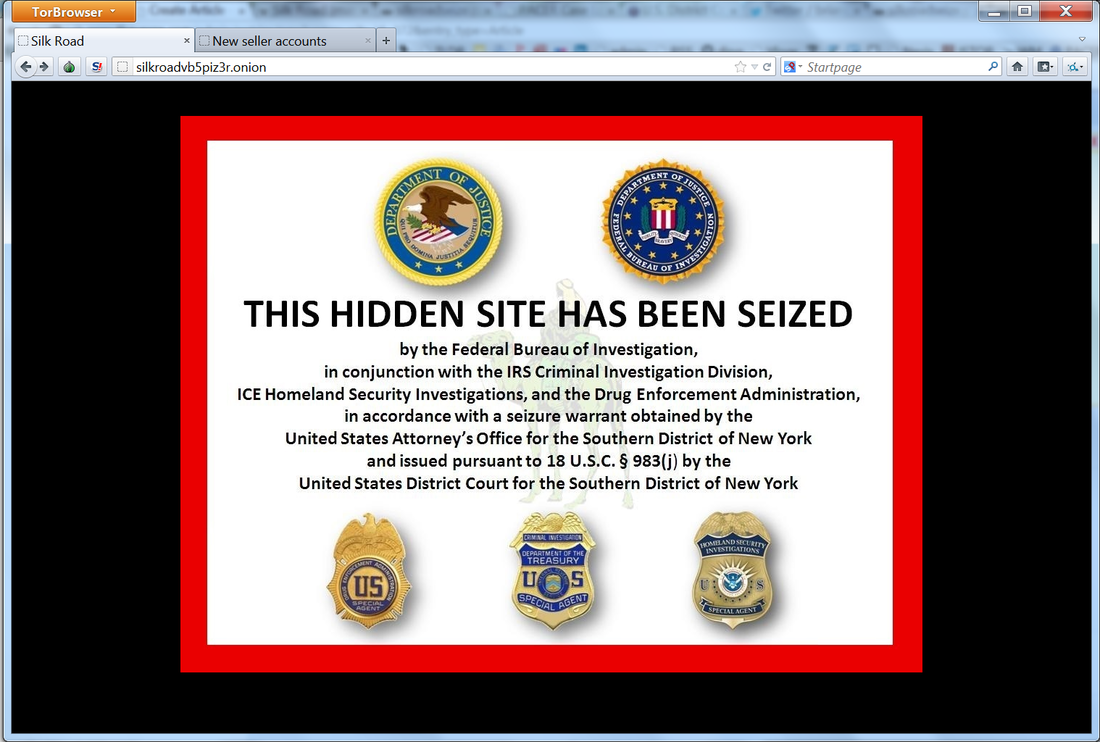
The recent seizure of online black market website "Silk Road" and the arrest of its alleged owner, Ross Ulbricht, has brought the federal government under fire from certain internet circles. Still smarting from recent revelations of so called "domestic spying" by the NSA, civil liberties activists are accusing the federal government of using the arrest as a way to further its alleged anti-privacy agenda. However, it is important to understand that Mr. Ullbricht is simply just another criminal. The charges brought against him in two different states include conspiracy to traffic narcotics, money laundering, conspiracy to murder a witness, and attempt to procure "murder for hire" (Ullbricht allegedly paid a federal agent to kill a rival.). Mr. Ullbricht is no crusader for internet freedom; he is merely a common criminal looking to turn a profit by facilitating the overtly criminal activities of others. The indictment brought against Ullbricht is not an indicator of a tyrannical federal government, but of a legitimate need to act against those who live in blatant and irresponsible contempt of the law. The seizure of his website also brought into the spotlight Tor, an internet engine designed to facilitate anonymity on the web, and Bitcoin, an internet currency that is seen as a way to enable anonymous and easy monetary transactions online (but also seems to be laying the groundwork for tax evasion and money laundering amongst other things.)

What do you think about the government's intent in indicting Ullbricht? How about calls for greater regulation of the internet anonymity in light of this criminal activity?

Also food for thought: Is the internet a right? Does it bring with it a certain right to anonymity and enhanced privacy? Keep in the mind that the internet is a service provided by commercial interests and that anonymity may not be considered a reasonable expectation outside of the computer world...

Not bluffing? Then call the vote


Boehner has announced in an ABC interview yesterday that "There are not the votes in the House to pass a clean CR [continuing resolution]." 

A White House official has responded with: "The administration and Democrats in Congress are asking the speaker to prove that a majority in the House would not vote for the Senate-passed bill to reopen the government by holding an up-or-down vote on the clean continuing resolution."

218 votes are needed to pass the CR; if all 200 democrats and (as of today) the 25 confirmed Republicans all vote in favor of the clean funding bill, and then it would pass swiftly through the Senate and onto the president's desk to sign. No more shutdown. 

Why isn't Boehner putting the clean continuing resolution on the floor for a vote? If he's so certain, why not prove it to us all that there really aren't enough votes in the House to pass it? What's the deal with Boehner?

Sunday, October 6, 2013

The New and Improved $100 Bill


On Tuesday, the Federal Reserve will distribute the new $100 bill, which is designed in a way that will decrease counterfeiting issues. The new bill have more color, a different paper blend, a holographic inkwell, and a 3-d blue strip, which took over 10 years to be created. This is because the $100 bill is the most common bill to be stolen and counterfeited. Currency collectors are keeping their eye on the bills, some of which are willing to pay $15,000 for bills with low serial numbers (e.g. 00000001through 00000100). The most important purpose of the new $100 bill is to decrease the amount of counterfeiting issues within the nation. 


Friday, October 4, 2013

Secret NSA Documents Reveal Operations


On November 2007, Roger Dingledine spoke in an event held by the NSA, talking about his volunteer-run software that enables Internet anonymity. This program is used by millions of people to hide their identities on the online, and it allows information to get from one place to another without identifying where it came from and/or the pathway it took. Tor is very important to journalists and activists in the U.S and other countries in order to communicate without being reprised by their governments.
When former NSA employee Edward Snowden disclosed top-secret NSA information, one of the documents shown revealed that the NSA has been spying on users and unmasking their identities. The NSA was even able to block access to the program once. Human rights groups have been concerned over the fact that the NSA seems to neglect the people's right to privacy. On the other hand, Tor has been used by criminals to transact illegal activities in order to avoid suspicion. Tor still runs today and continues to promote internet privacy and anonymity.

Does the NSA have the right to do spy on us? And if so, to what extent? 

Do you support programs such as Tor that enable anonymity, despite the use of such programs for criminal activities?

Additional information: Washington Post, Tor

Thursday, October 3, 2013

From Shutdown to...Default?


President Barack Obama demanded that the Republican-led House of Representatives end the three day government shutdown, but no negotiations have been made so far. The government leaders must compromise quickly to avoid a "catastrophic" default before the debt limit date on October 17. A default, by definition, is when a debtor fails to fulfill his obligations stated in the debt contract. The government has reached its $16.999 trillion limit in May, but despite the U.S Treasury's creative strategies, these will not be enough to meet the nation's obligations on the 17th. Thus, the government could run out of money and end up in a default, which the U.S Treasury warns could cause the economy to disintegrate into a state that is worse than the Great Recession. This would mean that the country's credit rate would drop and "job creation, consumer spending and economic growth" would surely be affected. 

House Speaker John Boehner told Republicans that he will not let the government reach the point of a default, and says that if needed, he will pass a measure to prevent this with a slim Republican vote and a largely Democratic vote. 

The government's time is running out, and a solution must be made. It's either they work together, or continue this deadlock.

What do you think the next step of the government should be? Is the economy actually going to plummet down as badly as the U.S Treasury claims? 


Driver's Licenses to Illegal Immigrants


On Thursday, California Governor Jerry Brown signed a bill that allowed illegal immigrants to own driver's licenses, making California the tenth state to do this. These licenses would permit illegal immigrants to drive and/or own a car, but a special marking will indicate that such licenses could not be used for federal purposes. Immigrant advocates rejoiced since they have long advocated for a law like this, and they see this as a step towards equality for illegal immigrants. The licenses are to be issued starting January 1, 2015.

How significant is this bill to the immigration reform? Do you think that this bill could influence further immigration reform laws?  What is your stance on current immigration policies?

For more information: The Washington Times

Wednesday, October 2, 2013

Let's End the Shutdown, Shall We?


Hi guys! I'm sorry for the delayed blog posts, but here's one now:

This afternoon, Obama is calling for a meeting with Congress in order to discuss, and hopefully resolve, the government shutdown, and told CNBC that he feels "absolutely exasperated, because [the shutdown] is entirely unnecessary". The government closed due to the Republican House and the Democratic Senate's failure to compromise on debates over funding and budget bills before the beginning of the new fiscal year; this CNN article further explains the major summaries of the shutdown itself. In the meeting, Obama plans to ask the House to pass a new spending plan without restrictions on the Affordable Care Act and increase the debt ceiling, although it seems likely that GOP leaders are willing to persist against these proposals. White House spokesman Jay Carney stated that Obama does not plan to grant concessions to the Republicans, but rather just focus on reopening the government. We have yet to see what will come after this meeting, but alas, we shall wait. 

What do you think of the government shutdown? Do you think that compromise can be made quickly, or will this draw out a little longer than expected?