Thursday, February 20, 2020

Trump criticizes Oscar winning film, Parasite

Image result for parasite

During a rally on Thursday, President Trump criticized the Academy Awards for
bestowing their top prize to Parasite, a South Korean movie. He asked “what the hell
was that all about” when stating that the winner was a movie from South Korea. He
even goes further to state how “we got enough problems with South Korea with trade.”

Parasite, a movie on class discrimination and greed and how it would affect relationship
between the very wealthy Park family and poor Kim family. Parasite has also made history
by becoming the first foreign language film to win Best Picture at the Oscars earlier this
month. They had also received Oscars for Best Director, in which Director Bong Joon Ho
also made history by becoming the first Korean director to win the Oscar, Best Original
Screenplay, and Best International Feature Film. Many people were thrilled at how well
Parasite did especially considering the lack of diversity in Hollywood this year. 
I personally had the chance to watch Parasite recently and I had enjoyed the movie so
much I watched it three times... in one night. I thought that it was a well directed movie
with a very interesting plot. I admired how it had made such a resonating comment on
society, the socioeconomic class status and the disparity between different classes. It was
a well made movie with amazing cinematography (in my opinion) and I think that it fully
deserved the Oscars that it earned, thus making it very disappointing that Trump would be
so quick to discredit the movie because it was a foreign film especially when it seems as if
he hadn’t even watched it since he stated himself, “Was it good? I don’t know.” Though
disappointing in the way that he acted, I’m not very surprised by it. Hopefully in the future
we will be able to see more representation and diversity in the movies being nominated,
actors, actresses, as well as directors. 

Have you watched Parasite? What did you think of it and do you think it deserved the Oscar’s it received? 
Do you think foreign media or culture is making an impact on American culture? How so?

Wednesday, February 19, 2020

Andrew Yang drops out of the presidential election


On Tuesday, February 11th 2020 Andrew Yang had dropped out of the presidential race. Yang’s platforms mainly focused on his universal basic income policy where the government would give 1,000 a month to every American age 18 or older who wanted it. This would help people who lost their job due to automation or new careers pay for “exploring their creative side, and spend more money in the communities where they lived ''. Yang said that the cost of this plan, which many are estimated to be in the trillions would be funded by a Value Added Tax. 


Yang’s longevity of his campaign was a surprise to many Americans since he had outlasted many
sitting senators and governors. His campaign wasn’t very well known until they had announced
that they raised $9.9 million in the third quarter with another $16.5 million the following quarter. 
However, despite all this he had only gained about 1% of the raw vote from Iowa and no delegates,
thus prompting him to drop out. 

I personally wasn’t following Yang very closely until I had seen an interview done where Yang
addressed his lack of media coverage, such as a time when CNN had left off Yang in an election poll
graphic sometime in mid 2019 and another instance where he was called “John Yang” on MSNBC.
While both of these two were accidents (I believe) and not done out of intent and things likes this
can happen. The show apologized and corrected their error to which Yang accepted their apology.
Still, even though this might not be seen as important to others I still wonder if this would’ve
happened to any other candidate.  

I’m not sure if Yang continued how much support he would have or would have gathered,
but his political support had seemed to consist of mainly young and male voters and now
many people are speculating that his departure from the election could potentially help
Senator Bernie Sanders numbers. 

Additionally, as a fun fact CNN reported that they have added Yang as a political
commentator so we can expect to see more of him for the remainder of this race!

  1. Do you think that Andrew Yang dropping out would help other candidates' numbers?
  2. Do you think that Andrew Yang would run again for the 2024 presidential election? 
  3. How much of an effect do you think media coverage has upon a candidate and their campaign?
  4. Can a lack of media coverage prompt their actions in dropping out of the race? 

Sunday, February 9, 2020

Space Hotel?

Image result for iss hotel
https://futurism.com/the-byte/plans-moving-ahead-space-hotel-iss

   Axiom Space and NASA are taking the first steps towards creating a space hotel attached to the International Space Station. While this may sound odd or out of character for NASA, we are currently living an era where private companies, such as Boeing, Virgin Galactic, Lockheed Martin, and SpaceX, are growing into prominence (to amounts possibly greater than NASA). The future of space is, right now, leaving government hands and going private. Forging the new industry of space tourism along the way.
   The first "module" (or space hotel room) launches are set for 2024. In years after, the hotel will separate and form its own spacecraft.
   These rooms will, of course, be first for the extremely wealthy and, many years down the road, more available to others (resembling car and plane travel). They will start more limited in technology, amenities, and activities and, over time, grow to resemble something like a space cruise ship. (Surprisingly and possibly uncoincidentally, Axiom is the same name as the spaceship in WALL-E, performing the same function too).

1. Would you ever go to space?
2. Do you think private companies that are less know, like Axiom, will be as safe as NASA? Will they be able to compete with the likes of Elon Musk (SpaceX) and Richard Branson (Virgin)?
3. Is there still a need to spend taxpayer money on NASA with these companies in the same field?

Upcoming New Hampshire Primary

Image result for new hampshire primaryImage result for new hampshire primary

   The first primary of the 2020 Election is happening this Tuesday in New Hampshire. This comes just after a confusing and messy Iowa Caucus and Friday's Democratic Debate. The results in Iowa were close and hard to predict (as there was no preceding Iowa poll, like most years had). But, in New Hampshire, a relative consensus has been reached on who will take the most delegates.
   According to five polls, Senator Bernie Sanders will win New Hampshire, but not by a large margin. I believe this is a result of a few factors. The first being an obvious elements of any campaign, policy lots of people can get behind. The second is how his particular campaign is run (mobilizing younger voters and campaign contributions from average people). The third factor, specific to this primary, is that his state of Vermont, which he has held as a senator since 2007, is right next to New Hampshire.
   And while Mayor Pete has performed better than expected, winning Iowa by a small margin, and Vice President Biden and Senator Warren have performed worse than expected, this is set to change on the national scale (as Iowa and New Hampshire have a higher proportion of white voters than the US does).
   In the debate and throughout their campaigns in New Hampshire and the nation, candidates have been discussing civil liberties and civil rights issues and policy, such as gun control (Second Amendment), abortion (privacy), and civil rights and race as a whole. They will continue to do this until someone becomes President and then makes––or influences––policy on these topics.

1. Who do you think will win New Hampshire? Who will win the nomination?
2. What do you attribute to Mayor Pete's strong, early performance?
3. What are some civil liberties and civil rights policy you think Democrats will/should roll out if they take the presidency?

Senate Acquits The President

Image result for senate acquittal
https://twitter.com/realDonaldTrump/status/1142157838153895941

   President Trump has been acquitted by the Republican-run Senate, ending the impeachment process that started in September. As a result, he retains his position and is viable for reelection in November.
   Minutes after the mostly predictable vote ended, the President tweeted a video in which he runs for, and wins, reelection, not just in 2024, but every election year after that. Some Republicans who voted to acquit did so because they believe Trump had "learned" something from being the third ever impeached president. But, after this tweet (and the firing of everyone who testified against him), Americans have to question if this was simply an excuse to not give an inch to Democrats and keep their man in the running for 2020. The issue here is that the President now has evidence he can do, and get away with, anything he wants. Republicans will always defend him, purely for political reasons. They voted against witnesses in the face of crucial new information from National Security Advisor Bolton. And they voted to acquit with only one breaking of ranks on one article (Mitt Romney, R-UT).
   While Democrats may have proved their point through this whole process, they may regret doing so as the election comes. Many Trump supporters feel Democrats in Congress are trying to undemocratically overturn their vote in 2016. This will motivate them to, this election, vote in droves, defending their decision four years ago.
   In this situation, sympathetic Republican voters will exercise their First Amendment right to speech, press, and assembly (civil liberties) to express their opinions on acquittal and 2020, get people to the voting booths, and push their candidate.

1. Should the President have been acquitted?
2. Did he learn his lesson?
3. How can Democrats address the possible political ramifications of the impeachment process?

Thursday, February 6, 2020

2020 State of the Union Address

Image result for state of the union
https://www.cnn.com/2020/02/05/politics/donald-trump-nancy-pelosi-state-of-the-union-analysis/index.html
https://www.youtube.com/watch?v=SIkkknoAlQo&feature=emb_title
(Written on 2/5 but didn't post)

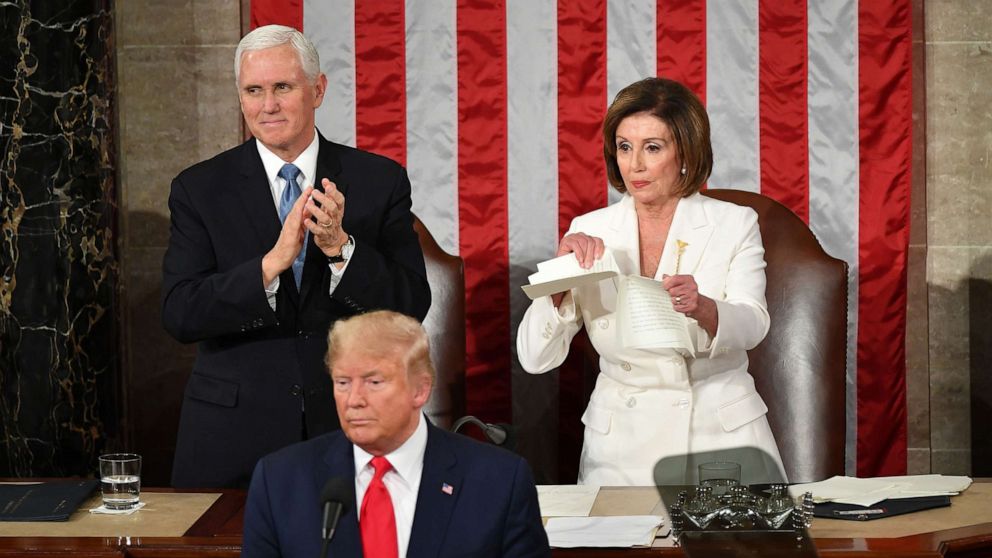
   Last night, the President gave his third State of the Union address. Typically in these speeches presidents include the statement "The State of the Union is strong," but this year President Trump broke with tradition, asserting that the "state of our union is stronger than ever before." This was received with an exalting standing ovation on the right (Republican) side of the House chamber, and disagreeing frowns and head shakes from the left (Democratic) side of the chamber––a side Trump hardly even looked at during the speech. The Democratic side was even missing ten members, including AOC, who boycotted the event. This goes to show the sharp divide the government, and country, is currently facing (especially in the midst of the Senate impeachment trial). This was furthered by Trump's rejection of Speaker Pelosi's hand, her unconventional announcement to begin the speech, and Pelosi's tearing of a copy of the speech.
   To some, this customarily formal speech seemed more like a show this year, with awards, surprises, and grand reveals. Here, the President is relying on spectacle as a campaign strategy, rather than facts (which he skewed, lied about, and sometimes blatantly ignored throughout the night).
   Trump, as usual, played heavily on the current strength of the economy, falsely claiming that it is the best ever, with the most jobs ever created. And while the economy is getting better and better, it has been doing so since before his presidency (and is only really benefiting the rich in the process).
   This annual address connects to course content as the President awarded the Medal of Freedom to Rush Limbaugh, an extremely conservative, racist, homophobic, misogynistic shock-jock radio host. This action was a nod to white supremacists across America––in the face of the 2020 election––as Limbaugh is vehemently opposed to the Black Lives Matter movement, has tried to place the blame from slavery away from white Americans, and has once said that slavery had merits. This act, awarding a bigot over of one of the few remaining Tuskegee Airmen (during Black History Month), sends a message that, like his first term, Trump's (possible) second term will do little to further civil rights in America. (It is also important to note that Trump's speechwriter, Stephen Miller, is a white nationalist).

1. What did you think of the President's speech?
2. Will this help is 2020 election bid?
3. What does his address, and the response to it, say about polarization today?

A few words about the mess in Iowa

I have to admit that I'm furious with some of my well-meaning friends who support Bernie for stoking the flames of conspiracy theory in respect to the failed app the Iowa Democratic party attempted to use to help tabulate and report results. This is almost certainly a matter of incompetence and lack of software testing than anything, and speculation about the DNC "rigging" the process against Bernie is recycled Russian propaganda. Stop it, Bernie fans, you didn't lose in 2016 because of the process. It's bad enough that people fell for the line that the hacked DNC emails showed a conspiracy against Bernie, but I actually read them, and they don't. OMG! People in politics have opinions about politics that they share with co workers! The Horror! The Sanders campaign rightfully complained that the DNC didn't schedule enough debates... and they scheduled more. Bernie got tons of national exposure and a large minority of support within the Democratic party -- but the plain fact of it is that considerably more Democrats supported Hillary Clinton in 2016 and she was the party nominee as she should have been.

But I'm more annoyed with the national political media, who once again have proven themselves tied to the past. In the past, when candidates could only accept campaign contributions in limited amounts from donors who could only donate in limited amounts, the fundraising game accelerated after Iowa and NH. Having 2 smaller states help "weed out" those candidates who couldn't get in the top 3 despite spending months in the state served a useful purpose. Now, there are 6-8 candidates with the funding to compete in Super Tuesday, which is now over half the country, so none of them are going to drop out due to lack of funding or reasonable path to the nomination. If no one is being weeded out, and the number of pledged delegates at stake in these 2 states is miniscule, then the only remaining relevance to Iowa is media momentum.

Buttigeg and Bernie will leave Iowa with the same number of national convention delegates. I know the media is used to having a winner declared who gives a victory speech (check out Obama's 08 Iowa speech) and that provides "momentum" that could influence voters in later states, but had one candidate emerged with 27% compared to 25%, that isn't a telling victory, and as far as I'm concerned, it is just as well that all the media people stayed up late on Monday with nothing to talk about. The 'winner' had nearly 3/4 of the caucus goers support someone else in the end, and there wasn't much to talk about other than Biden, with decades of experience, losing moderates to an openly gay mayor.

If we are going to have smaller states act to winnow the field -- and notice how this didn't happen in 2016 in the GOP -- then rotating states, including more diverse ones, makes a lot of sense. As it stands, however, the sequencing of nomination contests mostly seems to serve the purpose of giving the media a lazy horse-race question to ask, no different from a Gallup poll.

Sunday, February 2, 2020

Pigs in Blankets???


In preparation for Super bowl Sunday, the New York Times published an article suggesting pigs in blankets as the best snack for this occasion. The British immediately backlashed as the cover photo was not of pigs in blankets but rather “hot dog sausages wrapped in pastry.” In return, they began posting memes criticizing American foods.

I feel that although the British do seem a little too sensitive, they have the right to have this response and also are protecting their culture. I think that the responses are actually quite funny, but I do think that it was a mistake that the NYT would have changed if they had known. News reports like NYT should be able to better manage situations like this in the future as many people are viewing their papers, including those who easily get offended or otherwise. 

Saturday, February 1, 2020

US bank employee fired for doing good


Emily James, a past employee of the Oregon US Bank, was fired for “unprofessionally” assisting a customer in need. On Christmas Eve, Marc Eugenio was stuck at a gas station without any money to pay for fuel or a ride home. Prior to that, he had deposited a paycheck to his US bank account. Marc had been trying to get access to his money so that he could buy Christmas presents for his children. But the bank was unable to get back to him as they had put his money on hold. Although it is not stated by the bank specifically why his money had been put on hold, it is reasonable to assume that the service department had been on a holiday break as it happened on Christmas Eve. 

When Marc realized he could not access his money from other branches either, he called the bank’s customer service line, where he reached Emily James. After an hour of explanation, Emily decided to drive to the gas station and give him $20 of her own money. Marc refused at first but realized it was really the only way he could get home.

Shortly after, Emily was fired for putting herself and the company at risk. The US bank claimed that Emily failed to meet the company policies and procedures and conducted an “unauthorized interaction” with the customer. The company also said that Emily “did not use the available solutions to remedy the customer’s situation,” although at that time she had no other way of helping the customer. 

Even though the procedures are set to protect the employee and the bank itself, I feel that it was unnecessary Emily had to be fired for doing a good deed. Do you think there’s another way the company could have reacted? This case is similar to national security vs. free speech as Emily was forced to follow company rules, but instead did what she believed was morally right. Do you think the US bank should make changes and limitations to their policies? If so, how?

Thursday, January 30, 2020

Barbie in the 21st Century


It seems like we’ve come a long way from the days of skinny, blonde, blue-eyed Barbies. Barbie released some new additions to their doll collection this week. Among them are dolls with prosthetic limbs, vitiligo (an autoimmune condition that results in patches of skin losing color), and bald heads. These new additions are only part of a wave of diverse releases with a range of skin colors, hairstyles, and body types.

After years of criticism about inflating unrealistic beauty standards, I think it’s really admirable that Barbie is taking strides to be more inclusive and that there are going to be kids playing with dolls that reflect both themselves and the world as a whole. As a kid, it probably would have meant the world to be able to see someone who looked like me represented in mainstream media, and not just diluted into one-dimensional, token Asian nerd.

How do you think that these new additions will be received by children? Would you have liked these kinds of toys growing up?


The Fight for the ERA


Virginia has recently become the 38th state to ratify the Equal Rights Amendment (ERA) guaranteeing equal protection for women. This ratification means that the ⅔ majority needed to ratify an amendment has been met, however now a legal battle will be waged over whether too much time has elapsed for the amendment to be added to the Constitution (Congress enacted a 1982 deadline for ratification).


Many Democratic attorney generals are preparing to fight for passage of the ERA in the courts. They argue that because the deadline was merely in the preamble of the amendment, it isn’t legally binding.


While ERA advocates push for the ERA on the grounds that it would guard against sex-based discrimination and allow Congress to pass more anti-discrimination laws, opponents argue that the ERA would end commonsense protections for women, such as workplace accommodations during pregnancy, under the premise of equal treatment. Opponents also fear that the ERA would be leveraged by pro-choice advocates to eliminate abortion restrictions on the basis of discrimination.


In terms of civil liberties, the idea of equality is only invoked once in the 14th Amendment of the Bill of Rights. It makes no mention of being specific to guarding against gender-based discrimination, and is instead more broad to include “any person.” The abortion battle waged on the grounds of the right to privacy is also something the Constitution does not explicitly outline and is an implied right. Such parts of the Bill of Rights have played major roles in civil liberties cases that the ERA presumably would have dealt with had it passed long ago. The ERA would, therefore, elevate aspects of the Constitution and make rights either implied or merely mentioned to be more explicit, and perhaps not bring anything wholly new, per se, to the Bill of Rights. Do you think the ERA should be added, or do you think the issues it deals with are sufficiently protected under the current Bill of Rights?

Coronavirus = Opportunity to be racist toward Chinese people?

A man stands in a nearly empty street during the Chinese New Year holiday in Beijing, China.
As you may know, the coronavirus has now become a global issue, with over 100 cases confirmed in 20 places other than China. Although no deaths have been reported outside of China, the rapid increase of about 32% of confirmed cases has sparked fear in countries all over the world. In mainland China, around 170 people have died out of 8,100 confirmed cases. To avoid the uncontrollable global spread, about 60 million citizens are under lockdown in Chinese cities such as Wuhan. Countries such as the UK, US, and Japan are attempting to get their citizens outside of these chinese cities safely. In response to the coronavirus, Countries such as South Korea, Malaysia, Canada, and the UK have been spreading racism towards their own citizens (chinese). Restaurants in South Korea and Japan for example, have attached posters to their windows saying “No Chinese allowed.” Rather than excluding victims of the coronavirus, these restaurants are straight out excluding a whole race. A student in England affected by the unfair racism in his country responded, “This week, my ethnicity has made me feel like I was part of a threatening and diseased mass. To see me as someone who carries the virus just because of my race is, well, just racist.” This racist backlash is not only affecting Asians as individuals, but also hurting chinese businesses around the world. 

Personally, I think if racism caused this outbreak spreads towards Asian-Americans in the US, it would be a violation of the 14th amendment, which protects the civil rights and equality of all citizens of the US. I am already seeing signs of public discrimination in social media platforms such as Instagram and Tiktok. But the coronavirus should not be seen as an opportunity to be racist against asians, especially if they are American citizens. I feel that the risk of the chinese (outside of China) catching the coronavirus is the same as a person of any other race. So there is no reason why chinese people should be alienated and singled out. How do you think officials in the UK, Canada...etc. should respond to the racist backlash going on in their countries? How should  we prevent this scenario coming to the US? Any other thoughts on this Article?

Wednesday, January 29, 2020

Lev Parnas’ recording exposes Donald Trump once again


https://www.cnn.com/2020/01/25/politics/recording-trump-lev-parnas-igor-fruman-ukraine-ambassador/index.html

https://www.youtube.com/watch?v=aPPJ9cuq9M8


Lev Parnas, Soviet-born American businessman, supposedly “turned himself in” to the House Intelligence committee for secretly damaging President Trump’s political opposition. Parnas helped President Trump not only in diminishing power of opponents such as former Vice President Joe Biden, but also in advancing the removal of Ukraine Ambassador Yovanovitch. When this information was disclosed to the public, President Trump immediately denied his relationship with Parnas, saying that he does not recognize Parnas at all. However, President Trump’s words were proven false when Parnas released a recording in the setting of an intimate dinner between President Trump, Lev Parnas, and a few other unidentifiable important figures. The recording suggests President Trump listened to Lev Parnas as financial donor to remove Ukraine ambassador Yovanovitch, but for a cause other than fighting corruption. In response to Ukrainians looking down on Donald Trump’s presidency, he was venomous. The way he spoke in the recording did not sound like that of a president, but instead of a vengeful child. 


I find it funny that Donald Trump was still attempting to deny his past contact with Parnas even though there were quite a few pictures shown of them together. But I also find it embarrassing as I know that other countries will look at the US as a complete joke. How much do you think President Trump’s behavior has reflected on other countries’ views on the US? 


Moreover, President Trump knew about everything going on in Ukraine and close to none of it was about fighting corruption. I feel like with President Trump’s habit of constantly ruining his presidency and our country based on what other people say about him is only making things worse. What do you think about this situation and how it might affect our future choices?


Tuesday, January 28, 2020

Trump Administration Reduces Federal Protections for Streams and Wetlands


Recently, the Trump administration decided to roll back many Obama-era and decades-old environmental rules protecting waterways. Millions of miles of streams and more than half the nation's wetlands are soon to be removed from federal protection under the Clean Water Act. This leaves most of the responsibility to the states to protect their own wetlands and waterways, yet many states don't have the resources needed to create or enforce new state-level regulations. 

Farmers, oil and gas companies, construction firms, and businesses in many other industries have long favored reducing regulations on the environment. During his presidency, Obama introduced many controversial rules increasing federal protection of waterways and many claimed these regulations to be "massive federal overreach." With Trump's new rollback, these industries are now more able pollute waterways with fewer restrictions, but this will ultimately impact the waterways that will still be under federal protection. 

These changes are widely criticized by environmental activists and even many of the EPA's independent science advisors oppose the Trump administration's actions. In a report from these EPA science advisers, they claim that the rationale for these rollbacks "neglects established science" because the pollution of the water that would no longer be federally protected would lead to the contamination of many important water sources, including those that supply our drinking water. What do you think about the Trump administration's decision to roll back federal regulations on waterways?

Supreme Court rules in favor of Trump's wealth test for green cards


The Supreme Court allowed the Trump administration to proceed with their implementation of a “wealth test” that denies green cards to legal immigrants predicted to be a “public charge” (in other words, immigrants who are likely to take advantage of public aid like Medicaid, food stamps, and housing vouchers, even if used only occasionally).

This new policy will hit many immigrants hard, with an estimated 42% of legal immigrants having their green card applications “weighed negatively” and 94% facing increased scrutiny after using at least one of the identified public benefits programs (Kaiser Family Foundation).

Personally, this policy seems misguided and inherently discriminatory. In the vein of civil rights, this violates many of the values that Americans hold close. Equality of opportunity, equality in treatment, and the right to government services are being withheld from low-income immigrants; many are now stuck between a rock and a hard place, forced to choose between health-care and food despite there being government services that legal immigrants should have access to. Before the Trump administration, an immigrant was considered a public charge only if most of their income came from state assistance or was a long term resident in a government-funded institution. This new definition of a public charge is over-inflated and would disproportionately target minority immigrants. Especially because many immigrants come to the US without many resources in pursuit of the romantic “American dream” or are seeking refuge from conflict in their home country, the “wealth test” would hold so many to an unreasonable standard. 

Politically, this also seems unwise; the Trump administration is focused on enforcing legal immigration, however this policy does nothing to encourage it. In raising additional roadblocks for legal immigrants, they are making the process more daunting for those attempting to immigrate under the law.

What’s your take on this policy? Do you think it should be implemented and how do you think it will affect the nature of US immigration as a whole?

Taal Volcano alert level lowers following eruptive activity and evacuations


Two weeks after Taal Volcano erupted in the Philippines, spewing toxic ash and smoke which overwhelmed the province in a blanket of grey, more than 376,000 residents have been cleared to return to their homes. Following the eruption, an evacuation zone had been enforced around Taal Volcano, with police and a security cordon blocking roads.

The evacuation came quickly, forcing residents to flee with no warning and cram into 257 evacuation sites, many of which lacked protective masks, medicine, and water. For most, fleeing meant losing everything, including the livestock and crops they depend on for their livelihood.

Earlier this week, the alert level at Taal Volcano lowered, enabling much of the evacuation area and thousands of residents to return home. The notice came with a caution that this "should not be interpreted that (the volcano's) unrest has ceased or that the threat of a hazardous eruption has disappeared."

With some of the mandatory evacuations lifted, tensions have eased, however this situation raises the question of the line between freedom and danger, loosely related to the ideas raised in Schenk v US where freedom of speech and national security clashed. What do you think? Should people have the freedom to decide to stay put even if it means putting themselves in peril?
Taking on a broader scope, the Taal Volcano situation is only one of many crises faced by those abroad over the past few months. With the rise of so many natural disasters, should foreign aid go higher on the US’s list of priorities?

Monday, January 27, 2020

Impeachment Trial Looming, Chief Justice Reflects on Judicial Independence

In this article, Chief Justice John G. Roberts Jr. prepares to presides the impeachment trial of President Trump. He issued remarks on the state of the federal judiciary that seemed to address to the president himself. Chief Justice John G. Roberts Jr. states, “We should reflect on our duty to judge without fear or favor, deciding each matter with humility, integrity and dispatch.As the new year begins, and we turn to the tasks before us, we should each resolve to do our best to maintain the public’s trust that we are faithfully discharging our solemn obligation to equal justice under law.” This reminds me of the judiciary justice lesson we discussed in class. As the judicial branch is under the Supreme Court, it is in charge of interpreting the laws of the Constitution. Since the US Constitution is so difficult, there are justices that are selected to the Supreme Court who help analyze and interpret the Constitution. These judges are appointed for life so their opinions would not sacrifice their position as justices. In addition to justices, the class also brushed over an independent judiciary. There have been slight debates whether an independent judiciary is fit for American democracy. Although some say that certain parts of the judiciary branch lacks accountability for representative democracy, the judicial branch is a way to balance the other more powerful branches. With that being said, what you do guys think about the impeachment trial so far? Or any opinions about the independent judiciary or the judicial branch itself? 

America just had its best month for new home construction in 13 years

Since December, construction rose nearly 17% as Americans are in the market to buy houses again. After the financial crisis, the US housing market continues to recover and improve by a healthy American economy. From the graph above, there has been a healthy increase in demand for homes last year. With mortgages rates that fell to multi-year lows over the summer rates are still favorable for the buyers and had inspired an increase in home-buying activity by the end of 2019. According to some analysts, they remain skeptical that America’s housing market will boom once again. According to Rupkey, he said, “Housing starts have been below housing permits lately so today’s figures look suspicious, meaning the good news cannot last.” I disagree with this statement. Looking at the graph above, you can see that there has been a steady increase in the data. Although I agree that at some point, the data will decrease I’m doubtful that’ll it’ll end soon. What do you guys predict? What do you think will happen to theAmerica’s housing market in one year? Two years? A decade?