Just the other day, Anthropic, one of the biggest names in AI right now and the creator of Claude, a "safety-first" AI model, said that their new model could work 7 hours in a row. This model is reportedly approaching working for a full workday without any outside prompts from a human. This is obviously a little worrying for us humans that this model is gunning to replace. Recently, with the nonstop advancements in AI on top of the deregulation of it (as covered in a Hitchhiker's blog on May 22, 2025), there is a question and fear of whether AI will eventually turn back around to create more jobs than it destroys in the long run.
One point often brought up by AI enthusiasts is that previous technological shifts - big ones that come to mind are the industrial revolution and the rise of personal computing - have ended up creating new jobs. These prior large shifts in technology have caused a sort of burn and rebuild in which jobs are first destroyed and then eventually in the wake of this destruction many more are recreated. However, there are a few conceptual flaws with this idea. Something that seems minor but is actually pretty major is the lives of the few who are ruined. While the loss of jobs may be temporary for most, for a select few, this initial burn will leave scars that will never heal. In the past, people who have specialized their lives for one profession have been left behind in the wake of technological advancement. A more broad and pressing flaw is that just because something has happened in the past does not mean it will happen in the future. These past technological advancements have been mechanical muscle - replacing human effort - whereas AI is more of a mechanical mind (Artificial Intelligence, duh) - replacing human thought. Instead of an aid, AI operates more as an alternative. A calculator still needs a person to punch in the right numbers. Anthropic's Claude can read the problem, come up with the equations, punch the numbers, and give the answer, for nearly seven hours on end without human intervention. And as we've seen, this will only get stronger, cheaper, and more widely accessible.
This wide accessibility is something of a double edged sword. In the article "The distributive consequences of automation," the author expresses a central fear of automation redistributing wealth into already bulging pockets. This is certainly a justified fear. We already see AI taking jobs like Uber drivers and clerical roles, among others. Based on where we're standing right now, AI becoming more accessible looks like it will only allow these large companies to cut less important workers to pocket more profit. However, AI is still new, and we're seeing new forms of it emerging that work in different ways. ChatGPT is a closed-source model, meaning users cannot own or modify it, but they can still use it. There are new models, however, that fall under the bracket of "open-weight," which means that versions of the model are being released for free, for download, each version usable by anyone on any device they own powerful enough to run it (this is often referred to as "open-source," but is technically separate in the way that full control is still not given to users). Models like Meta's Llama or the recent breakout DeepSeek use this strategy for release. This is so important because, despite what the majority of news coverage and discussion might have you believe, chatbots prompted by individual users are a rather small portion of the use of AI in comparison to that by companies, in which many companies are building frameworks on top of these AI tools. This is all important because the rapidly increasing popularity of open-weight, and hopefully eventually open-source models will hopefully put power back into the hands of smaller companies and individuals, who will have easy access to industry-grade tools, applicable without a larger company's chokehold. Right now, AI is making the rich richer, but hopefully, as the technology progresses and becomes more accessible and cheap, the scales will swing back.
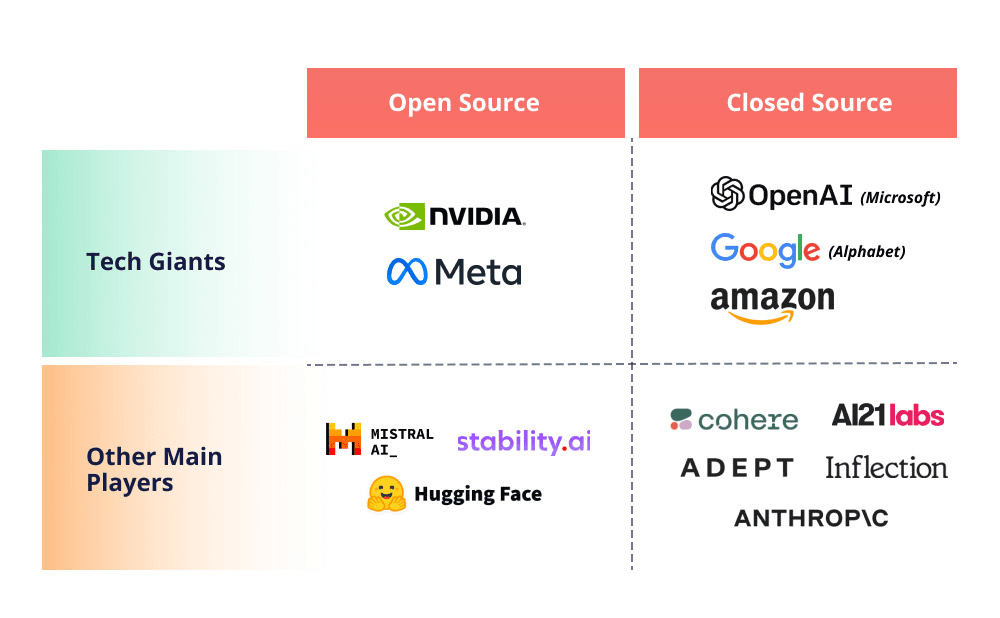
Graph from Aviso AI - https://www.aviso.com/blog/open-vs-closed-source-ai-sales-forecasting-dynamics
It's not clear how strongly AI will hurt job security or aid job creation in the long run, there is only the fact that there is much more nuance in this discussion than appears on the surface. Where we see hope for job creation, the uniqueness of AI's position instills doubts, but where we see fear of job destruction, the rapid advancement of this technology inspires hope for the little guy. Trump appears to want to give this train free reign to run wild, to advance as fast as possible, as seen through his "big beautiful bill" hoping to ban limiting AI development and regulation. The only question that remains is whether this technology will be a net positive, whether it will innovate and push society more than it confuses and harms it.
The distributive consequences of automation:
Sources:
https://www.anthropic.com/news/claude-4
https://www.cnn.com/2025/05/22/tech/ai-anthropic-claude-4-opus-sonnet-agent
https://www.steveglaveski.com/blog/ai-and-the-coming-productivity-paradox


2 comments:
There's a very complex relationship between technological advisement and human labor because AI is augmenting tech making it more of a closed loop than before. It's crazy to think that a machine can work a full shift without needing human intervention/operator which essentially eliminates entire categories of jobs. Compared to the Industrial Revolution, AI is fundamentally different because not only does it not always increase the output/labor because many robots are still in its baby stage, performing tasks at a slower pace than the human does it in the data collecting/learning process. The rise of open-source models like DeepSeek might allow small business and individuals to regain some power by using these tools independently, but big corporations are getting access the most advanced models from say Nvidia chips to cut costs first, before these small businesses gain any access. Trump's push to deregulate AI development would probably either empower small businesses and on top of that some corporations/political figures that monopolize on these tech and profits.
AI is changing things fast, but it’s kind of scary when you think about how it might affect job security in the future. People keep saying new tech will create jobs eventually, but since AI replaces human thinking, it’s different from the changes we saw before.
Post a Comment