Monday, December 9, 2024

Donald Trump Appoints David Sacks as White House AI and Crypto Czar

President-Elect Donald Trump has recently announced venture capitalist and podcaster David Sacks as the “White House A.I. and Crypto Czar” in a post on his social media network, Truth Social. Sacks has close ties with recently appointed DOGE lead Elon Musk, has advocated for deregulation, and is instrumental in influencing tech policy. His appointment suggests a shift toward a more industry-friendly approach, moving away from a more cautious stance seen under the Biden administration.

(Washington Post)

Who Is David Sacks?

David Sacks is a prominent figure in the tech world, best known for his role as a co-founder of PayPal along with fellow entrepreneur Peter Thiel, and as a venture capitalist at Craft Ventures. His recent pivot toward political activism, including financing a recall campaign against San Francisco’s district attorney, as well as Florida Governor Ron DeSantis’s campaign aligns him closely with right-wing political movements and pro-business policies.

Sacks is also known for his podcast, All In, which he co-hosts with fellow venture capitalists. The podcast delves into tech, business, and politics, reflecting Sacks' belief in a laissez-faire economy, and his concerns about what he views as the increasing woke culture in Silicon Valley.

The Role of AI and Crypto Czar

Although the specific duties of the AI and Crypto Czar remain unclear, the appointment reflects Trump’s commitment to promoting innovation in these fields. Trump’s administration has indicated a preference for less strict regulations on AI and cryptocurrency, both of which are seen as essential to future economic growth. For example, Trump’s previous criticism of AI safety regulations under the Biden administration is now being reversed, with a more an agenda focusing more on growth emerging.

In his new role, Sacks will advise Trump on tech policy, specifically working on creating favorable conditions for the AI and cryptocurrency industries. One of his key goals will be to provide clarity to the crypto market, to help AI companies avoid strict regulations while ensuring their operations are not subject to legal trouble.

Influence and Backlash

Sacks’ appointment has already attracted mixed reactions. Supporters, including members of the Republican Party and tech industry leaders, view him as a wise choice with the knowledge and connections to make impactful change. Republican Representative Dusty Johnson has praised Sacks for his ability to progress forward on critical issues such as digital assets and AI. However, others have expressed concern that Sacks’ industry ties might lead to excessive deregulation, potentially at the cost of public safety and fair market practices.

Skeptics, like Democratic Representative Stephen Lynch, worry that Sacks’ close relationship with Silicon Valley and his pro-business stance might lead to policies that prioritize industry interests over the broader public good. This concern is especially apparent in the context of cryptocurrency, where regulatory oversight remains a controversial issue.

Looking Ahead

David Sacks’ appointment as AI and Crypto Czar marks a significant shift in the Trump administration’s approach to technology policy. With a clear pro-business and deregulation stance, Sacks is tasked to shape the future of these emerging industries in a way that aligns with his Silicon Valley roots. As the U.S. continues to navigate the complexities of AI and crypto, Sacks’ influence will likely play a key role in determining how the government interacts with these innovations. As these technologies evolve, so too will the scrutiny over their regulation, and Sacks’ approach could either develop innovation or push the U.S. into unknown territory with potentially unpredictable consequences.


Sources:

https://www.nytimes.com/2024/12/05/us/politics/david-sacks-crypto-ai-trump.html?searchResultPosition=1
https://www.reuters.com/world/us/trump-appoints-former-paypal-coo-david-sacks-ai-crypto-czar-2024-12-06/
https://www.washingtonpost.com/technology/2024/12/06/trump-david-sacks-crypto-ai-czar/
https://www.politico.com/news/2024/12/06/ai-sacks-appointment-trump-00193028
https://time.com/7200518/david-sacks-new-white-house-ai-crypto-czar-trump-administration/

Assassination of UnitedHealthcare CEO: what it reveals about America's healthcare insurance system

    On Dec. 4, 2024, the killing of UnitedHealthcare CEO Brian Thompson sparked public outrage and highlighted systemic issues within the U.S health insurance industry. When the UnitedHealth Group expressed their sadness for Thompson's death in a Facebook post, the post received 62,000 reactions--- and ironically, 57,000 of which were laughing emojis. 

Credit: KARE 11

   So why were people reacting the way they were? Was this a minority v elite power struggle? Though the gunman's identity and motive has not yet been identified, Thompson's widow revealed that there had been "some threats potentially related to a lack of coverage" targeted at her husband. These threats were not exclusively targeted at the CEO, but the corporation itself. 

The problem

     Interestingly, the bullet casting was marked with phrases like "deny" and "defend," which implies a connection to systemic issues in insurance industry. The public backlash reflects widespread frustration with the private insurance sector. These issues include insurers using practices like prior authorizations and AI-driven claim denials to control costs; and this is often at the expense of patient health, specifically those facing high-cost care. For example, the 2023 KFF survey revealed that nearly one in five insured adults experienced claim denials in a 12-month period. On top of that, 1 in 4 of these individuals faced significant delays or were ultimately unable to receive care. For UnitedHealthcare specifically, a senate report found that its denial rate for post-acute care doubled from 10.9% in 2020 to 22.7% in 2022, and while some of the increase is caused by the spike in demand due to covid, part of it can also be attributed to the company's increased reliance of automation in claims processing. 

    Although reports show that 81% of insured adults rate their insurance as "excellent" or "good," there's still a significant gap in consumer protection. Only 43% of adults challenged a denial of care, and 50% of which were successful in their appeal. This demonstrates the arbitrary nature of the system's algorithms and their denials. Having personally gone through the healthcare coverage registration process for myself and my family, it's definitely a hassle:  making over 20 phone calls back and forth with three different corporate and governmental entities that are somehow connected to each other; registering on two different websites, and uploading a number of documents multiple times--I can see how this process can be extremely frustrating for many, especially those who are less proficient with technology. While it was a matter of whether I get cleared in time for sports tryouts, for other patients, the delay in coverage can greatly impact the decisions made by their families, especially on continuing with costly medications and medical trials for long-term treatment. In turn, this causes mental health strain among the impacted communities. For instance, 80% of adults reported anxiety or worry about delays in care, according to the Commonwealth Fund survey. 

    This ultimately exposes deep flaws in the US health care system. While private insurers struggle constantly with cases where clients are left with millions in unpaid medical bills, they are also blamed for prioritizing profits over patients. It's a systematic issue that private corporations cannot fix alone; and for this sector to keep running, public trust needs to be restored.

Are private insurers the ones to blame? 

    The underlying frustrations with the health insurance industry are also caused by market concentration issues, which are often caused by government policies/regulations. Federal programs like Medicare and Medicaid, essential for millions of Americans, unintentionally consolidate market power by favoring large insurers, which shuns out competitors and drive up costs. Some policies like restrictions on cross-state insurance sales fosters monopolistic behaviors and limits consumer choice. This can ultimately allow dominant insurers to slow down innovation/efficiencies to increase profit margin over patient care. As the social media reactions show earlier, Americans are increasingly aware of how systemic flaws in the system exacerbate their challenges with accessing accountable and affordable insurance providers. To make reforms, bureaucratic agencies have to step up and potentially deregulate the industry. Because by enabling greater participation from diverse competitors, the industry can shift toward prioritizing patient care, as more patients will be accounted for, not just by the dominant players in the market. 

Sources:

https://www.theatlantic.com/ideas/archive/2024/12/unitedhealthcare-ceo-assassination-investigation/680903/

https://www.nytimes.com/2024/12/05/nyregion/social-media-insurance-industry-brian-thompson.html

https://www.cnn.com/2024/12/06/business/insurance-claim-denials-unitedhealthcare-ceo/index.html

https://www.cato.org/briefing-paper/market-concentration-health-care-government-problem-not-solution#repeal-or-overhaul-federal-policies-encourage-market-concentration

https://www.economist.com/business/2023/10/08/who-profits-most-from-americas-baffling-health-care-system


Sunday, December 8, 2024

Trump states that he will end birthright citizenship within his second term


Trump in an interview with Kristen Welker (Politico)

Trump has been a long-time advocate for ending birthright citizenship, a right protected under the 14th Amendment, dating back to 2015. During his first term as president, he stated in an interview with Axios that he would try to end birthright citizenship using an executive order. However, most legal scholars and those closest to him believed that he had no grounds to do so. Due to this, he didn't really attempt to do much about this during his first term. Come 2024, Trump is once again attempting to end birthright citizenship. In a recent interview with NBC's Kristen Welker, incoming President Donald Trump stated that he plans to end birthright citizenship in America on his first day in office. Although he does not clearly state his plans, it is known that he will attempt to do so using executive action.

To give Trump credit, attempting to change U.S. law early in his presidency could be strategic, as he will probably have the highest approval rating and greatest public support at this time than any other. The timing of his plan seems to be similar to how former President Barack Obama got his Affordable Health Care Act done; a push for change as early as possible. However, changing or erasing the 14th Amendment would still be impossible through executive action. The only real way to do so would be to create a new amendment that would override the 14th Amendment which is a grueling process. 

The process of amending the Constitution under Article V is intentionally rigorous and involves several steps. Article V forces a proposed amendment to go through Congress and/or the state legislation where a majority vote has to be taken. Because of this many attempts to change the Constitution have failed and Trump's attempt will probably have the same fate as most. 

I do not believe Trump has the power to end birthright citizenship in America, but it is concerning to see him make such attempts. His approach often appears aimed at restricting minorities' access to this country, and his electoral victory remains surprising to some. I anticipate that during his presidency, he will try to pass bills aimed at deporting immigrants and tearing families apart. I can only hope that such measures do not succeed. His attempts seem like a presidential overreach and I do hope the checks and balances that are implemented into our government will make sure that he cannot do anything extreme. 


Thursday, December 5, 2024

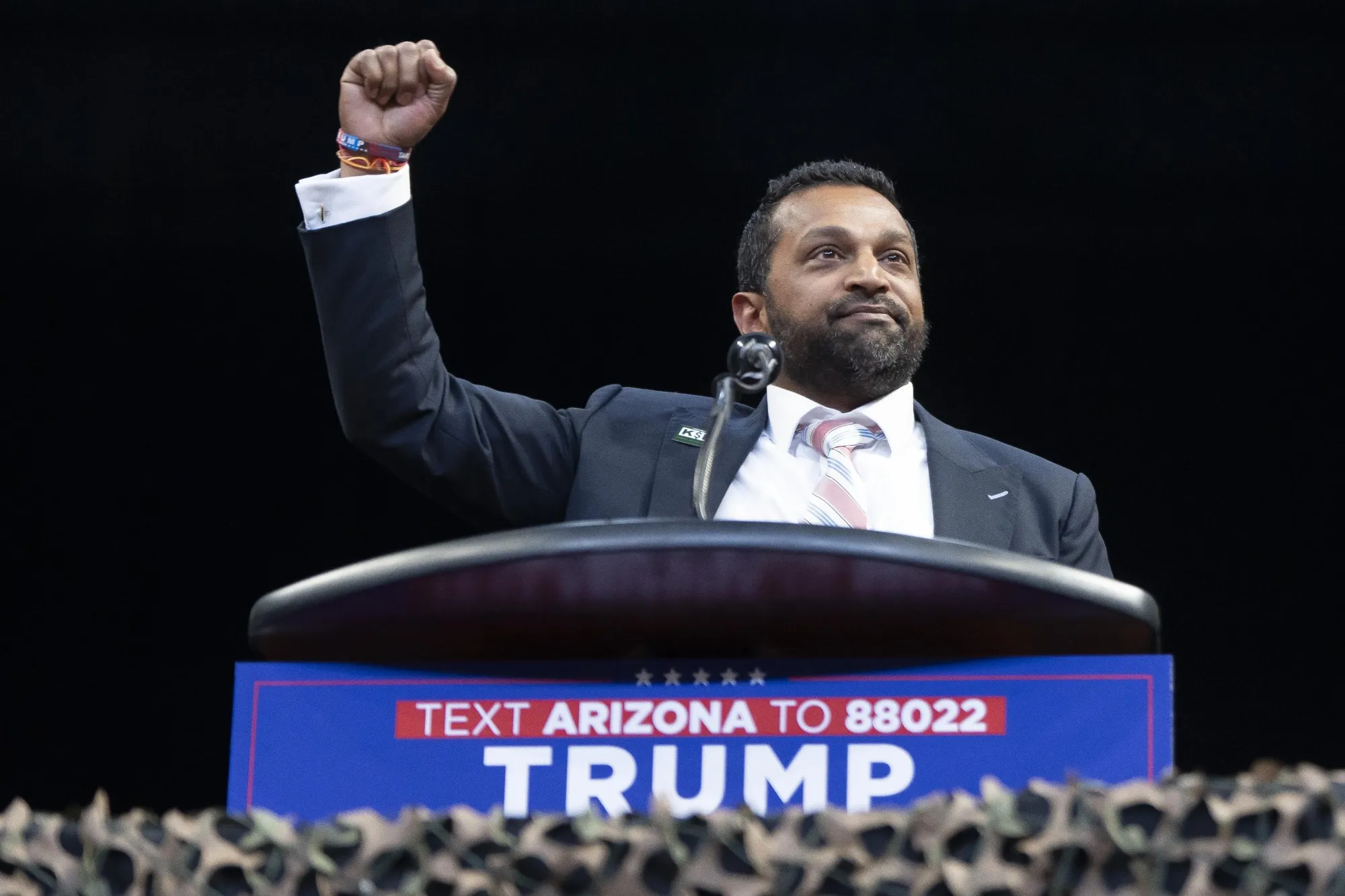
MAGA Loyalist Kash Patel to Lead the FBI


Donald Trump has picked former aide Kash Patel to become FBI director, which has stirred controversy. Patel would replace Christopher Wray, who was originally appointed by Trump in 2017 and still has three years left in his term. Wray would need to resign or be fired to make way for Patel.

Who Is Kash Patel?

Patel has worked closely with Trump in the past, and has held important roles such as Chief of Staff at the Department of Defense, Deputy Director of National Intelligence, and Senior Director for Counterterrorism at the National Security Council.
Trump has praised Patel on Truth Social, calling him a “brilliant lawyer, investigator, and ‘America First’ fighter who has spent his career exposing corruption, defending Justice, and protecting the American People.” Trump clearly has very high and confident expectations for Patel, having also posted that “This FBI will end the growing crime epidemic in America.” These expectations, however, may lead to issues. Patel may feel like me must follow Trump's beliefs at all times if wants to keep his job, though he has proven many times to be very loyal.

The Nomination

Many critics fear that he puts his loyalty to Trump above the duties of the government agencies he has served in. In his past positions, he has supposedly fired officials who did not fully align with Trump. Trump actually wanted to appoint Patel at the end of his previous term, however then-CIA Director Gina Haspel and then-Attorney General William Barr reportedly threatened to resign in protest.

He still needs to be confirmed by the senate, but despite the controversy, several senators predict that he will be confirmed. There may be benefits to having such an experienced individual in this position, however many worry rightfully about the potential politicization of the FBI under his leadership. It remains to be seen what will actually happen regarding his nomination as well as the other figures Trump has already proposed, however, it seems that Patel is part of a pattern of Trump nominating highly loyal, controversial figures to key positions

Wednesday, December 4, 2024

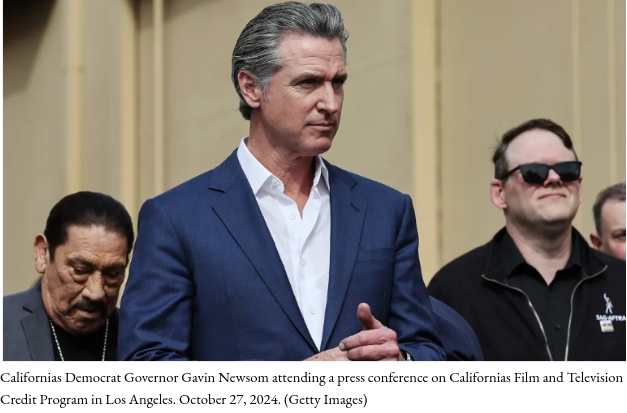
Governor Newsom gears up to fight back the Trump Administration by requesting 25 million dollar litigation fund to defend California from potential federal overreach.

 Last month, only a day after Trump defeated Kamala Harris in the presidential election,  California Governor Gavin Newsom announced a special session to discuss “Trump-Proofing”. That day finally came this Monday, December 2nd and included encouraging lawmakers to approve a $25 million dollar bonus litigation fund in preparation for Trump to take office. If passed, “the California Department of Justice and state agencies would get the extra[$25 million] funding for court battles in areas such as reproductive rights, environmental protection and immigration”(Reuters).

In Trump's 2016-2020 presidency, it has been reported that California spent nearly $42 million on litigation and filed 122 lawsuits against the Trump Administration (National). According to Newsom’s office, the spending on lawsuits “resulted in tens of millions of dollars more in federal reimbursements, billions of dollars in savings for California consumers, and protected billions of dollars in federal funding”(National). One example of California's success against Trump's budget-cutting policies would be back in 2017 when Trump issued immigration enforcement conditions on certain law enforcement grants. California's Attorney General Xavier Beccera responded by suing the administration. He stated, the administration “cannot manipulate federal grant fund requirements to pressure states, counties or municipalities to enforce federal immigration laws,”(Calmatters). California's Public Safety $28 million dollar a year grant was on the line, but two years later, after the Ninth District Court of Appeals upheld an injunction in the case, the federal government had to award California $57 million (Calmatters). 

California also joined other states as plaintiffs against Trump's unconstitutional civil rights bans such as his Transgender Military Ban and his attempt to repeal legal protection for DACA recipients. This largely ended in success as the Transgender Military Ban obtained a nationwide injunction and the court rejected Trump’s attempt to repeal legal protections for DACA recipients, siding with plaintiffs in the case, including California (Sacbee). The lawsuits display a trend of legal warfare between presidents and attorneys general from opposing parties that grew exponentially during the Obama administration.

If this $25 million dollar increase for litigation is approved, Newsom asserts that the fund “will help safeguard critical funding for disaster relief, health care, and other vital services that millions of Californians depend on daily”.  He added that the state plans to “defend against unlawful federal actions that could jeopardize not only tangible resources and the state’s economy as well as protection of reproductive health care and civil rights” (Reuters). 

Unsurprisingly, Trump issued a social media statement in response to Newsom’s unrelenting battle against his policy agenda stating, “He is using the term 'Trump-Proof' as a way of stopping all of the GREAT things that can be done to 'Make California Great Again,' but I just overwhelmingly won the Election”(CBS News). Newsflash, Trump; winning the election does not allow implementation of civil rights violations. 

If all goes well, Newsom’s office expects the special budget legislation to be signed into law before Trump’s inauguration on January 20 (Reuters). California's fight against Trump's executive authority displays the struggle between Federal control and states’ autonomy. 


Sources:

https://www.reuters.com/legal/california-governor-proposes-25-million-war-chest-legal-fights-with-trump-2024-12-02/ 

https://calmatters.org/justice/2021/01/california-cost-trump-lawsuits/ 

https://www.sacbee.com/news/politics-government/capitol-alert/article244692807.html 

https://www.nationalreview.com/news/california-governor-newsom-requests-25-million-from-legislature-for-anti-trump-litigation-fund/ 

https://www.cbsnews.com/sacramento/news/gavin-newsom-donald-trump-california-special-session-legislature/ 

https://www.sacbee.com/news/politics-government/capitol-alert/article188901094.html 


South Korea's quick martial law creates chaos as Parliament scrambles to undo it

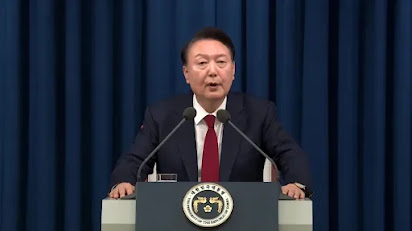
South Korean President, Yoon Suk Yeol,  announcing martial Law on South Korea (Reuters)


This Tuesday, December 3rd, 2024, South Korean President, Yoon Suk Yeol, imposed martial law on South Korea. This news was unexpected, there was no schedule for President Yoon to to have a speech broadcasted, and it occurred in the middle of the night. In this broadcast, he declared that he was placing South Korea under "emergency martial law". His explanation was vague, stating only that the South Korean government was under threat from North Korea.


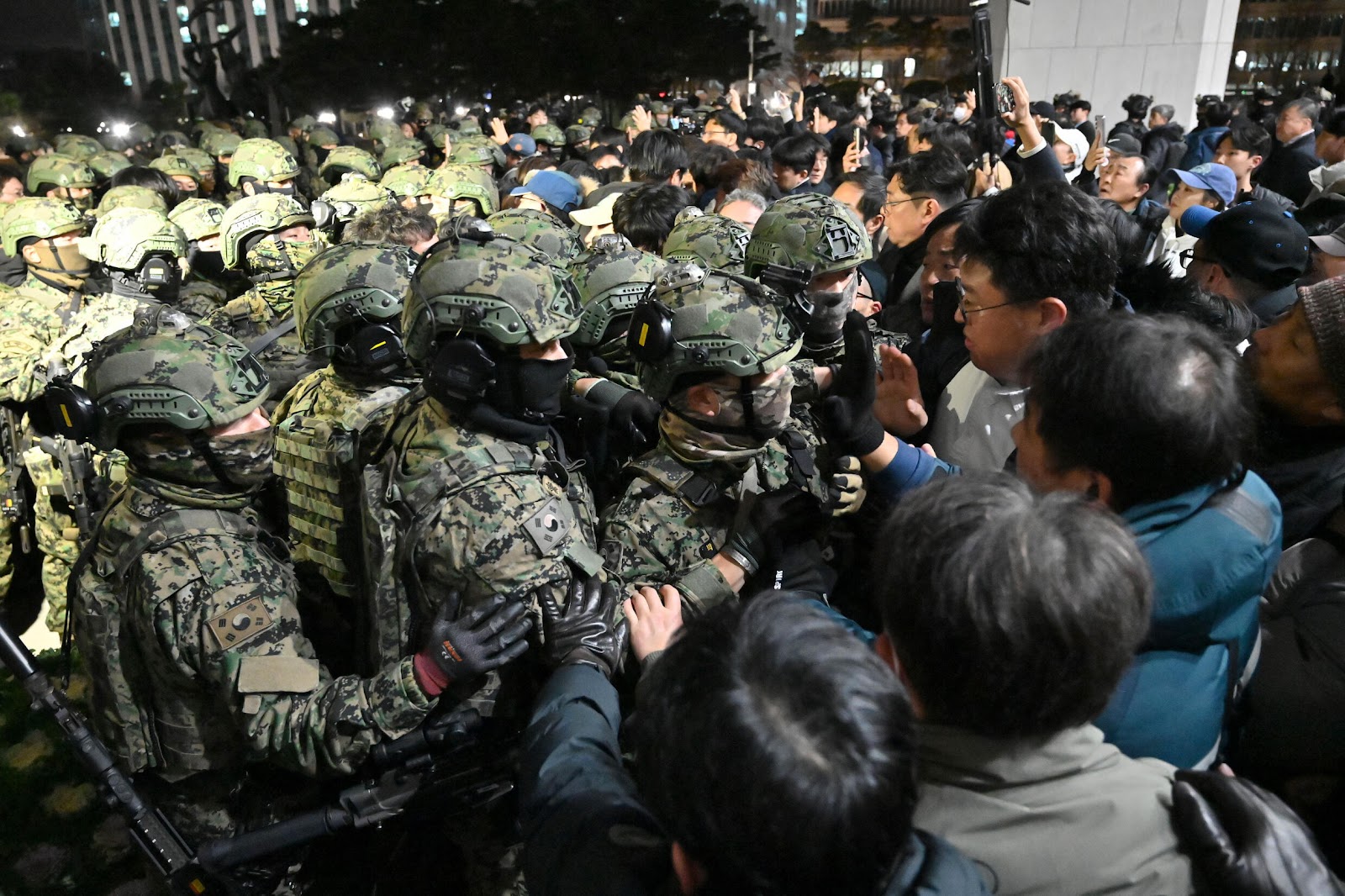
Soldiers try to enter the National Assembly after South Korean President Yoon Suk Yeol declared martial law

Protesters stopping Military personnel from getting into the National Assembly building(france24 news)


Martial law means that the military takes over the government. To try and execute this, soldiers were sent to the National Assembly building to try and stop members of Parliament from entering the building and lifting the order. Although the soldiers were sent quickly, 190 of the 300 members of Parliament were able to get into the building with some even having to jump over a fence because the police were blocking the gate. However, this was not the end as military personnel attempted to storm the National Assembly. They were met with fierce resistance from the staff and protesters piled up near parliament. The protesters were doing everything they could, from pulling soldiers away from the doors to even trying to pull away their guns. Although the soldiers were able to get into the building, barricades were set up within the building making it difficult to traverse. This gave the members of Parliament enough time to vote on whether to lift the martial law. With a unanimous vote, Parliament officially lifted the martial law at around 4:30 am on December 4th, 2024 local time.


What could this mean for President Yoon? President Yoon has had a low approval rating, with just about a 17% rating from the start and this new event will cause it to lower even more. With several corruption scandals on him, this will probably be his last one with many calling for his resignation or impeachment. There are already lawmakers in South Korea that have started the process of impeaching him and this will probably not have a hard time passing through as he tried to overthrow them using military force. It will only be a matter of time until he is impeached. 


This raises the question: Could this happen in America? The short answer is likely no. While the President has the authority to implement martial law, it would require a specific and compelling reason. In such a scenario similar to South Korea’s, Congress has the power to lift martial law promptly, ensuring that the situation is resolved before it escalates into something more severe. An overstep of this power will result in the same outcome as South Korea’s president, an impeachment. 


https://www.france24.com/en/live-news/20241204-soldiers-vs-office-chairs-south-korea-s-martial-law-standoff

https://www.bbc.com/news/articles/c0lgw1pw5zpo

https://www.pbs.org/newshour/world/south-korean-president-declares-emergency-martial-law-says-opposition-sides-with-north-korea

https://apnews.com/article/south-korea-yoon-martial-law-997c22ac93f6a9bece68454597e577c1


Tuesday, December 3, 2024

What Trump's Response to the Hunter Biden Pardon Means for the Jan 6 "Hostages"

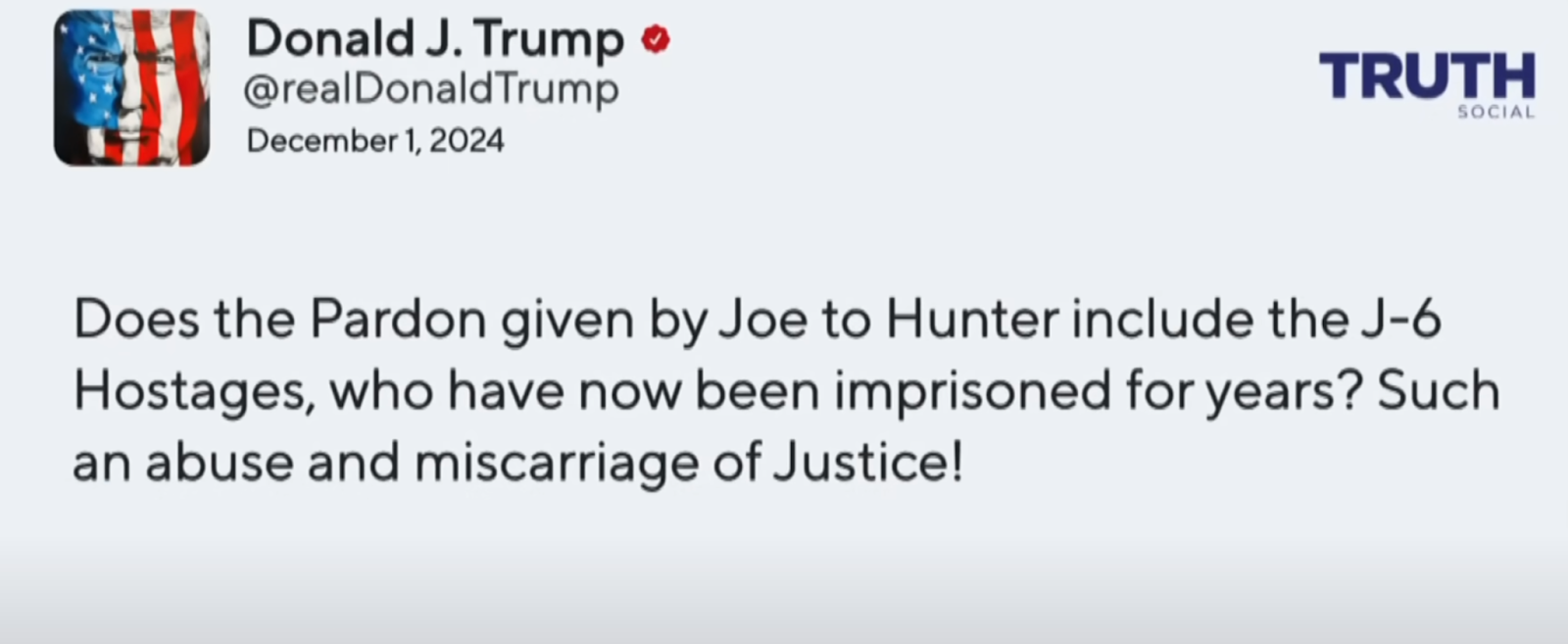
Shortly after outgoing President Joe Biden’s pardon of his son, Trump has criticized it sharply. He posted on Truth Social calling it “an abuse and miscarriage of justice.” Hunter’s pardon, which erased his convictions related to gun crimes and tax violations, has sparked controversy on both sides, and Trump and his supporters will likely use it as a springboard to revisit their grievances about the justice system.

Trump has long framed the individuals charged due to the January 6th Capitol riot as “political prisoners” and victims of a politicized legal system. His response to Hunter’s pardon highlights this, and it reinforces the precedent that Trump will pardon January 6 defendants when he returns to the White House. Trump’s post shortly after the event hints at this likelihood, building on his past accusation of Biden of weaponizing the justice system against political opponents.

Additionally, democrats fear Hunter’s pardon could enable Trump to justify his own controversial pardons, which are likely to happen when he regains his power. His incoming communications chief, Steven Cheung, underscored this by saying that the “system of justice must be fixed and due process must be restored for all Americans, which is exactly what President Trump will do as he returns to the White House.” However, although Hunter’s convictions are very different from the January 6 defendants, it would be hypocritical of Trump to just immediately pardon them all after criticizing Biden’s use of the controversial power.

The controversy also raises constitutional and political questions about the presidential pardon power. Both Biden and Trump have used this authority to address perceived injustices, but critics argue that these moves risk eroding public trust by prioritizing political loyalty over actual justice.

As Biden prepares to depart his presidency, he makes a last minute pardon for his son Hunter’s recent Gun and Tax convictions.

This past Sunday, current president Joe Biden announced that, despite the promise he made back in June, he would be pardoning his son from the convictions he was facing. Hunter Biden pleaded guilty in two separate trials over the summer - one on federal tax charges and one of lying about his drug use on a form when buying a handgun. After Hunter's June conviction, Joe Biden spoke on ABC; And when asked on whether he “ruled out a pardon” for his son, Biden replied; “yes”; assuring Americans that the justice system does not unfairly protect political elites (Geraghty). 


According to the indictment, “he not only refused to return the documents for many months, but he also obstructed justice by enlisting others to destroy evidence and then to lie about it”(Hur). On the other hand, “Mr. Biden turned in classified documents to the National Archives and the Department of Justice, consented to the search of multiple locations including his homes, sat for a voluntary interview, and in other ways cooperated with the investigation”(Hur). Trump was not unfairly selected because of his status but more so because of his actions. 

Hunter Biden on the other hand, paid back his 1.2 million of tax owed aswell as had been sober for 5 years; Surely enough to grant Clemency. But because Biden, in a 2021 memoir, wrote at length about his addiction to crack cocaineuu and alcohol”, he outed himself for potentially lying on the federal form he filled out in 2018 to obtain a handgun. Such information is rarely used to prosecute gun buyers, as it is hard to differentiate addiction and moderate consumption (The Trace). 


Another point to note is that part of the public outcry is due to Biden granting a “full and unconditionaly” pardon for any crimes Hunter may have committed from December 2014 till this past sunday. A particularly broad pardon compared to other presidential pardons. For example Bill Clinton's pardon of his brother Roger was only for a singular drug trafficking charge-not a decade long of drug addicted actions. 

Trump, planning to take office in January, was predicted to issue many pardons, especially for those involved in the January 6th capital raid; And now this move by Biden may have fueled the fire for Trump to pardon much more excessively and broadly; therefore setting a precedent of abuse of clemency power. Jeffrey Crouch, a legal expert from American University, told CBS his predictions after Biden's pardon; "If presidents from both political parties feel free to abuse clemency without consequence, the pardon power becomes less a tool of grace and more of a political instrument" (Zurcher).

Not all Democrats were even willing to support the president’s Sunday action. Rep. Greg Stanton (D-Ariz.) spoke out against the pardon, saying, “I respect President Biden, but I think he got this one wrong.” The former Phoenix mayor continued, “This wasn’t a politically-motivated prosecution. Hunter committed felonies, and was convicted by a jury of his peers”(Shia Kapos).  If these precedents continue we may see an exponential decrease in trust of government and a break from the 2 party system as both parties seem to be at blame this time. 

, Biden's pardon is justified in the sense that he worked to receive clemency but on the other hand a pardon of a decade long seems a bit out of hand and an abuse of presidency.


Sunday, December 1, 2024

Canada Prepares for an Influx of Immigrants


    The US-Mexico border gets so much attention when it comes to immigration policies, but what about the US-Canada border? It is the longest border between any two countries in the world afterall, at a length of 5,525 miles. 

    President-elect Donald Trump has long been pressing for domestic deportation in America, and if he follows through, it will be the largest in American history. With Trump set to take office in January of 2025, many migrants in the US who may face Trump’s mass deportation efforts are anticipating this unwelcomeness in the US and are thus pushing north, seeking asylum in Canada.

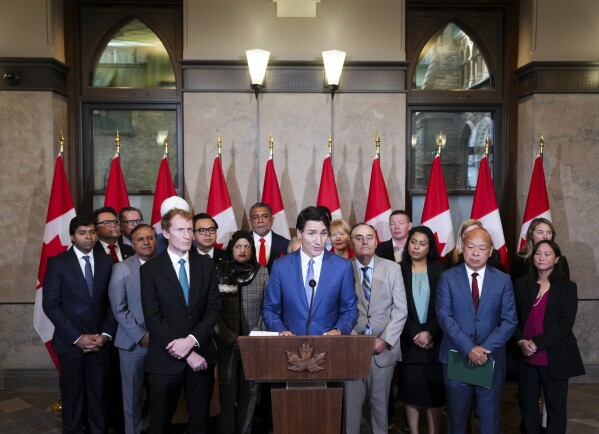
    During Trump’s first presidential term in 2016, Canadian Prime Minister Justin Trudeau conveyed that his country would be friendly to asylum-seekers, posting publicly on his social media: “To those fleeing persecution, terror & war, Canadians will welcome you, regardless of your faith. Diversity is our strength #WelcomeToCanada”. Trudeau did so even during this time when Trump pushed to tighten security along the Mexican border and threatened to separate families.

    But somewhat hypocritically, Trudeau recently vowed to significantly reduce the number of immigrants it allows into Canada: only allowing 396,000 by 2025, 380,000 in 2026, and 365,000 in 2027. He stated, “Immigration is essential for Canada’s future, but it must be controlled, and it must be sustainable.” Similarly, François Legault, the premier of Quebec (a province at the forefront of bracing for immigrants) said, “The problem isn’t immigrants, it’s the number”. 

    So in efforts to mitigate the effects of Trump’s deportation desires, the Royal Canadian Mounted Police (RCMP) created a plan to bolster the number of agents and vehicles it has along the Canadian border. They’ve identified enforcement agencies that could divert extra staff to the border and plan to use land along the border to set up temporary detention and processing facilities. Furthermore, ​​Canadian officials plan to add patrols, buy new vehicles and set up emergency reception facilities at the border between New York and Quebec. This all comes from anticipating a spike in migrants even before Trump is sworn in, because many migrants are seeking a preliminary solution to this potential problem.


    In addition to actions taken at the border itself, Canadian authorities also intend to uphold a key agreement between Canada and the US: to be able to send back asylum-seekers crossing into Canada back to the US. The agreement designates Canada and the US as “safe third countries” to make asylum claims, so when asylum-seekers travel from one country to the other, they can be sent back, with not many exceptions. However, Canada hopes to see this fully enforced, a two-way street. 


Sources:

Trump's Tariffs Threaten the Economy, But Congress Could Stop Them

    It has been a promise of Trump's campaign that on his first day in office, he will enact tariffs on China. However, he has recently expanded his tariff threats to Canada and Mexico as well. These tariffs would be used as leverage against Canada and Mexico to make them take action on the border issue, a pillar of Trump's policy agenda. However, these tariffs could be damaging the American economy, and make the lives of everyday Americans more difficult. Despite all this, there is still time for Congress and even the Supreme Court to stop these tariffs.

Just this year, The U.S. has imported 632.3 billion in goods from Mexico and 572.9 billion from Canada, over one-third of all U.S. goods. Tariffs would increase prices on basic goods like gas, and weaken U.S. manufacturing. For example, one of the largest manufacturing industries in North America is automobiles. Parts for cars often cross the border 7 or 8 times over the course of production, and with tariffs they would be taxed each time, increasing the final price of vehicles drastically. Current president Joe Biden said he hopes Trump rethinks the tariffs, calling it "a counterproductive thing to do" and saying it could "screw up" national relationships.

Trump has already shown he is more than willing and certainly able to place tariffs on foreign nations during his first term. He used Section 232 of the Trade Expansion Act of 1962 to impose tariffs during his first term, as well as Section 301 of the Trade Act of 1974 to impose six additional tariffs. Many forget, but these tariffs of between 7-25% did disrupt the global supply chain.

All of these tariff threats are concerning, but if you remember what we have learned in Congress, the Constitution actually gives them the power to regulate foreign trade, not the president. However, since the Great Depression, Congress has gradually delegated more and more foreign commerce powers and responsibilities to the president. Trump could use these delegated powers to enact tariffs as he did in the past. Congress still has time to revoke the authority delegated to the president though, and Reps. Suzan DelBene and Don Beyer have already introduced the Prevent Tariff Abuse Act, which could limit the ability of the president to enact tariffs. It may also be in the best interest of Congress members to prevent the tariffs, because as we learned, most people vote based on the economy. If tariffs cause a rise in prices, congressional incumbents could have a difficult time holding onto their seats during the midterms.

If Congress fails to prevent the tariffs, the Supreme Court may be able to step in as well. Chief Justice John Roberts recently wrote to overturn the Chevron Deference, concluding courts should exercise independent judgement and not defer to executive agencies when interpreting the Constitution. I thought that was already their job, but I guess not. The Supreme Court typically stays out of the way when it comes to presidential powers in foreign trade, but if they could prove imports from Mexico and Canada are not a national threat to national security, they could thwart the tariffs. Now only time will tell whether either of these branches of government will step up to potentially rescue the American economy from years of struggle.

Sources: