Sunday, March 5, 2023

Another Train Derails in Ohio, Prompting Increased Scrutiny of the Rail Industry

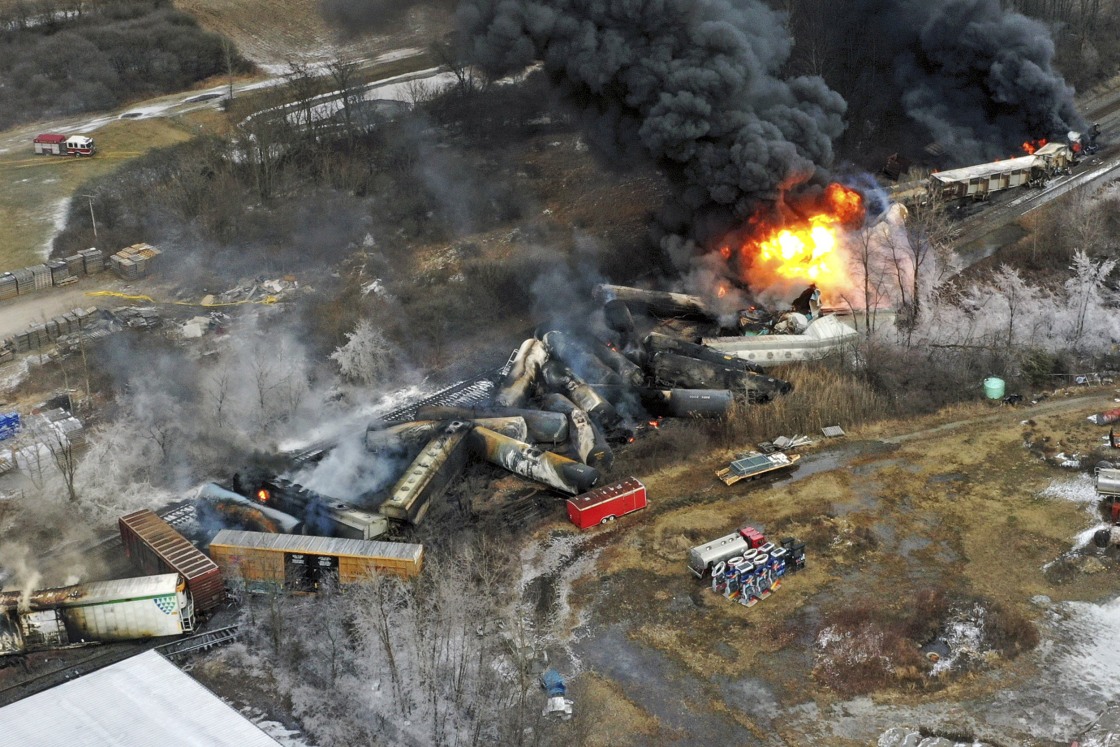
Multiple Norfolk Southern train cars toppled on March 4 in Clark County, Ohio. (Bill Lackey / Springfield-News Sun via AP)


Thirty days after the devastating Norfolk Southern train derailment in East Palestine, Ohio, residents are still reeling from the environmental effects of the toxic chemicals released from the 50 cars damaged in the crash. But the company operating the train doesn’t seem to have learned their lesson. At around 4:45pm yesterday, Saturday March 4, another Norfolk Southern train derailed near Springfield, Ohio.


As a refresher, the February 3 train derailment caused a fire that eventually led to officials releasing toxic fumes into the air in order to prevent further explosion from the hazardous chemicals onboard, including vinyl chloride, which is known to cause a rare form of liver cancer after chronic exposure. Around 5,000 residents were evacuated, and although they have since been allowed to return to their homes, serious concerns persist surrounding the health risks of remaining in the area. On February 8, the Ohio Department of Natural Resources reported that 3,500 fish had died in the local streams. Additionally, local residents have posted pictures online of dead farm animals, and many have reported coughs, rashes, and other illnesses common to chemical exposure. The Environmental Protection Agency (EPA) has been monitoring the chemical levels in the water, soil, and air surrounding the area, and has reported no unusual or harmful levels despite these reports. Many are also concerned at the safety of the soil, as farming and livestock are major sources of income to residents in the area. On top of that, locals expressed anger at environmental authorities do to their delayed response to the situation; it took EPA administrator Michael Regan almost two weeks to tour the crash site, located only 20 miles from his state border.


Yesterday’s crash appears to have been far less dangerous to the local environment. Officials issued a precautionary shelter-in-place to nearby homes, but most of the 20 cars that derailed were empty boxcars. Only one car was of real concern to environmental officials, which contained polyvinyl chloride (PVC) pellets that have affected the soil, although reports claim they aren’t toxic. Officials have worked to clean up the pellets today to prevent anything other than surface soil from being contaminated. Arguably the most impactful result was that the crash left over 1,500 local Ohioans without power.


Despite the fact that the second derailment was much less harmful, citizens nationwide have begun raising concerns about the safety regulations at both Norfolk Southern and the American rail industry. Several lawsuits have been filed against Norfolk Southern in the wake of the derailments, and CEO Alan Shaw is set to testify in Congress on Thursday, March 9 about the East Palestine derailment. Pennsylvania Governor Josh Shapiro also sent a letter to Shaw after the first crash claiming that Norfolk Southern failed to immediately inform authorities on the amount of chemicals involved and the true and complete effects of these chemicals. He also claims employees were too hurried in turning to controlled release to manage the chemicals, and did not explore other, safer options. Employees of Norfolk Southern and the railroad industry have also expressed discontent in recent years surrounding cut backs on regulations and added hours, making them feel less safe and confident in their work. Security footage from Salem, Ohio, which is 20 miles away from East Palestine, shows the axel that eventually caused the derailment was already glowing, with flames underneath at least one car of the train, but the employees operating the train claim they tried to stop as soon as the warning system alerted them there was a problem. Several Congress members, including both Ohio senators, have discussed and/or proposed legislation that would tighten railroad safety regulations.


In the wake of these derailments, the intense scrutiny the railroad industry has fallen under has been met with widespread support. Four derailments in less than five months in Ohio alone (two occurred last fall) in frankly unacceptable, and a huge risk to the lives of anyone nearby, in both the short and long term. No one knows how the chemicals from the East Palestine derailment may be affecting the health of those in surrounding areas, and we may not know for another 50 years. As Senator Sherrod Brown (Ohio) states, “Ohio communities should not be forced to live in fear of another disaster”. The federal government is already cracking down on the management of Norfolk Southern, as well as the entire railroad industry. Many are beginning to question if the industry itself has been left largely alone for too long, and are urging their representatives to take action in Congress. Rail companies spent almost $25 million lobbying Congress on various pieces of legislation in 2022 alone, and have stopped antitrust bills from passing in recent years. Despite their best efforts, the profit-oriented intentions of these rail giants has become painfully clear to the public in the wake of these derailments, and even their deep pockets may not be enough to save them from facing the consequences.


https://apnews.com/article/ohio-train-derailment-bcc6198dfbde42feefdeca8f24ccaea8 

https://www.nytimes.com/2023/02/28/us/ohio-train-derailment-east-palestine.html 

https://www.nytimes.com/2023/03/05/us/ohio-train-derailment.html 

https://www.washingtonpost.com/nation/2023/03/05/springfield-ohio-train-derailment/ 

https://www.nbcnews.com/news/us-news/20-cars-norfolk-southern-train-derail-ohio-no-hazardous-materials-boar-rcna73435 

https://www.axios.com/2023/02/13/what-we-know-about-ohio-train-derailment 

https://www.commondreams.org/news/rail-industry-federal-lobbying#:~:text=Rail%20giants%20spent%20%2424.6%20million,parties%2C%20and%20political%20action%20committees

Biden’s Student Debt Relief Plan in the Supreme Court, and What the Decision Could Mean for the Future of Higher Education

Sen. Elizabeth Warren (D-Mass), at a student debt relief advocates' rally on Capitol Hill. (AP Photo/Patrick Semansky)


This past Tuesday, February 28, the Supreme Court heard oral arguments from two cases challenging the legality of President Biden’s federal student loan relief plan. 


The plan, announced in August 2022, would allow the government to forgive up to $20,000 in debt per borrower for Pell Grant recipients who met the income eligibility requirements, and up to $10,000 per borrower for everyone else who meets the income eligibility requirements. Over 40 million Americans are eligible for loan forgiveness, and over 26 million managed to apply in the month between the application opening in October 2022 and being closed due to the legal uncertainty in November of the same year. The Congressional Budget Office estimates that the plan, were its legality to be upheld, would cost the federal government an estimated $400 billion.


U.S. Solicitor General Elizabeth Barchas Prelogar and the Biden administration maintain that this plan is legal first under the Higher Education Act (HEA) of 1965, which broadly gives the federal government the ability to cancel student debt, and more specifically under the HEROES Act of 2003, which gives the Secretary of Education the ability to “alleviate hardships” federal student loan recipients could suffer in result of a national emergency, in this case the COVID-19 pandemic. Federal student loan payments have already been halted in the wake of the pandemic as of March 2020, and will not resume until either 60 days after the Supreme Court decision or early August, whichever comes first.


The first case is brought forth by six states - Arkansas, Iowa, Kansas, Missouri, Nebraska, and South Carolina - and argues that this plan exceeds the boundaries of the HEROES Act and therefore needs Congressional approval. Notably, the states also claim to argue on behalf of MOHELA, the Missouri student loan authority that Nebraska Solicitor General Jim Campbell claims is a “state-created, state-controlled public entity”. In the second case, two members of the public who are not eligible for the full $20,000 of loan relief, backed by the Job Creators Network Foundation, argue on the basis of equality and claim the government should have sought out public comment and opinion before carrying out the plan.


Despite these accusations, the main dispute in both of these cases is whether or not the plaintiffs have legal standing. As discussed in class, legal standing refers to the requirement that the plaintiff is negatively affected by the action they are challenging. In the case of the states, both conservative and liberal justices are skeptical of the states’ ability to argue on behalf of MOHELA due to Missouri’s “arm-length relationship” with the organization. Additionally, the Biden administration plans to add the costs of the plan to the federal deficit, which means there is no direct payment required from taxpayers. However, some have noted that repercussions may arise in the future through efforts to lower the federal deficit, which was around $1.38 trillion in the 2022 fiscal year. For the second case, data has proven that although Pell Grant recipients receive more aid from the government than other student loan recipients, they also have a harder time paying it back in the future, making the relief inequality reasonable. If the Supreme Court upholds the standing of at least one of the cases, legal experts are in general agreement that the Court’s conservative supermajority will vote to overturn the plan.


One aspect that many are keen to point out is that President Biden’s debt relief is a one-time loan forgiveness model. Post-secondary education still racks up tens of thousands of dollars in debt per student, and the current rise in inflation is showing no signs of making these debts any easier to repay. On top of this, the job market is becoming more and more reliant on college degrees, with many industries being made virtually inaccessible to anyone without a degree in the field. While many states have worked to provide more accessible college education, with 26 states, including California, offering some form of free community college, the future is still bleak for those hoping to continue their studies after high school. If the Supreme Court upholds President Biden’s debt-relief plan, it could potentially set in motion additional policy to make post-secondary education more accessible to everyone. However, the more likely result, the Supreme Court striking down President Biden’s plan, would further separate college education from the state, establishing a precedent that would provide little leeway for the federal government to manage the costs of college degrees in the future. More immediately, the Biden administration has admitted that they have few alternatives available were this plan to fail. Either way, the Supreme Court’s decision will set important precedent on the ability of the government to involve itself in postsecondary education, for better or for worse. 


https://www.cnbc.com/2023/02/28/biden-student-loan-case-argued-at-supreme-court.html 

https://www.cnbc.com/2023/03/03/when-will-supreme-court-rule-on-bidens-student-loan-forgiveness-plan.html 

https://time.com/6259839/student-loan-repayments-supreme-court/ 

https://www.cnn.com/2023/03/05/politics/biden-student-loan-forgiveness-scotus/index.html 

https://www.nytimes.com/2023/02/28/briefing/supreme-court-student-debt.html 

https://www.forbes.com/advisor/personal-finance/who-pays-for-student-loan-forgiveness/ 

https://www.businessinsider.com/how-will-supreme-court-rule-student-loan-debt-cancellation-standing-2023-3

https://fiscaldata.treasury.gov/americas-finance-guide/national-deficit/#:~:text=In%20FY%202022%20total%20government,from%20the%20previous%20fiscal%20yearhttps://www.forbes.com/advisor/student-loans/are-community-colleges-free/

Thursday, March 2, 2023

Biden Nominates Julie Su for Secretary of Labor

This Tuesday, February 28, President Biden announced his nomination of Julie Su, current Deputy Security of Labor, for the role of Secretary. The announcement stems from current Labor Secretary Marty Walsh's decision to leave the administration and head the NHL. 

"It is my honor to nominate Julie Su to be our country's next Secretary of Labor. Julie has spent her life fighting to make sure that everyone has a fair shot, that no community is overlooked, and that no worker is left behind." 

Biden went on to commend Su's accomplishments, acknowledging her role in leading the largest state labor department, her success in representing over 70 undocumented Thai garment workers forced to work under sweatshop conditions, raising the minimum wage, and enforcing workplace standards for safety. 

Su's goals coincide with Biden's in that she, too, hopes to achieve a more equal and accessible workforce. 

"To all workers who are toiling in the shadows, to workers who are organizing for power and respect in the workplace, know that we see you."

Such comments reflect Biden's goal to "rebuild the backbone of this nation, the middle class." Closing out his statement, Biden stated, "I look forward to continuing to work with Julie to build an economy that works for working people, and I respectfully ask the Senate to take up this nomination quickly so that we can finish the job for America's workers."

However, Biden's hopes for a quick nomination will likely experience some friction as it flows through the Senate. While largely backed and supported by Democrats, there has been some backlash by Republicans regarding Su. In a letter written and signed by seven Republicans representing California, two arguments were made to discourage Biden from his nomination: the first was titled "Fraud showing the highest degree of negligence" and the second as "Damage to the livelihoods of hard-working Americans." The first incident surrounded conflict about unemployment insurance fraud during the height of the COVID-19 pandemic with Su as California Labor Secretary. The report cited $32 billion in fraudulent payments being sent out to people who did not qualify for the California unemployment compensation program, while others who proved eligible for the assistance failed to receive payment on time. The latter argument brought up Su's support of AB5, a law that the Republicans claimed "has cost tens of thousands of freelance workers and independent contractors their economic livelihoods." The letter concluded that these two incidents scream "incompetence." 

Looking back at her nomination for Deputy Secretary of Labor in 2021, her confirmation just barely passed with a 50-47 vote, noticeably with zero Republican support. In this year's Congress, Su faces a 51-49 Democratic-led Senate. If the same trend continues, a party-line vote by the Democrats will likely be needed to nominate Su for the position of Secretary. Complications may also give way as Democrat John Fetterman of Pennsylvania is out receiving inpatient treatment for depression. 

If confirmed, Su will be the first Asian American member of Biden's cabinet at the secretary level, joining AAPI Cabinet members Vice President Kamala Harris,  U.S. Trade Representative Katherine Tai, and Office of Science and Technology Policy Director Arati Prabhakar. Even with significant opposition by Republican opponents, Su still receives great support from the Congressional Black Caucus and the Congressional Asian and Pacific Islander Caucus. In fact, it was Asian American Democratic lawmakers and advocates that influenced Biden to nominate Su.


https://www.whitehouse.gov/briefing-room/statements-releases/2023/02/28/president-biden-nominates-julie-su-for-secretary-of-the-department-of-labor/ 

https://thehill.com/homenews/administration/3879003-biden-at-julie-su-nomination-event-im-just-anxious-to-finish-the-job-here/ 

https://www.nytimes.com/2023/02/28/business/economy/julie-su-labor-secretary.html

https://www.politico.com/news/2023/02/28/biden-to-tap-su-as-next-labor-secretary-00084776

https://www.npr.org/2023/02/28/1160104766/biden-labor-secretary-nominate-julie-su

https://d12t4t5x3vyizu.cloudfront.net/kiley.house.gov/uploads/2023/02/Su-Delegation-Letter-2.17.2023-Kiley.pdf


Monday, February 27, 2023

Balancing Inflation and Unemployment Rates


    As seen with the giant economic swings caused by COVID-19 it is very hard for the government to regulate both

inflation and unemployment even having access to complicated macroeconomic models.

    When the entire country shut down due to the spread of COVID-19, the economy took a turn for the worse as people stayed home from work and were not spending money on any non-essential items. This impacted industries from entertainment to restaurants to individuals who were laid off due to these impacted industries. The government stepped in with stimulus checks in order to revitalize the economy by giving consumers the resources to buy the products people needed. This increased the amount of money in circulation which in turn helped industries be able to hire more workers. However the government’s stimulus checks focused on providing macroeconomic stability while now we are dealing with the consequences of high inflation.

    According to Forbes Advisor, “During the Covid-19 economic crisis’s peak, unemployment rates soared 14.7% in April 2020. But as of July 2022, unemployment stands at 3.5%, the lowest level since February 2020.” Unemployment and inflation are inversely related. As unemployment increases, inflation decreases and vice versa. The government tries to balance out these two negatives. In the past, the Federal Reserve has used the Phillips curve as one of its macroeconomic models to set interest rates. The Phillips curve is a model that describes the relationship between inflation and unemployment and is used by the government in order to stabilize pricing while still maintaining high employment rates. Recently with the surge in inflation, many companies are laying off workers in order to deal with inflation. According to Insider, “Silicon Valley slashed some 100,000 jobs in the past six weeks in repentance for its pandemic-era hiring binge.” This is an example of inflation decreasing but unemployment increasing following the Phillips curve model. According to Investopedia, “When more people are working, they have the power to spend, which leads to an increase in demand. And prices (inflation) soon follow. The opposite is true when unemployment rises.” This shows how as inflation rises and labor becomes more expensive, businesses' margins of profit become slim enough that businesses start to lay off people in order to reduce their expenses and this decreases inflation again following the Phillips curve model.

    However, as the economy has changed with income inequality reducing the individual worker’s bargaining power as well as other factors like globalization and the increased efficiency brought by e-commerce, the Phillips curve has become less and less accurate. This has led to it becoming more and more difficult for the government to use fiscal policy to prevent recessions and minimize inflation. This is partly because although businesses now react to future models of inflation predictions, the Phillips curve does not take into account businesses having such advance reactions.

    It is clear that the government will have to take more things into account when creating fiscal policy with the intention of stabilizing prices and the labor market.

Sources:

Forbes Advisor

The Phillips Curve

Insider

NY Times - Tech Layoffs

Phillips Curve Image


Sunday, February 19, 2023

UFOs A Threat to National Security?


   On February 4, the US military shot down a Chinese “spy balloon” which was claimed by Chinese officials to just be a weather balloon. On February 10 and 11, two more unidentified flying objects were shot down. On February 12, another UFO was shot down over Lake Huron in Michigan. The question is, are these actions by the US military necessary to protect the privacy and safety of its citizens or is the US military being over zealous? 

According to CNN author Peter Burgen, “the number of UFO sightings significantly increased between March 2021 and August 2022, during which time 247 new sightings were reported, mostly by US Navy and Air Force pilots and personnel. That’s almost double the 144 UFO sightings reported in the 17-year period between 2004 to 2021.” Although the amount of UFOs is increasing dramatically, there is still no clear evidence that the increased UFOs sightings are linked to any military operation by another country or any threat to US national security. General Glen VanHerck, commander of US Northern Command and North American Aerospace Defense Command reported the US military had no new information about the three objects downed this weekend as opposed to the clearly identified Chinese balloon shot down on February 4. Despite having no real evidence of a particular reason behind the increased sightings of UFOs, the Pentagon created a new entity called the All-Domain Anomaly Resolution Office to investigate all credible UFO sightings by both the US military and the intelligence community. 

In addition, House Intelligence Committee Chairman Mike Turner said on February 12 that he preferred “them to be trigger-happy than to be permissive” when referring to the US military’s use of force without any knowledge of a known threat. And on Thursday February 16, President Joe Biden reported that the three unidentified flying objects shot down were “most likely” balloons owned by private companies, not foreign intelligence agencies.

It seems like there is no conclusive evidence that the UFOs can be dismissed as non-threatening, but are they worth the attention and the money spent on $400K missiles to shoot them down?


Sources:

CNN Opinion Piece

CNN

USA Today

NY Times

Tuesday, February 14, 2023

Nikki Haley for President 2024?

Nikki Haley | Biography & Facts | Britannica
Nikki Haley


    Former South Carolina Republican Gov. Nikki Haley said in a video on Tuesday that she will run for president in 2024, becoming the first significant challenger to former President Donald Trump for the Republican nomination. "The Washington elite has failed us again and again. "It's time for a new generation of leadership to rediscover fiscal responsibility, protect our border, and build our nation, our pride, and our purpose," Haley said in the video, speaking at a campaign launch event in Charleston on Wednesday. Under Trump, Haley served as the United States' ambassador to the United Nations.


    The former president, who launched his candidacy last year, recently appeared to endorse her entry into the race, telling reporters that she had called to inform him she was thinking about launching a campaign, and he had told her, "You should do it."


If she wins the primary, Haley will be the Republican Party's first female and Asian American presidential nominee. During her video announcement, Haley emphasized her record as a twice-elected South Carolina governor and her leadership in the state following the deadly shooting of nine people at a historically Black church in Charleston in 2015. Following the incident, Haley demanded that the Confederate flag be removed from the grounds of the Statehouse. In her announcement, she also drew on her foreign policy expertise, mentioning her stint as UN ambassador and claiming to have "seen evil."


As the second major candidate she looks to be Trump's biggest competitor. Not only is she the first candidate to openly challenge Trump, she is the first woman of color to run for Republic nomination. So that means Haley’s candidacy will be a high-profile test of how a woman of color is received by Republican primary voters.


Other prospective GOP contenders in this lane include Florida Gov. Ron DeSantis, former Vice President Mike Pence, and former Secretary of State Mike Pompeo, who are all believed to be considering 2024 campaigns and may similarly appeal to conservative Republicans wanting to turn the page on Trump. According to some Republican strategists, a large Republican primary field would benefit Trump, who still has enormous support among the party's base, and may fragment the vote, allowing the former president to win the nomination.


https://www.cnn.com/2023/02/14/politics/nikki-haley-2024-announcement/index.html
https://nikkihaley.com/
https://www.wsj.com/articles/nikki-haley-enters-gop-presidential-race-as-first-major-trump-challenger-4f88d0da

Monday, February 13, 2023

Not Another Pandemic...


Something new, something blue. Something floating, something flu. Currently, one of the largest bird flu outbreaks is occurring. Bad enough as it is, here's the kicker: it appears that the virus has managed to infect mammals (including us!!!). Rare as they may be, it only takes a bit o' mutating in order to get widespread infections among our populations. Will this flu be the next pandemic? Hopefully not. Though if it does happen, and is handled the same way COVID was, then uh oh, spaghettio. 


Bird flu, at least the current strain, H5N1, first came about in 2020, spreading to Africa, Asia, and Europe, then crossing over to NA in 2021. Bird flu is very, very contagious among avian populations, including chickens, eagles, hawks, ducks, geese, etc. From there, skunks, foxes, dolphins, bears, and others have also been detected to have the virus, though most of these cases appear to be from eating an infected bird. 


Though there are cases that demonstrate mammal to mammal transmission, which is a big red flag. A mink farm in Spain, and dead seals in Maine. On the farm, minks that exhibited symptoms usually died within a few days. However, the real problem begins here: autopsies revealed pneumonia in their lungs; lungs closer to those of a human's than a bird's. Ferrets are our best model for human influenza infection, and happen to be close relatives to minks, meaning if the minks got it, then we might have a problem. Sequencing the strain, researchers discovered a mutation that does not exist in the bird version: "T271A in the PB2 gene" - which was also seen in the 2009 swine flu H1N1, which was responsible for more than 12,000 deaths in the US according to the CDC. Scientists worry that this may be the prelude to a human epidemic.


As of December, the WHO reported 6 infected from circulating bird flu strains. The 4 cases in the US and Europe were asymptomatic/mild, while the patient in Vietnam developed severe symptoms but lived, while the patient in China unfortunately died. At the moment, it's difficult for the virus to do human to human, and the overwhelming majority of cases are caused by close contact with birds. The flu targets the lower respiratory tract, showing preference in the lungs. This is both a good and bad thing; it means there are less viral particles concentrated in the nose and mouth, meaning less infectivity, but also means it is more capable of causing severe disease. 


Given the viral nature, bird flu is unpredictable. It currently doesn't appear to support widespread mammalian transmission, but that obviously isn't a guarantee. Therefore, there is a nonzero chance that bird flu does in fact become a pandemic. Basically, scientists don't know when and how likely bird flu will become a pandemic, or if it will at all. Thus, be safe.


Assuming it does happen, the US may have some issues just like they did COVID. One critical issue was a decentralized response. Because of how our government is structured, a lot of the pandemic response was left up to state and local leaders, which led to a rinky-dink patchwork of policies that did not synergize at all, leading to spikes of infection, domino-ing into a huge burden on the healthcare system as hospitals filled up. Obviously, that was a disaster, especially when compared to how other nations handled it. They say history repeats itself, and we always hope it doesn't. But they say that for a reason.


Sources:

https://www.usatoday.com/story/news/health/2023/02/10/bird-flu-next-pandemic-preparation/11218600002/

https://www.scientificamerican.com/article/how-the-u-s-pandemic-response-went-wrong-and-what-went-right-during-a-year-of-covid/

Sunday, February 12, 2023

True or False: George Santos

 The saga of Geroge Santos continues 


We have all heard about the “resume embellishment” and the contradicting stories around his mother’s death as well as about his volleyball prowess, but despite catching Congressman George Santos in so many lies, he is still in office. 


What does this say about the state of our government?  And more importantly, what does it say about how people are voting? It is interesting to see that the North Shore Leader, the local newspaper in New York’s third district, wrote articles calling into doubt some of what Mr. Santos said on the campaign trail. The Leader even went as far as endorsing the “Democratic candidate, saying it wanted to support a Republican but that Mr. Santos ‘is so bizarre, unprincipled and sketchy that we cannot.’”  


So why did Santos win with a 54% of the vote? It's due to more party-line voting, especially for those still believing the debunked lies regarding election fraud in the recent presidential election. This is a key point of why George Santos isn’t funny. Not only was Santos able to run while telling lies, but he was also able to win elections by targeting a select audience. Unfortunately, even the speaker of the house hesitating on the decision for him to be removed highlights the fact that someone who lies their way into political roles can secure and maintain their position. 


The amazing part is that Santos continues to lie and seems to ignore the fact that he keeps getting caught.  Following his run-in with Senator Mitt Romney at the State of the Union address, he claimed that “Kyrsten Sinema told him to 'hang in there.'” but CNN reports that her office says that’s a 'lie.' At this point, Santos is starting to lie about things with zero relevance to anything and people are starting to take notice. Now his own party is pointing out lies. According to a survey from Newsday and Siena College “A total of 78% of voters in the Nassau County and Queens district want the 34-year-old GOP lawmaker to resign, including 89% of Democrats, 72% of independents and 71% of Republicans.”  In fact, his office in Washington DC is regularly protested by people from his district. Despite the recognition of these lies and since there is no call for his resignation from Republican congressional leadership, it looks like at least the people within his district have had enough.  


How can he represent the people of his district if they don’t trust him or want him in office by a vast majority? This is a big question for him, especially since he must now declare if he is running in the next election.  This decision is important as it impacts if he can raise money and how he spends it.  The financing of his last election has already been called into question and there is an ethics committee investigation.


Sources:

Picture: https://www.nbcnews.com/meet-the-press/meetthepressblog/poll-78-santos-voters-want-resign-rcna68349

Articles: https://www.economist.com/united-states/2023/01/17/george-santos-is-the-congressman-america-deserves

-https://nypost.com/2023/01/31/poll-78-of-george-santos-constituents-say-he-should-resign/

-https://www.bbc.com/news/world-us-canada-64587233

-https://thehill.com/homenews/senate/3852008-gop-senators-sympathetic-to-romneys-call-for-santos-to-resign/

-https://www.cnn.com/2023/02/10/politics/fec-george-santos-campaign-fundraising/index.html


Thursday, February 9, 2023

U.S. Sends Aid After Earthquake in Turkey and Syria


On February 6, a magnitude 7.8 earthquake hit Turkey and Syria, destroying homes and buildings, leaving more than 21,000 dead so far, with more than 17,000 deaths in Turkey and more than 3,000 in Syria. In addition to this there are more than 78,000 injured people across both of the countries. It is one of the deadliest earthquakes in the past 20 years, and the strongest earthquake in Turkey since the 1930s. 

President Joe Biden said that his "administration has been working closely with our NATO Ally Turkey". Since then, the U.S. has transported first responders and multiple urban search and rescue teams to provide aid to it's ally. However, according to spokesperson for the United States Department of State, Ned Price, the U.S. will aid Syria through non governmental organizations without engaging with the Syrian government. 

Syrian officials condemned the United State's refusal to engage with their country's government even following a deadly earthquake, but Price says that "It would be quite ironic — if not even counterproductive — for us to reach out to a government that has brutalised its people over the course of a dozen years now" He asserts that while aid will be provided, no U.S. funded humanitarian aid will be provided through the Syrian regime.

I think that while it may seem cruel to be refusing to send direct aid, it's a perfectly reasonable action. The Syrian government has no diplomatic relations with the U.S. and aid is still being sent, albeit through groups not affiliated with the government. Politics are an important consideration in every situation, and emergencies are no exception.

https://www.defense.gov/News/News-Stories/Article/Article/3293241/us-aids-turkey-after-devastating-quakes/
https://www.newsweek.com/syria-says-us-politicizes-earthquake-after-refusal-send-aid-assad-1779637 
https://www.aljazeera.com/news/2023/2/6/us-pledges-post-earthquake-aid-but-no-contact-with-syrias-assad 
https://www.politico.com/news/2023/02/06/u-s-response-blinken-turkey-syria-earthquake-00081307 
https://www.cnn.com/middleeast/live-news/turkey-syria-earthquake-updates-2-9-23-intl/index.html 

Monday, February 6, 2023

ChatGPT's Potential Future in Education and Government


We've all heard of ChatGPT. Some of us might have used it once or twice, perhaps just to dip your toes in the water and see it for yourself, or maybe write up a little text based narrative, maybe for homework help, or even important life decisions. Or even, used it to do a little cheaty-cheat here and there. However, it is capable of so much more. It can do a wide array of things among those listed above, but some of the more useful features are explaining complex topics simply, guessing and/or diagnosing medical issues, writing accurate code, writing emails, ads, blog posts(not this one though), up to entire essays. With a myriad of potential, the sky's the limit. But before the current potential issue with it, a little bit on how it works. 


Created by OpenAI, ChatGPT is, at its heart, an AI based chatbot. From my own, limited understanding of AI, ChatGPT mimics human behavior by studying and analyzing an unimaginable amount of data, and then generates a response to a question asked of it using that data and its own kind of learning. But here is a more professional explanation: "The program uses a deep learning technique called "transformer architecture" to sift through several terabytes of data that contain billions of words to create answers to prompts or questions. ChatGPT's predecessors include GPT-3, which also generates text, but has been trained on a much larger set of data. While this makes GPT-3 more powerful, ChatGPT is faster, more capable of generating human-like answers, and is available to the public. The bot works in the same way that AI generator tools like DALL-E 2, Midjourney, and Stable Diffusion do - but much like how those programs can create unrealistic images, ChatGPT is not always accurate." As it states, the AI is not an omnipotent being, and is wrong on occasion, as I have seen before. However, there is no denying its infinite usefulness, especially when it comes to the schoolzone battleground.


Many students around the world have differing opinions on the uses and applications of ChatGPT. However, common consensus is that it's a fun toy to experiment with, it can provide decent help and writing, and, of course, is a tool that can be used for cheating. However, the differing opinions were present, too, boiling down to these 2 main contenders: AI is the future, and is only beginning, and AI is some kind of crutch that will destroy our motivation and ability to do things. Both of these have merit, and really the only way to know is the passage of time. Here are some of those student sentiments: "In almost all classes in school, ChatGPT should not be used. As it continues to get better and better, ChatGPT will be doing work that the student should do for them." and "I’ve had experience using ChatGPT before and it’s been really helpful for me: When using it for personal questions, joke questions, or help on school assignments, it helps me gather research or understand the topic a lot better and faster …"


Onto how it relates here, though. AI will inevitably find its way into the workforce, and actually do what many fear most: replacing jobs. And from there, will undoubtedly come regulations and such. On the topic of regulations, in the regulatory process, there is a time period for comments and whatnot before said regulations take effect. Supposedly, humans are making these comments. However, interested parties might be able to wield ChatGPT and flood the system. As Washington Post states: "There is no law against using software to aid in the production of public comments, or legal documents for that matter, and if need be a human could always add some modest changes." Hardly the only area AI can use as a playground, another example of the potential plethora is something we're familiar with: grassroots lobbying. No longer will actual people have to compose letters and emails to their local lawperson, a computer can do it for them - and possibly even better, at that. Obviously, that would eventually pose problems due to the astroturfing nature of something like that.  


Though ChatGPT has no opinions and emotions of its own, from its current understanding of itself, this is what it had to say about its educational use and cheating:

O
Here is another example of its "opinion", or more accurately, analysis on government related uses: 

So enough from me, what are your opinions on AI? Is it the future, or our doom?

Ohio train derailment and evacuation


Earlier this month (Feb 3), by the border of Ohio and Pennsylvania, the town of East Palestine reported seeing a large plume of smoke. The cloud of smoke was caused by a train that derailed after a mechanical issue with a few of the wheel axles. The train was carrying vinyl chloride, an extremely toxic and flammable gas that was fatal if inhaled. Governor DeWine said the Ohio Department of Health would have to allow the chemical to safely run into a collecting trench, where it would be safely handled and removed. His statement said that this collection method is the safest removal option as of right now, and the best explosion preventative measure. Seeing as the gas was volatile at the time of the explosion, he ordered an evacuation of anyone living within a two mile radius. Around 5,000 people were displaced but were given refuge at two evacuation centers nearby. 911 emergency centers for that town have had to relocate, with assurances that emergency services wouldn't be affected, and schools within this area have been closed for the coming week. A shelter in place has been enacted, and the town will remain closed until all the chemical run off has been safely handled. As of February 6th, no other news about citizens going home have been released.

The growing debate over the AP African American studies course and its indication of Americans’ divided stance on Educational Freedom


Back in mid January, the College Board unveiled their new pilot AP course on African American history. Yet, after facing much backlash and criticism from conservative leaders and some scholars and professors, the College Board published revisions to the course, many which ameliorated the criticism that was widespread from the right. 

The government in Florida banned the course, on the basis that such topics of race. The state legislature recently passes laws that restricted from teacher in the state from speaking about such issues so that “ students are not made to feel guilty for racist acts carried out by others.” As per the terminology of the law, “A person should not be instructed that he or she must feel guilt, anguish, or other forms of psychological distress for actions, in which he or she played no part.” Florida’s republican governor Ron DeSantis has been at the forefront of the criticism of the course, and claimed that it had no place in the state of Florida. 

Yet, the most recent changes to the course remove lessons on Black Lives Matter, and readings from left-leaning authors such as Kimberlé Crenshaw, which talk about critical race theory. Joshua Myers from Howard University targeted liberals and their actions, stating “it shows how  far liberals will go to confront the creeping fascism in this country. And that’s not very far at all”. Myers argued that the liberals are actually not doing enough to fight for the educational freedom, and are not willing to go to far lengths in order to stand up for what they believe in. 

I believe that the criticism from both sides only serves to highlight the divided country that the United States is in the role of race, history, and educational freedom. We have those on the far right arguing that black history is not a crucial part of American History, while we have those on the left fighting to make sure that all students are exposed to the truth of black history. I think that what the College board is doing is great in introducing and making the topic of black history more widespread and important throughout the curriculum. I found much value and learning from the topics that we learned about with regards to black history, leaders, and movements last year in the 11th grade and feel that the same knowledge and education should not be restricted to students throughout the country.


https://www.nbcnews.com/politics/politics-news/ap-african-american-studies-course-watered-gop-pressure-rcna68454 (includes video) 


https://www.washingtonpost.com/education/2023/02/02/college-board-ap-african-american-studies-criticism/ 

https://www.nbcnews.com/news/latino/afro-latinos-desantis-black-ap-studies-rcna69036