Monday, January 15, 2018

Trump’s ‘Fake News Awards’ could violate ethics rules


Photo Courtesy: Daily Dot
Ever since President Donald Trump announced the upcoming media-bashing “Fake News Awards” to be held this Wednesday, there is very little knowledge about the event (with the exception that it will not include Fox News and the ultimate award is the fake news trophy). However, what is known by ethics experts and government watchdogs is that it if it is held at the White House rather than under the Trump campaign or RNC, it violates federal ethics codes. One specific section of codes it would violate is the executive branch’s Standards of Ethical Conduct, which deems it illegal for employees for using their position to “[endorse] any product, service or enterprise.” Though the president may be exempt from facing the repercussions of the awards event, White House staff involved would be subject to misuse of their position and can face repercussions varying from censure to dismissal from position. According to chairman of the Citizens for Responsibility and Ethics Norm Eisen, “risk violating §§ [section marks] 702, 704 & 705 [of the Standards of Ethical Conduct] forbidding use of gov time & $$$ to harm some media & aid others” (Twitter), regardless of whether they are praising one news outlet and bashing another. Moreover, former White House ethics lawyer Richard Painter warns that Trump’s slew of network-biased tweets, the awards, and other administrative actions pertaining to the media careen on First Amendment concerns, which would thus make it easier for a staffer to be subject to questions of ethical conduct and can place the president himself in a troubling position.

What do you think about the whole situation?
  • Do you think the president should be able to hold power over such an event, even if it has the potential for many of his own employees to be fired?
  • Though there are potential legal repercussions associated with the awards, comedians such as Stephen Colbert are treating the event (or, as Colbert calls it, “The Fakies”) as a joke. With that being said, how serious do you think the Fake News Awards are?

Links:

The Humiliation of Aziz Ansari


Although there have already been many men accused of sexual misconduct, Aziz Ansari is one of the first with whom our generation has a strong connection. Rather than simply cover this as another casualty in the MeToo movement, I have based this post off an opinion article in the Atlantic.

The author is a woman whose recent articles include “To Hell With the Witch-Hunt Debate: The post-Weinstein moment isn’t a war on sex. It’s a long-overdue revolution.” Thus, her stance -- that the accusations against Ansari are a step too far are -- is surprising but worth being considered.

I think that we all must come to terms with the way that the MeToo movement has flipped sexual assault allegations from “He’s right” to “She’s right.” Should it be a permanent change? Is it equally dangerous that only women are believed? Or is it a necessary danger that must be accepted in order to put women on a more equal footing?
 
Personally, I believe that the MeToo movement is a necessary step, but I hope that things do eventually cool down. Women must be safe from abuse and innocent men must be safe from accusation. This is not to say that I believe that any of the men accused are innocent -- I am simply saying we must as a society weigh the possibility of persecuting the innocent as we evaluate how to move forward.

Trump's Economy - Created 2 million jobs in 2017

Numbers were recently released detailing how good the stock market and job market currently are under President Trump. In 2017, about 2 million jobs were created especially under manufacturing - an industry Trump promised to repopulate in his election. However, while these numbers are impressive, when looking at the percentages of change in the stock market compared to presidents Trump's numbers still don't compare to Obama's. The stock market went up 27% in Trump's first year in office as compared to Obama's 33%.
Chart courtesy of CNN
There's also talk by experts that attribute the growth of the market in one year to the President that held office the year before. Additionally, although 2 million jobs is substantial, it doesn't compare to previous years. In 2016, 2.2 million jobs were created, in 2015 there were 2.7 million, and in 2014 there were 3 million. Of course this is only natural as coming out of the Great Recession more jobs were created at a faster rate and then as unemployment goes down so does the job market.

The job market is so strong actually that employers are complaining they can't find qualified workers for their industries. Because of this, some experts claim that part of the reason wage growth isn't growing at as fast a rate as it should is because of the fact that employers aren't finding people qualified enough to fit their jobs and therefore wage growth is being stumped at whatever level they are qualified at. The interesting point here is that Trump is planning to cut the federal education budget (leaving the education funding to the states) and also cut the amount of student loans given out in the name of jobs. But as time goes on we are seeing that almost every industry is requiring a higher level of education / qualification for its workers, so in the end is limiting students' access to college really going to help the job market? And while Trump has done a good job bolstering areas like manufacturing, some of his reforms have hurt small businesses and retailers who are losing their stores and jobs because of the shift.

When you look at the numbers, they are indeed impressive, and unemployment is at a 17-year low (4.1%), but they might not be as impressive as his tweets indicate considering the other factors like percentage of growth and how good the economy already was when he took office.

Questions:
1. Do you think Trump is actually doing as well as he claims regarding the economy? Why or why not?
2. What do you predict to happen in the following years of his presidency?

Sources:
CNN


Sunday, January 14, 2018

California Mudslide Toll Rises to 20


Photo Courtesy: Reuters

The destruction of vegetation and property caused by the Thomas wildfire that hit the Santa Barbara and Ventura counties in December has contributed to the occurrence of mudslides in the Montecito region. The slides have left at least 20 dead, four missing, and hundreds more homeless or seeking shelter. As rescue crews plow through mud, boulders, and other debris, highway US 101 is currently closed to protect against any further victims and to enable for effective searching. However, it is unclear as to when on Monday the highway will open (if on that day). Due to the degree of damage caused by the mudslides, the size of the mandatory evacuation zone was increased on Thursday and will be in effect for one week with a possible delay to two weeks.

Though the Thomas fire is now 100% contained, geologists and weather forecasters state that the magnitude of damage to the charred land has rendered the area susceptible to mudslides and may leave it in that state for years to come.

Questions
  • The CNN article proposes digging more basins to collect and delay the degree of damage caused by storms. What other means can be used to decrease the magnitude of destruction caused by such disasters?
  • What kind of aid do you think the government (whether local, state, or national) should give to the victims?
  • Aside from federal aid, what other means of raising money for the victims do you propose? What, mainly, should this money go towards?

Links


False missile alert sparks panic


On Saturday January 13th, mobile phone users received the text above reading, "BALLISTIC MISSILE THREAT INBOUND TO HAWAII. SEEK IMMEDIATE SHELTER. THIS IS NOT A DRILL." According to the CNBC news channel, the alert "momentarily put recipients into a state of frenzy, with scores reportedly running for shelter".  People tried to find outside shelter and this caused clogged highways and scenes of terror. Others stayed home and seeked shelter in their bathtubs. Travelers staying in hotels were gathered in the lobby and brought to underground parking garages for safety.

However, within around 30 minutes the alert was deemed as a false alarm. Although it was only a false alarm, people were really shaken up from this event. “What happened today is totally inexcusable,” Senator Brian Schatz said. “The whole state was terrified. There needs to be tough and quick accountability and a fixed process.” It was said to be sent out on accident by human error.

North Korea's missile and nuclear program is seen as a growing threat to America and Hawaii is one of the US states closest to North Korea. It is because of its location that Hawaii has been threatened by the escalating tensions and the risks of war, more than any other part of the United States. Admiral Harry B. Harris Jr., commander of the United States Pacific Command, said “While the possibility of a nuclear strike is slim, we now live in a world where we must be prepared for every contingency.”

Questions:
1. Do you think the sender of the emergency alert should be the only one punished for this mistake?
2. With false alarms like this, do you think there will be a "boy cring wolf" situation if an actual missile were to come along?
3. Do you think this event could trigger actions from Kim Jong Un or President Trump that could lead us closer to war?

Saturday, January 13, 2018

To Get Medicaid in Kentucky, Many Will Have to Work. Advocates for the Poor Say They Will Sue.


Recently, the Trump administration approved their plan regarding Medicaid. According to the article, "Kentucky will be the first state to require many of its Medicaid recipients to work or face losing their benefits." The new plan that will start in July stated that people who receive Medicaid between ages 19 to 64 must work at least twenty hours a week. While they must have a paid job, they are able to use "volunteer work, job training, searching for a job, taking classes or caring for someone elderly or disabled" to help complete their hours. This plan excludes anyone who is disabled, pregnant, a full-time student, homeless, or caretakers. In addition to the required work hours, those that are not elders or disabled will have to pay $1 to $15 a month; the amount that they will pay depends on their income. 

The Bevin administration has predicted that they will lose around 100,000 recipients after five years, yet also save $2.4 billion. They also stated that this will encourage people to find jobs and create a path for them. Those who are against this plan think that health comes before work and that if people had a job, then they would likely need Medicaid.

Discussion Questions:
1. What is your opinion on this plan?
2. Do you think Medicaid should be limited to certain people?
3. Do you think this will force more people to go back to work?

Links:
NYTimes
Kentucky Health
Medicaid

Friday, January 12, 2018

Trump administration proposes offshore drilling


Last week, the Department of the Interior released its draft proposal to allow offshore drilling in essentially all U.S. waters, including the Atlantic Ocean. They are doing this because they believe it will unleash the offshore gas potential for the US. The president and his administration are committed to serving the needs of corporate interests, ignoring the impact on everyday Americans. These decisions are clearly designed to benefit Big Oil at the expense of coastal communities.

What is the new offshore drilling plan? The program is called The National Outer Continental Shelf Oil and Gas Leasing Program and it ,"has been proposed for 2019 through 2024 and would open 90 percent of the nation’s offshore reserves to development. It proposes the largest number of offshore lease sales in U.S. history." However, this is not finalized yet because states and environmental groups are predicted to challenge the new program. Governor Jerry Brown released a join statement saying, "flies in the face of decades of strong opposition on the part of Oregon, Washington and California."

Costal states are outraged and their governors are fighting to kill the proposal all together. However, there is one state that has been promised exemption from the offshore drilling, and that state is Florida. But after the Trump administration made this promise, it left other costal states thinking "what about us?"

Questions:
1. Why do think Trump and his administration would make this proposal if over 50% of Americans are against offshore drilling?
2. Do you think this proposal will end up working out? Or will too many states successfully oppose it?

Links:

Health and Human Services Secretary nominee under fire for formerly working in big pharma


*Photo courtesy of The Hill*

Summary:
Trump's pick for the new Secretary of the Health and Human Services department is Alex Azar, someone who's moved back and forth from Washington (under Bush) to Eli Lilly, a large pharmaceutical company. One of Trump's promises was to curb big pharma and cut down prices on drugs, but so far there haven't been any movement in that direction. He's nominating Azar for his experience working in both fields, but much of the Senate is opposed to this nomination considering that they don't see how someone who used to raise drug prices for a pharmaceutical company is going to help accomplish their goals.

Analysis:
Picking someone that headed the pricing committee at a large pharmaceutical company, and admitted to refusing to sign off on anything lowering drug prices while in that position, doesn't seem like the best move the President could've made. Not to mention the last secretary that Trump nominated, Tom Price, didn't lower any prices but did leave his post due to a scandal over his use of government money for private jet rides. It's almost as if the position itself is cursed. President Trump wants to lower drug prices not just for the general public, but also because he hopes it will lower the cost of Medicare and Medicaid: the two biggest chunks of the federal budget.

However it doesn't seem likely Azar will make a effort to achieve these goals. His track record at Eli Lilly tells a very different story than he did at a meeting with the Senate Finance Committee on Tuesday. He actively attempted to make Eli Lilly's drugs less accessible to other countries and has said that he doesn't think the government should sit down with pharmaceutical executives and negotiate drug prices (as Trump has advocated for in the past). Additionally, while stating that he agreed drug prices were too high he hasn't given much in the way of concrete and immediate solutions and has instead insisted that there is no "silver bullet" that will fix the system in a heartbeat. Something else to note is that Eli Lilly is offering a large donation to Trump's campaign efforts should Azar be approved.

*Video Courtesy of Washington Post*
On the flip side, Azar's supporters, mostly conservatives, have agreed that he is better equipped to deal with the current state of affairs regarding Medicaid, Medicare, and drug prices because of his affiliation with Eli Lilly and his former position in Health and Human Services under George W. Bush. Although Azar does have experience in these fields, the facts point more towards the idea that he is more invested in working with the drug companies to find some sort of Band-Aid solution that wouldn't jeopardize his previous industry's massive earnings but still lower the price of Medicare and Medicaid somewhat. It will be interesting to see if the Senate approves his nomination or not, and what he will do if in office.

Questions:
1. Why do you think Trump nominated him? Did he know how it would look and did he care?
2. What's your opinion on the issue?

Sources:
CNN
The Hill
Washington Post

Thursday, January 11, 2018

House Votes in Favor of NSA Surveillance Law

On Thursday, January 11, the House of Representatives voted to pass a bill in favor of renewing the National Security Agency’s surveillance program for another six years. This 256 to 164 vote is the House’s effort to renew a law that enables the NSA to collect data pertaining to foreigners from American companies, declining a bipartisan effort (mainly from conservative Republicans and liberal Democrats) to put up privacy barriers for Americans. This vote was cast shortly after President Trump appeared to change his mind about the law, sending out Tweets in favor of the law even though he accused such surveillance to be a ploy targeted against the Trump administration.

Trump's "change of heart" tweets
https://twitter.com/realDonaldTrump

Though this was quite a large margin in terms of votes, in order for this to become law, the results from the Senate’s procedural vote on this bill next week must be in favor of it, and President Trump must sign it into law as a final check. Republican Congressional leaders, US intelligence agencies, and even the White House have voiced their belief that the program needs little to no revision, but Trump’s Tweets from this morning may have a determining factor as to how senators will cast their ballots.

Questions:

  1. Why do you believe the margin of “yay” and “nay” votes was so large?
  2. What do you think it is about surveillance and privacy that makes it a topic that transcends party lines?
  3. Do you predict the Senate will vote in a similar fashion, or do you think this matter will go back to the drawing board?
Links

Most expensive year on record for US natural disasters


2017 was a record year for natural disasters in the US, seeing 16 separate events. With three strong hurricanes, flooding, and wildfires, the US tallied a record high bill of $306 billion. The total cost totaled higher than the previous record of $215 billion in 2005. Three of the five most expensive hurricanes of US history were in 2017. As well as hurricanes, there were devastating fires all over the US, particularly in California. Fires in both the north and south of California meant many residents had to be evacuated. The report from Noaa says that "across the US, the overall cost of these fires was $18bn, tripling the previous wildfire cost record."


"'While we have to be careful about knee-jerk cause-effect discussions, the National Academy of Science and recent peer-reviewed literature continue to show that some of today’s extremes have climate change fingerprints on them,' said University of Georgia meteorology professor Marshall Shepherd, a past president of the American Meteorological Society." This was the third straight year that all 50 states had above average temperatures for the year. Five states — Arizona, Georgia, North Carolina, South Carolina and New Mexico — had their warmest year ever.


Although it is seemingly obvious that these phenomenons are due to global warming, President Trump tweeted, "In the East, it could be the COLDEST New Year’s Eve on record. Perhaps we could use a little bit of that good old Global Warming that our Country, but not other countries, was going to pay TRILLIONS OF DOLLARS to protect against. Bundle up!" However, Noaa scientists were quick to point out that cold spells do occur even if the overall temperature trend is rising.

Questions:
1. Do you think global warming is a issue that presidents should focus on?
2. Do you think we should be budgeting more money to help slow down global warming?


Links:

Trump Alarms Lawmakers With Disparaging Words for Haiti and Africa


President Trump was recently discussing an immigration plan, which would benefit and protect immigrants from many different countries, with members of Congress. According to the NYTimes article, President Trump responded to this plan by "demanding to know at a White House meeting why he should accept immigrants from 's**thole countries' rather than people from places like Norway." It was also stated in the article that President Trump, once informed that Haitians were a part of the immigration plan, "asked whether they could be left out of the plan, asking, 'Why do we want people from Haiti here?'" Supporters of Trump explained that he was focusing on the American people, and that he wants immigrants who are educated and highly skilled, which will help support the economy. Those who oppose, not only think that the country needs both educated and uneducated immigrants, but also that his word choice was unacceptable and racist.

I am appalled by Trump's words. Despite his beliefs regarding immigration, the way in which he phrased his statements and questions are repulsive. Even though Trump officially has the ability to speak freely, it is unacceptable for the President to be using such vulgar and racists words. 

Discussion Questions: 
1. Do you think Trump's words are acceptable? 
2. Putting aside Trump's statement, what is your view on immigration?
3. If you believe in limiting immigration, what should it be based on? For example, skilled versus unskilled? Country of origin? Religion? 

Link: 

Judge Rules DACA Program to Remain for Now

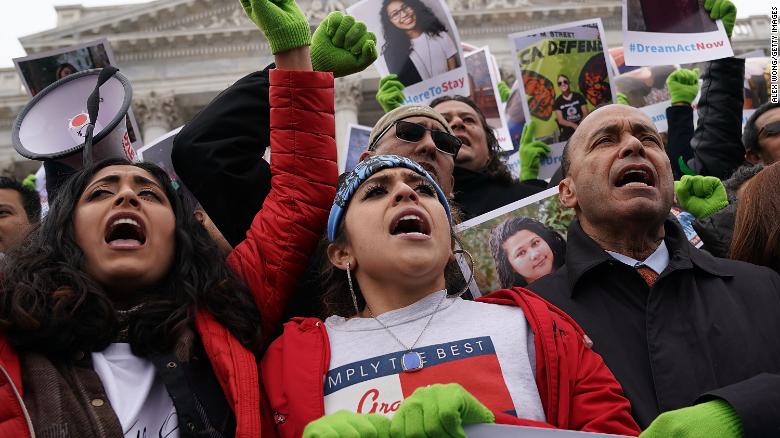
This week San Francisco judge William Alsup declared the DACA program must stay in place while the lawsuit trials go on, inciting outrage from Trump. The President wants to eliminate the DACA program completely, but he has had limited success so far because he originally rescinded the program back in September, claiming he was going to also deport those protected by it, but this judge's ruling reverses all that he's already done.

So what is DACA? It stands for Deferred Action of Childhood Arrivals, and is a program implemented by Barrack Obama through an executive order that lets illegal minors be deferred from deportation for two years, and that deferral can be renewed. The intent behind the program is to give children of illegal immigrants a chance to gain an education and later on obtain work permits instead of deporting the children immediately. There are about 800,000 "Dreamers" protected by this program, and Trump's original intent was to deport them all by slowly taking away DACA. However, this ruling is a real thorn in the side of President Trump's plans not only for DACA in particular but the immigration legislation he is desperately trying to get past, as per his main campaign points.

One of reasons Trump is so invested in taking away DACA is because he connects most of the issues that have to do with illegal immigration, and he has stated that the "Dreamers" are an essential part to legislation that also connects to the infamous 'wall' he's planning to build on the border of Mexico.

Closely related, a proposed immigration bill to 'fix' the system in the country, which includes funding for the wall and improved border security, was just unveiled by its supporters. Consisting mostly of rather conservative Republicans, the writers of the bill claim that it is a "starting point," which is good considering there are some moderate Republicans who do not even agree with the bill.

Nevertheless, it will be interesting to see how President Trump deals with the courts in this situation, and what happens with the 800,000 "Dreamers" that are hinging on the changes he intends to make.

Questions:
1. What do you think this indicates about the direction talks about "Dreamers" are going to take?
2. How do you think this will affect the overall outcome of Trump's plans to curb immigration heavily?
3. Do you agree with the judge's ruling? Why or why not?

Sources:
BBC
CNN
Washington Post
Chicago Tribune

Wednesday, January 10, 2018

To Pay for Wall, Trump Would Cut Proven Border Security Measures


Trump has been discussing his plan to build a wall on the border of Mexico and the United States in an attempt to end illegal immigration and drug trafficking. The wall would cost approximately $18 billion over the next ten years and it would run along the southern border for around 900 miles. Trump wants to take about half of the $33 billion allocated for border control of the U.S. budget and use it towards the wall. Border security is not just made up of walls; officials have "described border security as a holistic system, made up not just of walls and fencing but also patrol routes, lighting, cameras, sensors and personnel." Additionally, the new proposed budget would not pay for hiring new customs officials, who are a major part of controlling and stopping illegal immigrants and large amounts of drugs.

Trump has received significant criticism over spending so much money on the wall as opposed to spending money on more standard border security controls. In the article, the author states that "all proven security measures that officials and experts have said are more effective than building a wall along the Mexican border," signifying that there is other ways that are generally considered more effective than a wall.

The government has a federal budget, which provides a guideline for the government on ways to spend money. The border security has a budget of $33 billion. Is it worth spending part of the budget on the wall?

Discussion Questions:
1. What is your stance on Trump's plan to build a wall?
2. Do you think that taking over half of the border control's budget is a smart idea?
3. Is this the best way to fund his wall?

Link:
NYTimes

Apple Under Fire As It Admits to Intentionally Slowing Down Phone Processors

Photo Credit: https://s3.amazonaws.com/digitaltrends-uploads-prod/2017/09/apple-iphone-x-review-hands-on-11.jpg


Tech mogul Apple released a statement on December 28 apologizing for deliberately slowing down
the processors of its older iPhone models (including the 6, 7, and SE) via iOS updates. Its claim for
doing so is to protect against random system shut-downs that could happen as a result of their
rechargeable lithium-ion batteries, whose ability to hold a charge diminishes over time. As a form of
reparation, the company has decreased the price for a battery replacement from $79 to $29.

However, this apology isn’t sitting too well with many, with people such as U.S. Senator John Thune
(R-SD), chair of the Commerce, Science and Transportation Committee, asking Apple CEO Tim
Cook for more information about the nature of lithium batteries and putting the company’s
transparency into question. It is also in hot water with multiple lawsuits, especially from a French
criminal probe issued by the Halte à l’Obsolescence Programmée (HOP) consumer group, a country
in which planned/intentional obsolescence of technology is illegal under the law. If found guilty,
those involved can face a maximum 2 year prison sentence, a 300,000 euro fine, and may lose 5%
of the company’s annual turnover.

Questions:
- Modern Apple products have been extremely prevalent within the last 10 years or so, so what do you think prompted Apple to give this information at this point in time? Why not any earlier, or why not later?
- Since the company cites the deteriorating quality of the lithium-ion batteries as reason for the system slow-down, do you think the company should invest in crafting phones with different rechargeable batteries?
- Do you think all Apple users should be compensated for this omission of the truth, and if so, by what means?
- Should programmed obsolescence be illegal in the United States?

Did President Trump forget the words to the national anthem?


In Atlanta, at the national championship college football game on January 8, 2018, cameras showed that President Trump did not know all the words to the national anthem. This is extremely controversial as many people are disappointed that their own president does not know the words to the national anthem, which represents pride in the United States. However, others are indifferent towards this as there is no law specifically stating that the president must partake in singing the national anthem. The only obligation for the president regarding the national anthem is under the Flag Code, which states that the president must stand and present his or her attention towards the flag, and that they must have their right hand over their heart.

While President Trump did not violate any laws, many are disappointed in him as he did not know the anthem, yet he recently tried to suspend NFL players that took a knee during the national anthem. These players were trying to raise awareness and fight against racism. In the Sports Illustrated article, the author states that "Trump made comments about how players should stand during The Star-Spangled Banner as a sign of respect and that NFL owners should fire players who protest."


Discussion Questions:
1. Do you think it is necessary for the president to sing the national anthem?
2. Do you think that this event is related to the NFL issue?
3. Is Trump being hypocritical?

Links:
BBC
Sports Illustrated 

H&M Under Fire for Racist Advertising


Retailer H&M has recently been under fire for a sweatshirt with the saying "Coolest Monkey in the Jungle," being modeled by a young black boy. Critics say that this ad was "tone deaf and filled with racist undertones." H&M released a statement acknowledging people's concerns and they "are deeply sorry that the picture was taken, and... regret the actual print." They continued to remove the image from their channels and discontinue the product. The Weeknd was one of the many people who was disappointed in this advertisement and on Monday, January 8th, he tweeted "I’m deeply offended and will not be working with @hm anymore . . . ”.

H&M, however, is not the first company to create an ad that ends up under fire for controversy. Late last year Dove received backlash after creating a video where a black woman removes her shirt to reveal a white woman. Retail strategist Wendy Liebmann says that, "incidents such as these used to blow over more quickly, but not in today’s digital age." 

Questions:
1. What is your opinion on this whole situation?
2. With such big marketing teams, how do you think this advertisement was approved?
3. How could situations such as this be avoided in the future?

Links:
CBS
The Washington Post

Monday, January 8, 2018

Trump Administration Repealing TPS Status of nearly 200,000 Salvadorans

Photo Credits: http://cdn.cnn.com/cnnnext/dam/assets/180105230120-daca-tps-protest-washington-exlarge-169.jpg 


Following major earthquakes that shook El Salvador in 2001 (a 7.6 earthquake on January 13, which left at least 844 dead and 4,723 injured and a 6.6 earthquake on February 13, which left at least 274 dead 2,191 injured, both of which left over a million people displaced and caused billions of dollars in damage), the United States under the George W. Bush administration granted Salvadorans affected by these events Temporary Protected Status, or TPS. People who apply for TPS and pay hundred dollar fees are not required to leave the United States and are instead able to extend their stay via 18-month renewable extensions, working as a sort of semi-permanent residency pass.


However, the Trump administration now wants to repeal TPS permits from the almost 200,000 Salvadorans who depend on them for their US residency, claiming that the issues caused by the devastating quakes “no longer exist.” According to the Department of Homeland Security, these Salvadorans now have until September 9, 2019 to move, face deportation, or “seek an alternative lawful immigration status in the United States” - a period of time the Department claims will provide an “orderly transition” for these people and will “allow Congress to craft a potential legislative solution” for those who have lived and worked in the US for years.


There are multiple great concerns about the potential outcomes of this, mainly surrounding the economic status of the country. Almost one fifth of El Salvador’s GDP consists of money sent from relatives working in the US, so removing this TPS status may lead to an economic crash. Marshela Margerin of Amnesty International claims that this may coerce people to resort to kidnapping, becoming part of gangs, or becoming part of the sex industry. This can also pose as a huge problem for the American work force, as 88% of Salvadoran TPS migrants work here.

Questions
- The Department of Homeland Security states that this 18-month delay period can be used by Salvadoran TPS immigrants to find an “alternative lawful immigration status.” Given the large number of people wanting to immigrate to the United States, do you think this is at all possible?
- Why do you think the Trump administration chose to do this now, of all times?
- To what extent do you believe the term “Temporary” in the TPS acronym should extend?
- What do you think will happen to the children of these TPS migrants once the September 2019 date comes, especially if the children are citizens but their parents are not?

Monday, December 18, 2017

President Trump to reveal "America First" national security strategy

Article Links:
BBC
Fox News

Image result for trump vs obama foreign policy cartoonImage result for trump vs obama foreign policy cartoon


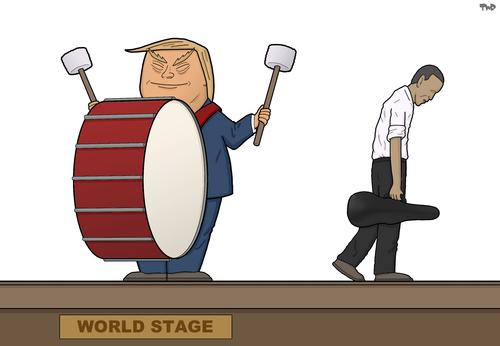
Trump's comprehensive national security policy is a 70-page document which prioritizes economic security foremost to gain national security. President Trump's national security plan will be built on four main themes, which include protecting homeland security, protecting economic prosperity, advancing America's influence as a superpower, and sustaining peace through strength. Trump's foreign policy is the opposite of President Obama's, and does not recognize climate change as a national security threat (although he will mention its importance, officials say). The policy's vision is for perpetually competitive international affairs in which superpowers compete for influence. President Trump predicts Russia and China to be the primary threats to U.S. dominance. President Trump will also discuss cyber hacking as a new threat.

President Trump, contrary to President Obama, has always strongly encouraged and supported an "America First" policy. I believe this attitude is certainly beneficial for America, although I believe climate change is an issue that should be heavily considered.

Discussion:
Although we do not have specific details on President Trump's plans, what do you think of his main focuses?
What are the benefits and detriments of the President's America First policy?
Is Trump delegating the necessary focus to climate change?

Sunday, December 17, 2017

Michigan seeks outlet to decline in manufacturing growth


Link to article: New York Times
Quillen, a young entrepreneur who is struggling to spark her business and create jobs in a Midwest state that relied on a manufacturing renaissance from President Trump, was visited by people from New York Times to discuss the social implications of jobs and the manufacturing economy. They prioritized jobs and were joined by numerous Presidents in their respective fields of manufacturing and Chamber of Commerce in Jackson County. Quillen and the others discussed the idea that there were not enough qualified workers to take on advanced manufacturing jobs and companies saw a general trend of poor working habits. Lately, for the first time in many years, manufacturing jobs started coming back to the United States, yet they require higher abilities since they include helping  robots on the assembly line and they accept a position beginning at $10.50 working up to making $25 an hour under four years if they decide that route.

Many people blamed Ms. Quillen for not paying workers decently to show responsibility regarding the organization. Her compensation scale, beginning at around $10, according to her, mirrors the neighborhood economy. Joblessness in Jackson is low. Wages, in any case, are not developing. Family salary is really 11 percent lower than in 2000 so it’s easy to see where the fault is originating from in light of the decline in sales growth. I wonder what effect the Republican tax bill would have on her wages and hiring process. Do you think that these tax cuts would boost economy and help build up Quillen’s business? How could she help employers in her county to sufficiently support themselves? What do you think she should do to address the business challenges she’s facing in her automotive industry? I personally think she should set up internship programs during the summer for students so they can be exposed to this working experience.

Saturday, December 16, 2017

GOP's Final Tax Reform Bill


Article Links:

BBC

Fox News


President Trump looks to make good on his promise to the American people to pass legislation for tax cuts by the end of this year. With the House of Representatives looking to vote on the final bill next Tuesday, and the Senate voting later in the week, the President's efforts seem to be coming to fruition. Republicans have promised that the bill would provide tax relief for American citizens of all income levels, although Democrats and other critics disagree, stating that it would benefit the rich and big businesses. Although many opposing the bill have hoped that Doug Jones, the winner of the Alabama Senate election, may tip the scales, it seems he will not be sworn into office before the voting on this bill.


"The plan brings the US corporate tax rate down to 21% from the current 35%. The top individual income tax drops to 37% from 39.6%" (BBC). While tax cuts for businesses may be permanent, tax cuts for individuals are likely to expire by 2026. This will amount to billions of dollars added to the already high national debt.


More information on the final tax plan here:


What's in the final tax plan?


We have learned about the process in which a bill becomes a law recently in AP government. The bill has just passed the combined House-Senate conference committee and will be voted on by both houses of Congress. Obviously, if the bill reaches the President, he will sign it into law. Republicans hold a majority in the Senate 52-48, and passed their original Senate bill with a 51-49 majority, with only Republican Senator Bob Corker voting against. However, Corker has stated he would support the bill despite initial reservations. Because the Vice President decides the Senate vote in the case of a tie, and Mike Pence obviously backs the bill, Republicans can afford to lose no more than two of their own party's votes. Due to the increasing polarization in today's Congress, this is not likely. The House of Representatives also has a Republican majority, but we shall see their voting outcome soon.


Discussion Questions:

What do you think of the new tax bill and will it help all American citizens?

Do you believe Republican victory is most likely here?

Friday, December 15, 2017

Russia: A potential risk to undersea cables

Article Links:
Fox News
BBC

Map of the world's sub-marine cable network

According to a recent report by the Policy Exchange think tank, the world's communication network is comprised of around 213 independent cable systems and 545,018 miles of fiber, as seen in the image above. Air Chief Marshal Stuart Peach says Britain and NATO must prioritize the defense of the undersea lines of communication against a potential Russian attack, as cutting or disrupting them could cause an economic catastrophe.

Because the cables do not have formal state ownership, they are quite vulnerable in international law. Also, an international power such as NATO needs to act because these cable systems are too extensive to be protected by any single nation. This is in response to increased Russian submarine activity and their willingness to use unconventional warfare. The potential effects of wire-tapping, cutting, or disrupting these networks could be disastrous according to many experts, including MP Rishi Sunak and Admiral James Stavridis, NATO's former top military chief.

Ultimately, we must remember that any Russian plot is only speculation for now. Admiral Stavridis even warned of potential threats from China and Iran. However, in the possibility of Russia's navy acting on these economically and socially vital cable networks, and in light of the ongoing accusations against President Trump for possibly colluding with Russia, what do you think the U.S. or NATO can, will, or won't do?

Thursday, December 14, 2017

FCC Repeals Net Neutrality

fcc-logo_white-on-dark-blue.jpg

This Thursday, the Federal Communications Commission voted to repeal net neutrality rules.

In 2015, net neutrality established internet service as a utility, preventing internet service providers from discriminating among web content by blocking certain sites or slowing the speed at which they load in addition to preventing them from providing faster internet service to customers who pay more. Yesterday's repeal removes all that regulation.

Supporters of net neutrality argue the end of net neutrality could lead to a future of internet service that privileges large companies and the wealthy. They fear services providers may start providing "bundles" like cable providers, requiring you to pay extra for certain sites, something that is already happening in Portugal. Small business owners are also concerned that they'll be more easily out-competed by larger corporations that can afford to pay for their sites to load faster if ISPs start offering priority to higher paying customers. However, Ajit Pai, chairman of the FCC, argues that these fears are unfounded. Before net neutrality was established, none of these problems existed and, as it ends now, major ISPs are reassuring the public they do not intend to change the way they provide internet.

Pai argues that deregulation of this market will foster increased competition, giving companies incentive to provide internet to more people. His critics point out that the market for internet service is highly consolidated and lacks competition, suggesting deregulation may be an opening for abuses instead of a jump-start to the competition of the market

Unfortunately, until the changes caused by repealing net neutrality come to pass, the consequences - or lack thereof - for repealing it are uncertain.

Questions:
1. Do you support or oppose the repeal of net neutrality?
2. Can we trust large corporations when they assure us the internet will continue to run as usual?
3. Are people's fears about the end of net neutrality reasonable?

Links:
New York Times: 1 and 2
Fox News
Image Source