Wednesday, December 4, 2024


South Korea's quick martial law creates chaos as Parliament scrambles to undo it
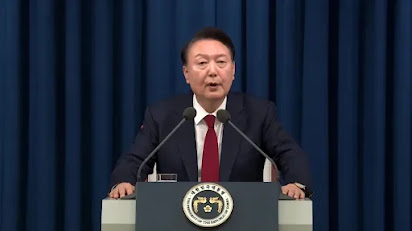
South Korean President, Yoon Suk Yeol,  announcing martial Law on South Korea (Reuters)


This Tuesday, December 3rd, 2024, South Korean President, Yoon Suk Yeol, imposed martial law on South Korea. This news was unexpected, there was no schedule for President Yoon to to have a speech broadcasted, and it occurred in the middle of the night. In this broadcast, he declared that he was placing South Korea under "emergency martial law". His explanation was vague, stating only that the South Korean government was under threat from North Korea.
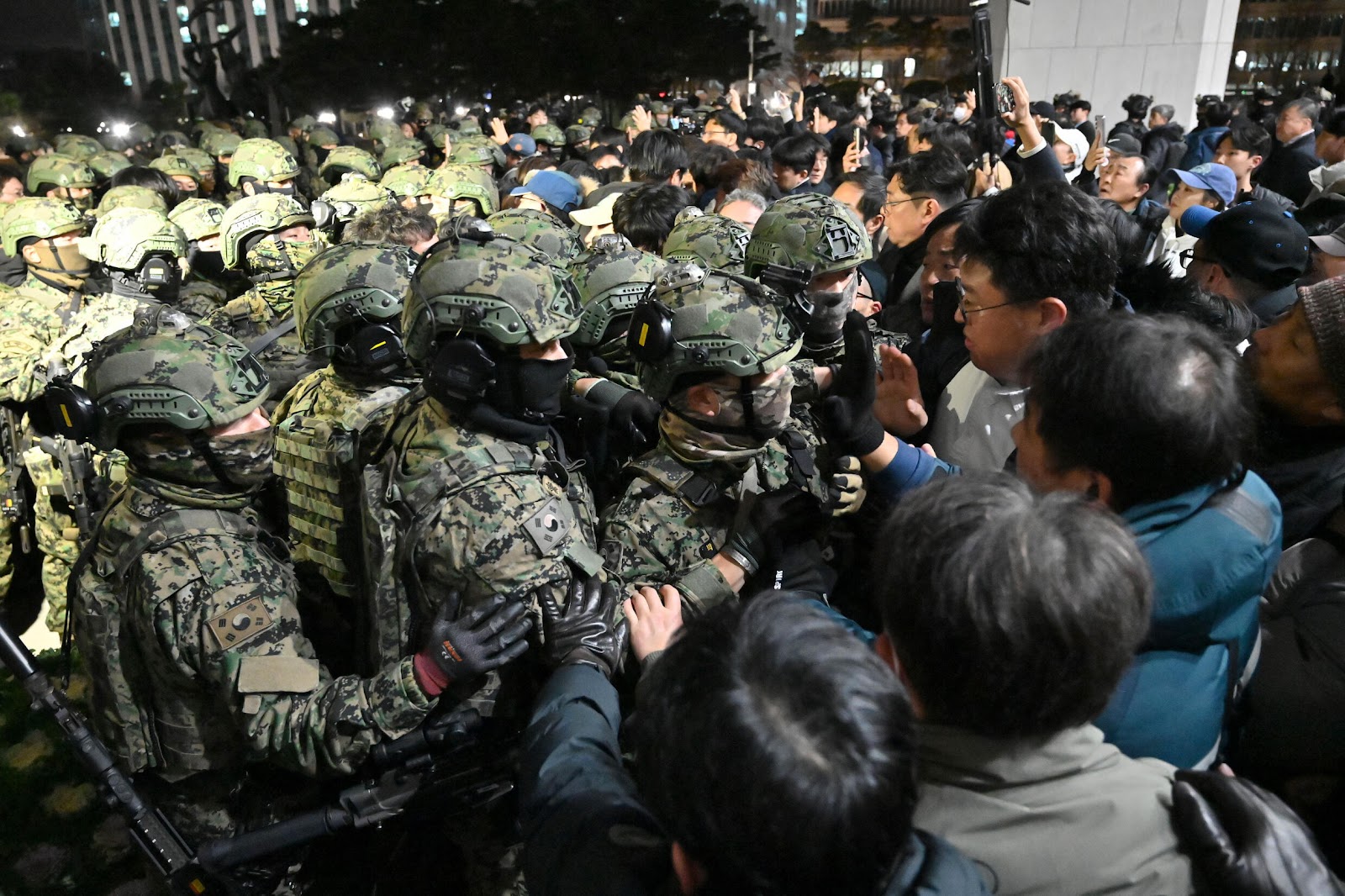

Soldiers try to enter the National Assembly after South Korean President Yoon Suk Yeol declared martial law

Protesters stopping Military personnel from getting into the National Assembly building(france24 news)


Martial law means that the military takes over the government. To try and execute this, soldiers were sent to the National Assembly building to try and stop members of Parliament from entering the building and lifting the order. Although the soldiers were sent quickly, 190 of the 300 members of Parliament were able to get into the building with some even having to jump over a fence because the police were blocking the gate. However, this was not the end as military personnel attempted to storm the National Assembly. They were met with fierce resistance from the staff and protesters piled up near parliament. The protesters were doing everything they could, from pulling soldiers away from the doors to even trying to pull away their guns. Although the soldiers were able to get into the building, barricades were set up within the building making it difficult to traverse. This gave the members of Parliament enough time to vote on whether to lift the martial law. With a unanimous vote, Parliament officially lifted the martial law at around 4:30 am on December 4th, 2024 local time.


What could this mean for President Yoon? President Yoon has had a low approval rating, with just about a 17% rating from the start and this new event will cause it to lower even more. With several corruption scandals on him, this will probably be his last one with many calling for his resignation or impeachment. There are already lawmakers in South Korea that have started the process of impeaching him and this will probably not have a hard time passing through as he tried to overthrow them using military force. It will only be a matter of time until he is impeached. 


This raises the question: Could this happen in America? The short answer is likely no. While the President has the authority to implement martial law, it would require a specific and compelling reason. In such a scenario similar to South Korea’s, Congress has the power to lift martial law promptly, ensuring that the situation is resolved before it escalates into something more severe. An overstep of this power will result in the same outcome as South Korea’s president, an impeachment. 


https://www.france24.com/en/live-news/20241204-soldiers-vs-office-chairs-south-korea-s-martial-law-standoff

https://www.bbc.com/news/articles/c0lgw1pw5zpo

https://www.pbs.org/newshour/world/south-korean-president-declares-emergency-martial-law-says-opposition-sides-with-north-korea

https://apnews.com/article/south-korea-yoon-martial-law-997c22ac93f6a9bece68454597e577c1


Tuesday, December 3, 2024

What Trump's Response to the Hunter Biden Pardon Means for the Jan 6 "Hostages"

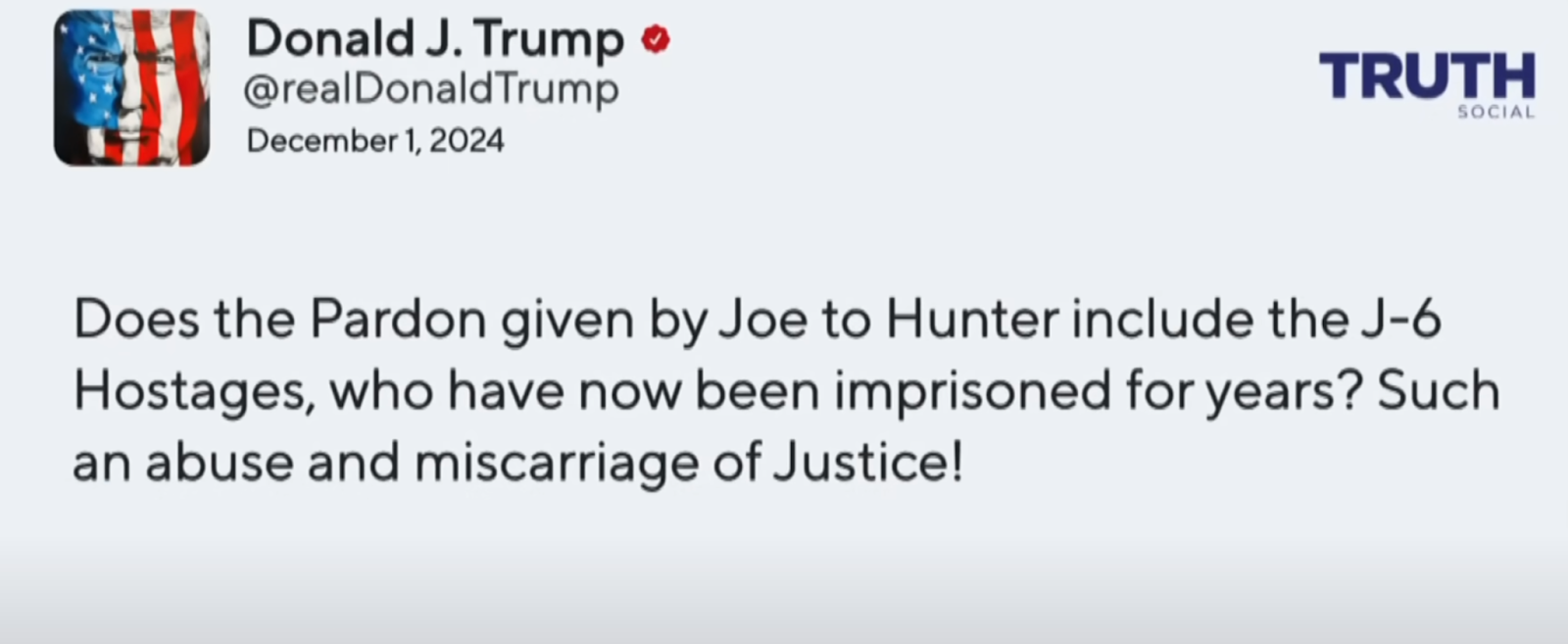
Shortly after outgoing President Joe Biden’s pardon of his son, Trump has criticized it sharply. He posted on Truth Social calling it “an abuse and miscarriage of justice.” Hunter’s pardon, which erased his convictions related to gun crimes and tax violations, has sparked controversy on both sides, and Trump and his supporters will likely use it as a springboard to revisit their grievances about the justice system.

Trump has long framed the individuals charged due to the January 6th Capitol riot as “political prisoners” and victims of a politicized legal system. His response to Hunter’s pardon highlights this, and it reinforces the precedent that Trump will pardon January 6 defendants when he returns to the White House. Trump’s post shortly after the event hints at this likelihood, building on his past accusation of Biden of weaponizing the justice system against political opponents.

Additionally, democrats fear Hunter’s pardon could enable Trump to justify his own controversial pardons, which are likely to happen when he regains his power. His incoming communications chief, Steven Cheung, underscored this by saying that the “system of justice must be fixed and due process must be restored for all Americans, which is exactly what President Trump will do as he returns to the White House.” However, although Hunter’s convictions are very different from the January 6 defendants, it would be hypocritical of Trump to just immediately pardon them all after criticizing Biden’s use of the controversial power.

The controversy also raises constitutional and political questions about the presidential pardon power. Both Biden and Trump have used this authority to address perceived injustices, but critics argue that these moves risk eroding public trust by prioritizing political loyalty over actual justice.

As Biden prepares to depart his presidency, he makes a last minute pardon for his son Hunter’s recent Gun and Tax convictions.

This past Sunday, current president Joe Biden announced that, despite the promise he made back in June, he would be pardoning his son from the convictions he was facing. Hunter Biden pleaded guilty in two separate trials over the summer - one on federal tax charges and one of lying about his drug use on a form when buying a handgun. After Hunter's June conviction, Joe Biden spoke on ABC; And when asked on whether he “ruled out a pardon” for his son, Biden replied; “yes”; assuring Americans that the justice system does not unfairly protect political elites (Geraghty). 


According to the indictment, “he not only refused to return the documents for many months, but he also obstructed justice by enlisting others to destroy evidence and then to lie about it”(Hur). On the other hand, “Mr. Biden turned in classified documents to the National Archives and the Department of Justice, consented to the search of multiple locations including his homes, sat for a voluntary interview, and in other ways cooperated with the investigation”(Hur). Trump was not unfairly selected because of his status but more so because of his actions. 

Hunter Biden on the other hand, paid back his 1.2 million of tax owed aswell as had been sober for 5 years; Surely enough to grant Clemency. But because Biden, in a 2021 memoir, wrote at length about his addiction to crack cocaineuu and alcohol”, he outed himself for potentially lying on the federal form he filled out in 2018 to obtain a handgun. Such information is rarely used to prosecute gun buyers, as it is hard to differentiate addiction and moderate consumption (The Trace). 


Another point to note is that part of the public outcry is due to Biden granting a “full and unconditionaly” pardon for any crimes Hunter may have committed from December 2014 till this past sunday. A particularly broad pardon compared to other presidential pardons. For example Bill Clinton's pardon of his brother Roger was only for a singular drug trafficking charge-not a decade long of drug addicted actions. 

Trump, planning to take office in January, was predicted to issue many pardons, especially for those involved in the January 6th capital raid; And now this move by Biden may have fueled the fire for Trump to pardon much more excessively and broadly; therefore setting a precedent of abuse of clemency power. Jeffrey Crouch, a legal expert from American University, told CBS his predictions after Biden's pardon; "If presidents from both political parties feel free to abuse clemency without consequence, the pardon power becomes less a tool of grace and more of a political instrument" (Zurcher).

Not all Democrats were even willing to support the president’s Sunday action. Rep. Greg Stanton (D-Ariz.) spoke out against the pardon, saying, “I respect President Biden, but I think he got this one wrong.” The former Phoenix mayor continued, “This wasn’t a politically-motivated prosecution. Hunter committed felonies, and was convicted by a jury of his peers”(Shia Kapos).  If these precedents continue we may see an exponential decrease in trust of government and a break from the 2 party system as both parties seem to be at blame this time. 

, Biden's pardon is justified in the sense that he worked to receive clemency but on the other hand a pardon of a decade long seems a bit out of hand and an abuse of presidency.


Sunday, December 1, 2024

Canada Prepares for an Influx of Immigrants


    The US-Mexico border gets so much attention when it comes to immigration policies, but what about the US-Canada border? It is the longest border between any two countries in the world afterall, at a length of 5,525 miles. 

    President-elect Donald Trump has long been pressing for domestic deportation in America, and if he follows through, it will be the largest in American history. With Trump set to take office in January of 2025, many migrants in the US who may face Trump’s mass deportation efforts are anticipating this unwelcomeness in the US and are thus pushing north, seeking asylum in Canada.

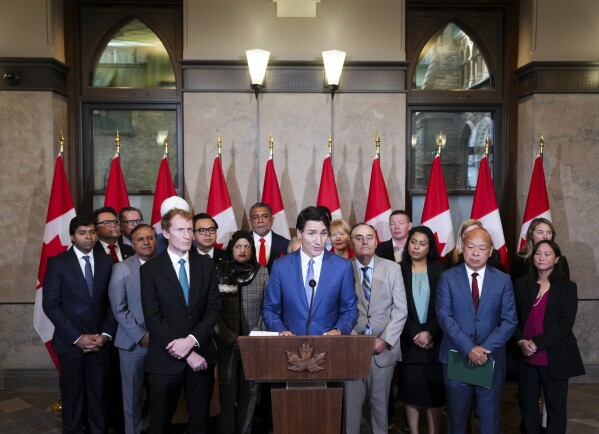
    During Trump’s first presidential term in 2016, Canadian Prime Minister Justin Trudeau conveyed that his country would be friendly to asylum-seekers, posting publicly on his social media: “To those fleeing persecution, terror & war, Canadians will welcome you, regardless of your faith. Diversity is our strength #WelcomeToCanada”. Trudeau did so even during this time when Trump pushed to tighten security along the Mexican border and threatened to separate families.

    But somewhat hypocritically, Trudeau recently vowed to significantly reduce the number of immigrants it allows into Canada: only allowing 396,000 by 2025, 380,000 in 2026, and 365,000 in 2027. He stated, “Immigration is essential for Canada’s future, but it must be controlled, and it must be sustainable.” Similarly, François Legault, the premier of Quebec (a province at the forefront of bracing for immigrants) said, “The problem isn’t immigrants, it’s the number”. 

    So in efforts to mitigate the effects of Trump’s deportation desires, the Royal Canadian Mounted Police (RCMP) created a plan to bolster the number of agents and vehicles it has along the Canadian border. They’ve identified enforcement agencies that could divert extra staff to the border and plan to use land along the border to set up temporary detention and processing facilities. Furthermore, ​​Canadian officials plan to add patrols, buy new vehicles and set up emergency reception facilities at the border between New York and Quebec. This all comes from anticipating a spike in migrants even before Trump is sworn in, because many migrants are seeking a preliminary solution to this potential problem.


    In addition to actions taken at the border itself, Canadian authorities also intend to uphold a key agreement between Canada and the US: to be able to send back asylum-seekers crossing into Canada back to the US. The agreement designates Canada and the US as “safe third countries” to make asylum claims, so when asylum-seekers travel from one country to the other, they can be sent back, with not many exceptions. However, Canada hopes to see this fully enforced, a two-way street. 


Sources:

Trump's Tariffs Threaten the Economy, But Congress Could Stop Them

    It has been a promise of Trump's campaign that on his first day in office, he will enact tariffs on China. However, he has recently expanded his tariff threats to Canada and Mexico as well. These tariffs would be used as leverage against Canada and Mexico to make them take action on the border issue, a pillar of Trump's policy agenda. However, these tariffs could be damaging the American economy, and make the lives of everyday Americans more difficult. Despite all this, there is still time for Congress and even the Supreme Court to stop these tariffs.

Just this year, The U.S. has imported 632.3 billion in goods from Mexico and 572.9 billion from Canada, over one-third of all U.S. goods. Tariffs would increase prices on basic goods like gas, and weaken U.S. manufacturing. For example, one of the largest manufacturing industries in North America is automobiles. Parts for cars often cross the border 7 or 8 times over the course of production, and with tariffs they would be taxed each time, increasing the final price of vehicles drastically. Current president Joe Biden said he hopes Trump rethinks the tariffs, calling it "a counterproductive thing to do" and saying it could "screw up" national relationships.

Trump has already shown he is more than willing and certainly able to place tariffs on foreign nations during his first term. He used Section 232 of the Trade Expansion Act of 1962 to impose tariffs during his first term, as well as Section 301 of the Trade Act of 1974 to impose six additional tariffs. Many forget, but these tariffs of between 7-25% did disrupt the global supply chain.

All of these tariff threats are concerning, but if you remember what we have learned in Congress, the Constitution actually gives them the power to regulate foreign trade, not the president. However, since the Great Depression, Congress has gradually delegated more and more foreign commerce powers and responsibilities to the president. Trump could use these delegated powers to enact tariffs as he did in the past. Congress still has time to revoke the authority delegated to the president though, and Reps. Suzan DelBene and Don Beyer have already introduced the Prevent Tariff Abuse Act, which could limit the ability of the president to enact tariffs. It may also be in the best interest of Congress members to prevent the tariffs, because as we learned, most people vote based on the economy. If tariffs cause a rise in prices, congressional incumbents could have a difficult time holding onto their seats during the midterms.

If Congress fails to prevent the tariffs, the Supreme Court may be able to step in as well. Chief Justice John Roberts recently wrote to overturn the Chevron Deference, concluding courts should exercise independent judgement and not defer to executive agencies when interpreting the Constitution. I thought that was already their job, but I guess not. The Supreme Court typically stays out of the way when it comes to presidential powers in foreign trade, but if they could prove imports from Mexico and Canada are not a national threat to national security, they could thwart the tariffs. Now only time will tell whether either of these branches of government will step up to potentially rescue the American economy from years of struggle.

Sources:


Friday, November 29, 2024

Trump's Team Signs Transition Documents, But Refuses Some Key Agreements

     Months after expected under federal law, and months after his former opponent Kamala Harris, Trump and his team have finally signed transition documents. Transitions are essential to the secure transfer of highly sensitive information and important organizations to the next administration. White House spokesperson Saloni Sharma says "A smooth transition is critical to the safety and security of the American people who are counting on their leaders to be responsible and prepared". This is a positive sign of cooperation between the Biden and Trump administrations, however, there may still be some hiccups to come in the transition process.

Despite signing the agreement as expected before his first term in 2016, this time around, Trump's team has refused to sign two important parts of the transition documents. They have declined to sign the agreement with the General Services Administration, which would provide over 7 million in federal funding as well as office space and cybersecurity support. This particular agreement also includes an ethics pledge. Trump's Team also refused to sign an agreement that would allow the FBI to conduct background checks and review security clearances of transition staff.

Trump's refusal to sign the G.S.A. could have serious implications in terms of funding and national security. Trump's team refused federal funding in favor of privately raising transition money. Although they pledged to refuse foreign donations and disclose all donors, this would allow the Trump team to raise as much money as they want for the transition. Trump also refused secure office space for meetings, and secure communication lines. Susie Wiles, Trump's pick for Chief of Staff, says this is to allow "cabinet nominees to begin critical preparations, including the deployment of landing teams to every department and agency, and complete the orderly transition of power. However, this could obviously pose a national security risk.

Trump's team also refused to sign an ethics pledge, instead opting to write their own. Despite following most of the guidelines, Trump's ethics agreement does not contain any of the typical provisions surrounding how he will combat his own conflicts of interest. Trump has been criticized for having conflicted interests with his many international corporations, and his refusal to include a pledge to avoid them could signal an undermining of his integrity as president.


Finally, Trump's team refused to sign an agreement with the Department of Justice that would allow the FBI to review security clearances of members of Trump's "landing teams", people who integrate with government agencies before and during the transition to the next administration. Trump's team is also bypassing background checks for cabinet picks, instead opting to use private organizations. This all points to Trump's lack of trust in federal organizations like the FBI, and unfortunately could hold up the transition process, as the Biden administration cannot legally share highly sensitive information with members of Trump's team who have not been cleared.

Despite the refusal to sign multiple key parts of the transition documents, it is a good sign that some agreements are in place. The Biden administration certainly had to settle for a compromise as Trump continued holding out, but now that communications are open, things can proceed more smoothly. It is certainly a good sign considering the, let's just say "difficulties" of the last transition.


Sources: 

https://www.msnbc.com/top-stories/latest/trump-transition-biden-administration-agreement-funding-fbi-rcna181985

https://www.msnbc.com/top-stories/latest/trump-transition-biden-administration-agreement-funding-fbi-rcna181985

https://www.cnn.com/2024/11/27/politics/trump-transition-ethics-pledge/index.html

https://www.washingtonpost.com/politics/2024/11/26/trump-transition-agreement-ethics-pledge-security-clearances/


Thursday, November 28, 2024

Elon Musk Joins Trump's Inner Circle

Musk gets a leg up from Trump in space ... An unexpected relationship blossomed between former president Donald Trump and tech-mogul Elon Musk last year. As Trump geared up for his presidential campaign, the world’s richest man hopped on board, bringing his wealth and influence and a unique perspective to Trump’s political operation. With Musk’s immense social media following of 200 million on X and his $200 million investment in Trump’s campaign, he became an invaluable ally, offering Trump a powerful new edge in his race for a second term. 


Musk also leveraged his American super PAC to rally support in key swing states, helping Trump secure a crucial advantage in his campaign. As a successful businessman, Musk helped Trump frame his campaign as one focused on efficiency and innovation. He drew from his experience running companies like Tesla and SpaceX to become a key advisor post-election. 


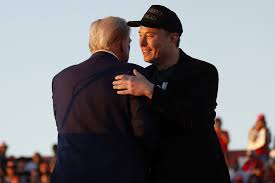
Since the day they decided to team up, Trump and Musk have become nearly inseparable. Musk has joined Trump at nearly every meeting at Mar-a-lago and even a U.F.C. fight together. Trump’s grandchild Kai even posted online that Musk was, “achieving uncle status.” What started as a professional partnership has evolved into a personal bond, with the two spending significant time together, discussing everything from business to politics. Their closeness even had Vice Presidential opponent Tim Walz joking that Musk was Trump’s running mate rather than J.D. Vance.


Trump is known for keeping his allies close, with many of his advisors being long-term friends or loyal confidants who have stood by him through thick and thin. However, he made an interesting exception with Elon Musk. This is due to several reasons, him being the world’s richest man, media influence, and interestingly his ability to say “You’re fired!” (a phrase Trump is deeply fond of) to 80% of X’s staff. Such bold, decisive moves were quick to capture Trump’s attention, and Musk’s unorthodox approach to leadership made him a natural fit in Trump’s inner circle.


As their bond strengthened, Trump recognized Musk’s unique ability to drive change–not just in business, but also in government. It was no surprise that Trump appointed him to co-lead the Department of Government Efficiency (DOGE). While DOGE is not a formal federal executive department (as that would require Congressional approval), it is designed to serve as an advisory group to help streamline federal operations and reduce inefficiency. Musk, whose expertise lies in business innovation rather than politics, was given this role based on his track record of transforming companies like Tesla and SpaceX into highly efficient and profitable enterprises. What Elon Musk Really Wants - The Atlantic


This powerful alignment of business and politics will be closely watched. The richest man in the world, standing hand-in-hand with the President of the United States, creates an unprecedented dynamic in American politics. As Elon Musk continues to cement his role in Trump’s campaign and political vision, their partnership is poised to redefine the landscape of American leadership. Will Musk be able to maintain his position as Trump’s right-hand man? Only time will tell. 


Sources:

https://www.nytimes.com/2024/11/22/us/politics/elon-musk-trump.html

https://www.newyorker.com/culture/infinite-scroll/how-elon-musk-rebranded-trump

https://www.vox.com/money/387348/elon-musk-trump-president-billionaire-oligarchy

https://www.reuters.com/technology/musk-uses-x-push-his-preferred-political-picks-trump-isnt-always-swayed-2024-11-26/


Wednesday, November 27, 2024

What's to Become of President-Elect Donald Trump's 34 Felony Counts?

Why Trump's Conviction Barely ... Donald Trump is set to become the 47th President of the United States, but his legal troubles are far from over. Facing 34 felony counts in New York, a pivotal decision looms. New York Judge Juan Merchan finds himself at a crossroads, navigating what he has described as “uncharted waters” in the legal system. After postponing Trump’s hush-money case sentencing multiple times, Justice Merchan has now decided to delay the sentencing indefinitely. Merchan must now decide whether to wait out Trump’s four-year presidential term before resuming the case or dismiss it altogether. 


Trump’s legal team is aggressively pushing for the latter option, emphasizing their determination to “fight to the death.” They plan to submit their arguments to Judge Merchan on December 2nd, urging him to drop the case. At the heart of their defense is a broad interpretation of a 1963 law that emphasizes the need for a smooth presidential transition and suggests that prosecuting Trump during his term would distract him from his duties. They also point to a longstanding Justice Department policy that a sitting president cannot face federal criminal prosecution, arguing that this policy should extend to Trump’s state-level charges as well.  


The defense further argues that certain witness testimonies and pieces of evidence in the case violate the Supreme Court’s ruling on presidential immunity, as some of the actions in question occurred while Trump was in office. This raises complex issues about the balance of power between the branches of government, with the Judicial Branch potentially shielding the Executive from legal consequences in unprecedented ways. 


On the other hand, Manhattan District Attorney Alvin Bragg is working to uphold the integrity of the judicial system. He has emphasized the importance of respecting the constitutional role of the 12-person New York jury, which convicted Trump for his involvement in the hush-money deal to cover up an alleged affair with a porn star. Bragg insists that the jury’s decision must be honored, stressing that the judicial process should be allowed to proceed without interference from political considerations. While the prosecution acknowledges the immunity Trump has been awarded, it argues that this immunity does not mandate the dismissal of, “a post-trial criminal proceeding that was initiated at a time when the defendant was not immune from criminal prosecution and that is based on unofficial conduct.” 


Judge delays sentencing in Trump's ...Despite the efforts of both sides, the ultimate decision rests with Justice Merchan: whether to uphold the integrity of the legal system or allow political considerations to influence the outcome. This country was founded on the principle of holding all individuals, regardless of their status, accountable for their actions. How Merchan rules will have significant implications, not only for Trump’s future but for the broader balance of power between the judiciary and the executive branch.


With the Supreme Court having already granted the former presidents immunity from certain criminal prosecutions, the power of the presidency is becoming increasingly imbalanced in ways that challenge the principles of democracy. As presidents continue to receive legal protections, the question arises: How far is too far? If this immunity extends too broadly, it risks eroding the checks and balances that are vital to a functioning democracy. The implications of this case could reshape the limits of presidential power for years to come. 


https://www.nytimes.com/2024/11/22/nyregion/trump-sentencing-postponed.html

https://thehill.com/regulation/court-battles/5008714-trumps-hush-money-sentencing-limbo/

https://www.npr.org/2024/11/22/g-s1-35393/donald-trump-sentencing-hush-money-case

https://www.politico.com/news/2024/11/19/trump-hush-money-case-new-york-00190417


Monday, November 25, 2024

GOP Senators vs. Trump’s Cabinet Nominations


Sen. Lisa Murkowski, R-Alaska, who disagrees with some of President Trump’s Cabinet nominations


    By now, it’s widely known that Rep. Matt Gaetz withdrew from consideration for Attorney General on November 21, 2024 due to allegations of sexual misconduct. If he hadn’t, there most certainly would have been chaos within the Senate, and that’s because one of the main jobs of a US Senator is that they have the power to approve or reject a president's cabinet nominees.


    But even with Gaetz out of the picture, Trump still has a few other controversial cabinet nominations, including Pete Hegseth for Secretary of Defense (who has sexual assault allegations against him and limited governmental experience) and Tulsi Gabbard for Director of National Intelligence (who faced criticism for meeting with Syrian President and foreign adversary, as well as her comments about Russia’s invasion of Ukraine). These nominations are causing some Republican senators to think twice before voting to confirm Trump’s picks.


Hegseth, left and Gabbard, right

    Several GOP senators have expressed their hesitations towards these nominations; for example, Sen. Kevin Cramer called the sexual assault allegation against Hegseth “pretty concerning”. Congress requires a simple majority from the Senate to approve Cabinet nominations, meaning in order to prevent one of Trump’s picks, all Democratic senators need to oppose the nominee and 4 Republicans would as well. It’s important to note, though, only one time has a nominee been rejected by a Senate vote; this occurred in 1989, when George H.W. Bush nominated John Tower for Secretary of Defense (an excessive drinker and had sexual harassment allegations similar to Hegseth). 


    Now, there are reasons for Republican senators on the fence to go along with Trump’s nominees, like simply not wanting to be singled out. And for incumbents running again in 2026 especially, they may want to avoid defying Trump. But a handful are considering their own morals and skepticism about these nominees’ personal past and ability to perform their duties, and are willing to maintain their right to have a say, despite Trump suggesting recess appointments (bypassing Senate votes to elect a nominee).


    So who are the Republican senators who may vote against some of Trump’s nominations? There’s Republican Sen. Lisa Murkowski of Alaska, who was so surprised to hear of Hegseth’s nomination that she said, quote, “Wow”. She has disagreed with Trump on a number of issues, being a moderate Republican. There’s also Republican Sen. Susan Collins of Maine, a ticket-splitter, who has also defied Trump before, having voted against some of his nominations in the past. She was alarmed by some of the president’s recent nominations as well. Finally, Republican Sen.-elect John Curtis of Utah has often been critical of Trump’s decisions. He’s strongly against recess appointments, believing the Senate should have the final say in confirming or rejecting the president’s cabinet nominees.


    While some Republicans might vote "no" for these controversial Trump nominees, the ones up for re-election in two years might choose against this. Senators with decently independent voting records, like Murkowski or Collins, are less afraid of punishment from Trump in a primary, even though there are swirlings of primary battles with Republican senators who rebel against Trump’s picks. Most everybody else, though, will likely attempt to remain in good standing with Trump if they want to win re-election, so we shall see how votes for the confirmations of these controversial cabinet nominees come in in early January.


Sources:

Saturday, November 23, 2024

What is the Presidential Immunity Ruling and what does this mean for Trump’s second term?

 The Supreme Court’s Presidential Immunity Ruling is primarily tied to the infamous constitutional idea of a separation of powers. The ruling evolved over time through judicial interpretation (there was not a specific court case that determined this ruling, per se). However, specific cases did circumscribe this ruling. 

Trump has immunity for official acts ...

The Supreme Court Case Nixon v. Fitzgerald of 1982 ultimately granted presidents with immunity when it came to civil damages that were taken when said president was in office. This was meant to allow the president the means to take action as they see fit without fears of constant litigation (lawsuits). However, the 1997 case Clinton v. Jones restricted presidential immunity, asserting that the immunity ruling does not expand past actions taken outside of official duties. This case unanimously ruled the acceptance of presidential litigation for actions unrelated to official presidential responsibilities. 

United States Supreme Court Building ...

However, recently, Trump seems to be asserting pushback against these parameters.  “Trump moved to dismiss the indictment based on Presidential immunity, arguing that a President has absolute immunity from criminal prosecution for actions performed within the outer perimeter of his official responsibilities, and that the indictment’s allegations fell within the core of his official duties”. Though this idea was soon refuted, there is some truth in the matter. When it comes down to it, Trump’s immunity could allow him the power and will to take more extreme actions with such protection. “The Supreme Court ruled in July that former presidents largely cannot be prosecuted based on their official acts in office, though they can still face charges for acts that were outside the scope of their official duties”.


The past few years, Trump has undergone several investigations regarding the accusation of illegally retaining classified documents after leaving office, conspiring to overturn the 2020 election, actions which in part may have led to the January 6th attack on the Capitol, business fraud, and so on.  This essentially means that whatever allegations these investigations came to, so long as they were within official presidential business, Trump is protected from. Ultimately, this complicates other prosecutions Trump is currently facing, as presidential immunity may slow down prosecution processes. 


Ultimately, the Presidential Immunity Ruling will give Trump power and protection as he enters his second presidential term, as well as set back ongoing investigations as parameters of the ruling are still being solidified. 


Sources: 

https://www.forbes.com/sites/alisondurkee/2024/11/12/what-supreme-courts-immunity-ruling-means-for-trumps-second-term/


https://www.supremecourt.gov/opinions/23pdf/23-939_e2pg.pdf


https://www.brennancenter.org/our-work/analysis-opinion/supreme-courts-presidential-immunity-ruling-undermines-democracy


https://www.cnn.com/2024/11/08/politics/trump-grasps-unprecedented-power-supreme-court-immunity/index.html