Friday, April 7, 2023

FDA approves of a Over The Counter Narcan Nasal Spray

On March 29, the FDA approved over the counter narcan nasal spray. It is a 4 milligram (mg) naloxone hydrochloride spray that consumers will be able to buy and use without a prescription, the first ever over the counter opioid overdose antidote. 

Narcan is an opioid antagonist, making it a type of medicine that can rapidly reverse an opioid overdose. According to the FDA, in the 12 months ending in October 2022, there have been 101,750 overdose deaths in the US. In 2021, opioids were involved in 91% of drug overdose deaths. FDAs approval of this over the counter medicine is significant, and could potentially pave the way for more life-saving over the counter medicines to be sold. 


The FDA first approved Narcan nasal spray in 2015 as a prescription drug. In February 2023, FDA Committee members voted unanimously to recommend it be approved for over-the-counter use. 


The price of the nasal spray has not yet been released, but overdose protection agencies caution that the price may be too high for accessibility. The National Harm Reduction Coalition has expressed the need for Naloxone to be free so that everyone can have access to the life saving medication. 


One way to possibly reduce the price of the nasal spray, which is expected to be around $47.50 a box, is placing a price ceiling on the product so retailers cant sell narcan for extremely high prices. But even though this could create more affordability for the product, it can also create a shortage, like how we learned in class.


Lastly, it is unclear when the naloxone nasal spray will be available to purchase everywhere without prescription. EmergentBioSolutions (narcan producers), say they hope to make the medication available to buy by late summer. Once Narcan medication can be sold everywhere with easy access, there could be a drastic reduction in the number of opioid-overdose related deaths


Sources:


https://nida.nih.gov/publications/drugfacts/naloxone 

https://www.fda.gov/news-events/press-announcements/fda-approves-first-over-counter-naloxone-nasal-spray 

https://www.npr.org/2023/03/29/1166750095/narcan-fda-approval-naloxone-over-the-counter-otc

https://www.nytimes.com/2023/03/28/health/narcan-otc-price.html 

https://www.mountainside-medical.com/products/narcan-nasal-spray-4mg-2-doses


Thursday, April 6, 2023

The Controversial Investment Tactic: Short Selling - Risks, Rewards, and Recent Headlines

Short selling. Short selling? Yes! Short selling-- the strategy that's long been used by investors to profit from a decline in the price of a security( like stocks, bonds, and derivatives). This controversial investment tactic has been making headlines recently, as short sellers reportedly made a jaw-dropping 7 billion dollar profit amid the banking turmoil. This figure has sparked a debate weighing the potential risks-to-rewards of short selling.


Recently, short sellers made significant profits by betting against banks during economic uncertainty. With Credit Suisse, First Republic Bank, and Silicon Vally Bank practically covered in corkboard panels and a taped note scrawled in frantic pen, "Pardon our dust! We are currently getting help; we'll be fine!" while construction workers with a blue JP logo on their vest carry comically large dollar-sign bags barge through-- uncertain and tumultuous times are most definitely upon us.


Critics argue that it can fuel market volatility and exacerbate stock price declines. Short sellers may create a 'self-fulfilling prophecy' by betting against a stock,* potentially dooming the company to fail artificially. Additionally, short selling can be risky for individual investors (ah, it could affect you!), as it requires a deep understanding of market dynamics and risk management.


Pictured above: an example of a recent stock short. Uh oh. CEO Tom Siebel of C3.ai is getting pretty heated over a short by Kerrisdale Capital which caused his company's shares to plunge 38% in the past few days. Shorting is not pretty-- and not very nice. KC should give C3.ai an "I'm sorry I shorted your stock and caused your company to go into a downward spiral" apology card.

    Despite these concerns, short selling remains a popular investment strategy among institutional investors and hedge funds. In fact, proponents argue short sellers play a valuable role in the market by providing liquidity and exposing overvalued stocks. I mean, look at these numbers!


Pictured above: Every long-term investor's nightmare-- an extreme example of what a shorted stock returns in profits due to bets and short-term 'meme' investments. 


Unfortunately, as I subtly hinted before-- short selling is not a suitable investment strategy for everyone. If you're considering short-selling, you'll need quite a bit of cash to make a profit. There's a reason only hedge funds and big-name investors are investing in these shorts: they already have a million or a few to throw away, which, when turning even a tiny profit, brings back a couple of million dollars more back into their portfolio (if everything goes to plan, of course). 


Short selling is also a very complex fundamental investment strategy that can be lucrative and very, very risky, requiring knowledge and years of experience to indeed 'game' the market.


*one perfect example is CVNA (Carvana), trading at a short float above 60%. They trade now at around ten dollars per share, but when traders shorted the stock back in 2021, shares sold for roughly 380 bucks a pop. In later posts, I will delve further into "meme stocks" and strategies that have been causing a stir in the otherwise traditional market.


My special secret sauce (sources):

https://thehill.com/business/3905734-heres-why-the-too-big-to-fail-banks-bailed-out-first-republic/
https://www.cnbc.com/2023/04/06/short-sellers-made-7-billion-in-profit-from-banking-turmoil-ortex.html
https://corporatefinanceinstitute.com/resources/capital-markets/self-fulfilling-prophecy-examples/
https://www.investopedia.com/terms/s/shortselling.asp
https://markets.businessinsider.com/news/stocks/toronto-dominion-short-sellers-banking-crisis-financials-schwab-first-horizon-2023-4
https://finance.yahoo.com/news/c3-ai-ceo-tom-siebel-221757229.html
https://thumbor.forbes.com/thumbor/fit-in/900x510/https://www.forbes.com/advisor/wp-content/uploads/2022/05/short-selling.jpeg
(extra for the CVNA reference: https://fintel.io/ss/us/cvna)

Wednesday, April 5, 2023

UBS Takeover of Credit Suisse

Following the recent banking failure of SVB, a ripple effect has caused many other banking institutions to fall. But, with any bearish market comes the opportunity for others to buy in. A time of chaos opens opportunities for others - take UBS as an example. On March 19th UBS Group AG, the largest Swiss investment bank agreed to buy Credit Suisse in a historic brokered deal. 

The crumbling confidence of banks has recently spread among banks not just within the United States. UBS's purchase of its rival Swiss bank, Credit Suisse, aimed to prevent this lack of confidence from spreading. The UBS merger with Credit Suisse was announced to be done without the approval of shareholders and the overall size of Credit Suisse will be downsized. 

The fall of Credit Suisse would mark one of the most significant moments in the banking world. It offers yet another layer of damage seen with the sudden banking collapse of SVB. Despite the $50 billion in liquidity funding Credit Suisse received from SNB, shares remained to decline in price.

As highlighted above, the overall net income of Credit Suisse has not yielded a positive quarter since 9/30/21. A year later, reported on 9/30/22, Credit Suisse's net income was down more than $8 billion. 

The actions of some of the largest banks in the world accurately reflect the confidence they have in the banking system. Despite many people having a lack of confidence in banking institutions, the support highlighted by the biggest banks like UBS and JP Morgan demonstrates a level of resilience throughout the banking world. The collapse of SVB and the ripple among many other banks alike offer precautious of what could happen in the future. 


Sources:
https://www.macrotrends.net/stocks/charts/SIVB/svb-financial-group/net-income 
https://twitter.com/business/status/1637506674637385728
https://www.pbs.org/newshour/economy/11-big-banks-create-30-billion-rescue-package-for-first-republic
https://www.bloomberg.com/news/live-blog/2023-03-15/credit-suisse-in-crisis?
https://www.wsj.com/articles/ubs-offers-1-billion-to-take-over-credit-suisse-bfac51fa?


Monday, April 3, 2023

California’s Record Breaking Snowpack


While California has had a history of droughts 2023 is proving to be a record breaking year for quite the opposite reason. After all of the recent storms and all of the natural occurrences resulting, mudslides, power outages, and flooding, this record breaking snowfall has many people scared for the possibility of similar occurrences once the snowpack melts. While there has been an increase in demand for ski excursions, not all feelings surrounding the weather are as pleasant.


According to The New York Times, “The recent storms have led Gov. Gavin Newsom to lift some drought restrictions, but parts of California are still struggling to meet their water needs, particularly rural communities in the Central Valley that rely on groundwater wells. As the snow melts in the coming months, the valley might have to deal simultaneously with “very, very significant flooding”” Many Californians are still dealing with the struggles of drought crisis but the very real possibility of flooding in the future is causing the state into a panic due to the unsure nature of when and how quickly the snow will melt and where all the water will go.


This uptick in snow storms in California is quite startling as it has resulted in 2.7 million acre-feet of water. A considerably greater amount than the amount of water which normally flows into the state's bodies of water. 800,000 more acre-feet to be precise. This snowpack is California’s record greatest for the past forty years thus far, but is trending towards breaking the all-time record, in relation to data beginning in 1950. 


Due to the severity of the storms specialists have been unable to measure the moisture level of the soil in the Sierra’s and make reliable predictions about how much of the water from the snow will be absorbed by the soil and how much will runoff into the state's bodies of water. Overall, this snowpacking occurrence represents the larger problem of climate change and the fallout that is beginning to ensue. Ultimately any outcome of the melting snow will not be good, either the snow melts early and it is too cold for the majority of the water trickling out to be absorbed by the plants leading to minor flooding. Or, all of the lakes and rivers will be overrun by all of the water at once resulting in very extreme flooding.


The livelihoods of many Californians are being put at risk and the government’s lack of willingness to consider climate change as an imminent danger, in need of immediate action, is causing financial insecurity and putting people at risk of physical danger created by the fallout of these weather conditions. All the while corporations are benefiting from the increase in demand for related goods like flashlights, batteries, and umbrellas while people are struggling to anticipate their future needs given the unprecedented nature of these weather occurrences.


Sunday, April 2, 2023

Donald Trump Faces Criminal Charges


On Thursday night, March 30th, a jury in New York voted to indict former President Donald Trump. He is allegedly being charged with falsifying business records. This case stems from 2016 when the President made a payment to silence an adult star named Stormy Daniels, who claims to have had an affair with Trump in 2006. However, Trump has always denied this. During the 2016 presidential race, Daniels tried to sell her account of the scandal to the media, which could have hurt his campaign. But Trump had his lawyer, Michael Cohen, pay her $130,000 in "hush" money. This action of "hush" money isn't illegal, but it is the way the Trump corporation covered it up that was. Cohen needed to get his $130,000 reimbursed, so Trump paid him through his business and falsified the payment by saying it was for legal fees. 

CBS reports that: "Trump is being charged with falsifying business records in the first degree, a felony in New York State." But again, none of the charges are confirmed, as the indictment is sealed by New York's grand jury. It is just speculation, but Trump is expected to be in court on Tuesday, April 2nd, where the charges will be made clear to everyone. However, if charged with a felony, Trump could face up to four years in prison. This could have a serious impact on his chances of serving a second term as President in the future

Trump has been very vocal about the charges issued against him. He claims that he has done nothing wrong and believes he will not experience a fair trial in New York. He has voiced his opinion on the social media platform Truth Social: "They only brought this fake, corrupt, and disgraceful charge against me because I stand with the American people, and they know that I cannot get a fair trial in New York!" He believes that Democrats are using the justice system to target him and interfere with the 2024 presidential election. With the election coming soon, there is a lot riding on this case. It could completely change the election if Trump is found guilty. However, cases like this are usually slow, and it's more likely that the outcome of this case will come after the 2024 election.


https://www.cbsnews.com/news/trump-faces-felony-charge-source-says/

https://www.bbc.com/news/world-us-canada-65136636

https://www.npr.org/2023/03/31/1167447880/trump-indictment-next-steps

Sunday, March 19, 2023

Biden Administration Approves the Willow Project

On March 13th, the Biden Administration approved the Willow project, an oil drilling project in Alaska. ConocoPhillips, a Petroleum refineries company, is the creator of the Willow project, allowing them to hold decades-long oil drilling operations on Alaska’s North Slope in the National Petroleum Reserve that holds 600 million barrels of oil, having the potential to collect 180,000 barrels of oil a day. 

This project was initially approved by the Trump Administration in 2020, but the Biden Administration decreased the number of drill pads to three. ConocoPhillips have legal rights and leases to have drill sites in Alaska, so the Biden Administration felt that the courts wouldn’t have allowed the full restriction of ConocoPhillips. 


This project has created lots of backlash from Alaska natives as well as environmentalists. Nuiqsut city officials state that they would bear most of the environmental consequences and health risks from the oil drilling. An environmental activist group Earthjustice has been very outspoken about the detriments the Willow project could have on the environment. “We are too late in the climate crisis to approve massive oil and gas projects that directly undermine the new clean economy that the Biden Administration committed to advancing," said Abigail Dillen, president of Earthjustice. The Willow project is projected to release 9.2 metric tons of carbon pollution a year. Earthjustice is currently working on a complaint against ConocoPhillips and is compiling its legal reasoning as to why this drilling shouldn’t be allowed. 


Supporters of the Willow project claim that it will be extremely beneficial to the economy, providing more jobs, and increasing domestic energy, and the U.S. won’t need to be as reliant on foreign oil. Some Alaskan tribes are even optimistic about the new source of revenue in the area which will be an investment in their land. 


The Biden campaign ran with promises to reduce emissions and end new oil and gas drilling projects but went against this promise with the approval of the Willow Project. This is devastating news to environmentalists and the health of the planet. It is hard to be pleased with the economic benefits this brings to the country with the ultimate sacrifice of the future of the planet's health.  


https://www.cnn.com/2023/03/14/politics/willow-project-oil-alaska-explained-climate/index.html

https://www.npr.org/2023/03/13/1163075377/willow-drilling-project-alaska-approved-biden

https://www.washingtonpost.com/climate-environment/2023/03/17/willow-project-alaska-oil-drilling-explained/


Saturday, March 18, 2023

Tennessee Bans Public Drag Performances


A bill was passed in Tennessee that prohibits drag performances in public and around children. The bill attempts to prevent “topless dancers, go-go dancers, exotic dancers, strippers, male or female impersonators” from being seen by children with a punishment of a misdemeanor and potentially a felony offense. 

A growing fear in the Republican party of drag shows being sexually explicit and inappropriate for children has partially fueled the passing of this bill. Yet the accusations of explicit content are often exaggerated to garner fear and a negative stigma of the LGBTQ+ community. This bill also enters a gray area as trans and non-binary people may be targets of discrimination and prosecution as many conservative people believe that trans and non-binary people are “male or female impersonators” as stated in the bill. 

This bill heavily infringes on the 1st amendment freedom of speech and expression and specifically targets the LGBTQ+ community while Republicans hide behind this clear violation of the Constitution with their value of “protecting the youth”

The LGBTQ+ community in America is obviously outraged at this unconstitutional piece of legislation and Emmy award-winning host of Rupaul’s Drag Race, Rupaul, released a statement on Instagram. “Drag queens are the Marines of the queer movement. Don’t get it twisted and don’t be distracted. Register to vote so we can get these stunt queens out of office and put some smart people with real solutions into government” said Rupaul. World of Wonder, the production company that produces Drag Race, has created a Drag Defense Fund, and this funds the ACLU’s progress toward LGBTQ+ rights. 

This law, along with other similar bills in other states, is frightening to America’s 1st amendment rights, yet people should not be hopeless as the LGBTQ+ community’s response has been strong, and prominent drag queens have spoken up, stating that they continue to resist attempts at taking away their rights.  Season 12 Contestant Jackie Cox states, “We’re going to keep fighting this fight. So stay strong, especially if you’re in one of those states where all these things are happening. I’m here to tell you that you can still do drag, you can still be your true self, whatever that is.”


Tuesday, March 14, 2023

Silicon Valley Bank Shut Down- Haywood Cooper


    In what NPR is calling the “second largest bank failure since 2008”, Silicon Valley Bank(SVB) reported a one billion dollar loss causing the FDIC to swiftly come in and take over the bank. SVB is a tech-startup lender and bank, which amounted to America's 16th largest bank holding around 209 billion dollars in assets across 17 branches in California and Massachusetts. They have funded companies such as Shopify, Pinterest, Fitbit, and many more companies. This was a simple bank run that happened on Friday afternoon causing mass panic and the eventual collapse of the bank. Back in 2021 during the height of Covid Tech, startups parked their money in SVB, so SVB decided to put the money into long-term bonds. As interest rates have gone up in time since then, the bonds have underperformed. This year as tech companies have seen slower growth, they have been withdrawing more money causing SVB to sell off its bonds at a huge loss. The “herd following”(NYT) and fast pace nature of SVB’s clientele is what experts believe triggered the bank run. Making long-term investments was not a smart decision for the bank who caters to risky depositors that want capital very quickly.

As The FDIC takes over, they have assured that all deposits below 250K are insured and accounts will have access to them by Friday. But according to NPR only 3% of the accounts at SVB have amounts that are below the 250K benchmark that the FDIC insures. In a statement from FDIC, they announced that all uninsured depositors will receive a certificate of deposit, and will receive their money once SVB’s assets have been sold. So far the government has not shown interest in buying the bank, leaving analysts to believe it will be absorbed into a larger bank and the issue being resolved shortly. Experts believe that this is an isolated incident unlike the events of 2008, all other banks are reporting strong capital. This comes as a major blow to tech startups across the country, and to the future of entrepreneurs. Many are questioning how tech startups in the future will find a bank that is willing to take them on. 


https://www.fdic.gov/news/press-releases/2023/pr23016.html

https://www.nytimes.com/2023/03/11/technology/silicon-valley-bank-failure-lessons.html

https://www.npr.org/2023/03/11/1162805718/silicon-valley-bank-failure-startups


Monday, March 13, 2023

Tensions between China and U.S rises

The relationship between China and the United States has been complex and fraught for decades, but recent events have strained it even further. From tensions over Taiwan and human rights abuses to cybersecurity concerns and trade disputes, there are many sources of conflict between these two global powers. 


The tumultuous relationship between China and the US is largely due to their conflicting views on Ukraine. The United States has recently alleged that China's involvement in Russia's military occupation of Ukraine can be proven by intelligence reports which claim that Beijing provides arms and other aid to bolster Russian forces. Such accusations have stirred a movement among lawmakers demanding more stringent action against China, with some even considering sanctions or retributive measures as necessary actions toward resolution.


In response to these allegations, China has denied any involvement in the conflict and accused the US of trying to stir up trouble. In a recent speech to the Chinese Congress, President Xi Jinping reiterated his commitment to peaceful coexistence and called on the US to "respect China's sovereignty and territorial integrity."


Another major issue in the US-China relationship is the ongoing COVID-19 pandemic. The US has accused China of not being transparent enough about the origins of the virus and of not doing enough to stop its spread. This has led to tensions over access to vaccines and medical supplies, as well as accusations of intellectual property theft related to vaccine research.


Apart from the more contemporary progressions, there exists a longstanding dispute between China and the United States concerning trade policies and economic matters. The US has alleged that China engages in inequitable trading practices as well as intellectual property misappropriation leading to tariffs imposition amongst other measures. Conversely, China argues against America's protectionist standpoints while accusing them of meddling with their internal affairs.


An issue causing significant worry is the escalating military competition between both nations. In an interview with The Guardian, US General Mark Milley conveyed apprehension regarding prospective conflict against China by stating that he had a premonition of war happening soon. Despite some specialists disregarding these remarks as exaggerated, they indicate mounting alarm in Washington about China's armed forces aspirations and their rising confidence in disputed areas like the South China Sea.


Despite the formidable difficulties, glimmers of optimism shine for the relationship between the United States and China. Dialogue remains possible as both nations express a readiness to address shared concerns like nuclear disarmament and climate change. Additionally, some encouraging strides have transpired in promoting trade cooperation; agreements have been reached recently that offer respite from tariffs on certain goods.


Overall it can be determined that the US-China conflict is a matter of great intricacy and diversity which may take considerable effort to resolve. The assortment of factors leading to this tension between two key players in global affairs suggests that finding common ground will not come easily. However, despite these challenges ahead lies an opening for collaboration through constructive communication and negotiation.


https://apnews.com/article/china-congress-2023-qin-us-1938a701c0d7a2114a18226962de4879


https://www.cnn.com/2023/02/28/politics/us-china-relations-ukraine-covid/index.html 


https://www.nytimes.com/2023/02/20/world/asia/china-russia-us-arms.html 


https://www.theguardian.com/world/2023/feb/02/us-general-gut-feeling-war-china-sparks-alarm-predictions


Tuesday, March 7, 2023

Recent mass tech layoffs


Within the past month, technology companies have experienced massive layoffs, cutting nearly 60,000 jobs. Major companies, such as Meta, fired 11,000 employees. Amazon cut about 18,000 jobs, and Google 12,000 laid off employees. Specifically, the majority of layoffs are done so with little prior notification to the workers. Many wake up to find out they’ve lost access to all work-affiliated accounts and seemingly have been selected to go unemployed at random.


Layoffs typically put companies in a negative light; however, because everyone is doing it, firing workers becomes socially acceptable. Companies grab on to this opportunity to reduce economic loss and turn the blame on macroeconomic factors.


During the pandemic, The Federal Reserve Board announced an emergency rate cut that lowered interest rates to near zero in order to sustain the economy. Companies such as Google are naturally pushed towards the notion of over-hiring workers, hindering the efficiency of profit, and being unable to maximize the utilization of available labor within the company.


In the present times, interest rates have started to rise back to normal levels. Technology companies that once aggressively hired workers now experience diminishing profit because its spending is not adequately generated back by revenue. Subsequently, many companies started getting rid of workers, which sparked the recent trend of massive layoffs.


Sources:

https://techcrunch.com/2023/02/16/tech-industry-layoffs/#:~:text=In%202023%2C%20layoffs%20have%20yet,from%20crypto%20to%20enterprise%20SaaS.


https://www.sfchronicle.com/tech/article/meta-plans-lay-thousands-17825316.php


https://www.cbsnews.com/news/tech-layoffs-sector-google-recession-2023-02-07/


https://www.cnbc.com/select/impact-of-fed-rate-cut-amid-coronavirus-concerns/


best-returns#:~:text=The%20last%20Fed%20hike%20raised,rates%20should%20continue%20to%20climb.

Attacks on US power grids


A series of attacks on US power stations throughout the years have invoked fear of vulnerabilities within the security of electricity infrastructure.

“We face an elevated threat from domestic violent extremists – that is, individuals in the United States who seek to commit violent criminal acts in furtherance of domestic social or political goals,” Assistant Attorney General Matthew Olsen said.

According to the latest statistics available from the Department of Energy, there has been a rapid upward trend of attacks on power facilities in recent years. There are many reasons electric power is targeted. Larger-scale attacks looked to catch the attention of the media and generate fear, while smaller attacks looked to commit robberies.

Damaging the power stations would mean turning off the electricity to the entire local area. By doing so, communication, transportation, markets, and other services are all disrupted.
Due to the lack of central authority to regulate the power system, it wasn't easy to improve the electrical system. This led to the creation of a new domestic terrorism unit in 2022.

As for 2023, the continuous attacks will likely create new security policies for energy infrastructures as the cost of improvements still remains a major obstacle.

Sources:

https://www.cnn.com/2023/02/04/us/us-power-grid-attacks/index.html


https://www.oe.netl.doe.gov/OE417_annual_summary.aspx


https://time.com/6244977/us-power-grid-attacks-extremism/


https://www.wsj.com/articles/power-grid-attacks-surge-and-are-likely-to-continue-study-finds-e7dfbc0b


https://www.utilitydive.com/news/substation-attacks-may-lead-to-new-energy-security-rules-in-2023-experts-s/640138/


Monday, March 6, 2023

Chicago Mayor Election

 Last Tuesday, the Chicago 2023 election for mayor took place. Paul Vallas and Brandon Johnson came out on top, advancing to the runoff election that will occur early next month. Vallas got the most votes, garnering 34%, while Johnson managed 20% of the total votes. What was really interesting, however, is who failed to clutch a spot in the runoffs: Lori Lightfoot–an incumbent and the first Chicago mayor not to receive a second term in four decades. 

Given Chicago’s liberal political landscape, the election isn’t between two parties like most are. Instead, both candidates are democrats; however, both still have very different views and goals for Chicago’s future.


Vallas is 69 years old and was also the only white candidate in the election for mayor. He is supported by the Chicago police union. Meanwhile, Johnson is a 46-year-old Black man, endorsed by many Chicago teachers. These divisions are reflected in their backgrounds, with Vallas being a more moderate Democrat, even having described himself as “more of a Republican” in the past, closely aligned with Chicago’s political and economic power brokers. On the other hand, Johnson is a much more progressive Democrat with experience as a public school teacher and from Austin, one of Chicago’s largest Black neighborhoods. Their beliefs and goals further highlight their differences. 

“Public safety is the fundamental right of every American,” Vallas said during his acceptance speech.

“It is a civil right, and it is the principal responsibility of government. We will have a safe Chicago, and we will make Chicago the safest city in America.”


Throughout Vallas’s career, he has made numerous attempts to privatize schools and cut down on teacher unions (noticeably the very opposite of Johnson’s goals.) However, it is clear that his most prominent goal is to fund and support the police force in Chicago. On his campaign website, he promises “suburbanites and tourists will no longer fear traveling downtown.” He plans to accomplish this by hiring around 2,000 more police officers. Vallas has also proved to have close ties with the police department before, having negotiated the city’s contract in 2021 with the police union, whose head, Jose Catanzara, notably defended the January 6 storming of the capital. These attempts at ensuring safety also line up with another goal of his that concerns civil rights and racial justice advocates and protesters: passing a public nuisance ordinance that could have the capability to punish people who “threaten, engage in, or promote looting, damage to property or violence” through prosecution and fines. 

“Tonight is about building a Chicago that truly invests in its people,” Johnson said during his victory speech. Johnson argued his strategy was “to get smart, not just tough” on crime.

Johnson’s more progressive goals are displayed through his advocation for policies that would, for example, tax multi-million dollar homes to source affordable housing for the homeless, end no-knock warrants, and reopen public mental health clinics (his efforts towards mental health have rewarded him with the support of local communities.) Such investments, he claims, would “de-escalate conflict and reduce violence.” As opposed to Vallas’s plans on placing extensive funding toward police and defense, Johnson has called for $1 billion in new investments in education, which would go towards training and job placement in the less-fortunate areas of Chicago. He has also pledged to cut “wasteful spending” in the city’s budget.

Although they fell short of a spot in the runoffs, in third and fourth place were Lightfoot and Jesus “Chuy” Garcia, each garnering 17% and less than 14% of the total votes, respectively. As the more progressive of the two remaining contenders for mayor, it is possible that Johnson will pick up Lightfoot’s votes in the South and West sides of the city. It is much more likely that Garcia’s votes will be split between Vallas and Johnson. If Johnson continues to lack support in Latinx neighborhoods, he could be seriously disadvantaged as Latinos could tilt to Vallas or stay home on election day. Still, there is a good chance that Latino progressives will join forces with the progressive Black candidate, creating more competition, even though Vallas begins with a 14-point edge over Johnson.

As we draw closer to the election, the odds are that we will see the candidates make some strong claims in an attempt to dissuade the public from voting for the other. It is likely Vallas will argue that Johnson is trying to “defund the police,” which Johnson has previously denied. Johnson has already made it clear that he will portray Vallas as a “closet Republican” that is too conservative to lead a liberal and Democratic city. The runoff election will take place on April 4. Until then, the citizens of Chicago will have to decide if they want a moderate or progressive Democrat, especially during a time of rising crime rates.

https://www.bloomberg.com/news/articles/2023-03-03/citadel-donors-unions-fuel-harshest-chicago-mayor-race-in-years

https://www.brookings.edu/blog/fixgov/2023/03/02/understanding-what-happened-in-the-chicago-mayoral-race/

https://inthesetimes.com/article/chicago-mayor-election-brandon-johnson-paul-vallas-lori-lightfoot

https://www.nbcchicago.com/chicago-mayoral-election-2023/what-to-know-about-chicago-mayors-race-runoff-election/3085475/

https://www.nprillinois.org/illinois/2023-03-03/state-week-chicagos-mayoral-runoff-election-is-set


February Employment Rates Rise Again


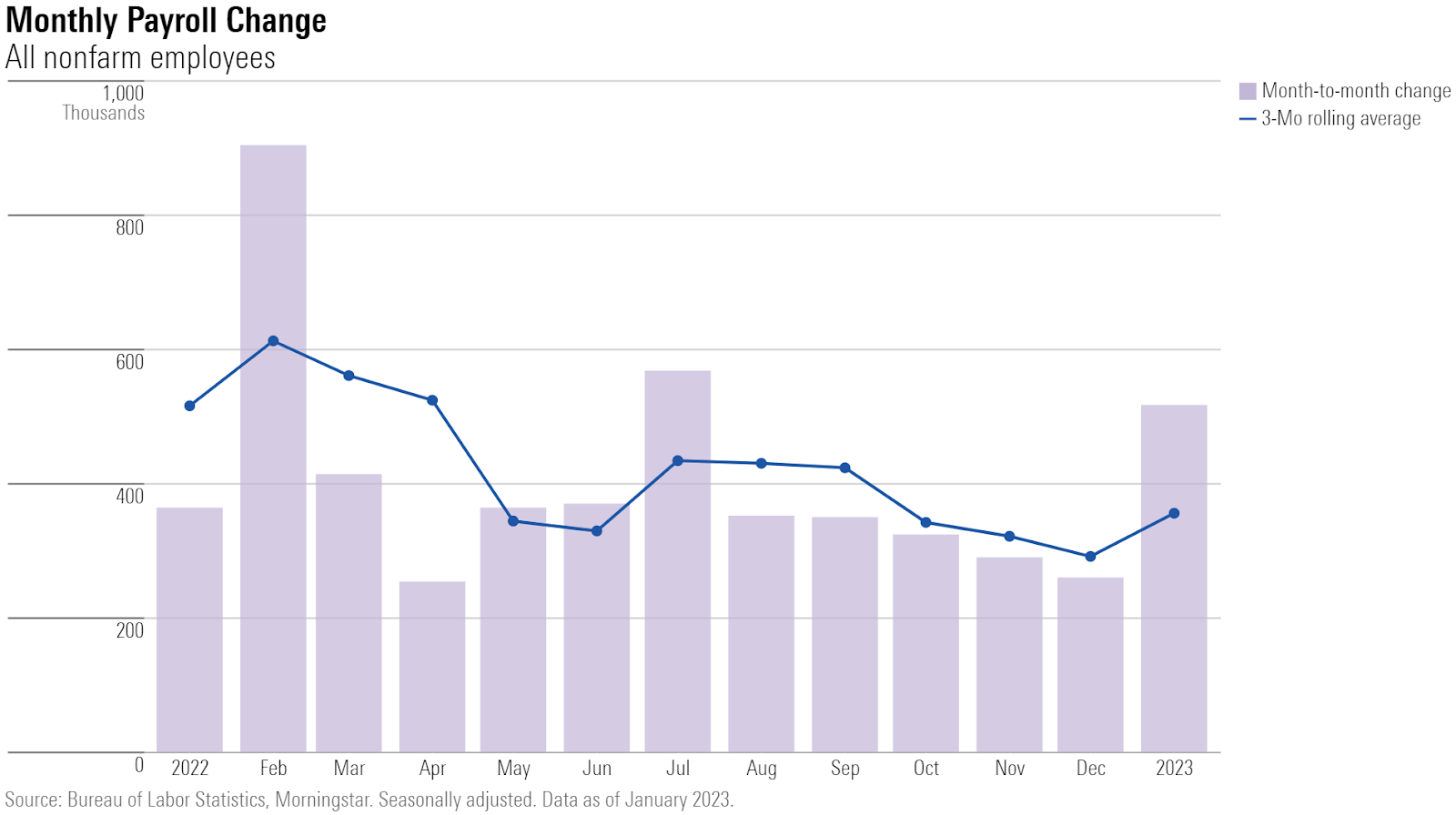
Month-to-month change in payroll for all nonfarm employees. Last Friday, the important concern for investors and the Federal Reserve was whether the unexpected improvement in the January reading on the jobs market would persist in the February employment report. It was not anticipated that there will be another massive hiring boom, but the general trend of a strong labor market is expected to persist. The January jobs report claimed that the economy had supplied around 517,000 new jobs. This was a huge surprise to the markets which believed the federal reserve will keep higher rates for a larger duration and facilitate February’s prediction of an increase in employment of 200,000 in comparison to the 517,000 of January and an unchanged unemployment rate of 3.4%.

            Despite the predictions, The Labor Department’s Bureau of Labor Statistics claimed payrolls for the month increased by 678,000 and additionally, the unemployment rate was 3.8%. Just as the report claimed for January the employment rates have once again increased tremendously in February leading economists to believe the rate is getting closer to employment reports before the COVID-19 Pandemic. Analyzing the market, the statement raised the total amount of Americans who were employed, while it was still 1.14 million behind levels before the Pandemic. From October to December of 2021 Towards the end of 2021, there were 10.9 million unfilled positions, a record-high gap that left nearly 1.7 positions for every employee. Vacancies continue to be a major barrier to filling these positions. 

Additionally, the Bureau of Labor Statistics also recorded the national wage only rose by 1 cent per hour (0.03%) in comparison with the expected 0.05% gain which economists are led to believe that current inflation may be on its downfall soon. Senior economists for the job placement site Glassdoor claim, “This report indicates that the job market is healthy and resilient to the ebbs and flows of the pandemic.” Employment rates have been persistently coming back to fight the lows of the pandemic as the United States has seen an increase in employment of over 400,000 opportunities each month since June 2022. As more Americans return to being employed with the pandemic regulations and restrictions fading, economists are expecting strong job growth in the future. 

However, with the increase in employment rates investors today are left questioning when will the employment rate really begin to slow down. Senior economics and strategist Eric Winograd at Alliance Berstein says, “Until the pace of hiring slows significantly, the Fed[eral Reserve] won’t be able to think about pausing rate hikes.” A high employment data defying expectations is probable to convince the market to believe that the Fed will hike interest rates once again in July.

https://www.morningstar.com/articles/1142099/markets-brief-what-to-watch-in-the-february-jobs-report

https://www.cnbc.com/2022/03/04/jobs-report-february-2022.html

https://www.bls.gov/news.release/empsit.nr0.htm

https://www.nytimes.com/live/2022/03/04/business/jobs-report-february-2022