Thursday, January 21, 2016

Russia Ruble Drops to New Low


The ruble, Russia’s currency has hit a new low since 2014 and is on a rapid decline. The US dollar is worth just over 80 rubles.

Russia’s economy is highly tied to energy production. They are the second biggest oil producer after Saudi Arabia and have even passed them on several occasions. Russia’s oil companies produce around ten million barrels of crude oil a day.

The decline of their currency is connected to the decreasing price of crude oil. The drop in oil prices can be connected to the US’s increase in energy independence and domestic oil production. Obama worked throughout his presidency to make the US import less energy from other countries. This was one of the preliminary steps to increasing the renewable energy use of the United States. It is hard to rely on other countries to switch to clean energy so proactively making energy changes internally is much more reliable.

The Russian economy has been through many ups and downs, but the Putin administration has stayed strong. Typically, in the recession, the blue collar works experience pay cuts and when the economy slightly improves, their wages stay low. This has had a very strong negative impact on the middle and lower class in Russia.

Several members of the oil industry have speculated that the downturn in the oil industry may force Russia to become more competitive instead of relying on several large importers such as the US. The Asian market is growing, but there are many companies trying to market to them and Russia could not compete with their current prices. Additionally, the government of Russia makes around 50% of their revenue off of the energy sector. Forcing the government off of this money might make it more responsive to the people.

Russia had several large international power demonstrations such as their invasion of Crimea, but they have been fairly absent recently. I think this may be in part due to their steadily decreasing economy. I think that the Russian people may start to reconsider Putin as their leader despite his apparent high approval ratings. I also think that it may signal the start of major reform to the Russian economy as even more people are forced into poverty.

What do you think the future holds for Russia? Do you think the downturn is an important stage in a new country or do you think it will just hurt the lower class even more? Should other countries consider helping or does Russia not deserve the support after the attacks they have lead in Crimea?

http://money.cnn.com/2016/01/20/investing/russia-ruble-record-low/
http://www.forbes.com/sites/timworstall/2016/01/20/ruble-fall-past-80-to-the-just-what-russia-needs-to-deal-with-oil-price-collapse/#2715e4857a0b4f1e7204362c
http://www.iea.org/publications/freepublications/publication/KeyWorld_Statistics_2015.pdf
http://www.nytimes.com/interactive/2016/business/energy-environment/oil-prices.html

Wednesday, January 20, 2016

Our Solar System Might Actually Have a 9th Planet

earthsky.org
It was a disappointing moment in 2006 when scientists decided that Pluto is not a planet. However it turns out that even with the loss of Pluto’s status as a planet, we still might have nine planets in our solar system. This planet has not yet been found, but scientists in multiple countries are racing to find Planet 9. When the planet is spotted there will be no debate about it being an actual planet like there was a debate for Pluto because it is estimated to be ten times the size of Earth which would definitely not make it a dwarf planet. Scientists have not been able to find this planet for so long due to its “bizarre elongated orbit” according to Caltech astronomers. One orbit around the Sun takes up to 20,000 years for Planet 9. If it took us this long to find Planet 9 there could maybe even be a Planet 10.
Questions:
1. Do you think this new planet is just a false alarm?
2. Why do you think it is taking so long for astronomers to find this planet?

Sources:
http://earthsky.org/space/solid-evidence-for-a-9th-planet-say-caltech-astronomers

ISIS Cuts Fighers' Pay In Half

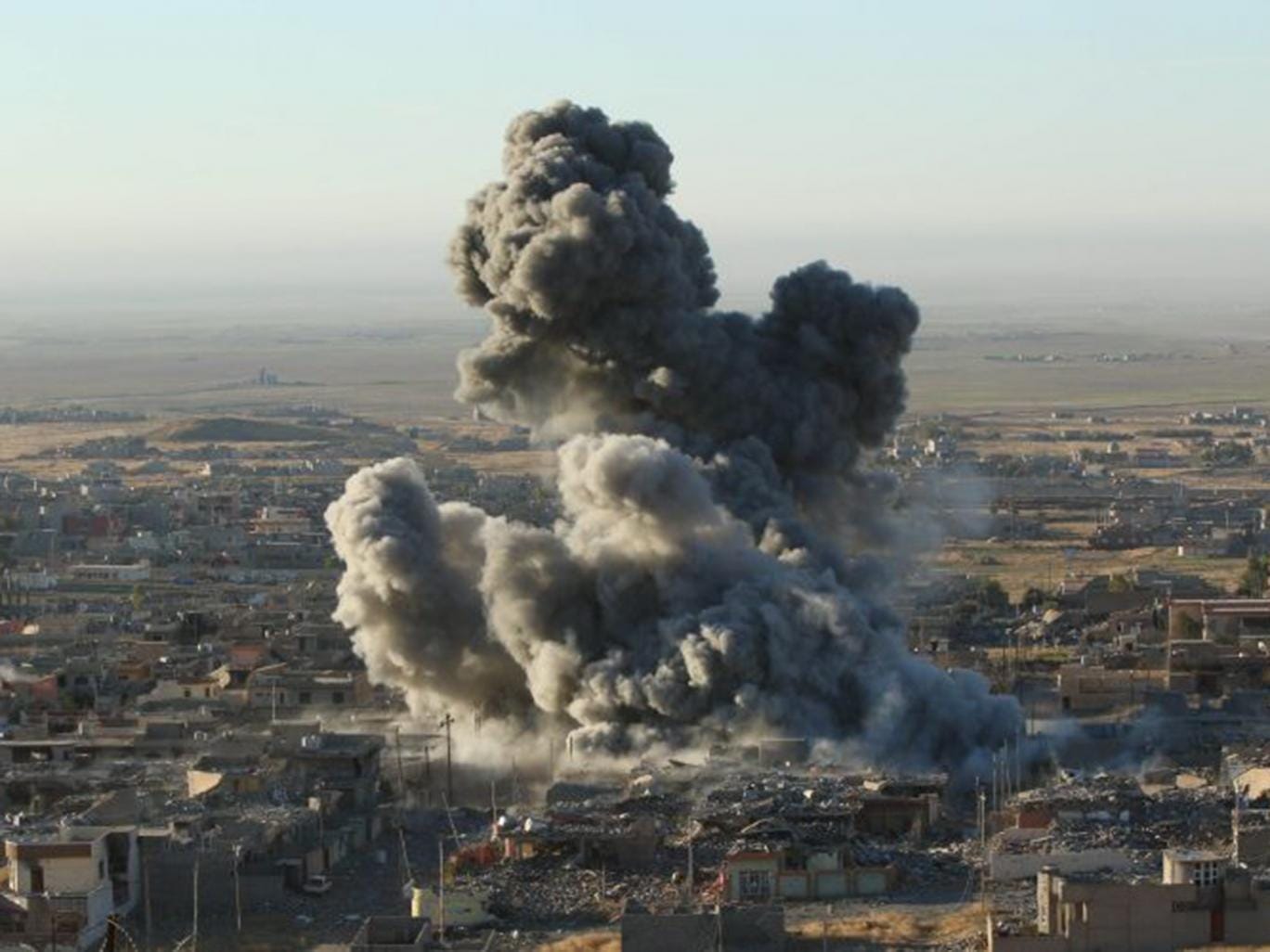
A bombing target in ISIS-occupied Syria. Source: independent.co.uk

The terrorist group ISIS has been in the news a lot lately, especially as they continue to grow and recruit new militant fighters.

One key factor that makes fighting with ISIS so appealing to the people who join is the salary. According to the Congressional Research Service, ISIS soldiers can earn the equivalent of $400 to $1,200 every month, or $4,800 to $14,400 a year. That may not seem like much, but considering that the average yearly income in Iraq is only $4,000, it's not a bad deal.

Late last year, the ISIS government issued an internal message saying that "it has been decided to reduce the salaries that are paid to all mujahideen by half." The document was recently leaked and publicized by several news sources.

We believe that the United States-led coalition's bombing campaign is partially responsible for this massive pay cut, as the main targets have been oil equipment (trucks, storage, refineries). Recently, the campaign also targeted a building that served as sort of a bank for ISIS, holding millions of dollars worth of cash. Seeing that ISIS is forced to cut its fighters' pay could be a sign that these bombing runs are actually working.

I think that targeting ISIS's sources of money is a strategically good move, and will help weaken ISIS's recruiting abilities. Many of the fighters are joining ISIS to have money to send home to their families or for other financial reasons. However, I don't believe that this sort of military action is sustainable. Bombing ISIS-occupied territory may aid their fearmongering efforts in scapegoating the West. Additionally, ISIS will figure out other sources for money - they already get most of their finances by taxing citizens of occupied territory. Continuing to bomb them will become less and less effective.

What do you think? How big of an effect do you think this pay cut will have on ISIS's growth? Should the U.S. and other countries continue the current bombing campaign, or are there better, more sustainable options for the future? How large of a role should the U.S. try to play in combating ISIS?

http://money.cnn.com/2016/01/19/news/world/isis-salary-cuts/
http://time.com/money/4185726/isis-fighters-pay-cut/
http://www.csmonitor.com/World/Global-News/2016/0119/50-percent-pay-cut-a-tough-break-for-ISIS-fighters
http://weekly.ahram.org.eg/News/3598/19/More-salary,-less-work.aspx
http://money.cnn.com/news/isis-the-business-of-terror/?iid=EL

Tuesday, January 19, 2016

Taiwan Elects First Female President, Promises to Keep Taiwan Independent

On the 16th of January, Taiwan (Republic of China) held its 2016 General Elections, electing its first female president into office, Tsai Ing-Wen. The Kuomintang (Nationalist) party, the once-leading party of Taiwan, lost the seat to the presidency and a majority in the Legislative Branch that it held for nearly 70 years. Most importantly, the woman elected was of the Democratic Progressive Party, which unlike the previously dominating Kuomintang party, “vowed to preserve the status quo in relations with China, adding Beijing must respect Taiwan's democracy and both sides must ensure there are no provocations.” (Tsai)
Before the end of the Chinese Civil War in 1950, The Republic of China was the legitamite government of the entirety of China. However, Mao’s Revolution and the ensuing Civil War pushed the ROC Nationalist government out of the mainland, forcing the government and military to evacuate to Taiwan.
The United States, panicked by Mao’s Communist takeover, provided aid and support to Taiwan, recognizing it as the legitimate government of China, and let it have the seat for China in the United Nations. In 1971, The ROC lost its seat in the UN to the People’s Republic of China, Mao’s government. With the loss of support and recognition by the international community, it seemed like Democratic China would soon cease to exist, as even the Kuomintang party began promoting reunification with China. Over the past decades, trade between Taiwan and China have been increasing.


Now, with the Democratic Progressive Party in power, tensions between Taiwan and China may escalate to the point were China will once again threaten to invade the island nation and destroy that government in exile. If the U.S. and/or the UN supports the Taiwan ROC and its decision to be independent, tensions with China could rise to pre-Nixon times. If the U.S. and/or the UN were to support Chinese reunification, the would risk massive lashback from the public.
What do you think of this? What do you believe will ROC/PRC/U.S./UN tensions be in the coming years? Decades? Should the U.S. and UN support the independence of Taiwan? How will international trade be affected? Could we someday see an invasion of the island nation?

Sources:

How Will Voter Turnout Be This Election?

It’s election year and the candidates have not failed to dominate the news. People are still trying to figure out who to vote for or if they should vote at all. I know plenty of people who say they would not vote for any of the candidates they have seen. Many people feel as though it won’t make a difference if they vote. Some are just too lazy to register, so even though we see Donald Trump and Hillary Clinton everywhere and the election is a common conversation topic among many, this election is “probably going to have the lowest-turnout election [nationally] since 1942” according to Michael McDonald, a political scientist who specializes in voter turnout.

In the past two elections large groups of people were passionate about one or two candidates. When Obama ran black women had a larger voter turnout than any other group. 98 percent of the black women who voted, voted for Obama. It is probable that voter turnout for black women is going to drop. Women are not all gravitating toward Hillary as she hoped, and many of the young adults seem to be interested in Bernie Sanders who would decrease adult democratic voter turnout dramatically if chosen in the primaries. Overall there is no candidate who seems to be dramatically raising the voter turnout for a group like Obama did in the past two elections. We will have to see what happens in the general elections when more people start getting behind a candidate.

Questions:
1. What do you think could bring voter turnout up?
2. How do you think voter turnout is going to be this election?
http://www.usatoday.com/story/opinion/2016/01/12/donald-trump-expanding-voter-participation-reagan-democrats-column/78689906/

Flint, Michigan


 http://wac.450f.edgecastcdn.net/80450F/wcrz.com/files/2011/04/il_570xN.222856831.jpg


In his recent State of the State speech, Governor Rick Snyder of Michigan apologized to the city of Flint, Michigan for his administration’s approach to the clean water crisis in their city. He said that “[he] is sorry and [he] will fix it.”

The residents have had contaminated tap water for several weeks after the state decided to switch the water source to the Flint River to save costs. The water had previously come from Lake Huron which was much cleaner water. The river has been tested and found to have high levels of lead. This lead can have negative effects on the development of young children, fetus development, nerve operation, and muscles and joints. The Snyder administration has also been heavily criticized due to the large African American population of the city.

Whistle blowers have stated that the Snyder administration knew about the toxic lead levels long before the water was switched away from the lake. Despite the potential harm it might cause, they decided to go along with the plan to save costs.

Obama called a state of emergency in Flint and the story has been an important topic on talk shows such as The Rachael Maddow Show and was also briefly discussed during the recent democratic debate.

As we have talked about in class many times, an important part of winning an election is keeping your constituents pleased and harming them with unsafe water seems like a very bad way to do this.

Snyder was an accountant before entering the state government and was popular due to the belief that he might help stream line the state. This is one of the likely causes of the crisis. But it has also been caused by many government officials making poor decisions on a wide variety of issues. Should the residents of Michigan trust Snyder at this point? Should people be removed from the government? Do you think this will prevent Snyder from being reelected if he even decides to run?

I think the people of Flint should continue to pressure the government of Michigan to actively work on this problem and to continue to involve the media. Americans frequently lose interest in a topic when a more interesting one arises, but this is definitely a serious problem that needs to be fixed as soon as possible to prevent harm to the citizens.


Fourth Democratic Debate


The democratic candidates just had their fourth debate in South Carolina, the final debate before the Iowa Caucus. While Clinton, Sanders, and O’Malley were all present, it was mostly a contest between Clinton and Sanders to gain any advantage they could in Iowa and New Hampshire.

Clinton and Sanders had several opportunities to differentiate their values from each other on topic ranging from campaign finance to health care to tax rates and financing policies. Sanders accused Clinton of taking speaking fees from Goldman Sachs and O’Malley also attacked Clinton on her attachment to Wall Street. Later, Clinton criticized Sander’s single payer health care plan and said that it was starting from scratch and getting rid of the Affordable Care Act. Sanders was also asked to defend his position on gun control, one of his most controversial opinions, and was opposed by both Clinton and O’Malley.

The timing of the debates has been often criticized by both Sanders and O’Malley. The debates have landed at the same time as popular football games and the middle of holiday weekends. Both candidates say that this benefits Clinton since she is a much more well-known person and doesn’t need the air time to gain support. The DNC’s odd debate times and attempt to block Sanders out of the voter database has been seen as some as de facto support for Clinton.

O’Malley got very few opportunities to speak during the night, potentially because of the fact that he is polling so low. There were several occasions where he was trying to get a chance to respond, but NBC started running commercials. Do you think that O’Malley should get a chance to speak? Is having a third opinion valuable?

The audience of the debate seemed to be skewed slightly Clinton. There were multiple moments where she had multiple seconds of loud applause after a remark. This could have been caused purely by the validity of her statements or maybe the audience slightly favored her. Despite this, Sanders was the most googled candidate after the debates in all fifty states and 89% of a snap poll of 100 thousand people say that Sanders “won” the debate. Do you think that a candidate can win a debate? Do you think one of the candidates performed remarkably better?

The three democratic candidates will continue to face off in the next two weeks to gain any advantage they can in the very close state of Iowa.