Wednesday, October 15, 2008

Gearing Up For The Debate...

As most of you know, the last Presidential Debate is tonight! If we look at past debates and the debates now, we realize that they were a lot more intense before. In class, we watched a video of old debates and some of those reporters were harsh & direct. Do we see any of that anymore? Nope.

So I thought that before the debate happens, we could think about some things that the public would really like to hear addressed.

For example, a lot of people have a problem with McCain's age. Will his old age affect his presidency & what would he say to voters worried about it? If he dies within his presidency, that means Palin would become President. Most people (at least, I'd think so) would pick Obama over Palin at the very least, right? Even Republicans? And the constantly reiterated point that he's a POW. Is that enough of a platform to win? Does that prove that he will be a good President?

One of the main problems people have with Obama is his youth and lack of experience. I think the laws put in place by our forefathers said that the minimum age necessary to be President is 35. Obama is past that age, and yet some people still have a problem with it. Lack of experience? The Republicans have no argument considering the person next in line for Presidency after McCain is even more inexperienced than him. Is that really a legitimate case against Obama? And another is his race/skin color... I heard some political figures actually saying that would put the U.S. back with foreign countries because they'd see him as an ally with terrorists?? Wow.

Since this debate is going to be such a turning point for McCain's campaign (or breaking point), I wonder if any of these issues will be addressed tonight. Will they hurt Obama, and therefore help McCain? Or will they help Obama, and push him further ahead?

We'll see.

Tuesday, October 14, 2008

Anticipating tomorrow's final presidential debate of 2008

Anyone phyched about the tomorrow's presidential debate?

It seems like, for McCain, this debate will be a make or break deal. Both candidates have to prove to Americans, or those who can be swayed, that they are the right leader. Currently, Obama is leading with mostly Democrats, and McCain is lagging on behind him. Both leaders have a plan in mind of what they would do to the failing economy, if elected President of the United States. Tomorrow's debate will discuss the candidates' economic policies.

Obama feels that the economic condition would better if a Democrat led the presidency. Obama feels that the government should be involved with regulating the banking crisis, or at least investing in them. Why? "It gives taxpayers a better chance of getting their money out. Potentially, it also gives the Treasury some more direct mechanisms to monitor and apply some ground rules to participating banks." (http://news.yahoo.com/s/ap/obama;_ylt=ApTqOy0ya7pzsQjdb653G7ph24cA) Obama thinks that top executives should have limits to their salaries and taxpayers must get the same ownership and returns as other investors in the banks. He admits, though, that investing in the banks is not going to do much in regards to solving the current economic crisis. However, the basis of Obama's plan to help the economy is:
• Penalty-free withdrawals of up to $10,000 from IRAs and 401(k)s in tax years 2008 and 2009.
• A $3,000 tax credit for every new full-time job created in the USA by businesses in 2009-10.
• A requirement that banks benefiting from the federally funded bailout provide a 90-day moratorium on foreclosures to give homeowners time to work out a payment plan.
• Empowering the Federal Reserve to provide short-term loans to state and local governments caught in the credit crunch.
(from: http://www.usatoday.com/news/politics/election2008/2008-10-13-obama_N.htm?csp=34)


McCain's plan is a proposal of a 52.5 billion dollar bill. I was looking at an article on yahoo on McCain's plan (http://news.yahoo.com/s/ap/20081014/ap_on_el_pr/mccain;_ylt=AhUizegYOQY.qMa3.gQTtzZh24cA), and basically what McCain is proposing is buying the shares in the nation's leading banks. He wants to take the government out of the business of the bailouts and leave them to their business. He also call for a tax cut. More specifically, down to 7.5 percent for two years, in hopes of encouraging people to buy more stuff, spend more money and therefore stimulate the economy.


Does anyone have a preference for either plan?

Monday, October 13, 2008

Reagan's 1980 Debate Surge

In an effort to debunk the idea that Reagan made a comeback in 1980 that might inspire hope for a McCain rally, Jon Cohen writes:

...there was no evident momentum for either candidate as the 1980 presidential election neared its completion. That is until Reagan's breakthrough debate performance.

Of course, at that time Carter was the president with sub-30 percent approval ratings, and Reagan the relative outsider seeking to prove himself to be a "safe" choice.


Of course, being the only debate between the 2 major party candidates and having it on October 29th made it an even bigger deal than any one of three debates will be this cycle. Taken as a whole, however, I think they'll have the same impact: legitimizing the newcomer in a way that activates retrospective voting.

The public is vicous.

Hey everyone,

I thought I'd post about campaign ads. I'm sure everyone has seen Obama's "Hope" sticker:


https://blogger.googleusercontent.com/img/b/R29vZ2xl/AVvXsEj5JiMcxqO4f00rGFvEGrBQyweH0jxQPHczlqlos8Wo-2aecq42gbuROyOWR3jJIqBVOki53-SKvn_J3CYOz4WcFZ-IzHaktXJebrsYPtkA1BLDfcf1izcX3RBFPXZ2bvOqtP3QWreUEOo/s1600-h/Obama_Hope.jpg

And they've made an anti-McCain version too:


https://blogger.googleusercontent.com/img/b/R29vZ2xl/AVvXsEjv928k0RbHZlD2-D3X7r37qteOOr6f1vnVj0-ggUT2vZesmxNDZBO_YD6mNN-moU-0VdkMXvg66GzsMVevG3p-TeX1HpGu2nOBFHNQhbfOD1BMNXdFLZdZFl5CAvTTyQwyRnSOoU5sFoY/s1600-h/125-McCain-Nope.jpg

I found this on another blog. Can you believe they make t-shirts out of these?
The caption that reads under McCain's sticker is "Peace? Nope. Health care? Nope. Fair trade and tax? Nope. Choice? Nope. Environment? Nope. Get the idea? Get the T-Shirt!"

I thought it was funny, but yes, I am biased.

Now on to the real point. These are actually pretty mild in terms of attacking the opponent. I've seen some images that are really racist. I saw a caricature of Obama (with big ears, looking like a monkey) on the phone with a terrorist. Really, people? This is the 21st century. If all you can attack him for is his skin color, then I think it's pretty obvious who should be President. It's one thing to attack a candidate for his policies or even his eloquence, but personal attacks? This then made me think if candidates take it all personally. Political figures have to have really tough skin to do what they do, and I never respected or admired them as much as I started to recently. I know I personally was waiting for Palin to mess up during the Vice Presidential Debate, but now I have a little more respect for her for not completely cracking.

But you know, that's just me. I dislike prejudices and stereotypes. Thoughts, anyone??

Relief on Wall Street

As the week begins, I’m sure that it is a relief for many to see that the Dow Jones Industrials has attained a shocking 936-point increase, especially after eight consecutive days of losses. Also, United States stock market paper gains reached $1.2 trillion. Following suit with this surprising turn of events, the NASDAQ composite index also increased by a total of 195 points. In the previous week, the Dow dropped by a devastating 2,400 points and about $2.4 trillion in shareholder wealth. Although this is comes as a major relief, Wall Street still has a long way to go in order to restore our economy. As of the today, the Dow’s current 9,387 points still remains to be about 5,000 short of the 14,165 seen a year ago. In addition to the stock market, Wall Street has other issues to tackle, including a troubled housing market as well as worried investors. In the end, it’s reassuring to see that hope is beginning to resurface; however, time will tell if this same trend will follow in the future.

Sunday, October 12, 2008

National debt; too large to count

It is no secret that our country is in debt. This debt however has skyrocketed in past eight years and as recently as Saturday afternoon, it reached 10.2 trillion dollars. Ironically, the debt clock in Times Square cannot record the digits of such a large number. Our national debt is so large that it is unable to be recorded. No one could have predicted that the national debt could have risen this much in recent years and the clock being unable to accurately record our debt is symbolic of how drastically the American economy has been altered. In addition to recording national debt, the clock also displays how much each American family will owe. This amount almost reaches 90,000 dollars, which is more than most American families earn in a year. Everyone is impacted by such poor economic decisions and in this case the people are paying for the mistakes of others. Unless the economy improves, the American lifestyle of overbuying and risky investment will be a thing of the past. As the economy worsens, people should begin to be more wise with their money.

The 700 Billion Dollar Bailout in Text, and What it Means for our Economy: Post 2 (The Good)

...damn...

Been trying for a hour to think of one way the bailout could have saved our economy, but from the last week, we can see it isn't working...
Was worth a try, was supposed to stall Armageddon, guess that didn't work...

a week in review...

... It's Been One Hell of a Week....

Friday, October 10, 2008

Fundamentals

I found Tuesday's debate to be fairly interesting. With the economy as the number one hazard, McCain was surprisingly short on his answers economics, instead trying to distance his beliefs from those of Obama's and criticizing the Illinois Senator about his policies, rather than specifying his own. in the debate, the Senator from Arizona said that he "knows" how to fix problems like the economy, Bin Laden, crisises more than 7 times, but only twice did he actually bother to tell us "how" he would actually do what he said he would do. The alleged "King of the Town Hall" was also defeated soundly by Obama on most of the policies. If America does indeed vote for McCain... I will almost definitely be moving to Canada.

Thursday, October 9, 2008

Crisis

The Japanese stock market has dropped 11% so far in Friday trading.

Friday stands to be a crazy day. I'm reduced to hoping it isn't a historical day.

Rationally, it shouldn't. The physical capital, the technology, the infrastructure, the innovation, and the productivity of the US and global work forces are intact. There was an interesting report on PBS News Hour tonight about Silicon Valley and how many entrepreneurs here are optimistic about the potential for new startup companies in the tech sector. There has been no violence to the people or machines that drive economic growth. Unfortunately this has the potential to be beyond rational, and the worst case scenario is on the table, and that's really, really bad.

The next time a student whines that social studies are not relevant to their daily lives I think I might have a complete meltdown. It is nearly impossible to imagine people retiring at 65 as planned with people's savings worth 30% less, and that's just counting the situation as of the close of business Thursday -- basically, it looks like we all just got sentenced to thousands of hours of extra work. That isn't relevant? The baby boomer generation just got whacked and will want to be sticking around in the labor market for much longer than expected. That will either produce greater competition for jobs, or, if they get replaced, put an unforeseen burden on younger generations to take care of their elders.

In 1987 a speculative bubble burst, with housing and bad banking in the mix, and the market tanked 20% in a day. The next day, it bounced back, and people who bought at the bottom made huge gains for more than a decade. That probably won't happen this time for all sorts of macroeconomic reasons. I'm just trying to find a silver lining, hoping that we've reached bottom. If not... yeah... I'm basically down to hoping that we make it through tomorrow, the next week, the next month, and if we do, we'll get away with "only" a bad recession. Whoop. De. Doo.

Ask not what your country can do for you

I was just watching Glenn Beck's talkshow and his guest tonight was actor Kelsey Grammer. Both are conservative and support McCain, yet i found it interesting that although both bashed Obama regularly, they were more concerned with the current state of government. Regardless of party affiliation, both Beck and Grammer suggested that a smaller Congress and government in general would be an improvement. This made me think about whether voters are interested in a particular candidate or altering the current state of government. Obama's platform has always been to bring about "change" in Washington and he has been very sucessful.
Grammer said that he fully believed in Kennedy's iconic phrase "Ask not what your country can do for you, ask what you can do for your country," and that it appears that all America is concerned with at the moment is what the government is going to do. I am guilty of this as well. I want government to solve all of my problems: social, economic, and political, but is that really fair? We are naive if we believe that government has all the answers. In fact government really should just be the vehicle for organizing the public's ideals. Setting unrealistic expectations for our next President will only lead to disappointment. If real change is going to occur it needs to come from the people. We need to be more responsible with our investments and we need to reduce our our dependence on oil. The government has only a responsibility now to get us out of a national crisis, but if we want permanent change, then we have to be more active in ensuring that the voice of the people is reflected in legislature, not the voice of politicians. I do believe that the government needs to be reformed and that it should be more involved in guaranteeing that Americans have homes and healthcare, but I am also firm in my belief that government should always have in mind the best interests of the entire nation.

Wednesday, October 8, 2008

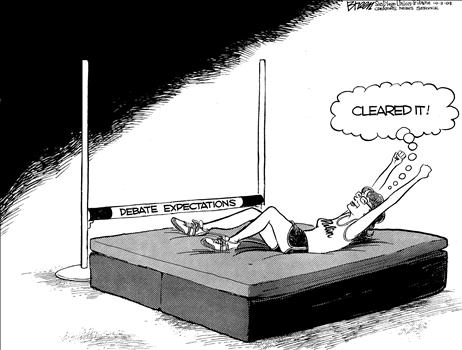
Some Cartoon Perspective


Photobucket


Will McCain actually be able to catch up? I dont think so unless his next performance is alot better than last night's. You're going to have to earn those states back "My friend."


Photobucket
Keeping in mind that McCain is a moderate Republican, both candidates are slightly more liberal than they have been in the past. Regardless of who wins the election I think that both will inspire and work for change in Washington.

For those of you who were at the Potluck yesterday night: The Presidential Debate

A link to a video stream of the debate:
The Debate

For all those people who were at the Potluck who could not watch the Debate yesterday night.
This is just a quick post right now in the morning, I will post a detailed followup to the debate later.

Tuesday, October 7, 2008

If McCain says "My Friends" one more time i might just scream

For the most part tonights debate was business as usual. McCain and Obama bickered about who signed what bill and positions regarding alternative energy, the economy, and international affairs seemed typical. I found that instead of having a better understanding regarding the actions that each candidate will take, after watching the debate I am even more unsure of how this country will ever put the pieces back together. The debate began with a discussion regarding the economy and what each candidate plans to do to help the people. It became quite evident that I am not the only one who wants to know what the governemnt is going to do now to ease the suffering caused by our failing economy. A young man asked what the government plans to do now to help those who are not earning enough to support themselves and who are faced with the harsh reality of losing their homes. McCain was quick to state that the bailout will be the resolution to such hardships and suggested that "Fannie May and Freddie Mac" were responsible for the current state of our economy. While McCain was placing blame and oversimplifying the course of action required to repair the economy, Obama offered a more reflective response by stating that the bailout was just the beginning of a long hard process to restore national economic stability.
I felt that Obama outshined McCain in the economic portion, but I was disappointed by both responses to a question that required that both candidates offer their opinions on what would have to be sacrificed by the American public in the midst of such crisis. Neither candidate bluntly stated that yes alot will need to be sacrificed and people will lose their homes and their jobs and continue to worry about their retirement. Instead both discussed how policies would be thrown out and how they were hopeful about the future. Im pretty sure at this point no one thinks that the next couple years will be easy and so a more honest answer would have given the voters more insight into how both candidates plan to fix the economy .
I was also disappointed by both responses to the closing question: "What do both of you not know and how do you plan to learn about it?" Both responded similarly in that they are unsure about the future of this country. While Obama seemed to be more concerned about preserving the "American Dream" ideals and the the U.S. continues to be a place of opportunity, McCain simply stated that he was unsure about the future.
In all i was a little disappointed, but more so by McCain's performance than Obama's. McCain is trailing Obama and frankly i expected more from him. McCain continuously made historical references and at times was condescending (especially during the foreign policy portion.) He also insisted on addressing the audience as "my friends" the entire night which is just simply annoying. I admit that at times I am biased becuase I support Obama, but tonight i was rooting for McCain and was expecting a performance that showed that he is ready to be our President, but after tonights debate he just seems like more of the same.
All in all the debate was not great, but important topics were discussed. Even with rehearsed responses, I felt like the character of both candidates still shined through and at times that can be more influential than ideology. So who won? Im not sure if there was a winner, if I had to choose I would say that Obama was more fluid and personable in his responses and therefore was more captivating, but there really wasnt a decisive victor. I am very interested to see what you all think so if you havent watched the debate theres a link attatched to the title.

Monday, October 6, 2008

Who will save us from our own economy?

When the bailout was first rejected I was anything but surprised. "Big business" needed to be punished and a 700 billion dollar bailout is hardly a slap on the wrist. But now even with the bailout, the economy is still in shambles. The stock market plunged earlier today and the American economy is in such despair that our misfortune is translating into problems in markets overseas. European markets are beginning to feel the ripple effect of our economic instability. With or without the bailout the U.S. would have had immense obstacles to overcome and there is still much uncertainty regarding how effective the bailout will be in offering relief. Even with the billions of dollars that the bailout provides, experts say that close to 100 banks will still be forced to close within the next year. What we can conclude from this is that more needs to be done. The bailout cannot solve all of our economic problems. WE NEED A PLAN. Our economy is slowly falling into a downward spiral. Unless something is done to breathe life back into what is left of our economy, Americans will be forced to endure more foreclosures and unemployment and world markets will continue to suffer. So who will come to our rescue? The current state of the economy will certainly be a main topic in the upcoming debate. The candidate with the most convincing and stable plan to bring us out of this recession will undoubtedly pull ahead. How to win over the American public: promise to get them their homes and jobs back.

Sunday, October 5, 2008

700 Billion Bailout Critique, the Jon Stewart Way

Here ya go:

The 700 Billion Dollar Bailout in Text, and What it Means for our Economy: Post 1 (The Bad)

Here it is in all its glory, The 700 Billion Dollar Bailout Plan (accompanying fanfare inserted here):
Legislative Proposal for Treasury Authority To Purchase Mortgage-Related Assets, Wahington Post

After reading this, t
he first thing that popped into my mind was, "We are screwed..."

If you read closely, you will see that the Senate and House, not to mention "Double U" Bush have effectively placed, 700 Billion Dollars (say it a few times, let the number roll in your mouth and sink in) into the hands of Secretary of the Treasury Paulson's hands and added that amount onto the already immense public debt, raising it to
$11,315,000,000,000(with an estimated 1.5 trillion directly to China). I don't have to be an economic expert or a mathematician, but according to these absurd numbers, this bailout alone raised the taxes that each taxpayer owed to the world by two thousand three hundred dollars, bringing our individual debt to other countries to 37,716 dollars, or roughly 20 years of taxes used on nothing but paying our debt off and the bare necessities of the United States State and Federal Governments. I know that the now OKed proposal says that Paulson can only spend a maximum of 700 Billion Dollars(No, I can't stress that enough) over the course of 2 years, but hear me out, it also states "at any one time." which translates neatly to banks as "as long as we can sell off these mortgages, we can always loan you more money.". And really, I haven't even gotten to the worst part of the plan, which is that Paulson gets to use this money all with no possible reprecussions or strings attached, as mentioned in Section 8, which means we will never be able to critique this bastard on the poor investments he will undoubtedly make.

It is a sad state of affairs, a sad sad state of affairs...

Leaving on a Fun Note

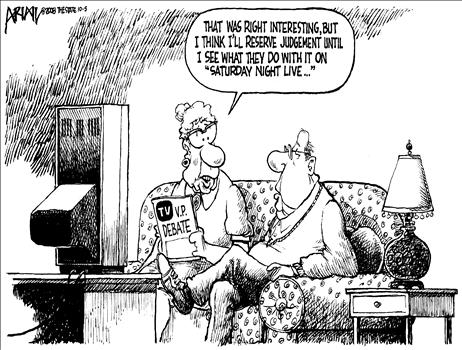
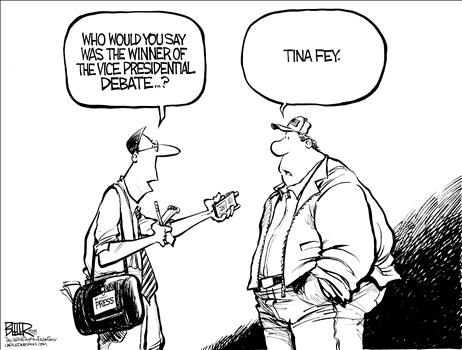
I just watched the SNL skit that ana posted...pretty darn funny. especially with palin's answers and use of the word "maverick" as an explanation. anyways here's some funny cartoons i found to round up the week...

hmmm...i do think that there is truth to this cartoon. it seems as if the media is picking on palin a little more than they are biden, but then again, palin's giving quite a bit of parody material.


SNL's VP Debate

For any of you who missed SNL here is the clip they did on the VP debate. I thought it was pretty funny, although not as good as the Couric and Palin interview. SNL didn't seem biased to me because they made fun of Biden and Palin equally. I am knida sad that they didn't do anything on how Sarah Palin says "nuclear" or how she said "straight up" during the debate.

Saturday, October 4, 2008

Corrections

As disclosed, I only caught about 30% of the VP debate on radio.

Apparently, the frequent downward glances by the candidates was innocent -- they had blank scratch paper only. So the joke we started class with was not literally true. See here. (Still pretty funny IMO.)

On the VP question, I maintain that Sarah Palin's answer was a conceptual trainwreck. Having seen the transcript, however, I have to admit that Biden's answer was at the very least a verbal trainwreck.

The Vice President in mentioned in both Article I and Article II of the US Constitution. That does not mean the VP is simultaneously considered to be "in" both the legislative and executive branches, despite Dick Cheney’s bald assertion of uncheckable power to that effect. The title "Vice President" and method of election or impeachment clearly place the VP in the executive branch.

In practice, the VP had a very small role in either branch for most of US history. Recent VPs have been major advisers to the President, diplomats on his behalf, and lobbyists to the US Congress on behalf of the President's legislative priorities, which build a pattern of the VP acting as a liaison from the executive toward the legislative, as part of the executive branch.

Article I, Section III of the United States Constitution says:

The Vice President of the United States shall be President of the Senate, but shall have no Vote, unless they be equally divided.

The Senate shall chuse their other Officers, and also a President pro tempore, in the absence of the Vice President, or when he shall exercise the Office of President of the United States.


The tiebreaking vote isn't considered a major power. No VP since the Reconstruction era has cast more than 10 votes in the Senate. (Senate.gov)

The Senate President pro tempore provision clearly anticipates the absence of the VP from daily deliberations in the Senate chamber. VPs have rarely presided over or worked worked live in the Senate chamber, although recent ones have lobbied the Congress behind the scenes, trying to persuade legislators to vote in accordance with the President's agenda. In practice, the Presdient pro tempore (the pro tem) doesn't have the most authority in the Senate, although he is next in line to the Presidency after the Speaker of the House. The Senate Majority Leader is the most important Senator from a legislative point of view. The Senate has a long institutional history of valuing the equality of its members, and is unlikely to accept an expansive view of the VP's legislative role and Constitutional powers even if that VP was of the same party.

Palin says:
"No, no. Of course, we know what a vice president does. And that's not only to preside over the Senate and will take that position very seriously also. I'm thankful the Constitution would allow a bit more authority given to the vice president if that vice president so chose to exert it in working with the Senate and making sure that we are supportive of the president's policies and making sure too that our president understands what our strengths are."


No, you are not expected to take that position very seriously also. You might be expected to lobby and/or campaign for the McCain agenda, but the 55-58 Democrats in the Senate would reject a Democratic VP trying to read the Constitution to "allow a bit more authority given to the vice president if that vice president so chose to exert it in working with the Senate," much less a Republican one. Ridiculous answer. She goes on to agree with Cheney’s view that the VP is in both branches at the same time. Yeeech. Did she misspeak or does she think that highly of herself and her future powers?

Biden said, "I would be the point person for the legislative initiatives in the United States Congress for our administration" and goes on to describe a robust role for himself in an Obama administration more or less along the lines of Gore.

Biden's 2nd answer:

Vice President Cheney has been the most dangerous vice president we've had probably in American history. The idea he doesn't realize that Article I of the Constitution defines the role of the vice president of the United States, that's the Executive Branch. He works in the Executive Branch. He should understand that. Everyone should understand that.


No, Article I is the legislative branch. He probably meant to say Article II. That makes more sense, but it could be construed as if Biden didn't realize the Vice President was mentioned in both Articles. (The Senate is mentioned in Article II's "advice and consent" clause on Presidential appointments, but that doesn't mean the Senate is also "in" the executive branch.)

So did Biden misspeak or did he really not know the text of the Constitution? Here's where Biden's resume makes him bulletproof in a way Palin's doesn't. Of course he misspoke. He went on to say:

And the primary role of the vice president of the United States of America is to support the president of the United States of America, give that president his or her best judgment when sought, and as vice president, to preside over the Senate, only in a time when in fact there's a tie vote. The Constitution is explicit.

I agree with all of this except the last sentence. The Constitution is somewhat vague about the VP, and assigns the office few formal powers, and describing it as "explicit" marginalizes the importance of historical precedent in framing the role of the VP.

The final part of Biden's answer cited the "unitary executive" doctrine as dangerous. Agree or disagree, he had a clear opinion that the VP, the office he is seeking, has less power than Cheney or Palin claim for it.

Update: for more on how both candidates whiffed at the question about the office they are seeking, see here.