On Friday, February 16th, the Alabama Supreme Court reversed an earlier decision made by one of the state’s circuit courts (Mobile County Circuit Court), ruling that cryogenically preserved embryos are classified as “children.”
In 2022, three couples filed a lawsuit against the Center for Reproductive Medicine in Mobile, AL under the Wrongful Death of a Minor Act, suing on the grounds that the clinic’s negligence had “wrongfully” killed their child.
One of the fertility clinic’s patients had somehow gained access to the cryogenic storage room, and when the freezing temperature of the embryo tube burnt their hand, they dropped the embryos onto the floor, killing them. The couples claimed that since the fertility clinic had “allowed one of its patients to leave from his or her room in the Infirmary’s hospital area and access the cryogenic storage area,” they could sue for wrongful death.
The original decision made by the county circuit court had stated that cryopreserved embryos were not considered “people,” and thus the lawsuit was dismissed because the Wrongful Death of a Minor Act did not cover embryos outside the womb.
However, the Alabama Supreme Court disagreed with the ruling, overturning it 8-1 on Friday. Alabama Supreme Court Justice Jay Mitchell wrote in the Court’s decision that the Wrongful Death of A Minor Act “applies to all children, born and unborn, without limitation. It is not the role of this Court to craft a new limitation based on our own view of what is or is not wise public policy.”

The Heflin-Torbert Judicial Building in Montgomery, home to the Alabama Supreme Court.
As we learned in class, Alabama’s Supreme Court decision is a clear example of judicial restraint, in which judges will limit the exercise of their discretion and keep to the language of the law as much as possible. The Court restricted its own power, refusing to add age limitations to the Act, prioritizing instead the original intent and wording of the law. Since the Act doesn’t specify that an embryo is not a minor or that embryos are not protected under the law, then the lawsuit is applicable, according to the Court.
The Court’s ruling mirrors the recent pro-life state policy changes after the overruling of Roe v. Wade, in which Alabama legislators immediately banned abortions except in cases where the mother’s life is threatened or put at severe risk. Additionally, Alabama’s own state constitution explicitly outlines the rights of “unborn” children: “It is the public policy of this state to recognize and support the sanctity of unborn life and the rights of unborn children, including the right to life… Nothing in this constitution secures or protects a right to abortion or requires the funding of an abortion” (Alabama Constitution of 1901, Art. I, Sec. 36.06).
Many fertility clinics and medical institutions in Alabama warn against the consequences that the Alabama Supreme Court’s decision will have on medical procedures that involve embryos, such as in vitro fertilization, where egg cells are fertilized in a lab, and the embryo is placed into the mother’s womb. The procedure allows people with fertility issues or genetic disorders to have children and start their own family.
The Medical Association of the State of Alabama states that “the increased exposure to wrongful death liability would – at best – substantially increase the costs associated with IVF. More ominously, the increased risk of legal exposure might result in Alabama’s fertility clinics shutting down and fertility specialists moving to other states to practice fertility medicine.”
In Alabama, a deeply conservative state, most reproductive health clinics either shut down or have shifted away from abortions entirely after the fall of Roe v. Wade, instead focusing their sights on family planning and contraception. The personhood laws enacted in multiple states post-Roe v. Wade can also affect IVF procedures now that the rights of embryos are protected and the usage of embryos is becoming the subject of legal controversy.
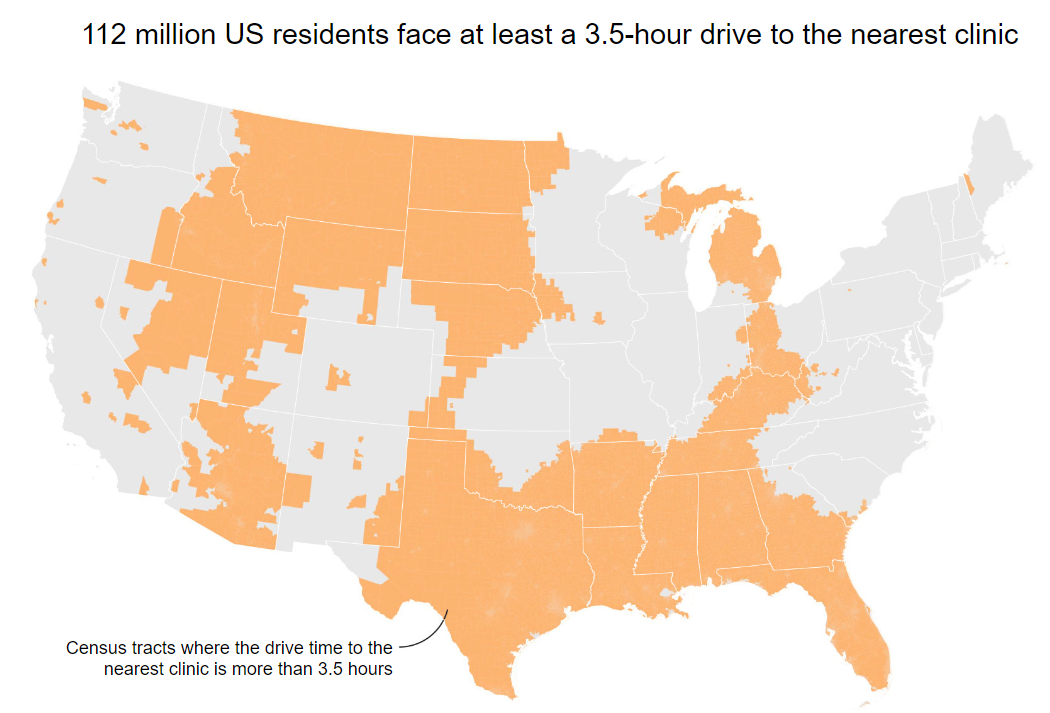
112 million US residents face at least a 3.5-hour drive to the nearest clinic | CNN Analysis
Medical professionals fear that fertility clinics, similar to abortion clinics, may become scarce if IVF and other embryo-related procedures become legally restricted. In states like Alabama where the lack of reproductive health clinics is already at a crisis-level high, the effects of such Court decisions and pro-life legislation can have heavy consequences on the future availability of comprehensive reproductive healthcare.
Sources:
https://mynbc15.com/news/local/alabama-supreme-court-rules-in-vitro-embryos-are-children
https://www.huffpost.com/entry/alabama-ruling-frozen-embryos-children_n_65d29a77e4b043f1c0aba2b9
https://www.politico.com/news/magazine/2023/05/29/alabama-abortion-clinic-problem-00096020
https://www.cnn.com/interactive/2022/us/abortion-laws-access-by-state/index.html
Emily Ren