Monday, January 23, 2023

Two California mass shootings in two days: Half Moon Bay and Monterey Park


    Today at 2:20 p.m., seven people were killed in a shooting near Highway 92 in Half Moon Bay, close to Half Moon Bay city limits. The suspect, Zhao Chunli, was taken into custody shortly after the shooting occurred; a semi-automatic handgun was recovered and determined to be the weapon used in the shooting. An eighth person is being treated at Stanford Medical Center for their critical injuries.    

    With seven victims thus far, the incident can be classified as a mass shooting. According to CNN, there have been 38 such incidents in the first 23 days of 2023. Yesterday, 11 people were killed in Monterey Park, California. Nine others were wounded. The suspect, Huu Can Tran, was apprehended upon entering a second location with an intent to continue shooting.  

    Both events are similarly disturbing attacks on the Asian American Pacific Islander community, and the motives of each attacker are unknown at this time. The fact that they both occurred within hours of one another highlights the severity of gun violence in America, and calls into question the effectiveness of state restrictions by themselves.     

    California has some of the most restrictive gun laws in America. There are restrictions on assault weapons and their associated magazines, required universal background checks, waiting periods, minimum age laws, and protections in place for victims of domestic violence. Despite this, the legislation comes with complications; “California compliant” AR-15 copycats are being made to meet demand, and federal judges have blocked laws that aim to hold gun dealers responsible for selling illegal assault weapons accountable. Overall, California’s gun restrictions appear to have been at least somewhat successful in comparison to other states. According to the Washington Post, California also has the seventh lowest firearm mortality rate in the country, with 8.5 deaths per 100,000 people in 2021.     

    However, some of these restrictions may be up for reconsideration. In June of 2022, the Supreme Court ruled 6-3 on the New York State Rifle and Pistol Association v. Bruen. In essence, this ruling interpreted the “right to bear arms” as the right to bear arms outside of the home, declaring that restrictions on the ability to carry a gun in public are unconstitutional. California was one of eight states, including New York prior to the Bruen ruling, that required an individual to express a true "good cause" to carry a firearm before issuing a concealed carry permit. The Bruen ruling struck down the "good cause" clause specifically. Newsom condemned the court’s decision–while the Bruen ruling didn’t invalidate the restrictions in place, it made them vulnerable to a challenge in court. The implementation of the ruling is ultimately left up to the local and county offices that issue concealed carry permits, and many officials are unsure how to proceed in light of increased demand. This, to me, is an example of both the ramifications of the Supreme Court's decisions, and a friction that follows federalism in practice. The Supreme Court has no power by itself to implement a decision; in a state like California, where laws restricting access to firearms could likely pass and the governor is in support of those laws, bills are written to work around the rulings made at the federal level. This differs from the interpretation of the Bruen ruling in a state like Missouri or Texas.

       In the wake of the past days’ tragedies, Governor Gavin Newsom has expressed a desire for gun reform at the national level. President Biden, who signed a bipartisan gun reform bill into law in June of last year, issued a statement last night in support of the victims of the Monterey Park shooting.


Sources:

https://www.nytimes.com/live/2023/01/23/us/shooting-half-moon-bay-california

https://www.washingtonpost.com/nation/2023/01/22/california-gun-laws-monterey-park-shooting/

https://calmatters.org/justice/criminal-justice/2022/06/california-gun-laws-supreme-court/

https://www.oyez.org/cases/2021/20-843

https://www.everytown.org/press/california-is-advancing-an-important-bill-to-combat-the-supreme-courts-dangerous-ruling-in-nysrpa-v-bruen-heres-what-to-know/#:~:text=Bruen.,carry%20a%20firearm%20in%20public.

https://www.whitehouse.gov/briefing-room/statements-releases/2023/01/22/statement-from-president-joe-biden-on-the-shooting-in-monterey-park-california/

https://www.supremecourt.gov/opinions/21pdf/20-843_7j80.pdf 


Monday, January 16, 2023

Google Files Defense Brief for Contentious Supreme Court Tech Case


On Thursday, January 12, the Supreme Court case Gonzalez v. Google gained fresh media attention after Google filed a defense brief to the Supreme Court. The family of Nohemi Gomez, who was killed in a terrorist attack in France in 2015, alleges that YouTube (which is owned by Google) allowed for terrorist organization Islamic State to gain members via the promotion of terrorist content by YouTube's recommendation algorithm. Google claims that it's protected by Section 230 of the Communications and Decency Act of 1996, although the Supreme Court may potentially overturn or alter this section of the act. 

Section 230 states that companies aren't liable for any content posted on their websites by third-parties, similar to how phone companies aren't liable for conversations that people have through their phone lines. Section 230 has given internet companies an enormous amount of protection from lawsuits, although with social media having exploded in popularity in recent years, the internet has changed significantly since 1996. Large amounts of misinformation, hate speech, and other harmful content has been posted on these platforms, and many are beginning to question whether Section 230 should be altered or completely removed. 

Dislike for Section 230 seems to be one of the few things Democrats and Republicans can agree on, although for very different reasons. Democrats argue that Section 230 protects misinformation and hate speech posted on online platforms, and that holding tech companies legally responsible for such content would help to decrease the presence of such harmful content. Republicans, however, argue that the lack of guarantees for free speech in Section 230 gives companies a free-pass to censor whatever they deem harmful (which Republicans claim is often done with anti-conservative biases). On Wednesday, President Biden tried to harness this bipartisan dissatisfaction with Section 230 and called for its reform in an op-ed in the Wall Street Journal.

Online companies are terrified at the prospect of losing this liability shield, and proponents of Section 230 have claimed that it's a necessary protection that will prevent internet companies from having to greatly rework the way they operate. Google stated in it's defense brief that greatly altering or abolishing Section 230 would "upend the internet" and could lead to increases in content moderation if companies fear getting sued and remove anything that anyone objects to. However, Google claims it could also cause increases in harmful speech if companies decide to remove all content filters, allowing them to ignore third-party content posted on platforms. 

The Supreme Court accepted the case on October 3, 2022, and is scheduled to hear oral arguments on February 21st, where attorneys from both sides will have 30 minutes to argue their cases. The Supreme Court has never had a case on Section 230 before, and thus no judicial precedent exists for it. If the court overturns or greatly alters Section 230, it will have significant implications for online platforms and how they operate.

Sources: 

https://www.washingtonpost.com/politics/2023/01/12/biden-calls-changing-big-tech-moderation-rules-not-how/ 

https://fortune.com/2023/01/04/what-is-section-230-social-media-tech-regulation-3-way-could-change-twitter-facebook/

https://thehill.com/policy/technology/3811161-google-warns-supreme-court-against-gutting-controversial-tech-provision/ 

https://www.forbes.com/sites/saradorn/2023/01/11/biden-urges-bipartisan-legislation-to-rein-in-big-tech-companies-as-gop-targets-president-in-tech-probes/?sh=78f250882efd

Image source: https://www.cumanagement.com/articles/2022/08/compliance-what-supreme-courts-administrative-state-decision-means-credit-unions

Sunday, January 15, 2023

Biden's Document Troubles


This past week, news broke that classified documents had been found both at President Biden's former office at the Penn Biden Center for Diplomacy and Global Engagement, and at his home in Wilmington, Delaware. The documents were likely misplaced during Biden's time as Vice President, with Biden stating that he was "surprised" to hear about their discovery. While under most circumstances the story would simply be dismissed as sloppy staff filing, the development has gained much more significance in light of the situation surrounding former president Donald Trump's possession of classified documents. In August, the FBI raided Trump's Mar-A-Lago home in Florida and seized hundreds of classified documents, with President Biden and other Democrats rightfully criticizing Trump for being irresponsible with such highly sensitive material. However, this has led to criticism (mostly from Republicans) that Biden was hypocritical for criticizing Trump's possession of classified documents despite having his own set of classified documents.  

However, there are significant differences between President Biden's and former president Trump's cases. For starters, while less than 20 documents have been discovered in Biden's residence and former office so far, Trump was in possession of over 300 classified documents. Additionally, upon discovery of the documents, Biden quickly turned them over to the National Archives and Records Administration. In contrast, Trump refused to return his documents despite the NARA's request in 2021 that they be returned, resulting with the FBI's raid on Mar-A-Lago over a year later. In short, while Biden has cooperated with the investigation and it seems like he simply misplaced the documents, Trump has actively tried to work against investigations into his possession of classified documents. Attorney General Merrick Garland has appointed separate special counsels to review both Biden's and Trump's possession of classified documents.

Both Democrats and Republicans have also criticized Biden for not announcing the discovery of the documents sooner, as the batch found in his former office and the batch found in his residence were discovered on November 2nd (only 6 days before the midterm elections) and December 20th, respectively. Additionally, despite the clear differences in both Biden's and Trump's cases, there is a possibility that people won't look further into the details of each case and incorrectly assume that the two cases are equivalent, despite Trump's situation being more serious due to both the number of documents and his lack of cooperation with investigators. This could potentially give Trump some cover in the 2024 presidential race, although a possible indictment from Garland would likely turn public opinion further against Trump. As the situation seems to be an unforced error by Biden's team, the case will likely blow over for the president after the special counsel completes its investigation, although not without attacks from Republicans. 

Sources:

https://www.cbsnews.com/seattle/news/ag-merrick-garland-appoints-special-counsel-to-take-over-biden-classified-documents-investigation/?intcid=CNM-00-10abd1h

https://www.cnn.com/2023/01/10/politics/biden-classified-documents-what-matters/index.html

https://www.politico.com/news/2023/01/15/biden-trump-document-discovery-classified-00077988

https://www.cbsnews.com/news/biden-documents-classified-white-house-response-democrats/

Wednesday, January 11, 2023

Kevin McCarthy New Speaker Of The House


On January 7th republican Kevin McCarthy was elected speaker of the house. This vote came after former speaker of the house democrat Nancy Pelosi stepped down in November of last year. Mccarthy hails from Bakersfield California,  and was first elected to congress in 2006. He has served as both minority and majority leader through the years. 

He was declared the speaker after the 15th round of voting. Now newly elected as speaker of the house there is controversy over how he secured the last remaining votes. He is thought to have struck deals with the last withholding votes coming from the far right. 

After the 14th round of voting concluded and he was still not installed as speaker the house did not adjourn but voted again. Entering the 15th round of voting far right senators from Virginia and Arizona voted present. This action moved the threshold of needed support securing his win. 

This vote marks the longests election for a house speaker in a century. According to an NPR article on Mccarthy’s election  “The longest vote in U.S. history took place in 1855, lasting 133 rounds over two months.” 


https://kevinmccarthy.house.gov/about

https://www.npr.org/2023/01/06/1147470516/kevin-mccarthy-speaker-of-the-house-vote

https://www.cnbc.com/2022/11/17/nancy-pelosi-to-step-down-as-house-democratic-leader-as-gop-to-take-majority.html

https://pressgallery.house.gov/member-data/party-breakdown


Delegitimizing the Oppostion

I grew up during the high water mark of "the Loyal Opposition" bipartisanship, linked to Cold War politics aka "politics stops at the water's edge" all thanks to the elite consensus over containing communism and maintaining the global institutions established after WWII. Having a party system in which the parties themselves agree on the Constitutional order and believe in giving up power after losing an election is paramount to the future political stability of the USA and therefore the world.

I think that's why this recent piece of analysis about the internal GOP fight over the House Speaker resonated with me (Nymag's Jonathan Chait via the OG blog Digby's Hullaballo (https://digbysblog.net/2023/01/04/eating-their-own/):

By way of illustration, take this op-ed by Representative Bob Good, one of the anti-McCarthy rebels. “We must elect a speaker who will utilize the power of the purse as leverage to restore fiscal sanity and defund the government tyranny we campaign against,” he writes. “For the good of the Republican conference, for the good of Congress and for the good of the country, let’s hope Republican leaders will listen to the will of their constituents and vote for transformational change on Jan. 3.”

Good believes that the Biden administration is imposing “government tyranny” and that the House will somehow bring it to an end through a funding agreement with the Biden administration. He believes the House should be a venue for “transformational change.” Many political activists and candidates have called for transformational change, but only on the right wing is it considered normal to expect this to happen while the other party controls the presidency...

Because this anger has no productive channel, it returns again and again in the form of internal recriminations. The House [Republican] caucus during Democratic presidencies for the last quarter-century has been an endless procession of coup attempts. Gingrich was deposed for failing in his holy mission of forcing Clinton to slash government. John Boehner and Paul Ryan were driven into retirement. The House Republican caucus will be a cauldron of rage, because the party, at its core, does not believe it should be forced to share power. (emphasis added)

Hullaballo is really one of the better political blogs out there, clearly Democratic in orientation (not just anti-MAGA) but full of reasoned analysis. Congressional politics don't make it into HS history surveys, but having lived through the 1994 Gingrich-led "Republican Revolution" and all that came after, that final paragraph stings. Gingrich was also taking the fall for the ill-fated attempt to remove Bill Clinton from office after Clinton lied under oath about his extramarital affairs, but the recent history of GOP Speakers is not encouraging and there have been periodic government shutdowns as a series of GOP House caucuses insisted on trying to make refusal to pass a budget a way of taking a hostage and negotiating for major policy changes on that basis. While the far right has lost most of these showdowns, Ryan and Boehner basically did quit in frustration with the far right, and the far right is the dominant wing of the party in the House of Representatives, and the country at large. So here we are. The next opportunity to "take a hostage" will be the debt ceiling fight coming up in a few months and that could threaten global economic stability. More on that another time unless a student blogger beats me to it.

Monday, December 12, 2022

Twitter files and what it exposes


 After Elon Musk took over Twitter with a 44 billion dollar acquisition of the company, he kept promoting that one of his main goals is protecting free speech. Now Elon Musk is revealing things called the “Twitter Files”. The reason why Elon Musk wanted to expose the Twitter Files is to show the corruption the company had in the past and how it is gonna change to include free speech and there is not gonna be suppression against certain people or stories. The reason why these are very important is that it is showing how twitter openly suppressed tweets and people's whole accounts. Some sources such as fox news are stating that it is a breach of the first amendment right because Twitter was asked to do these things by the government itself. Some of these people that were “blacklisted” are talk show host Dan Bongino, conservative activist Charlie Kirk and anti-lockdown campaigner Dr. Jay Bhattacharya who were all censored by Twitter employees for their right-wing viewpoints. The evidence does show that it was not only an inside job done by Jack Dorsey and Vijay Gadde but also the government worked with these people to sensor what we are able to see. Other stories that were blacklisted/ suppressed were the leaked information coming from Hunter Biden's computer, another story that right-wing activists are saying was suppressed by the government. 


People who controlled the power to suppress people's accounts were the previous CEO Jack Patrick Dorsey and Vijaya Gadde head of legal, policy, and trust at Twitter were two of the most notable names. The reason why Vijaya Gadde is taking most of the heat is for her comments back in 2018 where she states “And we certainly don't shadow ban based on political viewpoints or ideology”, with this definitive proof now out there people are now afraid of what other social media companies like Facebook are doing when it comes to censorship or suppression towards certain people and ideas. What is scary is that would this be a violation of our 1st amendment not only suppressing news but not giving people a voice because of tweets they are making. 


One thing that is interesting is that are these being used in a wrongful way and not what they are intended for, who knows? Intelligencer New york magazine is saying that Elon Musk is only reporting on these certain incidences to promote right-wing ideas and show how the left is shady and should not be trusted because of such suppression. Only time will tell what these Twitter files will prove and if new information will become public about this case and what actions will be taken because of it.


Sunday, December 11, 2022

China covid protest affecting more than China, US stock market as well

    The public in China is taking to the streets to protest against lockdowns due to Covid restrictions in China. People of China are frustrated with the lockdown policy, the protest started online and then marched to government buildings, protesting, and shouting, “end lockdowns” causing widespread civil disobedience. Protest is now evidenced all over the country in 79 Universities in 15 different provinces.


In November 2022, there was a recent deadly protest in Urumqi, Xinjiang Province where a resident of China was calling for the lifting of lockdown that confined them in their homes for more than three months with lacking necessary supplies. The people of China are very angry with the COVID restriction, and they are protesting for democracy and human rights and even asking for the resignation of Chinese President Xi Jinping and his zero-COVID policy. China's economy is gone down as a result of the lockdown increasing unemployment. There are also worries about how large these protests are becoming and that they might turn south similar to what happened in Tiananmen square 1989, but what everyone knows for sure is that this protest is just the beginning of what Chinese citizens are willing to do for a change in how life is.


China's Protest has had a negative impact on the Chinese economy and has drastically affected the world stock market, especially it has a negative impact on shares of companies that rely on China for production. Apple's production of phones reduced significantly having a negative impact on Apple's stock price and today December 11 the Apple stock price decreased to $142 per share compared to a high of $182 per share in 2021. Supply chain issue is faced all over the globe, increasing delivery time from China. Some companies are evaluating moving their production facilities to other countries, such as Apple shifted some of its manufacturing to India. We can see companies being less reliant on China causing China to have an even more serious problem with unemployment rates increasing in the years coming.


https://www.cnn.com/2019/08/09/business/hong-kong-economy-protests-business/index.html

https://www.nytimes.com/2022/11/26/world/asia/china-protests-covid.html

https://www.axios.com/2022/11/28/china-protests-zero-covid-apple

Tensions Rise Over Exchange Involving Brittney Griner's Release

On December 8th, WNBA star Brittney Griner was released from Russia, and finally touched American soil the next day in San Antonio, Texas, after being detained for 294 days. And while the release of American citizens has normally been a moment of bipartisan celebration, the decision to bring her home has been met with a lot of criticism.

Brittney Griner was originally detained in February, when she was arrested on drug smuggling charges at an airport in the Moscow region, with her appeal of her prison sentence in October being rejected. She was detained just a week before Russia launched a full-scale military attack against Ukraine, souring the relations with America, making it very difficult to negotiate for her release. Eventually, The United States and Russia agreed to a one-for-one prisoner exchange, where Brittney Griner would be returned home in exchange for releasing Viktor Bout. 

Much of the controversy lies in the agreement to release Victor Bout, "The Merchant of Death." Bout, a former Soviet military translator turned international arms dealer, had been imprisoned for more than a decade after he was lured to Thailand in a Drug Enforcement Administration sting operation that spanned three continents. Bout helped fuel civil wars across the world by supplying more sophisticated weapons, sometimes to both sides of the bloody conflicts. "If I didn't do it, someone else would," Bout told the New Yorker. Michael Braun, the former chief of operations for the U.S. Drug Enforcement Administration, told "60 Minutes" in 2010 that "Viktor Bout, in my eyes, is one of the most dangerous men on the face of the Earth." The reputation of Bout has led many to question whether the trade to bring Griner home was ethical, given the potential destruction Bout could cause once in Russian hands.

Additionally, Republicans are angered by the release of Griner, as the Biden administration was unable to secure Paul Whelan, a Marine turned corporate security executive who was convicted of espionage and is serving a 16-year sentence in a Russian prison. Biden said his administration has “not forgotten about Paul Whelan,” and promised to “keep negotiating in good faith for his release.”

Regardless, Republicans claim favoritism, with Tucker Carlson calling out the decision on Fox News. “Whelan is a Trump voter, and he made the mistake of saying so on social media,” Mr. Carlson said in his monologue. “He’s paying the price now. Brittney Griner is not. She has very different politics. Brittney Griner despises the United States.” 

This disapproval of the decision seems to have influenced a rise of homophobia and racism towards Griner and the left as whole. Ms. Gilbert, an expert on prisoner exchanges, received a spike in emails — many of them racist and homophobic — questioning why Ms. Griner should be released at all.

Ultimately, regardless of whether the decision to release Brittney Griner was good or not, the polarization between political parties and reinforced homophobia and racism is not a great response from any perspective, and is not a proper one for the successfully bringing an American citizen home.

https://www.nytimes.com/2022/12/09/us/politics/griner-blowback.html

https://www.cnn.com/2022/12/11/politics/griner-whelan-american-detainees-carstens-cnntv/index.html

https://www.cbssports.com/wnba/news/brittney-griner-situation-explained-wnba-all-star-released-from-russian-custody-after-prisoner-swap/

https://www.cbsnews.com/news/viktor-bout-russia-arms-dealer-merchant-of-death-brittney-griner/

House Plans To Reveal Information on the January 6th Insurrection on December 21st

 The January 6th House Committee has seemingly concluded the investigation and plans to release information surrounding the insurrection on December 21st. The committee’s representative, Bennie Thompson, a Democrat representing the second congressional district of Mississippi, said in a statement that he believes the committee will make criminal referrals, and is even considering one for former President Donald Trump and his close allies.


The report will most probably include ideas for future legislation in an effort to prevent the riots from happening again, although these bills may have to go through strenuous committee, and the document is said to be almost 8 pages long, according to Thompson. It is important to note that referrals from committees serve nearly no legal weight, but can serve as advocates for change in legislation or agenda. However, that being said, most of the members in the committee believe a criminal referral is necessary to finalize their work.


According to the committee, Trump “summoned” people to the White House after refusing to accept election results, claiming the election was “stolen” and “rigged”. Facebook groups were formed rallying for Trump, who on the day of the 6th said "We will never give up. We will never concede."


https://www.nbcnews.com/politics/congress/jan-6-committee-plans-issue-criminal-referrals-part-final-report-rcna60541


https://www.cnn.com/2022/12/06/politics/january-6-committee-criminal-referrals/index.html


Saturday, December 10, 2022

Same-Sex Marriage Bill Passes Both Chambers of Congress With Surprising Bipartisan Support


Approaching an uncertain future of increasing political polarization, society has to hold onto and cherish the little victories that come along the way. It may not seem like much, but these small political moments of positivity provide optimism for better days ahead. The recent updates regarding the Respect for Marriage Act is one of those glimmers of hope, and can perhaps be a sign of a changing tide against polarization.

The Respect for Marriage Act is a bill that if passed would repeal the Defense of Marriage Act (DOMA) and require the federal government to recognize same-sex and interracial marriages. And while these are already protected by the 2015 Supreme Court case Obergefell v. Hodges, which found that same-sex marriage is constitutionally protected, this bill acts as a fail safe, in case the ruling is overturned sometime in the future. 

This bill was passed in the Senate on November 29th, with a final vote of 61-36, after breaking a filibuster earlier in the month, and was passed in the House of Representatives, with a final vote of 268-169, with one member voting present.

While the news of a beneficial bill heading on its way to President Biden is already good, what makes it great is the surprising amount of bipartisan support in both Chambers of Congress. 39 House Republicans voted for the bill, as well as 12 Republican Senators. Many politicians and reporters are celebrating the support for the bill, with President Biden himself hailing it as a “bipartisan achievement.” 

But what does this mean for the future? Was this an anomaly on the overall path of worsening political polarization? Or is this a turning point in the US government, where the pattern of polarization will begin to change for the better? Only time will tell, but if bipartisan support is present in a bill that supports same-sex marriage, a rather heated topic, which only a decade ago was regarded by members of both parties as divisive and risky terrain, things for once might be changing for the better. The bill now heads to President Biden to be signed into law.

https://www.nytimes.com/2022/11/29/us/politics/same-sex-marriage-bill-senate.html

https://www.nytimes.com/2022/12/08/us/politics/same-sex-marriage-congress.html

https://www.npr.org/2022/12/08/1140808263/what-does-the-respect-for-marriage-act-do-the-answer-will-vary-by-state

Thursday, December 8, 2022

As Railroad Workers Threaten to Halt US Economy, Biden Forced to Make Tough Decisions

Image Credits: Brandon Bell/Getty Images

On December 2nd, President Biden signed legislation that forced railroad workers to agree to an employment contract that only granted workers 1 day of paid sick leave. 

Railroad workers, who, under current contracts, have no paid sick leave, felt like they were being exploited to prop up the United States economy and Railroad Industry during the pandemic. With workers falling ill and dying to COVID-19, many employees viewed the lack of paid sick leave as a gross mistreatment. 


Most railroad workers, including engineers and conductors, are represented by 12 unions. Over the past three years, negotiations between these unions and railroad companies have proved ineffective, and union workers threatened to strike on December 9th, 2022 if no agreement was reached. Strikes would’ve halted the industry’s functions and “30% of the nation’s freight shipments” that railroads account for (Chris Isidore, CNN Business) . 


Faced with the possibility of massive supply chain delays, Biden urged Congress to pass a bill that forced union workers to agree to a contract set by Congress. Passed in 1926, the Railway Labor Act grants Congress the power to force contracts upon railroad workers and stop strikes. Initially, the House of Representatives passed a law that would grant union workers a week’s worth of paid sick leave; however, the Senate only gained 52 votes in support of the bill that the House passed—8 votes short to overcome the filibuster. 


Ultimately, the House and Senate passed a bill that granted workers only 1 extra day of paid sick leave—a far stretch from the 7 days of paid sick leave that unions demanded. Although this Congress-enforced contract also included an increase in pay, 4 of the labor unions refused to agree to this 1-day-paid-sick-leave contract during the earlier negotiations stages. 


President Biden, a self-proclaimed “proud pro-labor President,” signed this bill on December 2nd, forcing railroad workers to accept only 1 day of paid sick leave. 


Although Biden had a tight timeline and few options to win over senatorial support for a more pro-worker bill, the railroad workers that supported Biden are undoubtedly disappointed. 


Yet, the blame shouldn’t fall entirely on Biden. After all, the Senate’s minority party (most of the initial contract’s opposition was from Republicans) wielded the filibuster to deny underappreciated workers of 6 extra sick days, highlighting the undemocratic nature of the filibuster.


Sources: https://www.cnn.com/2022/12/02/business/railway-labor-act-freight-railroad-strike/index.html

https://www.washingtonpost.com/business/2022/11/28/rail-strike-biden-congress/


Tensions in Iran rise as Student Day Approaches and Iranian Figures Denounce the Regime


Student Day in Iran signifies the anniversary of the murder of three students at the University of Tehran on December 7th, 1953 by Iranian police under the regime of Mohammad Reza Pahlavi (commonly known as Mohammad Reza Shah). The sentiment of Student Day is exceedingly relevant amidst the current protest in Iran against the abuses of the Islamic regime and police force. 


Former Iranian president Mohammad Khatami issued a statement to the current regime in anticipation of increased protest action around Student Day. “I advise the officials to appreciate this presence and instead of dealing with it inappropriately, take a softer approach and listen to them and with their help, recognize the wrong aspects of governance before it is too late for them to move towards good governance,” said Khatami, regarding the government’s handling of the protests. Since the escalation of protests following the death of Mahsa Amini (the 22 year old Kurdish Iranian woman who died in police custody after violating hijab laws), at least 448 protesters have been killed in the uproar according to the Iran Human Rights organization.

Former Pres. Mohammad Khatami

Khatami emphasized in his address that the essence of freedom and security are not mutually exclusive stating “Just as freedom is an urgent need and an important demand, security is also important for the country.” Khatami’s support is just what the Iranian people need to refuel their fight and stand their ground against the regime. Khatami reprimanded the Mohammad Khatami government for not paying attention to or valuing the rightful demands of the people. Khatami faulted Iran’s government a few weeks ago when he expressed via Twitter that the “bitter events” in Iran were being caused by the “faulty and incorrect mechanism and method of governance.” Khatami also called the phrase “Zan (woman), Zendegi (life), Azadi (freedom),” a beautiful message “that shows the movement towards a better future,” emphasizing that fighting hate with hate is ineffective and that focusing on uplifting the Iranian people will always have more value than attempting to tear the government down. 


Similarly to Khatami, Iranian Summi cleric Molavi Abdolhamid Ismaeelzahi urged Iran’s judiciary to investigate and prosecute individuals guilty of abusing women in prison. CNN recently released an investigation revealing the abuse endured by female prisoners in Iran’s detention facilities, giving survivors and eyewitnesses who fled the country a platform to speak about the sexual abuse they suffered. Ismaeelzahi added that “news about the sexual assault of female prisoners with the intention of humiliating, suppressing and forcing them for confessions have been reported in the media, and some prisoners’ accounts confirm this,” and concluded his statement saying “It is necessary for the judiciary to prosecute these people and punish them severely.”

Protests in Iran following the death of Mahsa Amini

(pictured signs read Zan (Woman) Zendegi (Life) Azadi (Freedom))


https://www.cnn.com/2022/12/07/middleeast/iran-protests-khatami-former-president-intl

Monday, December 5, 2022

After Months of Protest by the Iranian People, Reports Suggest the Morality Police Has Been Abolished


On September 16th, 2022, 22-year-old Mahsa Amini was detained and killed for not following the laws put in place by the theocratic Iranian government, stirring a multitude of protests. However, reports suggest that after three months of brutal protest, and the political debate surrounding the national team singing the anthem during the World Cup, the morality police, in charge of the enforcing strict laws following the religion of Islam, including strict dress codes for women, has seemingly been abolished. On Saturday, December 3rd, Attorney General Mohammad Javad Montazeri, a senior Iranian official, told a national news outlet that Iran had parted ways with the morality police, coming with much joy to the Iranian people. 


The protests,  with the coined phrase “women, life, freedom” has also come with compromise; while officials may also consider changing hijab laws, a momentous step in the eyes of the protestors, it is also very probable that the government may set other precedents in other areas of life. While 99.5% of Iran is Muslim, many in the country do not stand with the theocratic government, that embrace its name of the “Islamic Republic of Iran”.


While the protests started with the killing of Amini, tensions in Iran have been persistent. According to the BBC, there has been unrest over poverty and unemployment for decades in Iran, dating back to the Iranian Revolution in 1979. In 2006, the morality police was put in place by the government, and tensions have steadily risen.


It is clear that while the morality police may have been disbanded by the government, it is very possible that the Iranian people may have to struggle for human rights, and this may just be the tip of the iceberg. It is highly probable that the Iranian government, valuing strong authority, may continue to put other laws in place infringing freedoms Westerners may see as unalienable. While the continuous Iranian protests may have succeeded this time, it is very likely that more may follow in the coming months and/or years.


https://www.bbc.com/news/world-middle-east-63850656

https://www.nytimes.com/2022/12/04/world/middleeast/iran-morality-police.html


Sunday, December 4, 2022

Georgia's Senate Race Could Have Significant Ramifications for Democratic Legislation in the Senate


Democrat Raphael Warnock (Left) & Republican Herschel Walker (Right)

According to Georgia’s Secretary of State Brad Raffensperger, 1.85 million people in Georgia have already voted early in the Georgia runoff election for the United States Senate. 


To win Georgia’s senatorial seat in Congress, candidates must win 50% of the vote in the general election. After both Democratic Senator Raphael Warnock and Republican Herschel Walker fell short of this 50% requirement in November, the state initiated its runoff process between the two candidates. 


Currently, the record-breaking voter turnout has favored Warnock, who has captured 52% of early votes. If Walker, a candidate endorsed by former President Donald Trump, loses, his campaign will lengthen Trump’s list of failed endorsements, serving as an indication for Republican leaders to distance themselves from the former President and his efforts for the Republican presidential nomination. 


Similar to the 2020 election, Democrats have won 50 seats in the Senate; however, two Democratic Senators, Joe Manchin (WV) and Kyrsten Sinema (AZ) have demonstrated that they are willing to dissent against the Democratic party’s Senate leadership. Manchin, a Democrat from a particularly Republican state, touts himself as a “conservative Democrat,” a stance that is necessary for him to maintain support in the heavily Republican West Virginia. Similarly, Sinema is a centrist-Democrat that will only support tax reforms benefiting Arizona’s economic growth. Manchin refused to vote for Biden’s Inflation Reduction Act until the program’s proposed budget was significantly reduced, and Sinema opposed a clause in the Inflation Reduction Act that closed tax loopholes for hedge fund managers, law firm partners, etc. 


If Raphael Warnock wins re-election in Georgia, Senate Democrats will have a much easier time passing bills. A 51-49 split in favor of the Democrats will reduce Manchin and Sinema’s ability to halt Democratic bills and grant Democrats majority control in all Senate committees, allowing Democrats to form more favorable reports for Democrat-backed legislation and bring more bills to the Senate’s voting floor. 


The nation’s founders intended the Senate to be safeguard against majority tyranny of larger states. Slim leads in party control give a small handful of Senators, such as Manchin and Sinema, massive leverage to pass legislation that benefits their constituents. Although this may have been the process of bargaining and compromise that the founders wanted, it contributes to policy gridlock. With Republicans winning the House this election cycle, the Democrats will already have a difficult time passing legislation. Warnock’s victory would reduce the chances for gridlock by shrinking the Democrats’ hurdles in the Senate. 


Sources: 

https://thehill.com/homenews/campaign/3758843-five-reasons-why-the-georgia-senate-runoff-matters/

https://www.politico.com/news/2022/12/02/georgia-senate-runoff-early-voting-00071944

https://www.theguardian.com/us-news/2022/jul/31/joe-manchin-hails-deal-inflation-reduction-act


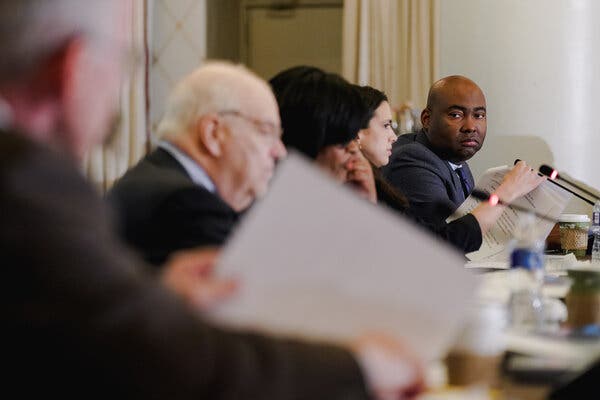
Democratic Committee Approves Bidens Plan to Re-order the First Democratic Primaries.

        Jaime Harrison, the chairman of the Democratic National Committee, at the group’s meeting on Friday. A key party panel moved to adopt President Biden’s plan to overhaul the party’s presidential nominating process.

                                              (


When it comes to the presidential nomination race it has been a standing tradition for the first four primaries and caucuses to be Iowa, New Hampshire, Nevada, and South Carolina. Yet this may not be the case for the 2024 election.

            Last Friday, a proposed order of democratic primaries was proposed and accepted by a key party panel within the DNC. The proposed order had “South Carolina on Feb. 3, followed by New Hampshire and Nevada on Feb. 6, Georgia on Feb. 13 and then Michigan on Feb. 27.” Additionally, Iowa was set to be significantly later with the rest of the pack. 


The plan is supposed to put “battleground states” earlier in the election and to better represent the diversity of the democratic vote. In an election there are really only about 8 “battleground” states with the rest swinging completely towards one side. Thus, by placing Michigan and Georgia earlier in the primary order those states are given more emphasis in the overall race. 


Yet the main reason for the proposed change is to better represent the diversity of the democratic vote. South Carolina, a state in which Black voters were more than half of the democratic vote, was proposed to go first. Moreover, Nevada, a state with a sizable Latino democratic vote was moved up as well. On the other hand, the primarily White Iowa was sent back with the rest of the pack. 


“We rely on these voters in elections but have not recognized their importance in our nominating calendar. It is time to stop taking these votes for granted, and time to give them a louder and earlier voice in the process,” wrote President Biden in a letter to the committee. 


In the 2020 race, Biden struggled in both the Iowa and New Hampshire races, only receiving a meager 15.8% and 8.4% of the vote respectively. Thus, Biden is the main facilitator and strong supporter of the plan as it would give him a strong start in the nomination process and allow him to not have to rely on super Tuesday. 


Yet, as of December 2nd, Biden has not announced his campaign for re-election. Whether Biden decides to run again or not, the proposed plan would greatly help any candidate get a strong start in the beginning of the race.


Another proposed part of the plan is the removal of caucuses. In recent years, caucuses are becoming less and less popular. Nevada has moved over to having a primary, and Iowa, a state who has a caucus, is no longer an important race according to the proposed plan.


Whether the proposed plan will ever see the light of day still remains to be seen. A main preventing factor is New Hampshire. New Hampshire has a state law that gives its secretary of state the power to move up the date of the primary to protect its first-in-the-nation status. Additionally, another criticism is that no state situated in the Central or Mountain time zone is represented in the opening primaries.


The plan now faces full DNC approval in early February of next year. Whether the plan, or a modified version of it, is approved or not, the 2024 democratic nomination race will depend greatly on the first primaries. 


Sources:

https://www.nytimes.com/2022/12/02/us/politics/michigan-democratic-presidential-primary.html

https://www.nytimes.com/2022/12/02/us/politics/democrats-south-carolina-primary-2024.html

https://www.npr.org/2022/12/01/1140193037/president-biden-calls-for-a-big-shakeup-in-democrats-presidential-nominating-cal


Saturday, December 3, 2022

Inflations impact on the holiday season

 The pandemic catalyzed inflation in the United States, creating rifts in the supply chain while forcing the American government to pump stimuli into the economy. Services have become increasingly more expensive, as workers have been reluctant to return to pre-covid work. Factory closures have impacted food prices, while the Russian invasion of Ukraine has damaged gas and energy production, subsequently causing those prices to skyrocket. The federal reserve has been trying to raise interest rates to counteract the rampant inflation, but they have had little success. Inflation has leaked further into the American economy than just physical goods and services, threatening areas ranging from dental care to hotel rates. The Fed continues the strategy of increasing borrowing costs to slow spending, and then rein in prices, but the US economy remains at a 7.7% inflation rate*. This year, inflation has been at its highest level since the early 1980s, raising the price of goods at a rate that is significantly more than the growth of American wages.       

US inflation over last 100 years


For retailers, the fourth quarter is always the biggest as the holiday season approaches. Despite inflation, retailers can look forward to seeing some of their biggest earnings yet this year. Black Friday experienced a record-high 196.7 million people rushing back to stores to catch the best deals, while Amazon's online sales surged on Cyber Monday. Eric Swanson, an economics professor at the University of California, Irvine stated, “most people in America spend pretty much their whole budget anyway… So the money is going to get spent, it’s just a question of what it’s going to get spent on.” This is good news for big corporations, as though the average American is becoming significantly poorer relative to the costs around them, the large monopolies will continue to capitalize on their gains this holiday season. The healthcare and retail industries have not only been virtually unaffected but they actually have seen some of their largest profits ever this year. 

Black Friday at Walmart


But, most importantly, inflation is affecting how much the average American will have to spend during these holidays. Americans saw Thanksgiving feasts cost 20% more than last year, and 40% more than in 2020. The average box of stuffing went up 69%, pie crust went up 26%, and dinner rolls became 22% more expensive than last year. Turkey, the staple of Thanksgiving went up 21%. Its high cost can be attributed to not only inflation but a deadly strain of avian flu that wiped out 49 million turkeys this year. All in all, many Americans had to spend significantly more on their Thanksgiving feast this year. 


As Christmas approaches, it is likely that we will continue to see the trends from Black Friday and Thanksgiving. The corporations will continue to flourish while the average American will be left seeing a lot less bang for their buck. 


*As of November 2022

Here's how much more Thanksgiving dinner will cost you this year

Thanksgiving dinner will cost 20% more this year because of inflation

Inflation Might Be Cooling But Thanksgiving Dinner Prices Are Still Red-Hot

3 things that keep driving inflation so high—and raising the risk of recession