 |
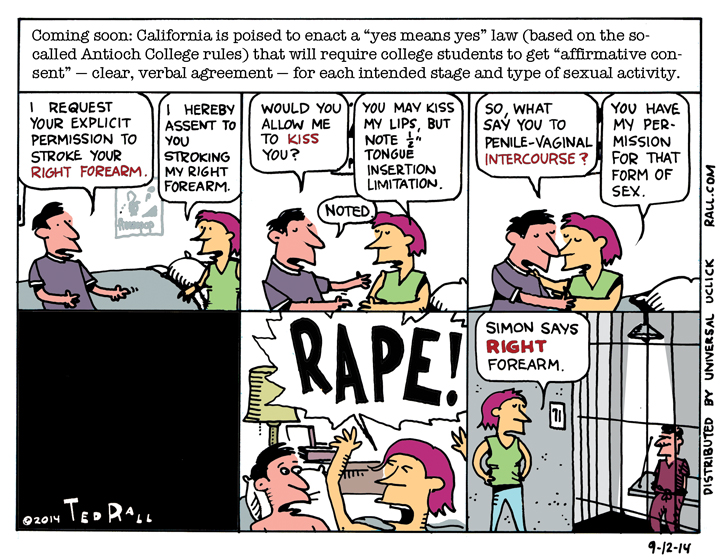
| A political cartoon against affirmative consent. http://rall.com/wp-content/uploads/2014/09/9-12-14.jpg |
As public high school students, most, if not all, of us have already gone through sex ed and learned about the phrase "no means no," which means that sexual advances must stop at any and all forms of the statement "no." Recently, however, there has been a shift towards a new mantra, "yes means yes," which makes the line between consensual sex and rape more distinct: one can only make sexual advances when his or her partner has given explicit consent. In fact, under the new legislation signed by Governor Jerry Brown, public high schools that are already teaching sex ed. must teach the new mantra and teach sexual consent.
Already, California has required colleges to use affirmative consent, and established standards for what consent is. Over a dozen states are following suite by establishing their own standards.
Critics of this new mantra, including John F. Banzhaf, a professor at the George Washington University of Law, argue that the initiative towards affirmative consent is "illogical," and that "nobody works that way." Indeed, a class of high school students in a sex ed class seem to feel awkward about the overly "clinical" way of asking for consent: asking questions like "can I touch you there."
Sex ed can sometimes be quite an awkward topic to talk about, even though we have already experienced the class years ago. This issue, however, like many others, is certainly not going to improve by avoiding it, no matter how awkward it may be. Are these rules really practical? Is mandating that consent be an explicit verbal "yes" too intrusive and impractical to our private lives? Or is it a necessary law to make the lines of the law clearer, and to lower sexual violence?
Source: http://topics.nytimes.com/top/reference/timestopics/people/b/jerry_brown/index.html?inline=nyt-per