Thursday, January 9, 2014

Basketball game in North Korea


Sources:

In celebration of Kim Jun Un;s 31st birthday, the retired basketball player, Dennis Rodman, recruited a group of 40 and 50 year old retired basketball players to play in an exhibition game against a North Korean basketball team. The game took place yesterday in Pyngnong. This was Rodman’s fourth visit to North Korea in the last year. He has claimed to be trying to open up relations between the US and Korea, but in light of what happened in the last two days, he is obviously pitifully ignorant to the political atmosphere in North Korea and its connection to the US.

The exhibition game began as a pretty hilarious news story for most people, but on Wednesday, when Chris Cuomo asked Rodman if he would use this opportunity to help Kenneth Bae, the imprisoned US citizen, Rodman erupted into an incoherent and highly offensive rant. (check it out here: http://www.cnn.com/video/data/2.0/video/world/2014/01/07/newday-cuomo-dennis-rodman-kenneth-bae-cutdown.cnn.html).

The players have said that they have no political intentions, but what are some of the political byproducts that could result from this game having been played? Is it time to stop strong-handing North Korea and instead try to ease tensions through basketball games and maybe hot dog eating contests? I’m being facitious, but it’s a legitimate question.

Wednesday, January 8, 2014

Another post on everybody's favorite plant!


sources:
http://swampland.time.com/2014/01/06/why-legal-weed-is-working-in-colorado/


On January 1st, in what many are calling “green Wednesday” (Altman). sColorado rolled out the law that passed last year, legalizing the sale, use, and growth of marijuana for recreational purposes. Most of us know this, but is Colorado’s current law legal? What we have, is an interesting dynamic of federalism at play. Throughout our nation’s history, states have tried to assert their own agendas, even if they contradicted federal law. Will the federal government force Colorado to close down marijuana dispensaries? Probably not. Then, what’s the point of a national ban on the drug? This get’s even more complicated when you consider the role of the courts.  “In august, the legal justice department said it will not challenge states which legalize recreational marijuana, but it still remains illegal under federal law” (CNN, Shmidt).
Instead of centering comments on what this story means for the fight for marijuana legalization or decriminalization, let’s discuss what this means for the federal government. What do it mean for the states? Does this represent a trend of a more hands off, libertarian federal government? Could Colorado have had such a successful roll out of their law with a republican president or senate in charge?

For a short, but comprehensive overview of the status of legal marijuana in colorado and the conditions of the law check out the video here: http://swampland.time.com/2014/01/06/why-legal-weed-is-working-in-colorado


CAN GAY PEOPLE GET MARRIED ALREADY


Fox News Article
http://www.foxnews.com/politics/2014/01/08/utah-governor-says-state-will-not-recognize-gay-marriages-amid-court-battle/

New York Times Article
http://www.nytimes.com/2014/01/09/us/utah-governors-office-says-state-wont-recognize-same-sex-marriages.html

The Daily Beast (Newsweek) Synopsis
http://www.thedailybeast.com/cheats/2014/01/08/utah-gov-gay-marriages-are-void.html

Utah Gov. Bob Herbert told state agencies Tuesday not to recognize same-sex marriages that took place in the two weeks after a federal judge overturned the state's ban on them (Newsweek). Until further resolution is clarified, same sex marriages are blocked while state officials appeal a decision determining what exactly a civil union is defined as. (This is an extremely simplified summary of all the legal procedure involving the garbled situation that is gay marriage in America. For more specific details, please read the articles. The New York Times one is the most detailed, and The Daily Beast's is the most concise.)
My question: why is the marriage equality issue so complicated? Obviously there are many factors surrounding conflicting personal beliefs and whatnot, but I'm talking about all the legal conflict between state and federal decisions. Is there an easier way? Are we doomed by our federal system to make only slow and tedious change? What do you think?

REPUBLICANS MOVE TO CLAIM POVERTY-FIGHTING MANTLE


New York Times article
http://www.nytimes.com/2014/01/09/us/politics/republicans-move-to-reclaim-poverty-fighting-mantle.html?hp

Republicans are attempting to gradually shift their focus as a party to include the issue of poverty. In other words, the GOP is trying to gain a reputation as more compassionate and aware of issues involving people from all economic levels.
The NY times article depicts the Republicans as seeking to more or less get credit for trying to tackle the issue of poverty so that they will be more liked by a broader audience. From a Republican politician standpoint, this is a great idea. Already viewed as distant from the poor by the general public, the Republican Party would surely benefit from being thought of as a more "poverty-fighting" type of crowd. Nevertheless, I can't help but feel that poverty is not a Republican issue, nor a Democratic issue. Poverty is nonpartisan, and such attempts to try and attach combating poverty to a specific party is silly and ineffective.
However, it is possible that this article is casting the GOP in an unfavorable light. Perhaps the various antipoverty programs that are being introduced demonstrate an actual desire to improve conditions of the poor and there is no ulterior motive behind said programs at all. What do you think?

STEUBENVILLE DEFENDANT RELEASED


ABC News Article

The Daily Beast (Newsweek) Synopsis

After a little under a year, Ma'lik Richmond was released from his juvenile detention center. I think this is ridiculous. Although this case happened back in March, learning about Richmond's release aggravates me since it feels very, very, very soon for him to be let out. I feel that his punishment was not harsh enough and inadvertently makes light of the fact that he raped another human being while she was intoxicated and vulnerable.
But what do you think? Please don't be frightened by my strong feelings about this case; I'm genuinely interested in hearing other opinions on Richmond's release. According to Richmond's attorney, Richmond has "reflected, learned, matured and grown in many ways." I'm not sure if I am swayed by Richmond's self discovery, but if you are, I'd be interested in hearing why.

Oh, and another topic of discussion: Richmond's age. As a seventeen year old, he is subject to a different set of rules under a criminal law trial than he would be if he were only a little older. In regard to this case, I feel Richmond's age seems a little arbitrary considering his actions but I can understand others' arguments that stress the importance of young people not having to be defined by one moment in their life. 
Are these different standards for seventeen year old criminals versus eighteen year old criminals necessary? Archaic? Fair? Unfair?

Saturday, January 4, 2014

Abortion restrictions on the rise - what's next?

Source
An increasing number of abortion clinics are being shut down or are vulnerable to being shut down due to the growing amount of anti-abortion restrictions that states are passing. One issue that will be heard at a federal appeals court is "a Texas requirement that abortion doctors have admitting privileges at local hospitals." Admitting privileges refer to "doctors’ right to admit his or her patients to a specific hospital or other treatment facility," and is a reason why so many clinics are forced to close in Texas. Abortion rights advocates are pushing for support in a Democrat Senate, and likewise, pro-life advocates are hoping to pressure the Senate through the Republican House.

Both sides agree that  2014 will be an important year for the debate on abortion. Abortion rights advocates believe candidates who are more moderate will have higher chance of getting elected in key red and swing states, lessening the influence of extremists. On the other hand, pro-life advocates believe it is much harder to get an abortion with today with these restrictions in place. An interesting point raised that how difficult it would be get an abortion depends on where someone lived - a "pre-Roe" like condition. Do you agree that our nation is at a turning point in regards to abortion? Have certain requirements (like admitting privileges) regressed states back before Roe v. Wade

Friday, January 3, 2014

Military veteran pension cuts trigger backlash


One provision in the bipartisan budget deal signed by President Obama last Thursday has received considerable backlash: cuts to military veteran pensions. The cut is a "one-percentage-point reduction in the annual cost-of-living increase" which is a relatively modest, and is estimated to save $6 billion in 10 years. A considerable chunk of the defense budget is allocated for pension and compensation, and Paul Ryan, one of authors of the budget deal, has insisted that this is a "reasonable adjustment" to a defense budget that may soon become unstable. Critics concede that reform is necessary, but any changes should be applied to future enlistees only. 

Due to the considerable backlash, new ideas have been proposed replacing military pension cuts, one of them being ending Saturday mail. This proposal would end Saturday mail delivery by the United States Postal Service, and is expected to save $17 billion over 10 years, more saved than that of the military pension cuts. However, this proposal will definitely spark anger throughout postal service groups, and there is no perfect solution to please everyone. I believe the veteran's outrage has another layer than just money. Of course, money would play a huge role in their anger, especially when some in the military have planned their future with the promised pension in mind, but I think to veterans these cuts look like the United States dismissing an important promise. 

It seems that someone's budget/service is going to be slashed, but the question is who and by how much, so what do you think is the most sensible and simple plan for these budget cuts? Are veterans and critics of the provision in the budget deal overreacting to a small cut, or they rightfully angry at what seems to be a breaking of a significant promise? Judging from the backlash and range of ideas to replace the military pension cut, I think this provision will at least be modified in the near future.

Thursday, January 2, 2014

Kerry (once again) to prioritize climate change policy

Climate change over ten year increments
Source

Even as a senator in 2010, current Secretary of State John Kerry has pushed for effective climate change and energy policy. Now Kerry is once again at the forefront of the battle to ensure that the United States develops comprehensive and effective policies to deal with our ever changing climate and the consequences that come with it. Although Kerry has the drive to fight climate change, his actual successes are few, and the Senate has historically rejected most climate change bills. One of Kerry's goals as of now is to establish a strong relationship with China in order to reach a 2015 treaty over climate change.
The United States has had a long history of promising to do something about climate change, but Congress has not agreed on or passed any effective climate change policies in the last decade. However, just recently the EPA proposed new regulations in regard to carbon pollution for new power plants. Things at the capital seem to be changing and people are noticing that Kerry has brought in a new "dynamic" while dealing with climate change. While he does face obstacles, the "skepticism is much thinner" and the new year seems to be an opportune time to finally change our nation's passivity dealing with climate change. Do you think effective climate change policy will be created and passed this year, especially in light of controversial issues such as the Keystone Pipeline? Or will climate change once again be overshadowed by other issues like healthcare and the economy and Kerry's campaign is just another promise that will fall apart in the future?

Monday, December 30, 2013

Minimum wage: A key issue for 2014?


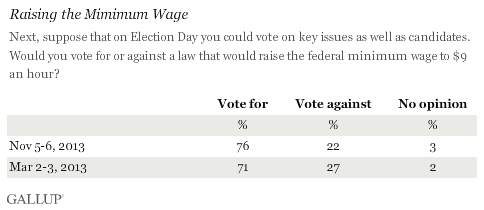
As the year comes to a close, the Democratic Party is hoping to shift gears and focus on the issue of minimum wage while the battle over healthcare continues. Democrats hope to raise the federal minimum wage (currently $7.25-per-hour) as well as place minimum wage raising proposals on state ballots in competitive states in time for the 2014 elections. Polls have indicated support for raising the minimum wage to $9-per-hour and Democrats are hoping to capitalize on this support and force the Republicans into position against "fairness." Here is a Gallup poll published about a month ago, indicating the increased support for raising the minimum wage:

Source

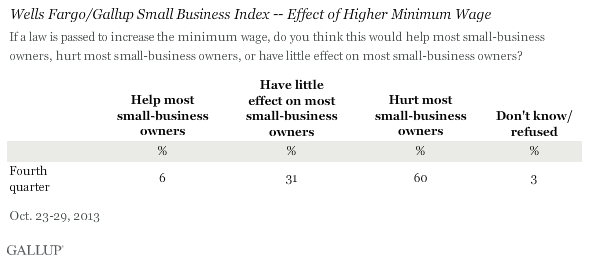
Republicans have asserted that raising the minimum wage hurts small businesses, and small businesses seem to agree. This Gallup was published at the end of November and asked small businesses whether raising the minimum wage would hurt and help small businesses:

Source
So while the general public seems to favor raising the minimum wage, it remains a more contested issue for small business owners. Republicans, including Speaker John Boehner, are more interested in creating jobs, and Boehner was quoted saying "Why would we want to make it harder for mall employers to hire people?" However, 2014 does seem to a be a turning point - 13 states will be raising the minimum wage starting January 1st. Placing this issue on the agenda for 2014 is definitely a political play for the Democrats who must overcome challenges in certain Senate races, but the execution of what the Democrats promise seems likely as well, seeing as the 13 states have already raised their minimum wage and that support continues to grow. Do you see the minimum wage debate an important issue for 2014? Or perhaps is this issue merely a way for the Democrats to regroup before the 2014 elections as the fight regarding healthcare rages on?

Saturday, December 28, 2013

Obama addresses new sexual assault policies in military


On Thursday President Obama signed a defense authorization bill aimed to reform sexual assault policies in the military, a much needed piece of legislation considering the slew of military scandals regarding sexual assault this year. The provisions of this bill include ending the statute of limitations for sexual assault or rape cases in military, so that even after a certain period of time has passed the perpetrator can still be prosecuted for the charges. Military commanders are now barred from overturning jury decisions in such cases  and are mandated to dishonorably discharge or dismiss those convicted of sexual assault. In the Wilkerson case linked above, Wilkerson's commander even attempted to give him a promotion after the commander overturned the jury decision. 

One measure, however, did not make the cut. Many survivors are advocating for sexual assault cases in the military to be prosecuted independently. As of now these cases are prosecuted within the chain of command for the purpose of "order and discipline," but how valid is that reasoning when it's clear that these cases are ignored or even harmful to victims that report them? Changes are happening -- the increased reporting of sexual assault indicate that the definition of sexual assault is becoming more clear to victims, and a decreasing of the fear and stigma that comes with reporting these cases. However, do you think change is happening fast enough? Obama has given a year for the military to conduct a review of its changes regarding sexual assault policies, but how effective can these changes be without the key measure mentioned above?

Friday, December 27, 2013

Gateway Drug


Mayor Robert Jacob behind the counter at Peace in Medicine
Photo by Max Whittaker, New York Times

Earlier this month the city of Sebastopol, California unanimously voted in Robert Jacob for mayor. Jacob, 36, is the founder and director of local medical marijuana dispensary Peace in Medicine. Consequently, he has become the first mayor in the United States to have a background in the medical marijuana industry. Sebastopol, a city an hour north of San Francisco, has a population of just over 7,500 and is known for its small town charm. Historically famous for its Gravenstein apples and plum orchards, this city has become home to Jacob’s thriving business. Peace in Medicine produces over 46,000 dollars of tax revenue for the small city, and Jacob has served in Sebastopol’s city council since 2012. With the evident economic prosperity of Peace in Medicine and the city’s election of Jacob, the industry of medical marijuana seems to be gaining influence locally. With twenty states legalizing the use of marijuana for medical purposes, and Colorado and Washington legalizing its recreational use in 2012, is it possible that the cannabis industry will grow to become as financially influential as traditional businesses, such as technology and agriculture? Will the medical marijuana industry produce more business owners that have the financial means to run for elected positions? How will the federal government, banning the legalization of marijuana on a national level, respond if this industry continues to expand and facilitate medical marijuana business owners to run for office? 

Read More:
http://www.nytimes.com/2013/12/26/us/in-california-a-mayors-rise-is-a-sign-of-the-times.html?smid=pl-share 

Thursday, December 19, 2013

NSA, FISA, the Protect America Act and the PATRIOT Act

While crediting the blog today, I came across a post/thread http://aragonhitchhikers.blogspot.com/2013/11/aclu-requests-new-york-judge-to-stop.html
regarding the National Security Agency's surveillance programs. A number of students linked the NSA story to the PATRIOT Act and I believe this is incorrect.

Several of the recently disclosed NSA programs are unconstitutional in my view of the 4th amendment, but I don't think that has anything to do with the constitutionality of the PATRIOT Act because the PATRIOT Act did not authorize these particular programs.

Some NSA programs such as PRISM that collect data on Americans in an effort to identify foreign threats were authorized by the 2007 Protect America Act, which revised the 1970s era Foreign Intelligence Surveillance Act. FISA by itself was not constitutionally controversial, primarily because it regarded foreigners without constitutional protections and was a way of reigning in an executive branch that had made some questionable decisions in secret with no oversight; if anything this was a step in a more constitutional direction at a checks and balances level. The Protect America Act might help the NSA programs survive a constitutional challenge around a Commander in Chief vs. Declaration of War argument, but I'm not sure. The Bush administration didn't think some of these things needed Congressional approval; it may be that government spycraft does not require an Act of Congress to be considered constitutional, because Commander in Chief apparently means almost anything goes, too bad for Congress. It could also be that provisions of any Act that expanded surveillance in some way are inherently unconstitutional if the specific behaviors the Act was trying to legalize violated the Bill of Rights. The Bill of Rights applies to the entire federal government, so "enabling legislation" shouldn't apply. So, I think the opposite of the Bush administration: the Protect America Act doesn't trump the constitution -- thank you Marbury v. Madison -- and is therefore irrelevant to whether the NSA programs are constitutional. Declaring things legal doesn't make them Constitutional, but it does keep the government officials who had, in some cases, broken the law on orders from their superiors, safe from prosecution.

As it relates to the balance of power among the branches, on one hand, the Protect America Act law put some of the arguably illegal programs ("warrant-less wiretapping") under the jurisdiction of the Foreign Intelligence Surveillance Court (FISC), not unlike some of the provisions of the revised PATRIOT Act, and in the process Congress legalized things that had been executive branch actions justified via the Commander in Chief powers and implemented via secret executive orders. Providing some oversight while giving law enforcement immunity was seen as a trade-off to make these programs more palatable.

On the other hand, the FISC reviews and approves an impossible volume of requests and it doesn't seem to act as much of a real check on the NSA or anything else. The judges on the FISC aren't known to be civil libertarians, either, although they apparently ruled some of the NSA operations unconstitutional when it came to their attention.

The PATRIOT Act has a number of provisions, some of which I believe are perfectly understandable and good changes, while others, like the national security letters, are really creepy. National security letters are not an NSA specific thing and were known about in the abstract well before this summer. The problem with the letters is that most of them are never known about by the subjects being investigated (they are secret unless they result in a criminal prosecution) so no one can challenge one having been issued about them, having one impose a cost on their business, or the constitutionality thereof. Most of the PATRIOT Act is not constitutionally controversial but the NSLs lack proper oversight by the judiciary and raise probable cause issues.

Terrorism doesn't fit the foreign/domestic distinction as well as previous eras with uniformed soldiers and declarations of war between nation-states. The idea that the federal government has a need and responsibility to identify threats from within, and that this will require changes to the legal environment doesn't shake most people. Throwing out the concepts of 'probable cause' and 'individualized suspicion,' however, have created an unaccountable domain of government power. This isn't just about privacy today; it's about the norms of government and potential tyranny in the future. Majorities in Congress have been too willing to enact laws that expand government power with limited oversight, and the only remedy left is constitutional judicial review by Article III courts, which, not incidentally, is hard to rely on when the programs are secret in the first place. I'm increasingly thankful for Mr. Snowden's choices, without which we wouldn't know what was happening. "LIVE FREE OR DIE" -- I'll take a marginally higher chance of being killed by a terrorist over massive, unaccountable, and imperfect databases collected without warrants becoming normal and used for domestic law enforcement.

Sunday, December 15, 2013

The lesser-known story about mass killings

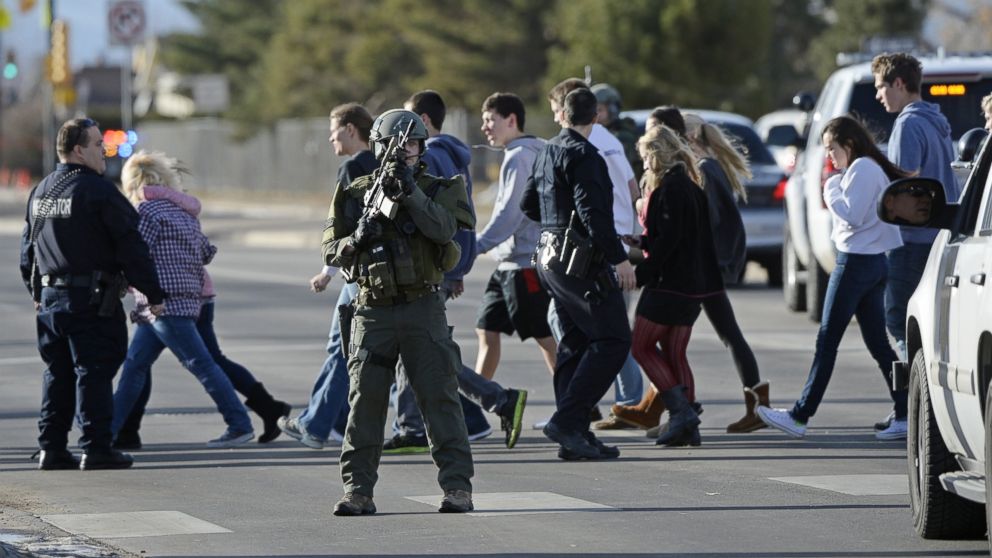
Students being escorted out of Arapahoe High School in
Colorado, yet another tragic public murder this year
I found this article and analysis of mass killings by USA Today brought up an interesting point. Although there have been many horrific tragedies this year, including Sandy Hook and the Boston Marathon, mass killings are not on the rise, and the average deaths per year have remained relatively the same. In fact, mass killings represent only 1% of all murders, although they still happen about once every two weeks. Admittedly, the paper uses an arbitrary number to define mass killings—four or more people killed, the point still holds. Is the media being overly hysterical, when instead they should focus more on the other 99% of murders?

In regards to mass killings, public massacres that attract the most media attention, such as Sandy Hook, only comprise 16% of mass killings. Most of the time, the killings are family-related, or the killer knows the victim.

When a gun was used in mass killings, 72.9% of the time the weapon of choice is a handgun—which are not banned in most proposed gun control laws. In addition, most guns are obtained legally. The analysis also states that mass killings often involve a "failed safety net," such as issues with the mental health system and immigration bureaucracy. Should we be pushing for new laws in these sectors rather than focusing on increased gun control? Or should more effective gun laws still be prioritized?

Saturday, December 14, 2013

Polygamy decriminalized in Utah

Cody Brown and his four wives, who brought up the lawsuit

Yesterday, the United States District Court in Utah ruled that the state's law banning polygamy was unconstitutional. Although most of the several thousand Mormons who believe or actually practice polygamy live in Utah, Utah is one of the strictest states in laws regarding polygamy—cohabitation, living together in a polygamous relationship, is even outlawed. Polygamists had argued that it violated their privacy and religious freedoms. With this new ruling, a man still cannot have more than one marriage license, meaning he still cannot marry more than one wife, but he can now legally live with more than one partner.

Do you think that the previous anti-cohabitation law violated the First Amendment right to freedom of religion? The court ruled that it did, citing the changing interpretation of the Constitution and the strengthening of individual freedoms in recent years; the state is expected to appeal the decision. Seeing as same-sex relationships have gained increased rights in past years, should polygamy and other forms of cohabitation that were once prohibited be legal as well?

Friday, December 13, 2013

A step toward allowing in-flight phone calls

On Thursday, the Federal Communications Commission (FCC) voted to seek public comment regarding lifting the ban on in-flight cell phone calls. Another vote would be required to actually end the ban. This proposal is far from being approved legislation, and the process would definitely take more than a year. The FCC previously banned calls for technical reasons, but improved technology has made that obsolete: in-flight voice calls are already allowed in various countries. In fact, two months ago the Federal Aviation Administration allowed the use of portable electronic devices for all phases of flight.

Reaction to this proposal has been mixed to negative, however. An AP poll released Wednesday found that 48% oppose voice calls, while only 19% support calls, the main reason being noise and terror concerns. Among those who have flown more than once in the past year, the percentage that opposes grows to 59%.

Meanwhile, the chairman of the House Transportation Committee introduced a bill to ban cell phone calls but to allow text messaging. Senators Dianne Feinstein and Lamar Alexander introduced similar legislation. Should phone calls be allowed, or only text messaging?

Kansas v. Cheever: a Fifth Amendment case


On Wednesday, the Supreme Court ruled unanimously on the case Kansas v. Cheever that prosecutors can counter a claim of self-induced mental incompetence.

This ruling is on a grotesque 2005 murder, when Scott Cheever, after smoking methamphetamine, fatally shot a sheriff with an arrest warrant for Cheever. The warrant was for stealing firearms, unrelated to the methamphetamine incident. Cheever shot the sheriff in the chest, left, then returned and shot him again.

In court, Cheever claimed he was mentally incapacitated due to the influence of drugs, but was convicted and sentenced to death anyways due to evidence from the prosecution. However, the Kansas Supreme Court rejected the conviction, declaring it unconstitutional due it being against the Fifth Amendment right preventing self-incrimination, or " the state trying to use [his own] words to execute him." The state rebutted Cheever's defense using testimony from the psychiatrist who examined him.

The Supreme Court then countered this claim, ruling that the state could provide evidence when the incompetence was not due to mental disease or defect. Justices focused on the fact that the defendant could rely on a possibly shaky mental health defense without a counter, essentially "tying one hand behind the government’s back." What do you think; does it violate the Fifth Amendment, and what should the ruling on Cheever's case be? NPR also mentioned an interesting fact of the case, which the Supreme Court did not address—the prosecution's psychiatric witness "testified in the first person, as if he actually were Cheever." Should this affect the ruling of the case?


Tuesday, December 10, 2013

Obama-Castro handshake: potential thaw in US-Cuba relations?


During a memorial service for the late South African President Nelson Mandela, President Obama briefly shook hands with Cuban President Raul Castro. Cuba and the US have been at odds for decades, to put it mildly, although in recent years relations have been improving.

Following the handshake, various news sources described it as "a message of openness" and "a deliberate seizing of the moment to edge forward the prospect of a thaw in relations." Obama emphasized after the memorial the need for reconciliation and forgiveness, and although he was talking about Mandela, his words could have very well applied to Cuba. However, this gesture was not without its controversy. Several Republicans, including Senator McCain, denounced the handshake—McCain called it propaganda to improve Castro's image. He took it even further, remarking, "Neville Chamberlain shook hands with Hitler," and comparing Hitler to Castro. Reactions by other Republicans were more muted, many of which declined to criticize Obama. Senator Marco Rubio, a Cuban American, simply stated Obama should have questioned Castro on human-rights issues.

Is this handshake a monumental step forward to improved US-Cuba relations? Or was President Obama simply channeling the memorial's message of forgiveness? Was this "symbolic gesture" mere sensationalism? And should the US even attempt to thaw relations with Cuba, or continue with its existing sanctions instead?

Sunday, December 8, 2013

What's happening to humanities?

In this day and age, much of our focus as students and as citizens are on technological and scientific advances. It appears that the future will be largely defined by the fields of science, technology, engineering, and mathematics (STEM).

The article discusses how, throughout the world, research in humanities and the number of students studying humanities are facing a general decline. It notes that, at the college and university level, research funding for humanities is rather low when compared to research funding for other fields. This cut in funding for humanities may be due to the prevalent mindset that STEM fields will allow for greater, and more efficient, breakthroughs for generations to come.

Do you think that there is still value in studying/researching humanities today? What do you think might become of our society is people continue to be so antagonistic towards humanities?

Also, seeing that most of us are applying to colleges and deciding what to study now, how many of you are planning to major in some type of humanities? Why will you, or why won’t you, choose to study liberal arts?  


http://www.nytimes.com/2013/12/02/us/humanities-studies-under-strain-around-the-globe.html?pagewanted=1&_r=1&src=rechp


Marijuana editor for The Denver Post

Ricardo Baco
Article
Last month The Denver Post announced that Ricardo Baco would be its first marijuana editor ever. Baco and The Denver Post have both received significant amounts of media attention for introducing the role of an editor for something as controversial as marijuana. Baco's new role is largely because Colorado will legalize the sale of recreational marijuana beginning on Jan. 1.

While marijuana once was, and still is, quite taboo, do you think Baco's new role will lead to more tolerance towards recreational marijuana; do you think that marijuana will become legalized throughout the U.S. someday? Will other newspapers will follow suit in naming a marijuana editor? Is Baco's role of marijuana editor indicative of a trend that there will be more specialized editors in the years to come?

http://www.nytimes.com/2013/12/09/business/media/quips-follow-denver-posts-naming-of-marijuana-editor-but-its-intent-is-serious.html?hp

Anniversary of Sandy Hook and media coverage

Article

Nearly a year has passed since the Sandy Hook shooting which left 26 dead and the town of Newtown looking for ways to heal. As the anniversary of Dec. 14 approaches, Newtown is shying away from media coverage.


The healing and recovery process for the citizens the town of Newtown has been a gradual and painful one. In particular, it seems that the media has played a questionable role in this healing process.


While it is somewhat commonplace for media outlets to flock to scenes of tragedy (9/11, Aurora, Colo. shooting) for anniversary coverage, the town of Newtown is asking the media to refrain from doing so. The town of Newtown is citing reasons like wanting to keep grieving private in their tight-knit community and not wanting to be defined by a single tragedy as explanations for their aversion to coverage.


Although major networks like ABC and NBC have decided to refrain from covering the anniversary, CBS News is adamant about covering the event. Tim Gaughan, director of special events for CBS News, says "Our goal is to have the smallest footprint possible. We don't want to be intrusive, but we're confident we can report the story and not get in the way." 

Do you think that media outlets should comply by Newtown's requests, or do you think that media has an obligation to cover the anniversary of such a tragedy? What is the role of the media in calamities like this, and how should they approach coverage?

http://www.nytimes.com/2013/12/08/nyregion/as-a-school-shootings-first-anniversary-nears-newtown-asks-for-privacy.html?pagewanted=1&src=un&feedurl=http://json8.nytimes.com/pages/business/media/index.jsonp

Friday, December 6, 2013

"Fed up with Congress? Then help elect more Republican women."


Many Americans have expressed their unhappiness with the 113th Congress and its ineffectiveness. (See Cristina's post from last week discussing the low productivity levels of our current Congress.) In fact, a Gallup poll from November revealed that our current Congress has received the lowest approval ratings thus far.

Anyways, I stumbled across an opinion column in the Washington Post by Danielle Thomsen which asserts that election of more Republican women would remedy the ineffective Congress. I found this piece particularly interesting because it reminded me of something in our chapter 7 reading. Our book talked about some data from the “NBC/Wall Street Journal poll [which] found that a majority of people agreed that it would be ‘better for society’ if ‘most of the members of Congress were women,’” (page 252). The book explains that voters might believe that women are more interested and perhaps better qualified to make decisions on domestic issues.

Thomsen's column essentially asserts that Republican women are able to compromise and generally tend to be moderate which leads to their success. Do you think that there should be more Republican women elected? Should more women, regardless of their party, be elected?
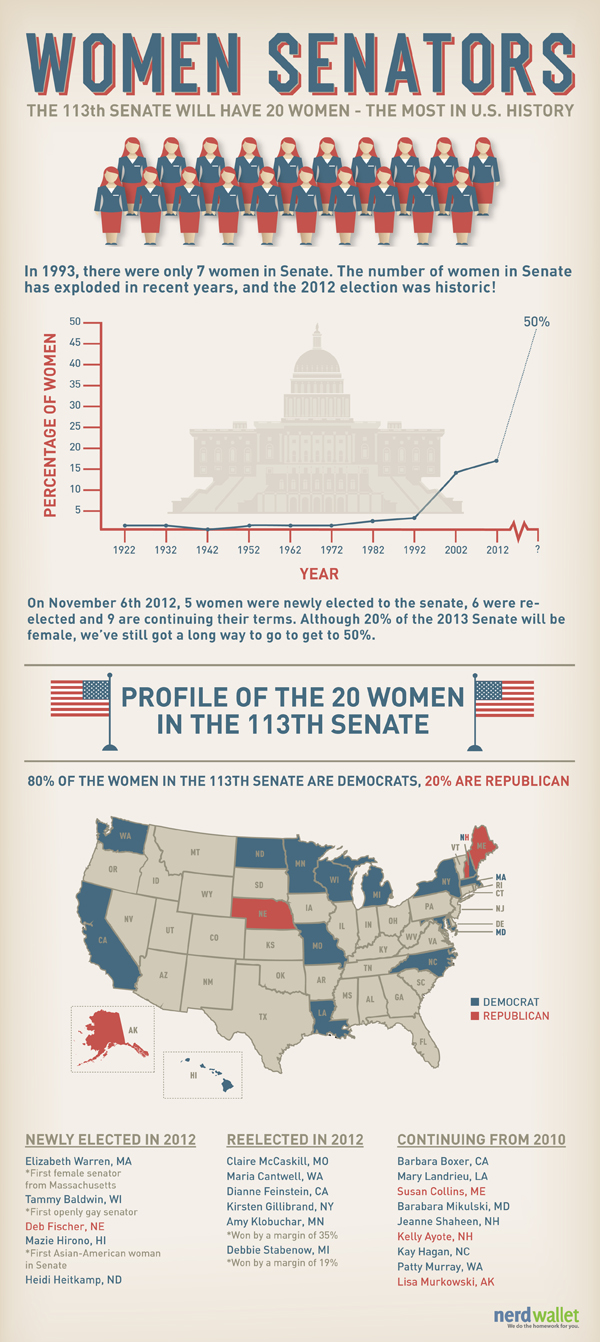
Considering that our current Congress is comprised of 98, or 20 percent, of women, how do you feel about the gender imbalance that Congress currently boasts? There are a total of 98 women in Congress - 20 on Senate (16 Democrat/ 4 Republicans) and 78 in the House (59 Democrats/19 Republicans). The Democratic party has roughly three times the amount of women that the Republican party has. How do you feel about the imbalance of women in the two different parties?  

Check out this really, really cool, albeit slightly dated (it's the 112th Congress) infographic graphic detailing the demographic of Congress (here's a small preview)! 

Here's another infographic; this one is just on women senators in the 113th Congress.


Disclaimer: The clever post title is taken from Thomsen's original column.


Thursday, December 5, 2013

Nelson Mandela and his legacy


CNN Article
I’m sure that by now most of you have heard about Nelson Mandela’s death. Mandela died peacefully today at the age of 95 after a long battle with illness. Mandela certainly left a legacy behind - he helped reunite South Africa after decades of apartheid, which he was awarded the Nobel Peace Prize for in 1993. Mandela was also the first president of South Africa elected in an open election.


As Obama aptly stated, “"We've lost one of the most influential, courageous and profoundly good human beings that any of us will share time with on this earth." Similar to Mandela, Obama is also the first black leader of his country. "He no longer belongs to us. He belongs to the ages," said Obama.


Obviously, Mandela hasn’t been in power in South Africa for a while given his old age and his mental state that was gradually deteriorating, but what effect, if any, do you think his death will have on the South African government? Many have speculated that Mandela was a uniting force in South Africa - do you think old tensions will be exposed now that Mandela has passed away? How might Mandela’s death change how other nations interact with South Africa? Oftentimes, prominent, influential leaders, like Mandela are the ones that bond two nations together. Do think the death of Mandela will result in the severing of some ties?  

How do you think South Africa will fare in the years to come? What do you think was Mandela’s greatest contribution to South Africa, or the world as a whole?


Chicago Tribune article

Timeline of Mandela's life

Washington post opinion piece celebrating Mandela

NO MORE VALUE MENU!?!?!

Fast food workers and laborers across the nation are protesting for higher wages. Though the number of participants who are workers is unclear, walkouts and rallies are planned in over 100 cities. They are trying to raise the federal minimum wage of $7.25, which amounts to $15,000 a year for full time workers, to $15. Raising the federal minimum wage would combat the growing income inequality.

Though support is growing, it is still an uphill battle since the fast food industry is a "price sensitive business". If wages increase to this amount, the prices of the food will increase at least by 20%. Also, higher wages might also mean eliminating jobs within this industry. 

President Obama supports the Democratic proposal to raise the minimum wage to $10.10 per hour. How do you stand on this issue? Is $15 per hour reasonable?

http://abcnews.go.com/Business/wireStory/fast-food-strikes-return-amid-push-wage-hikes-21107127

Wednesday, December 4, 2013

People can "GROW"

Prison garden programs are becoming more popular across the nation. These programs allow inmates to grow fruit, vegetables, and plants. They are used to rehabilitate inmates, providing them with a therapeutic effect and  teaching them landscaping skills that they can use to get jobs. A participant of this program stated that it allowed him to receive a "sense of serenity in such a hostile environment." 

This program has an economic benefit as well. For example, all 18 state prisons in Connecticut have garden programs, none of which cost taxpayers money. These Connecticut prisons have produced over 35,000 pounds of produce in the past three years,  which saves taxpayers $20,000 a year since that produce is put into the prison system. The extra produce also benefits communities since it is donated to charities. 


Furthermore, the return rate for former inmates who have gone through the garden program is significantly smaller than those who did not. To be qualified to participate in this program, prisoners must be eligible for release. Do you think it would be wise to open this program up to inmates who are not?

See you at the Pole... or maybe not.


A middle school in Kansas City is facing a federal lawsuit; they are accused of violating a student's First Amendment rights by prohibiting that student to post fliers with bible versus promoting the "See you at the Pole" event, a national event in which teens pray around their school flagpoles. The school district does have a strict policy of prohibiting the distribution of religious materials on school grounds. Although school sponsored prayers at public schools are unconstitutional, should prayers organized by the students themselves be allowed by free speech rights? If these fliers are permitted, should Christmas trees in public schools, executed by the students, be allowed as well?


http://www.foxnews.com/us/2013/12/03/kan-school-reportedly-prohibits-student-from-posting-poster-with-bible-verses/

Monday, December 2, 2013

Not so much love from the Love Canal?


Love Canal Lawsuits2.jpgIn the 1970's, the public discovered that the Occidental Petroleum Corporation had previously buried over 21,800 tons of industrial toxic waste in the Love Canal, a neighborhood in Niagara Falls, New York. While the property built over that former dumping site has been permanently closed, streets north and west of that landfill have been merely refurbished. Nearly $230 million was spent to cap the canal. Though homeowners are being assured that the waste is contained and that the area is safe, to this day, several reports of birth defects, miscarriages, mental disabilities, anomalies, cysts, and other illnesses persist. Many families believe that this site was never properly contained and that these toxins are leaching out. They also feel trapped in this area because they can not afford to live elsewhere. The Occidental Petroleum Corporation is now a target to several lawsuits. They, however, insist that the waste is properly contained and that the monitoring and containment system is effective; state and federal agencies support these claims. What do you guys think is really going on? Are the homeowners trying to make some money or is the government trying to protect the petroleum industry?

http://www.foxnews.com/us/2013/11/02/suits-claim-love-canal-still-oozing-35-years-later/