Wednesday, October 10, 2012

VP debate prep


The upcoming VP debate is an unpredictable weight for the upcoming election. There are six main points to watch out for in tomorrow's debate:

  • Uncontrollable Biden - Mr. Biden has been very vocal and aggressive about Romney's facts in the debate. The public, Mr. Ryan included, is sure that Biden will be in full attack mode, not letting any comment he disagrees with slip by. It is believed that Biden plans to make up for Obama's passiveness. 
  • Ryan Budget - Many people were put off by Romney's lack of specifics in last week's debate so people are hoping that Ryan will be able to fill in the blanks. Biden is ready to fill in the Romney supported budget. 
  • Medicare - The big question regarding medicare cuts is what position Ryan will take about it. Biden is hoping to trip up Ryan with some of the numbers but he need to make certain he doesn't go too far against "Obamacare." He had a similar plan incorporated into his House budget.
  • "Fiscal Cliff" - Romney is using the "fiscal cliff" as a direct attack against the White House. He believes that the tax cuts made during the Bush ere and the 2013 automatic spending cut will cripple the military. Again Ryan needs to watch out as he voted toward the automatic budget cuts.
  • Foreign - Foreign affairs is no doubt going to be a major focus because of Martha Raddatz, ABC New's senior foreign affairs correspondent, is the moderator and because of the recent events in North Africa and Middle East. Ryan hopes to undermine the killing of Osama bin Laden by linking it to the death of an American ambassador in Libya. 
  • Blunders - While many Republicans like to paint Biden as someone who often blunders. Ryan however, was impressed with Biden's 2008 debate against Palin. After reviewing debate tape people realized that while he may not make the best speeches, he has consistently done well with a structured debate. 

Tuesday, October 9, 2012

Cheating at the debate?


As an interesting little side note... I saw this online and thought it was interesting. I've also seen this suspicion mentioned in a couple of articles...

Is it a legitimate claim? Or just an over reaction to a tissue or something similar?

The Effect of the VP Debates on the Upcoming Election

 After Romney's apparent victory in the presidential debates on October 3rd, the vice presidential debates have the potential to be pivotal to the election says The Washington Post. 
As reported by a Pew Research poll, Romney has managed to close the gap between himself and Obama since the first presidential debate took place and a majority (66%) of registered voters believe that Romney did better in the debates than Obama. Because of Romey's sudden increase in popularity following the debate, both Biden and Ryan have a lot more on their shoulders than most VPs do for the VP debates.  One reason for this is that both VP candidates are more than random politicians chosen to fill the spot of VP. Biden, the current VP, has been in office with Obama for the last four years and has had a big influence on Obama's presidency, which makes him partially responsible for everything that has happened under the Obama administration and Ryan, Romney's VP candidate, has served in congress seven times and is the current House Budget Committee chairman. Biden will have to attempt to make up for Obama's loss in popularity following the debate, while Ryan will have to live up to people's expectations following Romney's impressive performance on October 3rd. 
Will the VP debates be important enough to change the outcome of the election?

The $5 Trillion Dollar Cut?

Since the first presidential debate last Wednesday, Romney has been continually pressed and subsequently, continually evasive about his tax plan. His supposed plan to $5 trillion cut in taxes. He has still yet to delineate his specific plan on how the dollar cuts would balance out. "I want to make it simpler, fairer. I want to encourage the economy to grow again," he said in an interview on Tuesday. 

Many have questioned where Romney plans to find enough deductions to make up the money from a 20% cut in tax rate. Tax experts doubt the possibility of finding enough money to make up for a cut of that size. Tax experts believe that if he has enough limits on deductions the result would actually require a raise in taxes on the middle class and a decrease in the taxes on the wealthy. 

The Huffington post reports that when Romney was further questioned about his plan he stated, "Well, I'm not going to lay out a piece of legislation here, because I intend to work together with Republicans and Democrats in Congress, but there are a number of ways one could approach this. One would be to have a total cap number... Or, instead, you could take the posture that Bowles-Simpson did... There are a number of ways we can accomplish the principles which I have." 

Should Romney be forced into specifics before the election? Or is it good that he wants everyone to collaborate on a plan if he were to be elected?

Sunday, October 7, 2012

A shift in Israeli policy

     Turning an eye to the world, Israel appears to be gearing up to explore another route in addressing the Iran question. As opposed to the militaristic stance previously expressed by means of the "red line," the NY Times reported that Israeli Prime Minister Netanyahu had pushed for increased sanctions in collaboration with its European allies.
Playing with fire.
From the Onion
     With its characteristic snark, though, the Onion framed the issue in a slightly more lighthearted context. Does the phrase "laying the groundwork for a nuclear holocaust that will kill billions of people and eventually end the world as we know it" strike fear into your heart? However the status quo may resemble brinkmanship, the prime minister certainly doesn't seemed fazed. 

Saturday, October 6, 2012

Unemployment down...with a political spin?

From Bureau of Labor Statistics
     According to a new report published yesterday by the Bureau of Labor Statistics, the unemployment rate in September dropped to 7.8 percent from the 8.1 percent of August. During the Obama Administration, this was the first time unemployment had dropped below 8 percent. 
     The LBS report indicates that 114,000 non-farm jobs had been added, and yet as Forbes points out, this was "essentially in line, the big surprised was the drop in unemployment rate, which fell 30 basis points month over month and marks the lowest level in more than 40 months." Indeed, the Washington Exmainer's editorial analysis compared the lower unemployment rate to the inferior "McJobs" created under the Reagan administration, arguing that the 7.8 percent was "largely because of an increase in Americans settling for part-time work."
     The Obama campaign received a much-needed boost in the aftermath of a stagnant debate performance; the president benefiting from more political capital.
     In turn, Governor Romney dismissed the job growth, pointing out that "if not for all the people who have simply dropped out of the labor force, the unemployment rate would be closer to 11 percent." As the Huffington Post reports, though, some skeptics have gone as far as to claim that the opportune drop in unemployment was backed by ulterior political motive.
     NY Times columnist Joe Nocera took a dim view of such claims, dismissing them as "ludicrous." However, in yesterday's column, he conceded that the numbers were irregular. While a survey of businesses gave rise to the number 114,000, "Extrapolating from [a survey of 55,000 households], the bureau concluded that an additional 873,000 people had found work in September. It is this number that brought the unemployment rate from 8.1 percent to 7.8 percent."
     Thus, the validity of this trend will ultimately be revealed when this month's unemployment statics are released shortly before the presidential elections. 

Friday, October 5, 2012

How much do the debates matter?

After the debate Wednesday night, there is a general question of how much the debates truly matter. A rasmussen article came out with effects of the firsts debates on the past election.
This chart conveys that the debates had an effect (some more drastic than others) on the past elections. However, the main indicator in this data is that the candidate that was ahead prior to the election, normally stayed ahead after the first debate. Furthermore, a CNN article mentioned how Obama's fundraising prior to the debates raised the largest amount of money during this campaign, which provided positive news after the not perfect debate. Yet another positive for Obama was the drop in unemployment rate to 7.8%. Are these positives going to keep Obama ahead in the race or do the debates have more weight than the polls say?

Thursday, October 4, 2012

Divided Government Loosing Popularity


I came across an interesting poll today about Americans' preference for one party power in both the executive branch and congress. 


It is interesting how there has been such an increase in the past year for this preference of one party government. The 38% increase may be due to the upcoming election or stronger party preferences. Another possible reason for this one party trend could be the increase of polarization between the two parties. People may be realizing that with a divided government (between Congress and the President) it is difficult to get things done do to this polarization.

In contrast, preference for a "split bill" is at a record-low of 23%. A possible explanation for this large decrease in support for two party rule could be the frustration with the difficulty in receiving Republican support behind some of Obama's proposals (such as the Affordable Health Care Act).

Why do you believe there is this large increase in support for One Party Government? How will this effect the upcoming election?

In the aftermath, 'staircase wit' and 'a sick joke'

   In the aftermath of the Denver debate, one NPR blog cogently noted that President Obama's subsequent response was "staircase wit" - a juicy retort which comes to mind right before going to bed and long after the conflict is over.
From canada.com 

   Indeed, in his campaign rallies today, the president claimed that Romney's rhetoric was inconsistent with the policies on which he had previously campaigned, further declaring, "Governor Romney may dance around his positions, but if you want to be president, you owe the American people the truth." 

   While the Romney campaign brushed off the president's aggressive stance as "damage control," NY Times columnist Paul Krugman blasted the governor's facetiousness in today's blog post. Referring to Romney's promise of medical insurance covering pre-existing conditions, Krugman wrote, "if you think he promised something real, you're the butt of a sick joke...we're talking about a lot of people left out in the cold - 89 million, to be precise."

   Inevitably, fact-checking revealed that both candidates were guilty of spin to some capacity. PolitiFact appeared to indicate a level spread of nontruths from both sides, and yet NPR headlined "Romney goes on offense, pays of it in first wave of fact checks."

   Ultimately, I am curious to see how Romney's "win" will even out in the polls, if it ever does, as we get a stronger grasp of the extent of Obama and Romney's disingenuity. 

Polls declare Romney debate winner, 'Obama looked tired'

   In spite of a poll published by Gallup indicating that President Obama would be the more successful debater, Governor Romney appeared to come out on top, with National Review noting that "Obama looked tired, in the Nixonian mode, and...sounded like a petualnt 1980 Jimmy Carter." 
No dice?
from humanevents.com

    Preliminary polls noted as much, with two-thirds of polled, registered voters saying that Romney had won, whereas only a quarter said the same of Obama.


    Remarkably, this debate came off as a relatively civil exchange, with few of the "zingers" allegedly prepared by Governor Romney coming to fruition. Towards the conclusion, however, the president's accusation jumped out: "[Romney] says that he's going to close deductions and loopholes for his tax plan. That's how it's going to be paid for, but we don't know the details. He says that he's going to replace Dodd-Frank, Wall Street reform, but we don't know exactly which ones. He won't tell us. He now says he's going to replace Obamacare and ensure that all the good things that are in it are going to be in there and you don't have to worry. And at some point, I think the American people have to ask themselves, is the reason that Governor Romney is keeping all these plans to replace secret because they're too good? Is it -- is it because that somehow middle-class families are going to benefit too much from them?"

    This demand for specifics yet again reflected criticism of the governor's vague rhetoric, as noted by Time here and here. Moreover, they corroborate the lead held by the president on most issues, as reflected by this Pew Research Center poll. Yet in light of Wednesday's results, Romney will undoubtedly enjoy a greater vote of confidence. 

    Mention of the 47 percent was incidentally absent from the debate, indicative of Obama's unaggressive performance. How the Obama's strategy evolves in the future debates should be interesting to note and may ultimately indicate if his initial passive engagement serves a more holistic purpose.

Wednesday, October 3, 2012

Off to the Races... Romney Gets in the Game

  Overall, Romney came out stronger in tonight's debate than Obama. Romney's overall presence left the impression of being more passionate than the President. However, both did great jobs of getting into specifics, something people wanted. This debate was full of details. However, there are a three main points I would like to focus on: job creation, healthcare, and the role of Federal Government. These were areas in which the candidates seemed to have the most divergent views.
    Beginning with job creation, Obama opened with an emphasis on improving education. He mentioned that using the "Race to the Top" plan while also employing more math and science teachers allows for growth in these educational areas to provide jobs. Obama also emphasized investing in clean energy and raising tax rates for larger corporations. Romney responded with his plan for job creation, which consists of making America energy independent, opening up trade with foreign countries, and balancing the budget, along with tax cuts for the middle class in order to "Champion small business." Obama challenged Romney's $5 trillion in tax cuts (which Obama stated would benefit the wealthy), however, Romney responded that these would be tax cuts for the middle class and not for higher income individuals. In summary on job creation, Romney emphasized lower tax rates on small business to increase job creation in the private sector and Obama emphasized providing jobs by employing more teachers to create a better trained workforce.
     Another highlighted topic was healthcare. Romney began by saying he would replace the Affordable Healthcare Act by giving this responsibility back to the states. He emphasized that Obama's healthcare plan hurts families and uses an appointed board to tell people what will be covered. He also stressed that free enterprise drives costs down, not government. Obama argued that the board Romney referred to can not make decisions about treatment plans, and that the program was similar to the one that Romney had implemented as Governor of Massachusetts.
Romney Responded to this by indicating that a healthcare plan on the national level was quite a different thing, and that his plan had not raised costs or put private insurance plans in jeopardy.
    The last area which I felt was fairly important was the role of the federal government.
Obama started off by saying the Federal Government's role was to keep people safe, give gateways to opportunity, and provide more teachers for a better trained work force. Romney emphasized protecting people by maintaining the military, religious tolerance and individuals' ability to pursue their dreams. Regarding Federal responsibility for education, Romney believes it is the state's jurisdiction, however the federal government can help. Obama talked about a stronger emphasis on federal government aiding education, and that he would implement programs to hire more math and science teachers, thereby bolstering areas where America is loosing its edge. Romney stated how making schools more competitive by "grading" them would improve education. The main difference between the two was that Romney felt the state government should have more power than the federal government (especially in education) and Obama felt that the federal government should play a larger role to create benefits for America.
    In my opinion, Romney shocked people tonight. He came off a lot more passionate than I think most people expected and responded very well to Obama's affronts. I feel this debate was definitely a benefit for Romney and revealed that he is still fighting to win this election. Do you think that this debate affected voter opinion? What needs to happen during the next debates for the two candidates to receive positive results?

Pennsylvania voter ID tabled, won't factor in 2012 election

Stuffing the ballot boxes.
From minnpost.com
This February report published by Pew Center of the States highlighted significant problems within the realm of voter registration. The more troubling realities include: 1.8 million deceased people still listed as voters; about 12.5 percent of voter registration are invalid or "significantly inaccurate"; 2.75 million individuals are registered in multiple states.

Various initiatives aimed at addressing this problem have been proposed over the past few years, with 30 states having enacted some form of legislation The most recent development was in Pennsylvania, where only yesterday a judge "blocked the key component of a highly contested state law requiring strict photographic identification to vote in next month's election...Pennsylvanians will not have to present a state-approved ID to vote in November" (full article here).

Interestingly enough, Reuters points out that the Pennsylvania law has been criticized to be "designed to keep minority voters, who typically vote Democratic, away from the polls." Indeed, the poll data regarding Pennsylvanian public opinion of the initiative reflects a comparable sentiment.

Yet this concern is one reflected in voter identification laws in general. According to ProPublica, the opposition contends that voter ID laws disenfranchise those that tend to vote Democratic, including "elderly, minority and low-income groups," by effectively instituting "a new 'financial barrier to the ballot box.'" Cases of voter fraud appear to be relatively few and far between. And yet one in eight registration are screwy. Are then voter ID laws justified or even necessary?

Tuesday, October 2, 2012

How Will Blue Collar Workers Affect this Election?

In another article I found further information concerning the upcoming debates and how blue collar workers may affect the election. A question that has been asked is which groups will Romney gain support from. After his "47% comment" about the middle class, many people believe he lost support there. However, there is another group which he may be able to gain support from, unemployed blue collar workers. Unemployment is a huge issue amongst many blue collar workers, and thus they are willing to listen to Romney's plans. Since many of these blue collar workers have a lower income than Romney's "47%" his comment did not apply to them. They will vote for the candidate who they feel is most likely to address the high unemployment rates. Further enforcing this article, a Gallup Poll suggests that blue collar workers are in fact more likely to vote for Romney.


However, another Gallup Poll contradicts this idea and suggests that lower income Americans are more likely to vote for Obama. Yet this may be explained by the fact the not everyone who has a lower income is a blue collar worker. Do you think it is more likely for blue collar workers to vote for Obama, Romney, or neither, and what will each candidate have address during the debate in order to win blue collar support?

Monday, October 1, 2012

Warming up with 'a laughable comedy of tactical self-effacement'

Image from ocfamily
An article published today in Time dryly noted that, in a "brief political moment of mutual admiration," a senior adviser in the Romney campaign praised President Obama's oratory skills, whereas the incumbent said, "Governor Romney, he's a good debater. I'm just OK."

While such display of reciprocated good feelings may seem odd on the eve of a pivotal head-to-head clash, Politico inferred that the Republican nominee was lowering the bar "in hopes of scoring the he-did-better-than-we-thought crown Thursday morning." On the other hand, the same Time piece posited that the candidates had begun "working the refs now" in hopes of a favorable verdict from the media.

NY Times columnist Frank Bruni described the exchange as "a laughable comedy of tactical self-effacement," and in the context of the campaign thus far, his cynicism is not entirely uncalled for. In some capacity, the president's campaign has been marked by an emphasis on the opposition's shortcomings as opposed to the incumbent's accomplishments; a comparable argument could be made of Gov. Romney. 

In any case, this Economist/YouGov poll underscored the public's perception of this election: a little over a third of partisan respondents indicated that they were voting against a candidate. It will be curious to see how this reflects in the response of "the refs."

Who Has the Upper Hand?

As the presidential debates rapidly approach, there has been much discussion over who currently has the upper hand in the election. According to a CNN Article and a Gallup poll, the race is just as close as it was before the party conventions. However, when broken down into issues, Obama has the lead when it comes to domestic problems (Healthcare and Education) and Romney has the upper hand on unemployment and deficit matters. Obama has a higher overall popularity rating as well; in comparison to Romney's approval ratings have slightly decreased since the conventions.

One thing holds true, the upcoming debates should finally begin to give some perspective of who truly has the advantage going into the election. The question that remains is how will the candidates respond to the weak parts of their campaigns. Romney must address Medicare and Healthcare and Obama needs to address unemployment and deficit matters.


Friday, September 28, 2012

One Step Closer to Equality


As of today, the Obama administration announced to immigration officials that "family relationships" include same-sex couples.  This means that in regards to deportation cases, one partner cannot be deported if the other is a citizen.  This is definitely a step forward in the national recognition of gay and lesbian couples (that I believe eventually, if not soon, will be a social norm across the country). This will hopefully prompt other states to follow suit in terms of providing more equality for LGBT citizens. 

Obama clearly seems to be campaigning hard for votes from the Latino and LGBT constituencies and this new act seems to encompass these groups quite conveniently.  I think this will greatly help his standings in the polls with the Latino group most notably.  Obama already has a large number of LGBT supporters, while the votes of Latinos are more on-the-margin and could go either way.  Despite my thought, Gallup had an interesting poll which reflects that Latino voters do not always consider immigration as the most important issue when they cast their votes.


Despite the data above, I do think that this inclusive act enacted by the Obama administration will push some on-the-bubble Latino voters over to the democratic party in the November election. 

Iran, Israel, and the US: A Complicated Triangle

   This Tuesday, a senior source in Israeli Prime Minster Benjamin Netanyahu's entourage stated, "In his speech, the prime minister will set a clear red line, but not one that will conflict with Obama's speech," sending a message that the United States and Israel are attempting to come to an agreement over appropriate action in regard to Iran. Iran has a nuclear program that many countries, Israel and the US included, consider extremely dangerous. 
   I'm not sure how many of us were thinking that Netanyahu would set a literal red line. 

   Netanyahu made very clear that Israel doesn't intend to launch a military operation against Iran's nuclear facilities in the near future, but he warned that a military strike could only be postponed for awhile. His 'red line' is essentially this: Iran should not be allowed to produce enough medium-enriched level for a bomb, if further refined to a 90 percent enrichment level. He made sure to emphasize that Israel will not allow Iran to get to this stage of nuclear development, and said he feared that in nine to six months Iran could perhaps reach this stage. 
   Shortly afterwards, Netanyahu had a lengthy conversation with U.S. Secretary of State Hillary Clinton and discussed Iran's regional developments and the peace process. This Thursday, President Barack Obama and Netanyahu talked on the phone, and the White House released a statement saying, "The two leaders underscored that they are in full agreement on the shared goal of preventing Iran from obtaining a nuclear weapon." 
   Presidential candidate Mitt Romney also had a telephone conversation with Netanyahu this afternoon. Romney said to reporters travelling with him that he will not take the military option off the table, as a nuclear-capable Iran is a serious threat, but he believes that force will not ultimately be needed. 
   While Netanyahu has softened his position in regard to a military strike on Iran, Obama has not issued an ultimatum to Tehran as Netanyahu has demanded. However, Netanyahu was very complimentary of Obama's actions to mobilize the world to impose sanctions on Iran. He noted that Israel and the United States are working together on the Iranian nuclear threat.


Thursday, September 27, 2012

Poll Analysis: Do We Trust the Government?


I came across this poll today regarding how much Americans trust the federal government in regards to domestic issues. (click to enlarge)


Poll 1
Poll 2

Shockingly, what I expected to see was completely incorrect with the graphs.  I expected to see a large dip in 2008 from both parties (Poll 1 and 2), because of the economic downturn.  I also expected the current state of trust in government to be higher than 2008 as a whole (Poll 1), but the percentages look nearly the same.

Around the time the Obama administration began, there was a large spike downward in the trust of the republican party’s trust in the government, and at that same time, a large spike up in trust for the democrats.  This may be expected because the opinions of the democrats and republicans regarding governmental trust virtually switched places during the transition from the Bush to the Obama administration.  To me, this reflects the large influence that political parties have over how much one should trust the government, not so much the events actually going on in the country at that time (like the economic crash). In 2008, the graphs reflect that trust was lower than in years past, but certainly did not provoke as much of a shift in trust as when the political party of the president changed. 

Does one’s political party automatically mean that they cannot be trusted to handle domestic affairs? 31% or Republican leaning voters thought so (Poll 2), dropping their trust after Obama’s election.  There may certainly be other factors involved, and I am not denying that, nor am I simply bashing the republican party as a whole.  I think it is important to be aware of what really affects our trust in the government, and whether or not it is valid.

Nakoula Basseley Nakoula Arrested

    The man who may be behind the anti-Muslim video that has inflamed the Middle East was arrested this afternoon.
    Kinda cool, especially considering that we posted about it a few days ago.

Wednesday, September 26, 2012

Romney's New Ad Makes Its Debut


Romney has released a new campaign ad, and compared to other propaganda we have seen throughout this campaign process, I am pleasantly pleased with what I see.  This isn’t a high-budget ad, just the candidate sitting down in front of the camera talking a bit about his policies. With the absence of provocative graphics and spooky music, I feel like the message of the campaign is less muddled and ambiguous.  This connects back to what I posted about on Monday: that the message of the candidates’ campaigns is getting lost through the media’s priorities.  Although I may not agree with Romney’s policies (and his statement that he is committed to creating new jobs for those on welfare, deviating from his “47 percent” comments), I am one to appreciate this sort of ad.

Is there a reason we don’t see more advertisements like this?  It irritates me that many people are more convinced by misleading ads that include a plethora of “weasel words,” fear inducing graphics, or flat-out lies.  These sorts of ads can have the intended effect because they are memorable.  However, it is a bit disconcerting to me that an ad such as the new Romney ad actually had the effect of sticking in my mind because it lacked all of the extra frills and spin we tend to see in the media we are exposed to daily.

Do you think this may win back some constituents that were offended by Romney’s comments in the past week?

Voter ID Law in Pennsylvania May Be Blocked

   Voter ID laws have been extremely controversial with the upcoming presidential election, but it looks like one of them may be repealed. The voter ID law passed in Pennsylvania, which would have reportedly disenfranchised as many as 750,000 voters, is currently in consideration by the state court. The lower court released a statement, saying,
        "The court is to consider whether the procedures being used for deployment of the [voter ID] cards comport with the requirement of liberal access which the General Assembly attached to the issuance of PennDOT identification cards. If they do not, or if the Commonwealth Court is not still convinced in its predictive judgment that there will be no voter disenfranchisement arising out of the Commonwealth’s implementation of a voter identification requirement for purposes of the upcoming election, that court is obliged to enter a preliminary injunction. Accordingly, the order of the Commonwealth Court is VACATED, and the matter is returned to the Commonwealth Court for further proceedings consistent with this Order. The Commonwealth Court is to file its supplemental opinion on or before October 2, 2012."
   To translate, the court will prohibit the voter ID law from being enforced if conclusive evidence is not shown that no voters will be disenfranchised by it. 

The Power of Party Labels

The chart below is related to our data analysis work, the "party in the electorate", as well as the theme of emerging partisan polarization. Discuss. h/t dailyyonder via Sullivan. Also, fellow bloggers, this is what I consider the maximum one should borrow/quote from a source for republication. You should always provide a link to the original source as a courtesy to your readers and your source. -- Mr. Silton


Tuesday, September 25, 2012

Recovery in the Works: An Economic Update


According to some recently released data, housing prices have been on a notable upward trend between May and July 2012.  Across the country, prices of single-family homes (across 20 cities) have shown an annual gain of 1.2 percent in July.  In areas such as Massachusetts and Chicago, the housing prices have risen even more than the national average.

Surely, this is some good news that everyone has been waiting for, but will it last? How will it effect the presidential election? I would hypothesize that this data (although July is a couple of months ago) being released will surely give Obama an advantage in the weeks ahead because it is evidence that his economic policy is effective for the country as a whole. 

Americans are notorious for thinking about their own wallets when it comes time to cast their votes, and rightfully so.  The economy is one of the most important factors in presidential elections.  Think: “it’s the economy, stupid.”  Based on past events, I would think that the release of this data will be largely advantageous to the Obama campaign, especially as November is not so far away.

Islamophobia

   One man, an admitted conman and a former drug manufacturer with little to no experience with film-making, has inflamed the Middle East. A YouTube clip of the movie Innocence of Muslims, thought to be directed by one Nakoula Basseley Nakoula, has instigated protests throughout the Middle East.  The United States rightly condemns the video, but many people have still to be quelled.
   Obviously, Nakoula is an Islamophobe; and sadly, he's not the only one. Many will remember Florida pastor Terry Jones' threats to burn the Qur'an, the rhetoric about the Ground Zero mosque, among many other anti-Islamist events in this country. Even some who don't go out of their way to harass or smear Muslims still treat them with suspicion or distaste. 
   Andrew Bacevich, a journalist for Mother Jones, writes, "With the launching of the Global War on Terrorism, Islamism succeeded Communism as the body of beliefs that, if left unchecked, threatened to sweep across the globe with dire consequences for freedom." To clarify, he is writing about how some people view Islam as the new threat to the "American Way," a spot which used to be occupied by Communism during the Cold War. 
   These people justify their views with  9-11, the Taliban, and al-Shabaab fanatics in Somalia. However, it is unfair to characterize a religion based on some of its most extreme members. So why does it still happen?
   The people who burn American flags and the people who burn Qur'ans are locked in a cycle; both point to each others' actions as justification for their own. It's a cycle of hatred, and  it will continue as long as both sides keep on committing hate crimes.
   This was terribly optimistic, I know, but the the hatred of the few has attracted the attention of the many, and has subsequently caused a complete uproar. It just gives you a perspective on how a few people can really change the world; sometimes, for the worse, not the better.

Monday, September 24, 2012

Presidential Election: Are Our Priorities Straight?


http://www.gallup.com/poll/150743/Obama-Romney.aspx
The closer we are nearing to the Presidential election, the less we seem to be hearing about the real political views of the candidates.  This became more evident to me after listening to This Week with George Stephanopoulos on the radio this weekend. Stephanopoulos (the host) interviewed officials from both the Romney and Obama campaigns but was uninterested when they wanted to talk about specific plans of their candidate. Instead, he wanted to hear about the numbers.  “Who’s in the lead? Who’s going to win this election?” Stephanopoulos kept cutting them off from saying what American voters should be concerned about: the matters they’re voting on, not just the status of the race. 

This was disheartening to me on a number of levels. I am curious to hear specifics about what each candidate has to offer, because in the long-term, they are important for everyone to be aware of (whether or not one chooses to agree with them is another issue).  

In my opinion, this is a type of media spin that is different from the outright lies and word-twisting we often see on TV, but equally as dangerous.  Taking voter attention away from the issues at the heart of this election and instead focusing mainly on who is winning emphasizes the superficial, not the substance. Personally, I don’t think that yet another poll should be on the front page of the Daily Kos, nor should a critique of Michelle Obama’s lunch menu be on the front page of Drudge Report.  The media is straying too far from what actually matters.

Chevron Richmond Refinery Investigation

Chevron Richmond Refinery Investigation

   The Bay Area Air Quality Management District has made claims that a Chevron oil refinery in Richmond, California has been incinerating pollutants in an unmonitored gas flare, releasing dangerous chemicals into the air. Now the Environmental Protection Agency (EPA) is investigating.
   Problems began with the Richmond refinery back in 2009, when two inspectors saw a flare from a pipe releasing gas into the air. The investigators asked to see Chevron's pollution monitoring equipment and discovered that it wasn't recording anything. According to Chevron, the pipe was meant to help balance pressure, but investigators could find no real need for it. The pipe bypass was used 27 times in the past 2 years, which investigators claim was completely unecessary.
   This August, a massive blaze broke out at the refinery, causing 900 people to be rushed to the emergency room for symptoms arising from the toxic smoke. A thousand people or so made legal claims and Chevron paid for some of their medical costs.
   More than a third of Richmond's population lives below the poverty level. Many have moved there because they want to have the opportunities of living in the Bay Area, but cannot afford the cost of living in some of its nicer areas. Pollution has plagued the city for a long time, and one resident, Constance Delaney, said, "We moved here from San Francisco because we couldn't afford it there anymore. Now we know why Richmond was so cheap. But a few hundred dollars isn't going to help us move somewhere without all this pollution." The refinery has been cited by San Francisco Bay area regulators for violating air regulations 93 times in the past five years.
   It hardly needs saying that if allegations turn out to be true, Chevron will be in major trouble. Bypassing federal regulations by interfering with monitoring is a criminal act.

Teacher Unions and the G.O.P.

Teacher Unions and the G.O.P.

Unlikely allies work together

   For the past few weeks, the news has highlighted the Chicago teachers' strike. A Democratic mayor, namely Mayor Rahm Emanuel, clashed with the city's teachers on contract negotiations. This conflict raised many questions about our education system: should teachers really have tenure? Is it fair to evaluate teachers based on their students' test scores?
   However, another intriguing consequence of the strike has risen: Democratic politicians cannot blindly rely on teachers' unions for their support. Teachers' groups have actually donated $1.23 million to Republican state candidates. They hope to sway those who are not completely in favor of test scores being used as ways to evaluate teachers, charter schools, or teachers losing tenure.
   Democrats still receive the bulk of donated union money, but the amount of donated money going to the GOP is the highest amount since 2004. Back in 2004, the No Child Left Behind (NCLB) act increased funding for disadvantaged children considerably (by about $13.5 billion) and teachers were in favor of NCLB staying in place. Hence, the donated money.
   President Obama has been in favor of evaluating teachers based on test scores, to many teachers' displeasure. Will this affect his campaign adversely?

Friday, September 21, 2012

The Final "Endeavour"

Space shuttle Endeavour passes over the Golden Gate Bridge before making its final landing in Los Angeles on Friday, September 21. The shuttle passed over California landmarks before heading to the airport. Endeavour will be placed on public display at the California Science Center. This is the final ferry flight scheduled in the Space Shuttle Program era.
The space shuttle Endeavour made its final flight before retirement today, carried by a jet across parts California.  This is a symbolic end of NASA's shuttle program, which lasted 30 years, but was officially retired in 2011.  The Endeavour itself will become a museum piece, never to fly again.  It is saddening that the space shuttle program is no more.  The final frontier is a place outside all political boundaries, where discovery reigns supreme.  But is this really the end of discovery and space exploration, or just the end of one program?  Should NASA consider rebooting it, or is it time to let go?

(Would this have been a good field trip opportunity?  Look at that Golden Gate photo, Aragon...)

Libya Just Can't Seem to Catch a Break

Violence continues (see Sam Alavi's coverage of the story, here and here) in Libya after the deaths of US Ambassador Christopher Stevens and three other Americans in the US Consulate ten days ago, which the Obama administration is now referring to as terrorist attacks.  To recap, Stevens, who was well respected by the people of Benghazi due to his involvement in the aforementioned removal, died from asphyxiation, as the building he was in was set on fire by attackers, who were retaliating against an Islamophobic video themselves.  The people of Benghazi (which, since Gaddafi's removal last year, has been considered "the heartland of Libya's uprising") are becoming both more vocal and physical, as marchers in a protest against the Consulate attack are calling for the militias to be disarmed, and in fact, overtook various militia headquarters this Friday.
Libyans march against Ansar al-Sharia in Benghazi. 21 Sept 2012
The protestors seem to be (at least in part) attempting to show the United States that they do not agree with the killings--one protestor even declared "I am sorry, America.  This is The real Libya" meaning that those who were responsible for Stevens' death were not acting with their support or validation.  Although it is unfortunate that the situation became so drastic, this effort was lauded by John McCain, who feels that this shows Libya's "freedom-loving" nature.

Does this suggest that Libya's troubles will soon be solved, or are they moving farther away from desired results?  Is the protest another unfortunate and dangerous situation, or is it a sign that the people of Libya have a voice, and that that voice is calling for more freedom, as John McCain feels?

Romney's Tax Returns

Today, Romney's campaign released his full tax returns from 2011 which had earlier been partially released.  Romney had an income of about $13.7 million, and he paid a 14.1% tax rate which equates to about $2 million.  According to this Huffington Post Article, the Romney family's income is 263 times larger than the median income.  The Post noted the complexity of the tax returns, and tried to decipher some of the highlights.

However, Romney donated $4 million to charity, but only claimed $2.5 million to ensure that his tax rate stayed above 13% fulfilling a campaign promise that his tax rate had been above 13% for the last ten years.  Some critics point out that this issue returns the issue of Romney's taxes to forefront in the media, but some point out that by letting out the tax releases now, the issue will blow over by the time the debates are over.

Is Romney's timing in releasing his taxes a good move or a terrible move considering the video from earlier this week?  What's your opinion on Romney's decision to not claim all of his charitable donations?  

Thursday, September 20, 2012

So You Disagree With Your Country's War Politically, EH?


Kimberly Rivera, an American Army private and mother of four, was arrested at the Canadian-US border and detained, having previously sought refuge in Canada to escape further participating in the Iraq War.  Rivera and her family fled the US sometime in 2007 while she was on leave, which means that they have been in the country for nearly five years—in fact, two of her four children were born there.  She effectively began a new life for herself, away from the trials of war.   However, she has lost her deportation case, and will be forced to leave—returning to the US with both the label of a deserter and, potentially, a cell with her name on it awaiting her.

Canada is known for providing somewhat of a sanctuary to individuals seeking to evade being drafted by the military—ninety thousand United States citizens did so during the Vietnam War, most of whom eventually became permanent citizens of Canada.  Many people are outraged that she is being forcibly removed—an online petition against her deportation was signed by twenty thousand people, and rallies held by other Canadians have even taken place supporting Rivera and encouraging the government to allow her to stay.  Even Desmond Tutu has put in his two cents on the matter, speaking to the defense of Rivera.  However, despite this support and Canada’s unofficial status as a safe haven, according to the spokeswoman of Jason Kenney, Canadian Immigration Minister, “Military deserters from the United States are not genuine refugees under the internationally accepted meaning of the term” and that claims like Rivera’s actually cause problems for refugees who are seeking more pressing issues, such as legitimate persecution.
 
Rivera did desert the Army—something she says she knew was wrong, and certainly something that our nation tends not to smile upon.  However, it does not appear that she made this decision for any trivial reason—she disagreed with the Iraq War and did not feel it was just to continue participating in it.  Are her commitments to her country more important than her own personal beliefs? Is it fair to ask someone to do something they do not feel right about?  When is it appropriate to bow out of performing one’s duty to their country?

How does a Candidate Deal with China?

Obama is becoming tougher on China after partisan criticism.  He recently filed two cases at the World Trade Organization against China's trade policies, and indicated he will move warships off the seas of China according to this  New York Times article tracking Obama's position on China.  Earlier in his administration, Obama tried to appease China by accommodating demands such as not meeting with the Dalai Lama or having a highly regulated trip to China hoping for "good will" (Landler of NY Times).  China responded by not controlling greenhouse gases and other climate control policies, not dealing with Iran quickly enough, and "bullying other countries" about nearby territory.  This exchange reminds me of the Ally's appeasement policy during the time leading up to World War II.  After China's lack of responsivenss, Obama has had a much more firm policy on China.

With the coming election, both Obama and Romney are "bashing China" to gain the support of people in industries in competition with the Chinese.  Romney has promised a tougher stance on China than his rival specifically relating to currency, while Obama claims that Romney has outsourced jobs to China.  The complaint that Obama filed with the World Trade Organization echoes a larger sentiment of fear that the Chinese are hurting American manufacturers, so by having a tough stance on that part of China the candidates can try to woo voters.  However, a multitude of articles have come out with the idea that scapegoating China's exports sounds good now, but ultimately the U.S. should try to open China's domestic market and increase free trade (Chicago Tribune) to promote a healthy economy in America.  A Washington Post article, echoes this sentiment advising against protectionism that could lead to a trade war.   Xinhua, China's official press, cited the Washington Post article on their website which seems to say that they approve of the idea of open trade and less bashing of their country (this sentence needs work).

Do you agree that this attempt to limit trade will only lead to a trade war or do you think that we need a tougher stance on China?  Will increased lassiez faire, as advocated by the articles, really improve the situation in your opinion?  Should the candidates stop bashing China or is this technique an acceptable ploy to get more votes?

Consumerism and the Election

I recently ran across this article on NPR detailing some strange election paraphernalia.  The common theme of these six bizarre ideas are that they are playing off the 2012 Election.

One of the most prominent is the 7-11's 7-Election where coffee drinkers choose either a red cup for Republican, a blue cup for Democrat, or a purple Slurpee for Independent; based on the color of the cups, 7-11 can "see who is winning" by state or in the nation (obviously this is not a poll that will accurately predict the results of the election due to small, self-selective sampling).  Other companies emulating the food duel, the Boston Market is doing a Left Wing Bowl vs. Right Wing Bowl competition, and California Tortilla is having a face-off between "Obama's Chicken Teriyaki Luau Bowl" and "Romney's Mexican Mitt-Loaf Bowl."

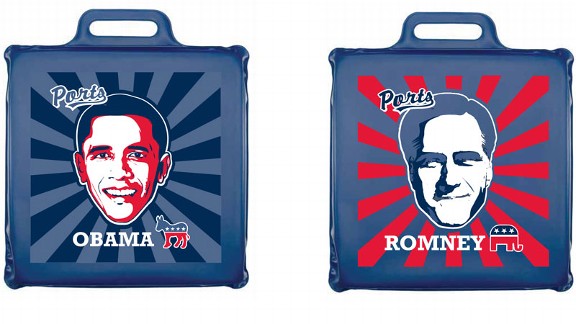
The Spirit (costume vendors) stores are tracking the sales of the two candidate's masks to predict the results.  On a slightly different note, there is the Stockton Ports (a minor league baseball team) offers a cushion that will allow attendees to sit on the face of the candidate that they oppose; with this unusual softener for one's tush, two twitter feeds have been released to further discussion: #SitonMitt and #BunsonObama.

The final strange idea is a study of past elections measuring the whiteness of each of the candidate's teeth to predict election results.  The teeth whitening company who released this study, Premium White, believes that Obama has got this election in the bag because of his pearly whites.

Has consumerism gone too far that Americans turn everything into a chance to buy knick-knacks? Or are these businesses wise to use the election hype? Which idea was your favorite?