Tuesday, September 25, 2012

Islamophobia

   One man, an admitted conman and a former drug manufacturer with little to no experience with film-making, has inflamed the Middle East. A YouTube clip of the movie Innocence of Muslims, thought to be directed by one Nakoula Basseley Nakoula, has instigated protests throughout the Middle East.  The United States rightly condemns the video, but many people have still to be quelled.
   Obviously, Nakoula is an Islamophobe; and sadly, he's not the only one. Many will remember Florida pastor Terry Jones' threats to burn the Qur'an, the rhetoric about the Ground Zero mosque, among many other anti-Islamist events in this country. Even some who don't go out of their way to harass or smear Muslims still treat them with suspicion or distaste. 
   Andrew Bacevich, a journalist for Mother Jones, writes, "With the launching of the Global War on Terrorism, Islamism succeeded Communism as the body of beliefs that, if left unchecked, threatened to sweep across the globe with dire consequences for freedom." To clarify, he is writing about how some people view Islam as the new threat to the "American Way," a spot which used to be occupied by Communism during the Cold War. 
   These people justify their views with  9-11, the Taliban, and al-Shabaab fanatics in Somalia. However, it is unfair to characterize a religion based on some of its most extreme members. So why does it still happen?
   The people who burn American flags and the people who burn Qur'ans are locked in a cycle; both point to each others' actions as justification for their own. It's a cycle of hatred, and  it will continue as long as both sides keep on committing hate crimes.
   This was terribly optimistic, I know, but the the hatred of the few has attracted the attention of the many, and has subsequently caused a complete uproar. It just gives you a perspective on how a few people can really change the world; sometimes, for the worse, not the better.

Monday, September 24, 2012

Presidential Election: Are Our Priorities Straight?


http://www.gallup.com/poll/150743/Obama-Romney.aspx
The closer we are nearing to the Presidential election, the less we seem to be hearing about the real political views of the candidates.  This became more evident to me after listening to This Week with George Stephanopoulos on the radio this weekend. Stephanopoulos (the host) interviewed officials from both the Romney and Obama campaigns but was uninterested when they wanted to talk about specific plans of their candidate. Instead, he wanted to hear about the numbers.  “Who’s in the lead? Who’s going to win this election?” Stephanopoulos kept cutting them off from saying what American voters should be concerned about: the matters they’re voting on, not just the status of the race. 

This was disheartening to me on a number of levels. I am curious to hear specifics about what each candidate has to offer, because in the long-term, they are important for everyone to be aware of (whether or not one chooses to agree with them is another issue).  

In my opinion, this is a type of media spin that is different from the outright lies and word-twisting we often see on TV, but equally as dangerous.  Taking voter attention away from the issues at the heart of this election and instead focusing mainly on who is winning emphasizes the superficial, not the substance. Personally, I don’t think that yet another poll should be on the front page of the Daily Kos, nor should a critique of Michelle Obama’s lunch menu be on the front page of Drudge Report.  The media is straying too far from what actually matters.

Chevron Richmond Refinery Investigation

Chevron Richmond Refinery Investigation

   The Bay Area Air Quality Management District has made claims that a Chevron oil refinery in Richmond, California has been incinerating pollutants in an unmonitored gas flare, releasing dangerous chemicals into the air. Now the Environmental Protection Agency (EPA) is investigating.
   Problems began with the Richmond refinery back in 2009, when two inspectors saw a flare from a pipe releasing gas into the air. The investigators asked to see Chevron's pollution monitoring equipment and discovered that it wasn't recording anything. According to Chevron, the pipe was meant to help balance pressure, but investigators could find no real need for it. The pipe bypass was used 27 times in the past 2 years, which investigators claim was completely unecessary.
   This August, a massive blaze broke out at the refinery, causing 900 people to be rushed to the emergency room for symptoms arising from the toxic smoke. A thousand people or so made legal claims and Chevron paid for some of their medical costs.
   More than a third of Richmond's population lives below the poverty level. Many have moved there because they want to have the opportunities of living in the Bay Area, but cannot afford the cost of living in some of its nicer areas. Pollution has plagued the city for a long time, and one resident, Constance Delaney, said, "We moved here from San Francisco because we couldn't afford it there anymore. Now we know why Richmond was so cheap. But a few hundred dollars isn't going to help us move somewhere without all this pollution." The refinery has been cited by San Francisco Bay area regulators for violating air regulations 93 times in the past five years.
   It hardly needs saying that if allegations turn out to be true, Chevron will be in major trouble. Bypassing federal regulations by interfering with monitoring is a criminal act.

Teacher Unions and the G.O.P.

Teacher Unions and the G.O.P.

Unlikely allies work together

   For the past few weeks, the news has highlighted the Chicago teachers' strike. A Democratic mayor, namely Mayor Rahm Emanuel, clashed with the city's teachers on contract negotiations. This conflict raised many questions about our education system: should teachers really have tenure? Is it fair to evaluate teachers based on their students' test scores?
   However, another intriguing consequence of the strike has risen: Democratic politicians cannot blindly rely on teachers' unions for their support. Teachers' groups have actually donated $1.23 million to Republican state candidates. They hope to sway those who are not completely in favor of test scores being used as ways to evaluate teachers, charter schools, or teachers losing tenure.
   Democrats still receive the bulk of donated union money, but the amount of donated money going to the GOP is the highest amount since 2004. Back in 2004, the No Child Left Behind (NCLB) act increased funding for disadvantaged children considerably (by about $13.5 billion) and teachers were in favor of NCLB staying in place. Hence, the donated money.
   President Obama has been in favor of evaluating teachers based on test scores, to many teachers' displeasure. Will this affect his campaign adversely?

Friday, September 21, 2012

The Final "Endeavour"

Space shuttle Endeavour passes over the Golden Gate Bridge before making its final landing in Los Angeles on Friday, September 21. The shuttle passed over California landmarks before heading to the airport. Endeavour will be placed on public display at the California Science Center. This is the final ferry flight scheduled in the Space Shuttle Program era.
The space shuttle Endeavour made its final flight before retirement today, carried by a jet across parts California.  This is a symbolic end of NASA's shuttle program, which lasted 30 years, but was officially retired in 2011.  The Endeavour itself will become a museum piece, never to fly again.  It is saddening that the space shuttle program is no more.  The final frontier is a place outside all political boundaries, where discovery reigns supreme.  But is this really the end of discovery and space exploration, or just the end of one program?  Should NASA consider rebooting it, or is it time to let go?

(Would this have been a good field trip opportunity?  Look at that Golden Gate photo, Aragon...)

Libya Just Can't Seem to Catch a Break

Violence continues (see Sam Alavi's coverage of the story, here and here) in Libya after the deaths of US Ambassador Christopher Stevens and three other Americans in the US Consulate ten days ago, which the Obama administration is now referring to as terrorist attacks.  To recap, Stevens, who was well respected by the people of Benghazi due to his involvement in the aforementioned removal, died from asphyxiation, as the building he was in was set on fire by attackers, who were retaliating against an Islamophobic video themselves.  The people of Benghazi (which, since Gaddafi's removal last year, has been considered "the heartland of Libya's uprising") are becoming both more vocal and physical, as marchers in a protest against the Consulate attack are calling for the militias to be disarmed, and in fact, overtook various militia headquarters this Friday.
Libyans march against Ansar al-Sharia in Benghazi. 21 Sept 2012
The protestors seem to be (at least in part) attempting to show the United States that they do not agree with the killings--one protestor even declared "I am sorry, America.  This is The real Libya" meaning that those who were responsible for Stevens' death were not acting with their support or validation.  Although it is unfortunate that the situation became so drastic, this effort was lauded by John McCain, who feels that this shows Libya's "freedom-loving" nature.

Does this suggest that Libya's troubles will soon be solved, or are they moving farther away from desired results?  Is the protest another unfortunate and dangerous situation, or is it a sign that the people of Libya have a voice, and that that voice is calling for more freedom, as John McCain feels?

Romney's Tax Returns

Today, Romney's campaign released his full tax returns from 2011 which had earlier been partially released.  Romney had an income of about $13.7 million, and he paid a 14.1% tax rate which equates to about $2 million.  According to this Huffington Post Article, the Romney family's income is 263 times larger than the median income.  The Post noted the complexity of the tax returns, and tried to decipher some of the highlights.

However, Romney donated $4 million to charity, but only claimed $2.5 million to ensure that his tax rate stayed above 13% fulfilling a campaign promise that his tax rate had been above 13% for the last ten years.  Some critics point out that this issue returns the issue of Romney's taxes to forefront in the media, but some point out that by letting out the tax releases now, the issue will blow over by the time the debates are over.

Is Romney's timing in releasing his taxes a good move or a terrible move considering the video from earlier this week?  What's your opinion on Romney's decision to not claim all of his charitable donations?  

Thursday, September 20, 2012

So You Disagree With Your Country's War Politically, EH?


Kimberly Rivera, an American Army private and mother of four, was arrested at the Canadian-US border and detained, having previously sought refuge in Canada to escape further participating in the Iraq War.  Rivera and her family fled the US sometime in 2007 while she was on leave, which means that they have been in the country for nearly five years—in fact, two of her four children were born there.  She effectively began a new life for herself, away from the trials of war.   However, she has lost her deportation case, and will be forced to leave—returning to the US with both the label of a deserter and, potentially, a cell with her name on it awaiting her.

Canada is known for providing somewhat of a sanctuary to individuals seeking to evade being drafted by the military—ninety thousand United States citizens did so during the Vietnam War, most of whom eventually became permanent citizens of Canada.  Many people are outraged that she is being forcibly removed—an online petition against her deportation was signed by twenty thousand people, and rallies held by other Canadians have even taken place supporting Rivera and encouraging the government to allow her to stay.  Even Desmond Tutu has put in his two cents on the matter, speaking to the defense of Rivera.  However, despite this support and Canada’s unofficial status as a safe haven, according to the spokeswoman of Jason Kenney, Canadian Immigration Minister, “Military deserters from the United States are not genuine refugees under the internationally accepted meaning of the term” and that claims like Rivera’s actually cause problems for refugees who are seeking more pressing issues, such as legitimate persecution.
 
Rivera did desert the Army—something she says she knew was wrong, and certainly something that our nation tends not to smile upon.  However, it does not appear that she made this decision for any trivial reason—she disagreed with the Iraq War and did not feel it was just to continue participating in it.  Are her commitments to her country more important than her own personal beliefs? Is it fair to ask someone to do something they do not feel right about?  When is it appropriate to bow out of performing one’s duty to their country?

How does a Candidate Deal with China?

Obama is becoming tougher on China after partisan criticism.  He recently filed two cases at the World Trade Organization against China's trade policies, and indicated he will move warships off the seas of China according to this  New York Times article tracking Obama's position on China.  Earlier in his administration, Obama tried to appease China by accommodating demands such as not meeting with the Dalai Lama or having a highly regulated trip to China hoping for "good will" (Landler of NY Times).  China responded by not controlling greenhouse gases and other climate control policies, not dealing with Iran quickly enough, and "bullying other countries" about nearby territory.  This exchange reminds me of the Ally's appeasement policy during the time leading up to World War II.  After China's lack of responsivenss, Obama has had a much more firm policy on China.

With the coming election, both Obama and Romney are "bashing China" to gain the support of people in industries in competition with the Chinese.  Romney has promised a tougher stance on China than his rival specifically relating to currency, while Obama claims that Romney has outsourced jobs to China.  The complaint that Obama filed with the World Trade Organization echoes a larger sentiment of fear that the Chinese are hurting American manufacturers, so by having a tough stance on that part of China the candidates can try to woo voters.  However, a multitude of articles have come out with the idea that scapegoating China's exports sounds good now, but ultimately the U.S. should try to open China's domestic market and increase free trade (Chicago Tribune) to promote a healthy economy in America.  A Washington Post article, echoes this sentiment advising against protectionism that could lead to a trade war.   Xinhua, China's official press, cited the Washington Post article on their website which seems to say that they approve of the idea of open trade and less bashing of their country (this sentence needs work).

Do you agree that this attempt to limit trade will only lead to a trade war or do you think that we need a tougher stance on China?  Will increased lassiez faire, as advocated by the articles, really improve the situation in your opinion?  Should the candidates stop bashing China or is this technique an acceptable ploy to get more votes?

Consumerism and the Election

I recently ran across this article on NPR detailing some strange election paraphernalia.  The common theme of these six bizarre ideas are that they are playing off the 2012 Election.

One of the most prominent is the 7-11's 7-Election where coffee drinkers choose either a red cup for Republican, a blue cup for Democrat, or a purple Slurpee for Independent; based on the color of the cups, 7-11 can "see who is winning" by state or in the nation (obviously this is not a poll that will accurately predict the results of the election due to small, self-selective sampling).  Other companies emulating the food duel, the Boston Market is doing a Left Wing Bowl vs. Right Wing Bowl competition, and California Tortilla is having a face-off between "Obama's Chicken Teriyaki Luau Bowl" and "Romney's Mexican Mitt-Loaf Bowl."

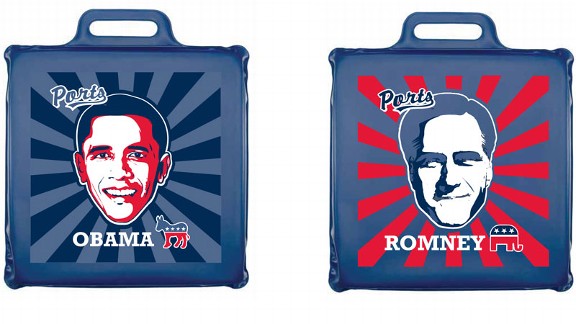
The Spirit (costume vendors) stores are tracking the sales of the two candidate's masks to predict the results.  On a slightly different note, there is the Stockton Ports (a minor league baseball team) offers a cushion that will allow attendees to sit on the face of the candidate that they oppose; with this unusual softener for one's tush, two twitter feeds have been released to further discussion: #SitonMitt and #BunsonObama.

The final strange idea is a study of past elections measuring the whiteness of each of the candidate's teeth to predict election results.  The teeth whitening company who released this study, Premium White, believes that Obama has got this election in the bag because of his pearly whites.

Has consumerism gone too far that Americans turn everything into a chance to buy knick-knacks? Or are these businesses wise to use the election hype? Which idea was your favorite?

Wednesday, September 19, 2012

It's My Internet, Not Yours

In an effort to protect against cyberattacks and seal out as much of the influence of the West as possible, the Iranian government is constructing its own version of the internet.  Members of the Iranian government argue that although not everyone will agree, this will be better for the security of Iran in the long run, as it "could help officials counter U.S.-funded programs that allow Iranian activists to evade online surveillance," as well as keep the cyberattacks Iran says the US and Israel are engaging in to a minimum.  Perhaps this is all there is to it, perhaps there are pieces of the story that we are missing.  The nitty gritty details behind the reasons for this change are known only to the Iranian government, but from a US perspective, this is bad news.  This insulated version of the World Wide Web will undoubtedly pose a problem for both those in favor of more internet freedom and the Obama administration, which have invested quite a bit of money into preventing situations such as this.  Certainly, freedom of speech and a fast and efficient means of communication between the people are threatened by this plan, which is slightly reminiscent of the SOPA bill proposed not too long ago.  Is the Iranian government in the right--will this ultimately be the best decision for the safety of the country?  Is it unjust to attempt to control and restrict the Iranian people's access to something that has become such a powerful tool?  Do both sides of the issue have merit?

Romney's Video: The Backlash Continues

As a continuation on the previous post on the leaked video from Romney's Boca Raton, Florida, fundraising speech, we will now look at the responses to the video from the press, fellow republicans, and Romney himself.

Romney still agrees with what he stated admitting only that his phrasing was less than eloquent at a impromptu press conference during a fundraising stop in Orange County.

As a reminder, Romney criticized the "47%" who supposedly do not pay taxes and are "victims."  However, as pointed out by this article, this strategy also emphasizes wealthy people's low tax rates, compounded with Romney's tax returns released earlier this year, which reminds voters that Romney is out of touch with the average American.

Another controversy was that Romney also proclaimed the possibility of peace in the Israeli-Palestinian Conflict was impossible since--according to Romney--Palestinians "have no interest" in peace.  Of course this infuriates the Palestinian Authority, who blame Romney for hurting the peace process by making this statement; furthermore "No one stands to gain more from peace with Israel than Palestinians and no one stands to lose more in the absence of peace than Palestinians," noted Chief Palestinian negotiator Saeb Erekat.  

Looks like the dog isn't the only thing on Romney's roof.
Senate republicans with difficult reelections coming up are trying to distance themselves from Romney's comments to preserve the possibility of reelection, while others are echoing Romney's basic point or criticizing Romney's write off of half the country.  An especially interesting case is Scott Brown from Massachusetts, who is at the same time trying to separate himself from Romney while his office and campaign office say that he still supports Romney.  Brown stated "that's what being an independent senator is about: criticizing my party when it's appropriate and then praising people when they have an opportunity to do something well" when asked directly about his position on Romney.

Undoubtedly, Romney is in trouble.  How should fellow Republicans be acting?  Should a tough reelection bid affect the Senator's response to Romney's points?  At this point is there any way to do any damage control?  Will peace for Israel and Palestine be affected by Romney's statements or is that an overreaction?  Will this wildfire blow over anytime soon?

Tuesday, September 18, 2012

Strike Stopped, Issue Dropped?

The teachers strike in Chicago (discussed by fellow Hitchhiker Sam Alavi here) has now come to an end.  The teachers did not emerge completely victorious, but having resolved at least an acceptable amount of the issues with their contract (with the ratification of the end result by the 26,000 members of the union incomplete, but anticipated) union president Karen Lewis admits that "it was time to suspend the strike".  Happily, this will allow the students of Chicago public schools to rejoin their classmates and commence their studies once more (though certainly many of them quietly appreciated the time off.  Students can be greedy about sleep).
Despite this compromise, however, some worry that the issues will remain prominent, and that the problem that brought on the strike is not completely solved.  Mayor Rahm Emanuel certainly seems content with the outcome, but others argue that somewhat of a schism has occurred, and therefore that cooperation in the future will be difficult, and more problems will arise.

On a more national level, Obama seems to have emerged from the issue relatively unscathed, although there were suggestions that his campaign would be somehow damaged by the issue due to his connections with Chicago and Mayor Emanuel.  Is this matter grounds for criticizing Obama, however?  Or if not now, does it have the potential to harm or in some way affect him in the future?

Occupy Wall Street: A Terrible Birthday?


Monday was the one year anniversary of the Occupy Wall Street (OWS) Movement, but there seems to be a consensus among journalists and bloggers that the movement has lost its relevance and its drive.  The birthday celebrations occurred where the movement started in lower Manhattan, but the protesters were outnumbered by police on this significant day.  Many were arrested for their protests.  Furthering the view of the decline, one businessman noted the contradiction that the reasons for the movement (banking corruption) and the motivation of an upcoming election have not increased the grassroots movement's action; he continues by listing his ideas of why OWS has failed.  A New York Times article also faults OWS for not having many significant accomplishments (although the article does note that the OWS supposedly helped to remove the additional fees on debit cards).  On the other hand, in the above video, a Columbia professor credits OWS for changing the vocabulary (the 99%, the 1%, etc.) and thus initiating a successful change on our country.

Now many compare Occupy Wall Street and the Tea Party.  The Tea Party is seen as successful since many republicans are now trying to gain the support of the Tea Party, and some Tea Party candidates have had success on different levels.  Overall, the Tea Party attributes its success to its main message, less taxation, as opposed to OWS purposefully vague messages.

Has Occupy Wall Street been successful? Do you think that Occupy Wall Street will make any political impact in the coming year or has their movement lost too much momentum?  What do you think about the anniversary of Occupy Wall Street or the Occupy movement in general?  Any other comparisons between the Tea Party and the Occupy movement?

**Update: I wanted to clarify my post regarding the comparison between Occupy Wall Street and the Tea Party.  Yes, the two groups are at odds with each other, but they started around the same time and are both grassroots organizations.  Further similarities include using large gatherings to garner support and the claim that each group speaks for a large section of Americans (for more examples see a list here)  A more appropriate word as opposed to compare would perhaps be differentiate; journalists have been differentiating between these two different movements are mainly attempting to change the way America works financially.  I hope that this update helps.

Monday, September 17, 2012

Mitt Romney: Sailing a Sinking Ship or Turning the Tides?


The election is far from won by either party, and both Barack Obama and Mitt Romney continue to campaign vigorously, both against each other and for themselves.  Romney in particular seems to be attempting to address some of his past missteps as the race gets closer.  Now, rather than making a point of disparaging President Obama, as he does here or in the recently released "secret video," it appears that he is attempting to meet the approval of a wider audience by refocusing, or at least broadening, his campaign.  Some of his topics of chocie:  the economy and immigration.  He claims that he would like "all Americans" to have the opportunity to pursue their dreams, and emphasizes moving people "from poverty to the middle-class."  It seems unlikely that Mr. Romney will be able to rally the impoverished or the middle-class, however, as he has gained the reputation of a member of the wealthy elite, and has thus far been unable to eloquently explain how he intends to help said people.  I quote from the above video:  "...my campaign is about helping people take more responsibility and becoming employed again, particularly those who don't have work...."  His chances of being supported by anyone in favor of the DREAM Act, (what was that about everyone being able to follow their dreams, he mentioned before?  Strange coincidence) or by those who speak with sensitivity towards others does not seem to be improving either.  However, Romney has said that he knows he has people in his camp who are with him through and through, and has (obviously) gained enough support to make it this far.  But is he really winning the people over, as he desires, or is he truly floundering?

Wisconsin Unions vs. Governor Walker

Governor Scott Walker (Republican) of Wisconsin survived his recall election this past summer after democrats tried to oust him based on his union policies.  Walker restricted the power of collective bargaining for public workers to attempt to trim the state budget by disallowing bargaining on health benefits, workplace safety, and vacation.

This past weekend, his union law was been deemed unconstitutional by Judge Juan Colas; Colas ruled it unconstitutional to cap union worker's wages while leaving nonunion members uncapped on the basis that it was a violation of equal representation, freedom of speech, and freedom of association.    Appeals are sure to follow or even a fast return to the State Supreme Court--where it was previously found constitutional--but many union workers and democrats are celebrating this victory.

By calling this law unconstitutional, workers supposedly return to the "status-quo" from when before the law was passed.  However, there is some debate on the ramifications of this case

 An interesting opinion piece also connects the recent (and ongoing) Chicago school teacher's strikes to this past summer's drama with Wisconsin.  For other two other court cases that have been trying to revoke the restriction of collective bargaining, check out this article.

At the heart of this issue lies the question: are unions today a dangerous faction or is this power necessary for the good of the workers?  What do you think of the law restricting collective bargaining and the recent ruling?  What will this mean for controlling unions in the future?

Are unions overbearing or necessary?

Thursday, September 13, 2012

YouTube in the Hot Seat for Islamaphobic Video


The recent violence in Libya which led to the death of a number of U.S. officials  (see blog post here) has triggered an interesting conversation about the internet and freedom of speech.  The video, The Innocence of Muslims, portrays Mohammad, the founder of Islam, as womanizer, fraud, and sexual predator.  Because the video has been said to have caused the violence in Libya, YouTube has blocked it in countries like Egypt and Libya in an effort to prevent riots. China, Syria, and Iran have also restricted access to YouTube.

Though some countries can no longer see the video, the Obama Administration asked YouTube to review the video and decide if the video should completely be taken down. YouTube ultimately decided that the video did not violate any of its Community Guidelines. In the past, YouTube has  blocked a series of videos in order to prevent violence, for example, videos of rioting in northeast India were removed at the request of officials.

YouTube's community guidelines say:

"We encourage free speech and defend everyone's right to express unpopular points of view. But we don't permit hate speech (speech which attacks or demeans a group based on race or ethnic origin, religion, disability, gender, age, veteran status, and sexual orientation/gender identity)."

I watched the extended trailer of the video, in hopes of being able to tell you all about it instead of making you all watch it. It might be one of the most poorly filmed and confusing videos I have ever seen (though admittedly, there was a pretty funny gay joke in there.) I'm not even Muslim, and I found it pretty offensive. Definitely 14 minutes of my life that I'll never be able to have back.

Do you think that a video mocking and disrespecting Islam should be against the Community Guidelines and taken down? Or is this one of those "I'm covered by the First Amendment" moments? Is it ok to perpetuate Islamaphobia if it's in an art form?  

More on the Ballot Than Barack and Mitt

When people think of the upcoming November elections, names like Romney and Obama come immediately to mind. But voters won’t just go to the polls to elect the President, they will also vote on a number of Propositions that are on the ballot this year.
Among those, is probably one of the most debated issues in the country, the death penalty. Proposition 34  is California’s proposition to replace the death penalty with a maximum sentence of life in prison without possibility of parole. The proposition will also create a $100 million fund for law enforcement agencies. This money will help provide more resources for solving rape and homicide cases. Though only 13 inmates have been executed since 1978, when the death penalty was reinstated, California has over 700 inmates on death row. If Prop 34 is passed, all those inmates will be held in prison for life. According to the Yes on 34 website, California’s  taxpayers will save $130 million each year without releasing a single prisoner. ACLU is among the supporters of Proposition 34.
Besides Prop 34, ten other propositions will be on California’s ballot, including Prop 35, which will increase punishment and security for sex traffickers and offenders, and Prop 37, which requires food distributers to accurately label their genetically engineered products. There are also a number of propositions having to do with taxes. For the full list of Propositions, see here: http://ballotpedia.org/wiki/index.php/California_2012_ballot_propositions.


Wednesday, September 12, 2012

To Make 9/11 An Even More Depressing Day..


As people all over America mourned those lost on 9/11 yesterday, they were also faced with another tragedy: the death of Ambassador Chris Stevens, during an attack on the U.S. Consulate in Libya. A native Californian, Stevens took the position of Ambassador to Libya in May of this year.

The attack also killed diplomat Sean Smith,  an Air Force veteran, as well as two other diplomats whose identities have not been released, pending notification of their families. The mob that attacked the Consulate has been said to have attacked because of anger over an anti-muslim film.

Stevens had dedicated his recent years to helping improve Libya’s climate. Time Magazine notes that, “It’s telling that less than three hours after Stevens’ death in Benghazi, Libyans had started an Arabic-language Facebook tribute page for him. On it they shared photos of the ambassador, for example, slouching down with Libyans eating local food with his hand. They also posted pictures of themselves holding candles lit in his memory.”

Stevens, who was 52, will be mourned by people all over the world and his contributions to the world as a U.S. diplomat will not be forgotten.

Tuesday, September 11, 2012

Teachers Strike in Chicago

In other news, while the upcoming elections seem to be the primary thing on people’s minds in terms of current events and politics, Chicago Teachers Union members, unhappy with the outcomes of this weekend’s contract negotiations, have taken to the street in their second day of strike. Though negotiations began again yesterday, teachers have so far agreed to only six of the 49 articles in the proposed contract. 

But while these 29,000 teachers take the streets fighting for their rights, what about the students? As exciting and relaxing it would be to not have to go to school, students are missing valuable time to learn. If negotiations and decisions are not made quickly, this could become an issue far beyond just missing a few days of school. The last strike led by teachers in Chicago was over 25 years ago, and lasted 15 days. Hopefully, negotiators will come to a solution that is both fair and quick.

Many people are saying that the attention on Chicago, a town with so much connection to Obama, will have a negative effect on his campaign. Others just want teachers back in their classrooms teaching their kids.

Will this take a toll on Obama's campaign? Do teachers have the right to stand up for themselves at the expense of students' education? What do you think?

The RNC and DNC Are Over, Now What?

With both the RNC and DNC behind us, Romney and Obama launch into the next phases of their campaigns. The RNC was important for Romney because unlike Obama, who has been in office for four years, Romney must fully convey the plans and positions he would take on as President. However this was Obama’s opportunity to rekindle the passion and excitement that he had in the 2008 elections, and re-engage his audience.

According to the Gallup daily tracking poll, Obama managed to do just that. Huffington Post says, “Gallup's last three nights of interviewing of adults, conducted Sept. 4 to 6, shows Obama with a 52 percent approval rating, the highest approval percentage reported for Obama on the Gallup tracking poll since May 2011, just after the killing of Osama bin Laden.”  Polls released on Friday September 7th, after days of speeches from a number of people including Michelle Obama, Joe Biden and Julian Castro advocating for Obama’s reelection, show Obama with a 3 point lead over Mitt Romney. At this point, every vote counts.

But the DNC was not just important to excite voters to go to the polls in November. The DNC was also Obama’s opportunity to raise more money, something he has been struggling with in his campaign thus far. Obama’s campaign announced on Monday that Obama raised $114 million this month, in comparison to last month’s $76 million. In contrast, Romney only got $112 million after the RNC. Unlike Romney, who is relying on a smaller amount of large donors, Obama’s campaign focuses on getting a large amount of small individual donations. This tactic can prove to be successful as November approaches. Since there is a limit on how much an individual can donate, Romney has tapped out many of his larger supporters, while Obama can go back to his 3.2 million donor base and ask for more. 

Gallup tracks daily the percentage of Americans who approve or disapprove of the job Barack Obama is doing as president. Daily results are based on telephone interviews with approximately 1,500 national adults; Margin of error is ±3 percentage points.

But despite the surge in support and money, will this be enough to help Obama win the elections? At this point in the campaign, how much will money help him get the votes he needs?

Friday, September 7, 2012

Oh look! A divisive issue!

The Democratic Party's platform was modified yesterday to include the phrase "god-given" and define Jerusalem as Israel's capital, to mixed reactions. President Obama called for the additions in the first place after hearing objections to the secular nature of the party platform. Many conservative news organizations criticized its complete lack of the word "god," so Obama ordered a change to the platform's wording.

For an action meant to appease, it was met with quite a few negative reactions. As the Democratic Party tried to appeal to a more religious voter base, they also ostracized those who preferred a more separate church and state. Chairman Antonio Villagairosa (pictured above) was met with "boos" as he called for a vote of the delegates (three times) to get the wording of the platform changed.

From just about the moment that the USA was founded, the question of how much religion should be involved in politics has always been prevalent. The aforementioned exchange at the DNC exemplifies this perfectly. Was the change to the platform's phrasing a minor modification meant more to appease than to declare any specific religiously driven goals? Or was it yet another example of politicians caving to pressures from religious voters and letting religion control their policies? Is religious pandering okay if there isn't any intention behind it, or is it just another step down a slippery slope to a country where religion reigns supreme?

Thursday, September 6, 2012

The Not-so-Landslide Election

Clearly, there are no guarantees in the election business. With a flurry of people still unsure who to vote for, the two party conventions have made huge steps in attracting "on the fence" voters. Four years ago, Obama focused part of his campaign on capturing the African American vote. And it worked, with about 95% of African Americans voting for him. But this time around, our President may not be so lucky. Running around preaching about hope and change moves many downtrodden people, but the same tactic will not work twice. This year, many voters are looking forward to what Obama plans to do for his second presidential term, focusing on his nomination acceptance speech today. Some voters want to hear about how he will deal with the nation's 14% unemployment rate. Others want to know if he can work with a Republican Congress to fix problems. The people have questions. And the president will have to give them answers.

Obama's reelection chances are dependent on how his speech goes. If he can energize the crowd like he did four years ago, he may actually do well. But in the event that he doesn't, then there are no guarantees that he will even do well in the election. People may want to try something else to fix America Mitt Romney's way. With some fabulous speeches already given at the Democratic National Convention, Obama's speech needs to be the "home run," so to speak. Or else it will be quite anti-climactic.

Now that we see that Obama has everything to lose in this speech, do you think he will step up to the challenge and successfully entrance voters?

A Call For Bipartisanship?

Last night, Bill Clinton's speech towed a very thinly drawn line. He made several good points about how Democrats and Republicans can and have worked together on important issues, saying that "Los Angeles is getting green and Chicago is getting an infrastructure bank because Republicans and Democrats are working together to get it." Clinton even points out how he has supported the endeavors of many Republican presidents: Eisenhower sending the National Guard to protect integration at Central High School, George W. Bush's PEPFAR (President's Emergency Plan for AIDS Relief) program, and Reagan's welfare reform, which Clinton helped Reagan work on. Clinton seems almost supportive of the Republican party at the beginning of his speech, but then turns around and says "Unfortunately, the faction that now dominates the Republican Party doesn’t see it that way. They think government is always the enemy, they’re always right, and compromise is weakness." At this point, Clinton's speech begins to make an entirely different point. He moves from optimistically talking about how the two parties can work together, to pointing out a myriad of flaws within the current Republican Party, implying that, while the GOP may have once worked in a productive way, they don't anymore. These flaws he mentions may or may not be true, but Clinton's statement about Republicans seeing "compromise [as] weakness"seems hypocritical, considering that even as he criticizes the Republicans for not compromising, he himself is refusing to compromise by making a blanket statement that all current Republicans have the aforementioned negative characteristics. 

Now, bashing the opposition is not an unusual practice at these conventions, but President Obama has been continually calling for bipartisanship throughout his time as president. He has appointed many Republicans in high places, such as John McHugh, the Republican Secretary of the Army, and Clinton praises this bipartisanship in his speech at the DNC. But Clinton himself still sticks to the tried and true practice of criticizing the "enemy," making statements that seem to run contrary to the cooperative message Obama is trying to send out. Perhaps we shouldn't try to expect any better, but in this time of politicians taking sides more than ever, don't these speeches passive-aggressively (or even just aggressively,) attacking the opposition only add to the problem? How can we have "change we can believe in" if the democrats stick to the same old tradition of making an enemy of the other party?

That said, Clinton does go on to make some more concrete statements about President Obama's worth, and about the Republican Party's shortcomings, (although some of his numbers were predictably fudged,) and he spoke about more than how horrible and incompetent the Republicans were before Obama took over and will be when they take over again. But some of Clinton's statements shone a light  on an important issue: it is one thing to say that you want to be bipartisan. It is another thing to act on it.

The quotes were taken from the full transcript of Clinton's speech, which can be found here.  

Wednesday, September 5, 2012

Silent Anti-Abortionists

As the Democratic National Convention moves into its second day, many speakers of the Democratic Party have offered their points of views and ideas about America. But one small group in the vast party is having trouble being seen or heard. The Democratic anti-abortionists are trying to "assert some influence" in Charlotte to get people to accept their views. One of the smallest factions in the Democratic Party, the anti-abortionists believe that they are key to the party retaking the majority in Congress. 35 years ago, there were 125 anti-abortionist Democrats in a Democratic Congress. Now, only 17 anti-abortionists call themselves Democrats. The question isn't "what are anti-abortionists doing in the Democratic Party," it's "what makes them Democrats?" The answer is actually quite simple: they support Democratic principles and have voted them through. Most of all, the anti-abortionists that remain in the Democratic Party believe that Republican nominee Mitt Romney would do a far worse job at protecting unborn children than President Obama. If Romney is elected and Paul Ryan's Medicare plan is implemented, the number of abortions would skyrocket. So as of now, the anti-abortionists are sticking with the Democratic Party and hoping that they can be heard at the convention.

Since there are so few anti-abortionists in the Democratic Party, do you think they can make a push in being heard or gaining support in the party?

Tuesday, September 4, 2012

The Wives Testify

The Democratic National Convention and the Republican National Convention, while quite different in rhetoric, had one similar feature: a speech made by the wife of the candidate. Both Ann Romney and Michelle Obama delivered heartfelt speeches attesting to the characters of their husbands, their solid, down-to-earth goodness, their humble beginnings, and their love of family and The American Way.

But the question is, why? Do voters really need to know about how the presidential candidates met their wives, or spend their weekends? No matter how charming it is that Ann and Mitt met at a high school dance, or that Barack and Michelle's life pre-Washington was "filled with simple joys. Saturdays at soccer games, Sundays at grandma's house," the rundown of the candidate's home lives seem like something of a non sequiter.

The fact is, these speeches disguise, either cleverly or not-so-cleverly, an attempt to woo voters that are facing financial hardships. "Humanizing the candidates" is one thing, but these speeches have a greater purpose: convincing voters that even the rich politicians spending millions on their campaigns have had their own troubles. Ann describes the humble basement apartment that she and Mitt moved into, where their "dining room table was a fold down ironing board in the kitchen," and Michelle fondly remembers the car that Barack would pick her up in "that was so rusted out, [she] could actually see the pavement going by in a hole in the passenger side door." These anecdotes, while they do not attest to the current policy of the candidates, are meant to give the voter something to relate to in these trying economic times.

What do you think? Do the "humble beginnings" of the Obamas or the Romneys convince you that they care about the lower income brackets? Is there a place for talking about the personality of candidates in a political debate?

You can watch Ann Romney's full speech here. The full video Michelle Obama's speech is not yet available.

DNC: The Calm Before the Storm

Although the Democratic National Convention begins today, incumbent president Barack Obama seeks to win the hearts and minds of voters all over the country on September 6, this Thursday. The convention is being held in Charlotte, North Carolina this year, mainly due to the states' weight in Obama's re-election campaign. In 2008, Obama defeated Republican nominee John McCain by less than 1% of the vote.... and won the election. Not only was the margin microscopic, but Obama was the first Democrat to win the state in 32 years! Some believe that if he can take North Carolina once more in this election, the presidency may as well be his again.

While polls favor President Obama in North Carolina at the moment, I am not convinced that this will be the deciding state for our future president. First of all, North Carolina is a solid Republican state, and for a Democrat to win in one out of 32 years is quite unconvincing. As far as I see it, President Obama will have to work quite hard to get the votes he needs from North Carolina. Second, his margin of victory was the slimmest of the slim, so I think this state could go both ways. Third, since Obama's acceptance speech is going to be outdoors this year (even though the forecast predicts storms later this week), not many people will show up due to a change in venue. This could potentially hurt his chances of winning North Carolina if his speech is moved indoors. But enough of me predicting the outcome of the election by the amount of people attending. For now, all we need to care about is what Obama's plans are for his next presidential term and if it appeals to us or not. So what's on your minds? Does North Carolina or any one state hold the key to either candidate's election? And here's a little Obama propaganda to go with it....


Monday, September 3, 2012

Summary of the GOP Platform - Part 2


I split this up into two parts expecting that there would be much more to talk about as I kept reading. Suffice to say, there wasn't. Most of the platform reiterated previous points, or expanded on ideas mentioned earlier. I'll just cover two things that I missed last time.

- Public vs. Private Education: The Republican Party has supported the idea to provide vouchers to people who choose to enroll their children into private schools. Their take on the education issue seems to be that we should avoid revising the public format and privatize yet another area. I disagree with this idea.

- Foreign Policy: Ranging from Syria to China to Russia, the Republican take on the current foreign policy is that we aren't being firm enough. Most of the foreign policy was summarized in Romney's speech at the Republican National Convention, where he insisted that "talking" to Iran hasn't been working. I'm not sure about anyone else, but I'm a little apprehensive towards any alternative to talking.

The platform, as before, can be found here.

In addition, Wyoming has made a wonderful ecologically-minded decision. Good job, Wyoming.

Sunday, September 2, 2012

RNC: The Aftermath


The Republican National Convention was an event filled with impressive rhetoric, controversial speeches, shameless mudslinging and, of course, a massive red, white and blue balloon drop. But after the balloons settled, how did the RNC affect Romney's chances in the election? As I mentioned in a previous post, conventions usually boost a presidential candidates poll numbers by a significant amount.

However, this year the Republican outlook doesn't look so good. So far, polls do not show a serious or meaningful jump in approval for Romney. Based on early data from different polls as well as TV ratings, Romney's boost from the RNC will be mediocre; and the same blog predicts President Obama's chances of winning the election to have increased over the course of the week.

What caused this flop for the RNC? I think that the majority of speakers attempted to attract voters with disparaging Obama comments and comments about family values but they did not successfully appeal to a new constituency. Instead of converting voters, the GOP probably just strengthened their existing supporters.  Paul Ryan's lie-filled speech and Clint Eastwood's rambling "speech" might have negatively affected the overall message of the convention. Perhaps Romney's speech failed to adequately deliver.

What do you think prevented the RNC from being fully successful? How important will this be to the election as a whole?

Saturday, September 1, 2012

In Other News...


Taking a breath after the flurry of events that were Hurricane Isaac and the Republican National Convention, let's look at some of the other events that occurred over the course of the week.

For example, Bill Nye offered his thoughts about creationism.

Creationists then responded in turn.

Desmond Tutu helped us understand the GOP's opposition to the US joining the International Criminal Court.

"Mark Owen," author of a book detailing the bin Laden raid, may or may not be sued by the Pentagon.

Mali moved closer to becoming a haven for extreme Islamists.

And let's not forget about the Syrian civil war.